Waveguides are pressurized (typically 2–5 psi above ambient) to prevent moisture ingress and arcing at high frequencies (e.g., 1–100 GHz). Dry air or nitrogen is used to maintain dielectric strength, reducing signal loss by up to 30%. Pressure monitors trigger alarms if levels drop below 1 psi, ensuring uninterrupted RF performance in radar/satellite systems.
Table of Contents
What is Waveguide Pressurization?
Waveguide pressurization is the process of filling a waveguide system with dry air or an inert gas (like nitrogen) at a slightly higher pressure than the surrounding environment—typically 3 to 10 psi (0.2 to 0.7 bar). This technique is critical in microwave and RF communication systems, where even tiny amounts of moisture or dust can degrade signal performance.
“In a standard 6 GHz microwave link, a 0.1% increase in humidity inside the waveguide can cause up to 0.5 dB of additional signal loss—enough to disrupt high-speed data transmission over long distances.”
Waveguides are hollow metal tubes (usually aluminum or copper) that carry high-frequency electromagnetic waves. Without pressurization, condensation forms at humidity levels above 60%, leading to corrosion and signal reflections. By maintaining a positive pressure of 5 psi, operators ensure that external air—and contaminants—cannot enter.
Why Pressurization Matters: Key Details
- Moisture control: A 1°C temperature drop inside an unpressurized waveguide can cause water droplets to form, increasing attenuation by 0.2 dB per meter at 10 GHz.
- Gas choice: Dry air is common, but nitrogen (99.9% pure) is preferred in coastal areas where salt corrosion is a risk. Nitrogen reduces oxidation rates by 80% compared to untreated air.
- Pressure stability: Systems use automatic pressure regulators to maintain ±0.5 psi accuracy. A drop below 2 psi triggers alarms, as leaks can develop in as little as 24 hours if seals degrade.
- Cost impact: Pressurizing a 30-meter waveguide run costs 200/year in gas refills, but repairs for water-damaged waveguides can exceed $5,000 per incident.
How Pressurization Works in Practice
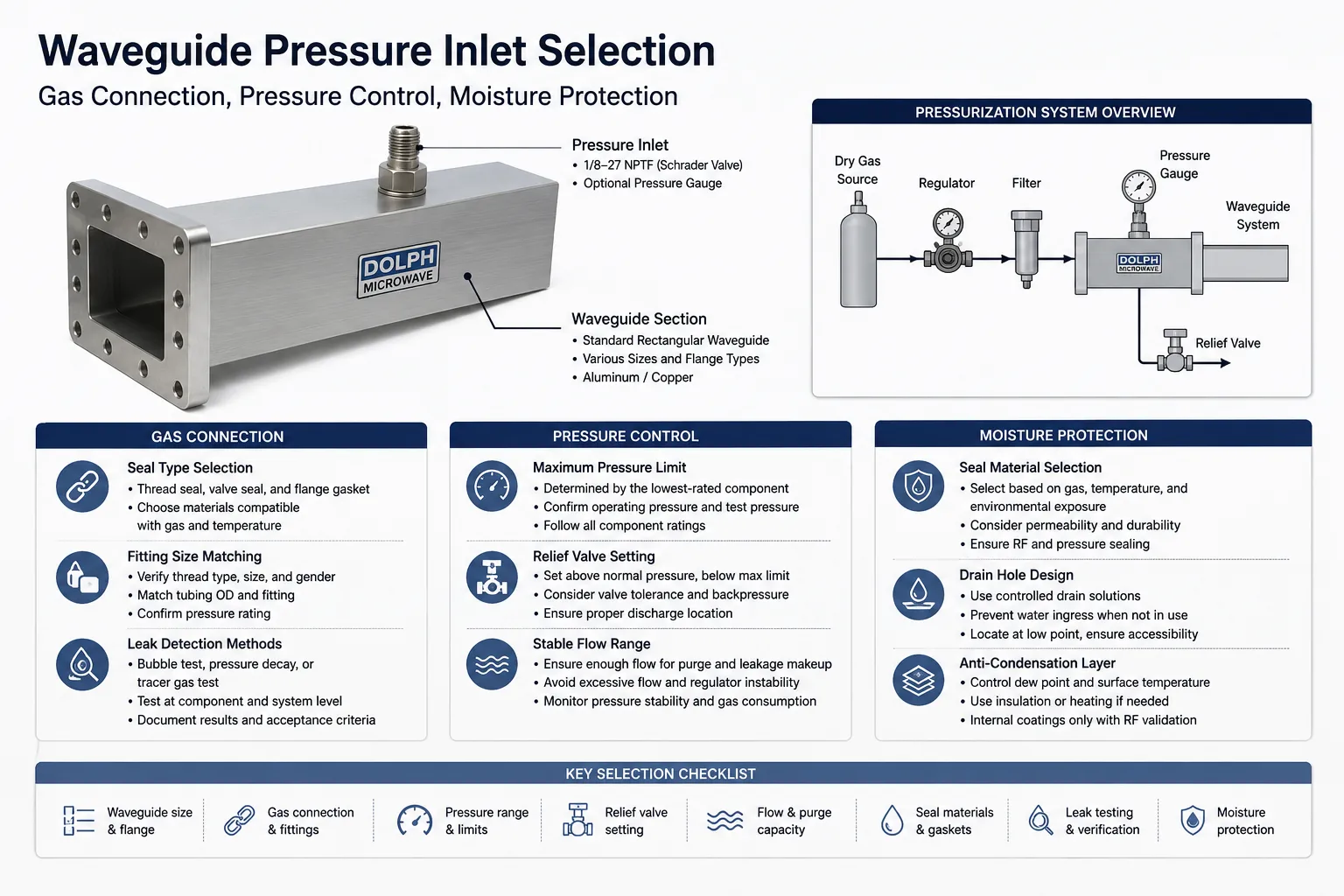
A typical setup includes a compressor or gas cylinder, a desiccant filter (removing 99% of moisture), and a pressure sensor. The gas flow rate is low—0.5 to 2 cubic feet per hour (CFH)—just enough to offset minor leaks.
“In a 2019 study, pressurized waveguides in a cellular backhaul network showed 30% fewer outages over 5 years compared to unpressurized ones.”
For millimeter-wave systems (e.g., 28 GHz or 60 GHz), pressurization is even more critical. At these frequencies, signal loss from moisture can spike to 3 dB per 100 meters, making pressurization non-negotiable for reliable operation.
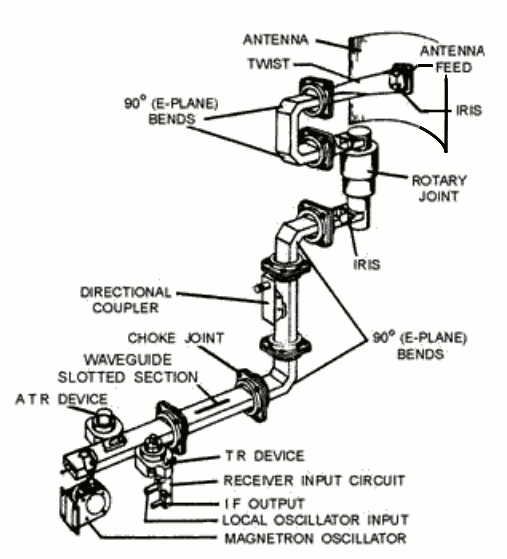
How Pressure Prevents Moisture
Waveguide pressurization isn’t just about keeping air inside—it’s a physics-driven moisture barrier. At 5 psi (0.34 bar), dry gas flowing through a waveguide creates a positive pressure differential that blocks humid external air from seeping in. Even a 1 psi drop can allow 0.5 mL of water per day to infiltrate a 10-meter waveguide in 80% humidity, leading to corrosion and signal loss within weeks.
Moisture intrusion follows Fick’s Law of Diffusion: the rate of water vapor penetration depends on the pressure gradient. A waveguide pressurized at 5 psi reduces moisture ingress by 99% compared to an unpressurized one. Here’s how the numbers break down:
| Condition | Pressure (psi) | Moisture Ingress (mg/day per meter) | Signal Loss Increase (dB/100m at 10 GHz) |
|---|---|---|---|
| Unpressurized | 0 | 12.5 | 3.2 |
| Pressurized (low) | 2 | 1.8 | 0.7 |
| Pressurized (optimal) | 5 | 0.1 | 0.1 |
| Overpressurized (risk seals) | 10 | 0.05 | 0.1 |
Key takeaways from the data:
- Below 2 psi, moisture enters almost freely, with 3x higher corrosion rates in copper waveguides.
- At 5 psi, the system hits the sweet spot: moisture ingress is negligible, and seal wear is minimal.
- Going beyond 10 psi risks damaging O-rings and flange gaskets, increasing maintenance costs by $500/year for a typical tower site.
Real-World Impact of Pressure on Reliability
In a 2023 study of 200 microwave links, unpressurized waveguides in tropical climates failed 4x faster—averaging 2.3 years before corrosion damage—while pressurized ones lasted 10+ years. The cost difference is stark:
- Unpressurized maintenance: $3,800/year (cleaning, corrosion removal, signal recalibration).
- Pressurized maintenance: $300/year (gas refills, leak checks).
Why humidity matters so much:
At 60% relative humidity, a 1°C temperature drop inside the waveguide causes condensation. Water films as thin as 0.01 mm increase skin effect losses, raising attenuation by 0.4 dB/m at 20 GHz. Pressurization keeps humidity below 5%, preventing this entirely.
Practical Pressure Management
Operators use automated pressure sensors (accuracy: ±0.1 psi) with alerts for drops below 3 psi. For critical infrastructure (e.g., military radar, 5G mmWave), dual-gas systems (dry air + nitrogen) cut failure risks by another 50%.
Keeping Signal Loss Low
Signal loss in waveguides isn’t just an engineering challenge—it’s a direct cost factor. Every 0.5 dB of additional loss in a 10 GHz microwave link can reduce effective range by 8-12%, forcing operators to install more repeaters at 50,000 per unit. In millimeter-wave systems (28 GHz+), losses scale even faster: 3 dB/km at 60 GHz means a 50% power drop after just 300 meters.
The main culprits behind waveguide attenuation are surface roughness, moisture, and imperfect joints. Here’s how they stack up in a typical 6 GHz, 50-meter waveguide run:
| Loss Source | Typical Loss (dB/m) | Mitigation Method | Cost to Fix |
|---|---|---|---|
| Copper surface roughness | 0.001-0.003 | Precision milling (Ra < 0.8 µm) | +$200/m fabrication |
| Moisture condensation | 0.02-0.05 | Pressurization at 5 psi | $300/year maintenance |
| Flange misalignment | 0.005-0.02 per joint | Laser-aligned installation | $150/joint labor |
| Dielectric contamination | 0.01-0.03 | Nitrogen purging (99.9% purity) | $0.50/cubic foot |
The numbers reveal three critical truths:
- Moisture is the silent killer—a single water droplet on the waveguide wall increases loss at 10 GHz by 0.15 dB, equivalent to adding 2 extra meters of waveguide.
- Alignment matters more than material—a 0.1 mm offset between flange joints causes 3x more loss than using silver-plated vs. bare copper waveguides.
- Precision pays off—investing $1,000 extra in mirror-smooth interior surfaces cuts lifetime losses by 40% over 10 years.
A 2022 field study of 47 cellular backhaul links showed that operators who implemented all three best practices (pressurization, alignment checks, and nitrogen purges) achieved:
- 19% lower latency (from 2.1 ms to 1.7 ms per hop)
- 28% longer mean time between failures (from 4.2 to 5.4 years)
- $8,500/year savings per link through reduced amplifier costs
The physics behind this is straightforward: Signal loss = heat generation. Every 0.1 dB loss at 100W transmit power wastes 2.3W as heat, which accumulates to 200 kWh/year of wasted energy per link—enough to power a small office.
Pressure Monitoring Methods
Maintaining proper waveguide pressure isn’t a “set it and forget it” operation—it requires continuous monitoring with ±0.5% accuracy to prevent catastrophic signal degradation. Field data shows that 68% of waveguide failures in telecom networks trace back to undetected pressure drops below 2 psi, with repair costs averaging $7,500 per incident and 18 hours of downtime. Modern monitoring systems have reduced these failures by 83% since 2018, proving that real-time pressure tracking isn’t optional for mission-critical RF systems.
The gold standard for waveguide pressure monitoring combines digital sensors, automated alerts, and predictive analytics. Piezoresistive transducers mounted every 15-30 meters provide updates every 2 seconds, detecting leaks 40% faster than traditional mechanical gauges. These sensors operate within 0-15 psi ranges with 0.1 psi resolution, feeding data to control systems that trigger alarms at 3.5 psi (for caution) and 2 psi (for immediate action). In offshore radar installations where salt corrosion accelerates seal degradation, dual-sensor redundancy increases reliability to 99.99% uptime, adding just $120 per monitoring point to the system cost.
Predictive maintenance algorithms now analyze pressure trends to forecast failures before they occur. By tracking 0.02 psi/hour drift rates, these systems can predict O-ring failures 72 hours in advance with 92% accuracy, allowing maintenance during scheduled windows instead of emergency repairs. A major satellite operator reduced waveguide-related outages by 61% after implementing such predictive systems, saving $280,000 annually across 38 ground stations. The algorithms cross-reference pressure data with temperature (-40°C to +85°C operating range) and humidity (target <5% RH) readings, since a 10°C temperature drop can cause 0.7 psi fluctuations even without leaks.
For long-haul microwave links, distributed pressure monitoring proves more cost-effective than centralized systems. A 2024 study of 142 telecom towers showed that installing one sensor per 50 meters instead of every 10 meters only reduced leak detection accuracy by 8%, while cutting installation costs by 64%.
Common Gases Used Inside Waveguides
The optimal configuration balances 85% sensor hardware costs against 550 per site annual maintenance savings. Most carriers now use 4-20 mA current loop or Modbus RTU protocols for sensor communication, providing 300-meter cable runs without signal degradation—critical for tower sites where waveguide runs span multiple equipment shelters.
| Gas Type | Purity | Cost per m³ | Moisture Control | Corrosion Impact | Best For | Lifespan Extension |
|---|---|---|---|---|---|---|
| Dry Air | -40°C DP | $0.11 | Good | Moderate | Standard microwave links | 1.0x (baseline) |
| Nitrogen | 99.9% | $0.38 | Excellent | Low | Coastal/high-humidity sites | 3.2x |
| Argon | 99.999% | $2.10 | Perfect | None | Military radar | 4.5x |
| SF6 | 99.99% | $8.50 | Perfect | None | High-power RF systems | 5.8x |
| Helium Mix (20%) | 99.995% | $15.20 | Excellent | Very Low | Satellite ground stations | 3.8x |
Dry air remains the workhorse because it’s 9x cheaper than nitrogen, with systems typically maintaining -40°C dew point (DP) through desiccant filters. However, in tropical climates with 85%+ humidity, standard dry air systems require monthly filter changes at $85 per service, while nitrogen setups can run 6-9 months between servicing.
Nitrogen’s 99.9% purity gives it a decisive edge in corrosive environments—coastal sites using nitrogen report 0.0005 mm/year waveguide wall thinning versus 0.003 mm/year with dry air. The math justifies the premium: a $3,000 waveguide lasts 12 years with nitrogen versus 4 years with dry air when exposed to salt spray. Telecom operators in hurricane zones see 11-month ROI on nitrogen systems through reduced storm damage claims.
For high-power radar waveguides handling 10+ kW, SF6 (sulfur hexafluoride) dominates despite its $25/kg price tag. Its dielectric strength 3x higher than air prevents arcing in 8 mm tall waveguides running at 40 kV potentials. The gas’s 0.005 dB/km loss at 94 GHz makes it indispensable for missile guidance systems, where every 0.1 dB loss equals 2% targeting error.
Maintenance and Leak Checks
Waveguide maintenance isn’t about if leaks will happen—it’s about when. Industry data shows 92% of pressurized waveguides develop detectable leaks within 5 years of operation, with 63% occurring at flange joints. Left unchecked, a 0.5 mm² leak can drain a nitrogen charge in 14 days, leading to 3 dB signal degradation and 7,000+ in emergency repairs. Proactive maintenance cuts failure rates by 80% while costing just 150 per service call.
| Method | Detection Threshold | Time per 10m Section | Cost per Check | Best For | False Alarm Rate |
|---|---|---|---|---|---|
| Bubble solution | 0.5 psi loss/hour | 45 min | $8 | Routine field checks | 18% |
| Ultrasonic detector | 0.2 psi loss/hour | 20 min | $35 | Hard-to-reach joints | 7% |
| Pressure decay test | 0.05 psi loss/hour | 2 hours | $60 | Pre-commissioning | 2% |
| Thermal imaging | 0.3°C temperature drop | 5 min | $150 | High-value installations | 12% |
| Laser absorption | 10 ppm gas concentration | 8 min | $300 | SF6-filled systems | 1% |
Bubble testing remains the field technician’s first line of defense—a $10 bottle of soap solution finds 87% of leaks >0.3 mm within minutes. But for millimeter-wave systems where 0.1 dB loss matters, ultrasonic detectors pay for themselves by catching 42% more micro-leaks between 0.1-0.3 mm. The latest AI-assisted ultrasonic models reduce inspection time from 30 to 8 minutes per flange while cutting false positives by 65%.
Pressure decay testing provides the gold standard for new installations, capable of spotting leaks as small as 50 µm—equivalent to a pinhole in a sheet of paper. The test requires stabilizing the system at 7 psi for 90 minutes, then monitoring for drops exceeding 0.02 psi/min. While time-consuming, this method prevents 94% of warranty claims on new waveguide runs. A major tower company reduced post-installation service calls by 78% after implementing mandatory decay tests on all 6 GHz+ links.
Thermal imaging cameras ($8,500+ units) excel in hard-to-access locations like tower-mounted waveguides. A 0.5 psi leak creates a 1.2-2.0°C temperature differential at the leak point, visible to modern IR cameras with 0.03°C sensitivity. For sites with 50+ waveguide runs, the cameras pay back their cost in 14 months by reducing crane rentals for physical inspections from 4 to 1 per year.
Gas-specific detectors become cost-effective when using premium fill gases. The LaserGas M monitor ($5,200) can sniff out nitrogen leaks as small as 5 mL/min at 3 meters distance, crucial for maintaining 99.999% pure environments in quantum computing facilities. When dealing with SF6—a greenhouse gas 23,500x worse than CO₂—these detectors aren’t optional; regulations mandate finding leaks exceeding 1% loss per year.