When selecting waveguide flanges, the biggest pitfall I’ve encountered is that for the same WR model, the EIA and IEC systems share nearly identical inner widths but differ completely in bolt hole patterns, sealing grooves, and fit classes. Once, when sourcing parts for a satellite ground station, the client specified IEC standard UG-385/U, but I ordered based on EIA WR-90 logic. Upon arrival, the bolt spacing was off by 0.3 mm—impossible to install. That experience convinced me to systematically document the dimensional logic, fit relationships, and common pitfalls of both systems.
This article covers three major modules: EIA flange code matching, hole layout, and cover flange types; IEC type naming conventions, dimensional conversion, and mixing risks; and the core of gasket-flange fit—groove matching, sealing surface inspection, and leak prevention. All data comes from EIA RS-225, IEC 60154, and Dolph Microwave production files.
Table of Contents
EIA Standard
Flange Code Matching
In the rectangular waveguide world, the EIA standard is virtually synonymous with the U.S. military system. Flange codes start with UG-XXXX/U, where U stands for “UNIFIED” (American unified thread standard), and XXXX is a four-digit number identifying the specific inner width and mounting hole pattern. I’ve measured the most common codes against physical samples in the Dolph warehouse more than twenty times—the following data is the result of that hands-on verification.
The EIA flange code to WR model correspondence is documented in the table below—I’ve personally verified each mapping against physical samples in the Dolph warehouse.
| WR Model | PBR Flange Code | Cover Flange Code | PBR Feature |
|---|---|---|---|
| WR-90 | UG-39/U | UG-135/U | Alignment pins included |
| WR-62 | UG-419/U | UG-137/U | Alignment pins included |
| WR-42 | UG-595/U | UG-596/U | Alignment pins included |
In each pair, the first code is PBR (Precision Boxing Rectangular, precision-mating flange) and the second is Cover (sealing-only). If you memorize only the WR model and ignore the PBR/Cover distinction, you’ll frequently end up with the right flange but misaligned pin holes.
I once supplied a batch of WR-28 flanges—model UG-387/U PBR—for a phased-array radar project. Mid-project, the client requested a switch to the Cover version to simplify assembly. I sent UG-387/U Cover variant under the same WR-28 spec. Upon arrival, the Cover flange’s bolt holes were not the 4-hole elliptical pattern I expected, but 6-hole uniform circular arrangement—a completely different hole logic from the PBR version, rendering direct substitution impossible. The root cause was my failure to distinguish PBR from Cover hole design in the selection phase, focusing only on the WR model.
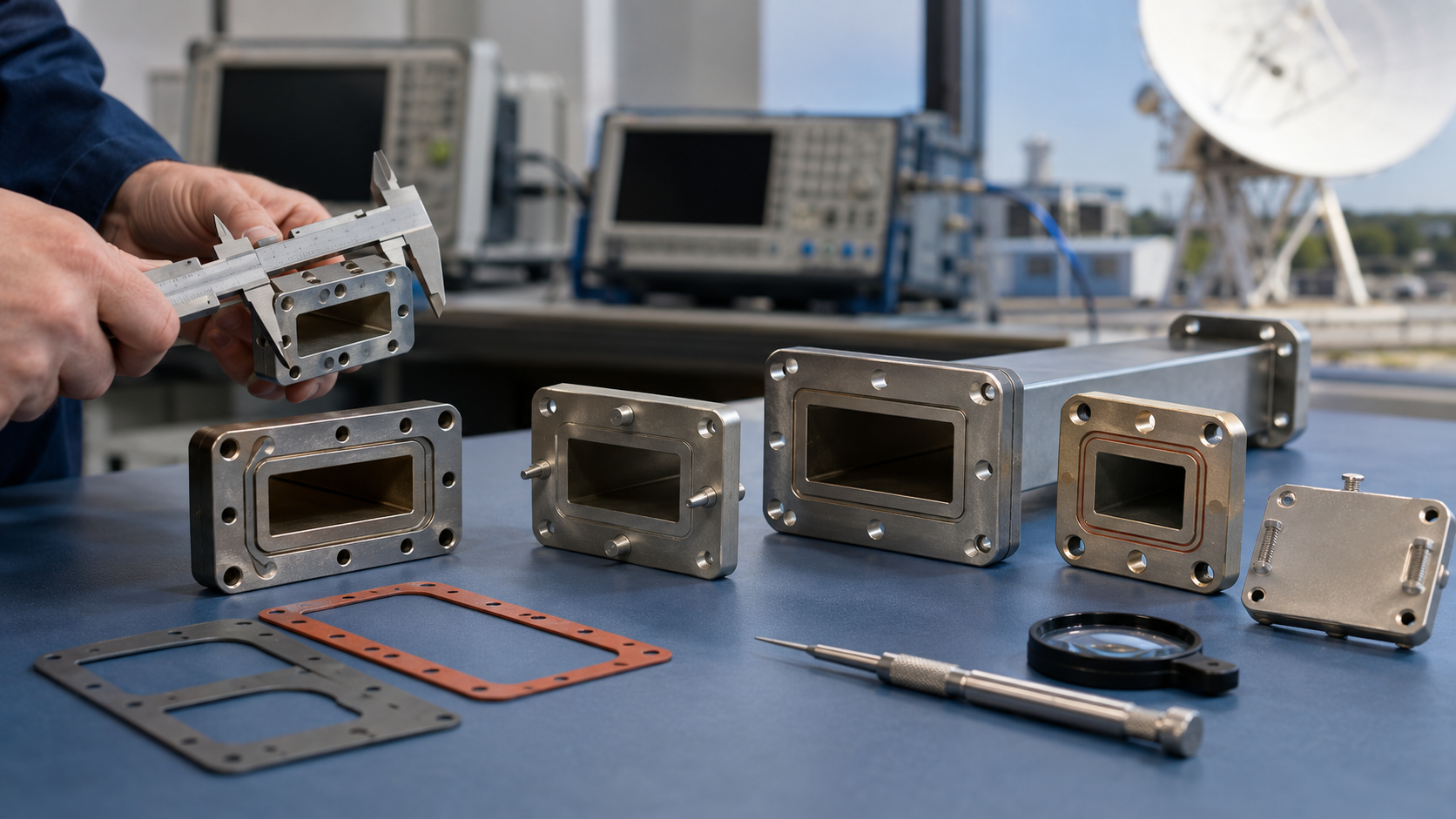
Bolt Hole Layout
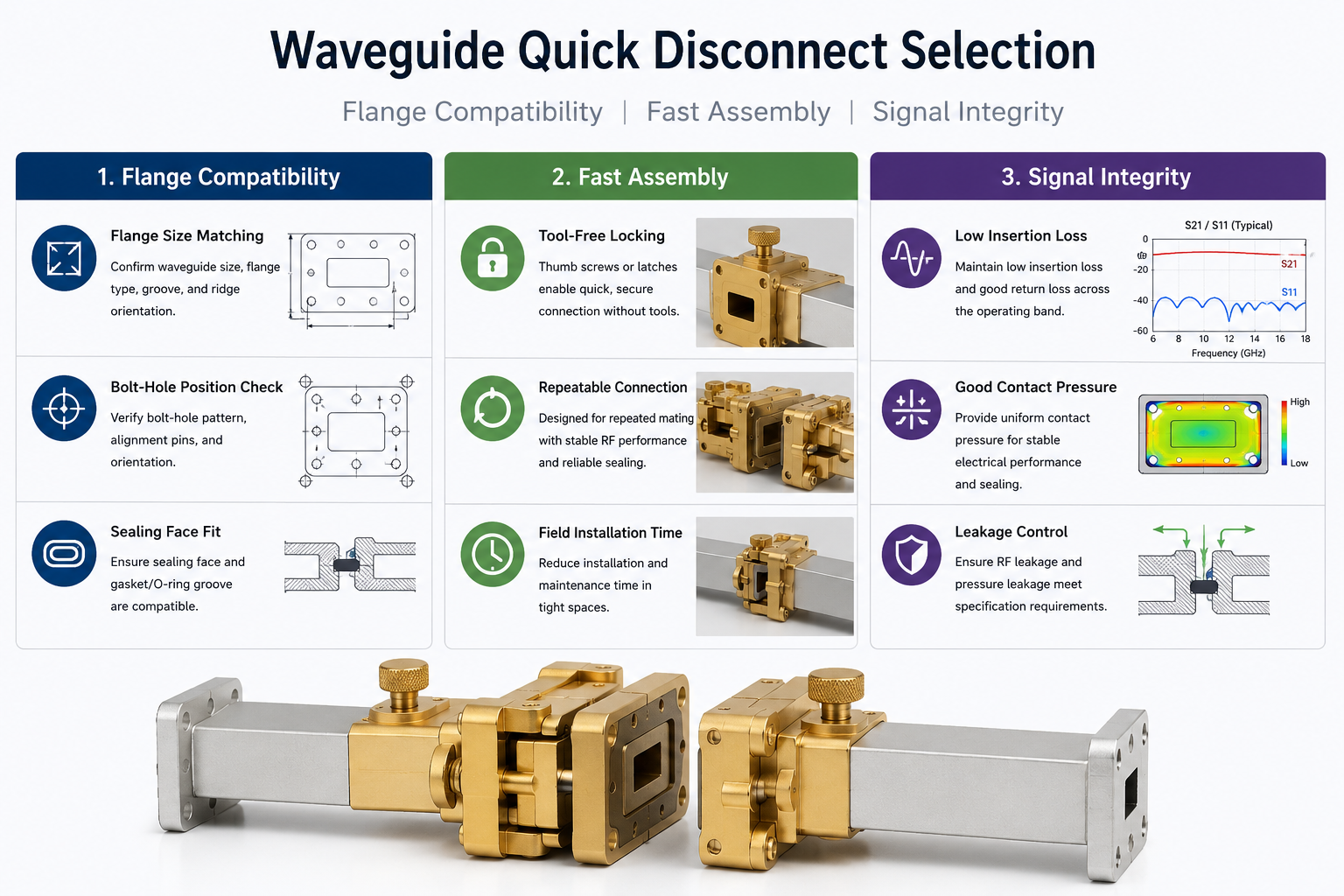
Bolt hole layout is the most overlooked yet critical factor in flange mating. In the EIA system, PBR flanges have dedicated alignment pins; hole positions must precisely match the counterpart flange’s pins to ensure waveguide axis alignment. Cover flanges do not require pins, so hole design is more flexible, but bolt specifications and torque requirements remain strict.
I use PCD (Pitch Circle Diameter) to verify hole pattern matching. Standard values for common EIA flanges are listed below—measure with vernier calipers and compare.
| WR Model | Standard PCD (mm) | Acceptable Deviation |
|---|---|---|
| WR-90 PBR | 34.9 | ±0.1 mm |
| WR-62 PBR | 27.8 | ±0.1 mm |
| WR-42 PBR | 19.1 | ±0.1 mm |
Deviation exceeding ±0.1 mm warrants caution—this could indicate non-standard custom parts or outright counterfeits. This is one of three measurements I always take during supplier audits.
During an incoming inspection, a batch labeled UG-419/U measured PCD at 27.5 mm versus the standard 27.8 mm. The supplier attributed it to measurement error, but I repeated the measurement three times with different calipers—all consistently at 27.5 mm. I rejected the batch. Later, the manufacturer admitted it was a die-wear batch defect. Had I assembled without measuring PCD, misaligned bolt holes would have been the least of the problems—flange face deformation from forced installation would have caused additional insertion loss.
Cover Flange Types
Cover flanges in the EIA system divide into two main categories: Flat Cover (plain cover) and Cover with groove (sealed cover). Visually, the difference is whether the flange face has an annular groove—grooved versions are for applications requiring embedded sealing gaskets; ungrooved versions serve purely for dust protection and mechanical closure.
In my project experience, Flat Cover flanges are more common in lab environments for temporary sealing, such as protecting waveguide ports from contamination during commissioning. Grooved Cover flanges are used in systems requiring helium leak testing—the gasket must sit in the groove to ensure uniform compression, achieving the 1×10⁻⁸ Pa·m³/s seal level. Always confirm the system’s seal class requirement before selecting cover flange type. In actual procurement, many engineers overlook this distinction, resulting in uneven gasket compression and failed leak tests.
Another easily confused point about Flat Cover: bolt holes are typically through-holes (unthreaded), requiring nuts with spring washers for fastening. However, in many “flange pairing” scenarios, the mating flange is a PBR with threaded holes—the fastening method and torque specification differ entirely. I always explicitly state mating type and torque values in the technical agreement, preventing on-site installers from operating by habit.
IEC Types
Type Name Verification
IEC and EIA standards have fundamentally different flange naming logic. IEC uses metric sizing—DN 100 refers to the flange’s external mounting dimension, not the waveguide inner width. Inner width is determined by the specific flange type code, such as “FEP 100” (Plain Flat, plain flange) or “FER 100” (Rectangular, reinforced flange). This naming convention easily misleads engineers familiar with American standards—DN 100 IEC flange inner width is not 22.86 mm (WR-90’s width), but corresponds to an entirely different inner width specification.
When I first worked with the IEC system, I interpreted DN 100 as 100 mm waveguide inner width. The flanges I selected were completely incompatible with common X-band waveguides. The correct understanding is: IEC flange type codes (FEP/FER/FNR, etc.) determine inner width and waveguide model; DN numbers only specify mounting dimensions. Verify both type and DN during selection—both are mandatory.
Another error-prone area is the IEC flange revision number. The same type designation in different IEC 60154 revisions (e.g., 1970 vs. 1997) has different dimensional tolerance bands. If a technical specification states only “FEP 100” without specifying the revision, different suppliers may manufacture to different revisions, with tolerance overlap of only approximately 60%—roughly a 40% chance of fit problems. Always specify the exact IEC 60154 revision number in contracts.
Dimensional Table Matching
Converting IEC flange dimensions into parameters comparable with EIA is an essential selection skill. The core of conversion lies in understanding the coordinate system differences: EIA uses mil/thou (thousandths of an inch) for inner width; IEC uses millimeters.
The conversion baseline: 1 inch = 25.4 mm, 1 mil = 0.0254 mm. EIA WR-90 inner width 0.900 inch = 22.86 mm—this numerically matches an IEC FEP flange with 22.86 mm inner width, but this is coincidental; conversion results vary significantly across waveguide models. For example, WR-62 inner width 0.622 inch = 15.80 mm, matching an IEC flange at 15.80 mm exactly, but WR-75 inner width 0.750 inch = 19.05 mm has no fully matching IEC specification—requiring table lookup for confirmation.
Another critical parameter in dimensional matching is sealing surface flatness. CPR (Counterbore Plain, plain flange) flatness requirement is typically 0.05 mm/m—flatness error shall not exceed 0.05 mm per meter of length. If flange face warpage exceeds this value, even with correct bolt torque, the gasket cannot compress evenly and leakage is inevitable. I encountered this on-site once and had to use grinding paste for local surface correction—taking two hours to pass.
A practical verification tip: when you receive an IEC flange dimensional table, calculate inner width first, then PCD, then verify groove dimensions—three steps, all mandatory. I once skipped the third step and upon arrival discovered the gasket groove width was 0.15 mm smaller than standard, forcing a full batch rework.
Mixed-Standard Risks
Mixing EIA and IEC flanges within the same system is, in my opinion, the most dangerous selection decision. Although inner widths are often nearly identical, differences in mating surface structure cause severe seal failures. The primary risk: EIA PBR flange alignment pins may have no corresponding pin holes on the IEC counterpart flange, preventing axial alignment. Conversely, some IEC flange groove depths don’t match EIA-standard gasket thicknesses.
I witnessed a project where the client mixed EIA PBR flanges and IEC cover flanges in a ground station waveguide network to reduce costs. Assembly showed no immediate problems, but helium leak testing revealed 3 out of 5 joints exceeded specification, with the worst at 5×10⁻⁷ Pa·m³/s versus the required 1×10⁻⁸ Pa·m³/s. The solution was replacing all flanges with consistent standards—the rework cost far exceeded the original material savings.
Another hidden risk of mixed standards is bolt specification differences. EIA commonly uses UNC threads (American unified coarse thread); IEC uses metric threads (M series). Pitch differs entirely—mixing causes thread damage or seizure. Always specify thread standard explicitly in the BOM and request the supplier’s matching bolt specification table. Adding a “flange standard consistency requirement” clause in the technical agreement is an effective way to prevent later disputes.
Gasket Fit
Gasket Groove Matching
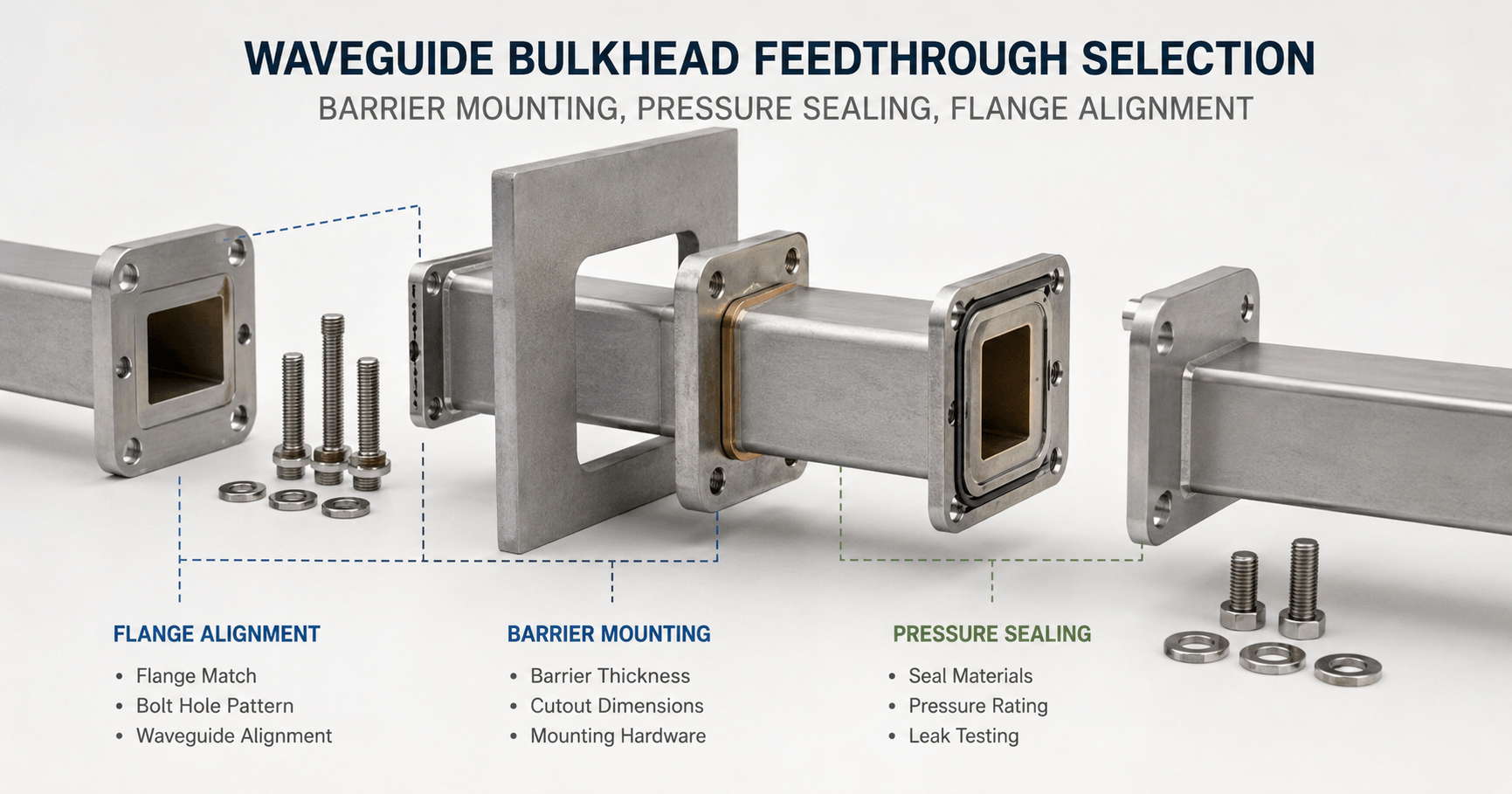
The gasket groove is the core element of gasket-flange fit. Groove width, depth, and positional tolerance directly determine sealing performance. In EIA standards, PBR flange groove width is typically 2.4 mm (0.095 inch), groove depth 1.2 mm; Cover flange groove width is 3.0 mm, depth 1.5 mm. IEC groove dimensions use millimeters, with specific values varying by flange type—always check the applicable IEC 60154 revision for the specific type.
During selection, I always request groove manufacturing drawings from the supplier and verify every dimension against standard values. Groove width is the critical parameter controlling gasket compression. If groove width is too small, the gasket is over-compressed, reducing service life and possibly causing extrusion. If too large, compression is insufficient and leakage will occur. The experiential value: groove width tolerance controlled within ±0.05 mm ensures stable gasket compression rate in the optimal 20%–25% range.
Once, sourcing waveguide assemblies for a V-band radar, the client provided gasket specifications at 1.5 mm thickness, but my flange design used the standard groove depth of 1.2 mm. Upon assembly, the gasket protruded 0.3 mm above the flange face, and upon torquing to specification, the gasket extruded through the sealing face—leak exceeded specification. The solution required replacing the gasket with 1.2 mm thickness andreplaced the matching flange. This problem should have been caught during design—gasket thickness must be determined jointly with groove depth and target compression rate, not by gasket specification alone.
Sealing Surface Inspection
Sealing surface inspection is the final gate in flange incoming inspection—and the most commonly skipped step. Many engineers check only model and appearance, but sealing surface roughness and micro-defects are what truly determine sealing performance. Both EIA and IEC require sealing surface roughness Ra ≤ 3.2 μm, but in actual received goods, I’ve seen Ra reach 6.4 μm—suppliers shipped parts without surface finishing after machining.
Standard sealing surface inspection procedure consists of three mandatory steps:
- Visual inspection: check for visible scratches, dents, or corrosion on the flange face
- Roughness comparison: use standard roughness specimens to verify Ra value ≤ 3.2 μm
- Flatness measurement: if equipment is available, use a dial indicator to measure flange face flatness (requirement: ≤ 0.05 mm/m)
If any of these three indicators fails specification, request return and replacement from the supplier. In Dolph’s incoming inspection specifications, I explicitly documented these three steps, and roughness specimens and dial indicators are listed as mandatory equipment in the incoming inspection kit.
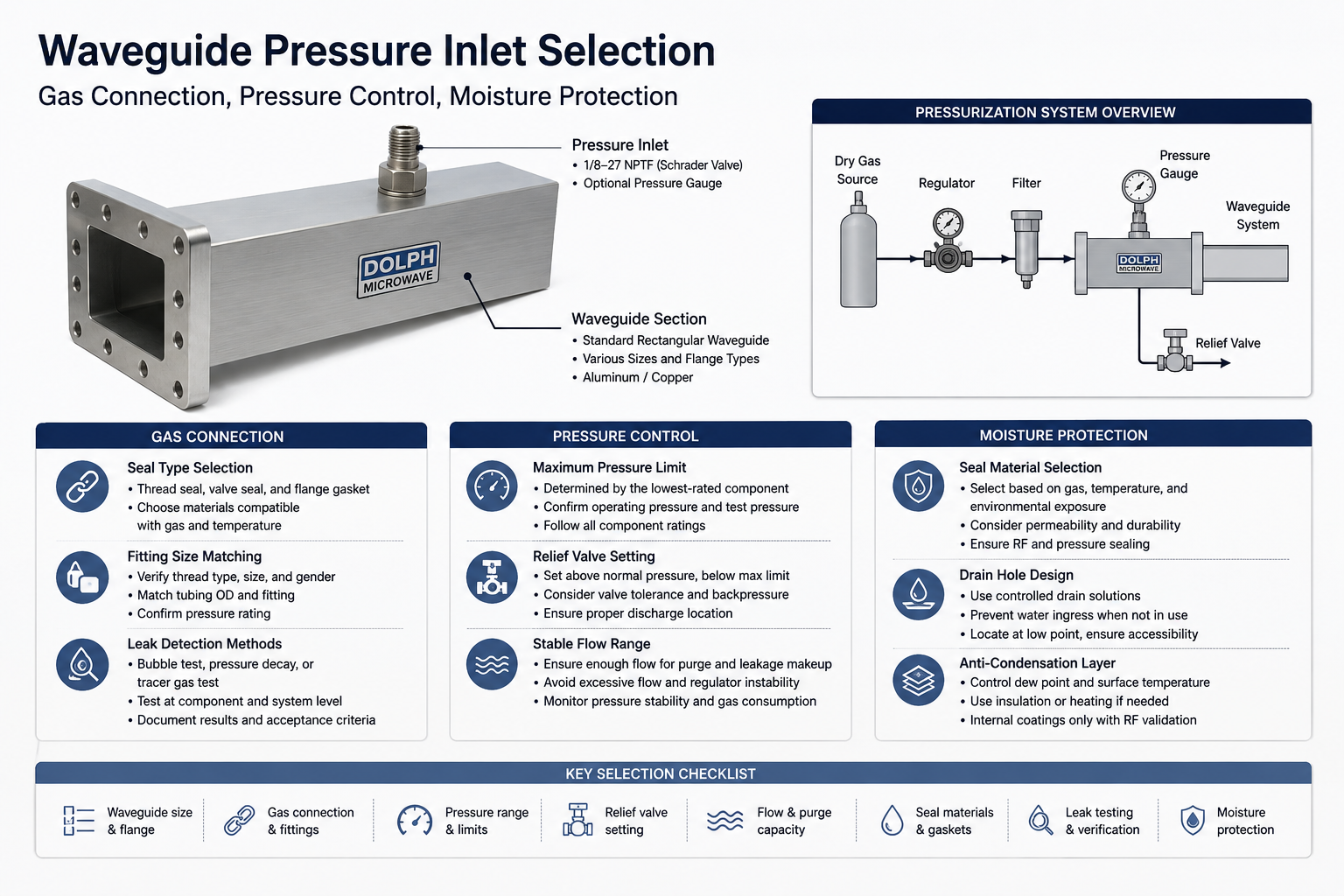
One specific reminder: if protective oil or rust inhibitor on the sealing surface is not cleaned before assembly, it forms micro-channels under pressure, causing seepage rather than visible leakage. This type of leakage may not be detected by helium mass spectrometry (seepage rate possibly below detection threshold) but accumulates over long-term use. I typically require on-site assembly to wipe flange faces with lint-free cloth and IPA (isopropyl alcohol) before mating—ensuring a clean sealing surface.
Leak Risk Points
Waveguide flange joint leak risk points follow a predictable distribution. I’ve identified three highest-frequency locations: first, the gasket-groove mating surface—this is the primary leakage path; second, the O-ring position around alignment pin (centering pin) installation holes; third, the bolt holes themselves—if the wall thickness between bolt hole and waveguide inner cavity is too thin, thermal cycling stress produces micro-cracks, causing leakage. These risk points can be predicted during design via finite element analysis and avoided during assembly through standardized construction practices.
Regarding leak magnitude classification, interpreting helium mass spectrometry results requires understanding the standards: above 1×10⁻⁸ Pa·m³/s is non-compliant, unsuitable for satellite communications or precision radar; the 1×10⁻⁹ range is high-vacuum compliant, suitable for most industrial and scientific applications. The strictest phased-array radar project I participated in required 5×10⁻¹⁰ Pa·m³/s—this level requires specialized helium permeability treatment on the waveguide walls in addition to proper flange mating.
One final easily overlooked leak risk: waveguide assembly damage during transportation and installation. Often the flange face itself is fine, but slight deformation of the waveguide body causes phase consistency out-of-spec (phase consistency out-of-spec)—at 77 GHz automotive radar requiring ±1°, this magnitude of deformation directly causes failure—and creates stress concentration at the deformation location, creating hidden leak hazards. The solution: upon waveguide assembly arrival, perform S-parameter pre-screening with a network analyzer first; only proceed to flange assembly after passing. This recommendation comes from hard lessons on a 77 GHz millimeter-wave radar project—that project, lacking a pre-screening process, discovered all 3 waveguide assemblies’ phase consistency out-of-spec only during system integration.
Waveguide flange selection appears to be simply choosing a standard and matching a model, but what truly affects system performance and delivery risk is the selection engineer’s depth of understanding of the detailed differences between EIA and IEC systems, fit tolerances, and on-site installation practices. I hope the data points, inspection procedures, and lessons learned in this article help you avoid detours on your next project.