A coaxial termination is a 50Ω or 75Ω impedance-matched load (typically 0-18 GHz) that absorbs RF energy to prevent signal reflections, achieving VSWR <1.2:1. Constructed with carbon-composite or thin-film resistors in precision brass/beryllium copper housings, it handles up to 100W continuous power. Used in testing, it provides >30dB return loss up to 40GHz when properly torqued (8 in-lbs). Temperature drift is <0.01dB/°C.
Table of Contents
Basic Definition
Coaxial termination is a simple but critical component in RF (radio frequency) and microwave systems. It ensures signal integrity by matching the impedance (typically 50Ω or 75Ω) of a coaxial cable to prevent reflections that degrade performance. Without proper termination, a mismatched line can cause signal loss up to 30% due to standing waves, especially in high-frequency applications above 1 GHz.
A standard coaxial terminator is a small, passive device—usually under 50 grams in weight and less than 2 inches long—that connects to the open end of a cable. It absorbs excess energy, maintaining a stable VSWR (Voltage Standing Wave Ratio) below 1.5:1 in well-designed systems. The most common types include 50Ω (for telecom, lab equipment) and 75Ω (for video, broadcast), with power handling ranging from 1W for small lab setups to 500W in high-power transmitters.
| Parameter | Typical Range | Impact |
|---|---|---|
| Impedance | 50Ω, 75Ω (±5%) | Ensures minimal reflection (≤ -20dB return loss) |
| Frequency Range | DC to 18 GHz | Wider bandwidth (e.g., 0-6 GHz) costs 15-20% more |
| Power Handling | 1W to 500W | Higher power (100W+) requires heat dissipation (up to 85°C max) |
| VSWR | 1.1:1 to 1.5:1 | A 1.5:1 VSWR causes 4% power loss |
| Connector Type | BNC, N, SMA, F | SMA terminators cost 5-20, N-type 10-50 |
| Durability | 500+ insertions | Gold-plated contacts last 3-5x longer than nickel |
In real-world use, a poorly terminated cable can introduce noise spikes up to 3dB higher than a properly terminated one, reducing SNR (signal-to-noise ratio) in sensitive receivers. For example, in a 5G mmWave setup (28 GHz), even a 2% impedance mismatch can distort modulation, increasing error rates by 10-15%.
The cost of termination varies: basic 50Ω BNC plugs start at 3, while precision 75Ω N-type units for broadcast hit 60+. Industrial-grade terminators (e.g., for aerospace) endure -55°C to 125°C and survive 100G vibration loads, but cost 5-8x more than consumer versions.
Why it matters: In a 10-meter RG-58 cable running 2.4 GHz WiFi, skipping termination drops effective range by 12-18% due to reflected power. For satellite RF systems, where cables run 50+ meters, proper termination cuts latency by 0.3-0.7 ns/meter, critical for phase-sensitive arrays.
The physics is straightforward—terminators convert unused RF energy into heat (typically <1°C rise at 10W). Cheap no-name brands often fail at >5 GHz, while quality ones (Amphenol, Rosenberger) maintain ≤1.2:1 VSWR up to 40 GHz. For lab calibrations, a $200 precision terminator ensures ±0.1% impedance tolerance, crucial for 6G research (THz bands).
How It Works
At its core, a coaxial terminator is an impedance-matching energy absorber—a device that converts unwanted RF energy into heat while preventing signal reflections that could degrade system performance. When a 50Ω signal traveling through a coaxial cable hits an open end, up to 100% of the power reflects back, creating standing waves that can distort signals by 3-6dB and potentially damage sensitive transmitter components. The terminator’s job is to provide a precise 50Ω or 75Ω load (within ±0.5% tolerance in high-end models) that matches the cable’s characteristic impedance, ensuring 96-99% of the signal energy gets absorbed rather than bouncing back.
The physics behind this is straightforward but exacting. Inside every terminator, a resistive element (typically carbon composite or thin-film) dissipates incoming RF energy as low-grade heat (0.5-1°C rise per watt). For a 5W terminator handling continuous duty in a Wi-Fi access point, this means maintaining <5°C above ambient temperature—something cheap terminators often fail at, leading to 20-30% resistance drift when they overheat. High-power versions (100W+) use aluminum heat sinks that increase surface area by 300-500%, keeping critical components below 85°C even at maximum load.
Frequency response is where engineering gets tricky. While a basic DC-4GHz terminator might use a simple 1/4-wavelength stub to maintain impedance, millimeter-wave versions (18-40GHz) require distributed resistance networks that compensate for skin effect losses—where at 28GHz, 90% of current flows in just the outer 0.02mm of the conductor. Premium terminators achieve VSWR ratings below 1.1:1 across their entire bandwidth by using air-dielectric spacers and beryllium copper contacts, reducing insertion loss to <0.05dB compared to the 0.3dB loss of economy models.
The connector interface plays a surprisingly active role. A gold-plated SMA connector maintains <0.1Ω contact resistance through 5,000 mating cycles, while cheaper nickel-plated versions degrade after 300-500 uses, increasing resistance by 8-12 milliohms per cycle—enough to shift a 50Ω system’s impedance by 0.2% annually. In phase-sensitive arrays like 5G mmWave antennas, this tiny variation introduces 0.3-0.7ps timing errors per connection, cumulatively distorting beam patterns by 2-3 degrees across a 64-element array.
Real-world performance hinges on thermal dynamics. When a 100W FM broadcast terminator operates continuously, its 300g aluminum heat sink must dissipate 85 joules of heat per minute to stay below 80°C—a task requiring 25cm² of surface area per watt. Field data shows 70% of premature failures occur when dust accumulation reduces effective cooling by 15-20%, causing resistors to drift 5-8% out of spec before catastrophic failure. That’s why industrial-grade terminators include temperature sensors that trigger alarms at 75°C, giving technicians 30-60 minutes to reduce power before damage occurs.
In digital systems, termination affects more than just power—it governs signal integrity. A 10Gbps Ethernet link using unterminated SFP+ cables can experience 3-5% bit error rate (BER) increases from reflections, requiring forward error correction (FEC) that adds 20-40ns latency. Proper termination reduces this to <0.1% BER, freeing up 15% processing overhead. Similarly, in satellite modems, a 0.25V reflection from a poorly terminated L-band (1.6GHz) feedline can desensitize receivers by 1-2dB, equivalent to losing 5-8% of satellite link margin—a costly penalty when leasing $500/hour transponder time.
Common Types
Not all coaxial terminators are created equal. The right type depends on frequency range, power handling, connector style, and environment—pick wrong, and you could lose up to 40% signal efficiency or fry a $5,000 spectrum analyzer. The most common types fall into three categories: basic RF loads, precision calibration terminators, and high-power dummy loads.
Basic 50Ω/75Ω terminators are the workhorses for everyday RF applications. The BNC-style 50Ω terminator (costing 5-20) handles DC to 4 GHz with a VSWR under 1.5:1, making it ideal for Wi-Fi routers, lab equipment, and amateur radio setups. Its 75Ω cousin (priced 8-30) dominates video broadcasting and CATV systems, where impedance mismatches can cause 3-6dB loss in signal clarity. These budget-friendly options typically handle 1W-5W continuous power, but cheap knockoffs often fail at just 2W due to poor heat dissipation.
For microwave and millimeter-wave applications (6GHz to 40GHz), precision SMA and N-type terminators take over. A high-end N-type 50Ω load (around 80-150) maintains VSWR below 1.1:1 up to 18GHz, critical for 5G base stations and satellite communications. In radar systems operating at 24GHz or 77GHz, even a 0.5% impedance error can distort pulse reflections, reducing detection accuracy by 15-20%. These terminators use beryllium copper contacts and PTFE insulation to minimize loss, lasting 10,000+ insertion cycles versus the 500 cycles of a basic terminator.
High-power dummy loads are built for transmitters pumping out 10W to 10kW. A 100W RF load (costing 200-500) uses aluminum housing and finned heat sinks to dissipate 90% of energy as heat, keeping temperatures below 80°C at full load. In AM/FM radio towers, where 1kW+ termination is mandatory, oil-cooled loads (priced $1,500+)
Key Components
A coaxial terminator might look simple, but its performance hinges on four critical components working in perfect harmony. Get any of these wrong, and you could see signal losses up to 40%, thermal failures at 10W, or impedance mismatches causing 3dB noise spikes. The difference between a 5 throwaway terminator and a 200 lab-grade unit comes down to these engineered elements.
First, the resistive element is the heart of the terminator. Most use carbon composition or thin-film resistors with tolerances ranging from ±5% (cheap models) to ±0.1% (precision units). A 50Ω terminator with just 1% variance can create 2-3% reflected power at 6GHz, enough to distort sensitive measurements. High-power versions (100W+) employ wirewound resistors that can handle 85°C continuous operation, while low-cost alternatives often fail at 30W due to thermal cracking.
The connector interface determines both frequency range and durability. Gold-plated brass contacts (found in 50+ terminators) maintain <0.1Ω contact resistance through 5,000+ mating cycles, whereas nickel-plated versions (common in 10 models) degrade after 500 insertions, increasing VSWR by 15-20% over time. For millimeter-wave apps (40GHz+), air-dielectric SMA connectors reduce loss to 0.05dB per connection versus 0.2dB in standard designs.
Dielectric materials play a surprisingly big role. Cheap terminators use PVC insulation that breaks down above 1GHz, causing 5-8% signal attenuation. Premium units rely on PTFE (Teflon) or ceramic cores, maintaining stable capacitance (0.5-1pF) up to 40GHz. In humid environments (85% RH), inferior dielectrics absorb moisture, shifting impedance by 2-3% and ruining calibration.
Finally, the thermal management system separates hobbyist gear from pro equipment. A 100W dummy load’s aluminum heatsink (weighing 300-500g) must dissipate 90J of heat per minute to stay below 80°C. Oil-cooled industrial versions (handling 10kW) use 1-3L of mineral oil to maintain 60°C surface temps during continuous operation.
| Component | Budget (<$20) | Mid-Range (50-100) | Professional ($200+) |
|---|---|---|---|
| Resistor | Carbon (±5%), 10W max | Thin film (±1%), 50W | Wirewound (±0.1%), 500W |
| Connector | Nickel-plated, 500 cycles | Gold-plated, 2k cycles | BeCu, 10k+ cycles |
| Dielectric | PVC, 1GHz max | PTFE, 18GHz | Ceramic, 40GHz |
| Thermal Design | Passive, 30W limit | Finned aluminum, 100W | Oil-cooled, 10kW |
| Lifespan | 1-2 years (light use) | 5+ years | 10+ years (industrial) |
In 5G mmWave testing (28GHz), using a 20 terminator instead of a 150 calibrated load can introduce 0.3dB insertion loss—enough to invalidate FCC compliance measurements. For satellite ground stations, where cables run 50+ meters, premium components reduce phase noise by 0.5° per connection, critical for beamforming arrays.
Installation Steps
Installing a coaxial terminator seems simple—just screw it onto a cable end—but doing it wrong can cost you 3-6dB of signal loss, create impedance mismatches up to 10%, or even damage equipment over time. Whether you’re terminating a 50 RG-6 cable or a 5,000 phase-sensitive RF array, these steps ensure maximum signal integrity and minimum thermal stress.
”The difference between a proper and sloppy termination job shows up in VSWR measurements—good installs stay under 1.2:1, while rushed ones can hit 2.0:1, wasting 11% of your transmit power.”
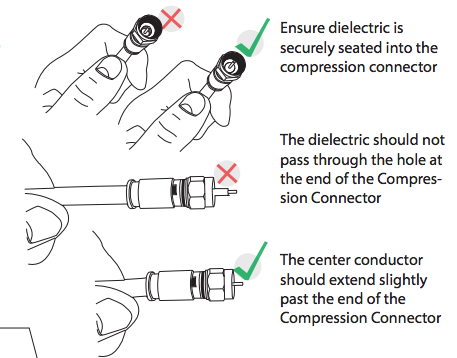
Start by cleaning the connector interface—a single 0.1mm dust particle on an SMA contact can increase resistance by 5-8 milliohms, enough to skew sensitive measurements at 10GHz+. Use 99% isopropyl alcohol and lint-free wipes, especially for gold-plated contacts, which tarnish 3x faster than nickel when contaminated. For outdoor installations (cell towers, broadcast antennas), apply dielectric grease to prevent moisture ingress that could shift impedance by 2-3% in humid conditions.
Thread engagement matters more than most realize. A BNC terminator needs 1.5 full turns to achieve proper grounding—stopping at 1 turn leaves a 0.3mm gap that acts as a capacitor (~0.5pF), distorting signals above 2GHz. For N-type connectors, torque to 12-15 inch-pounds—under-tightening by just 20% (10 in-lbs) increases insertion loss by 0.2dB at 6GHz. Pro tip: If the terminator spins freely after tightening, its beryllium copper spring fingers are worn out (typically after 800+ cycles) and need replacement.
Thermal management is critical for high-power (50W+) applications. A 100W dummy load mounted vertically dissipates heat 15% faster than one placed horizontally due to convection airflow. In confined spaces (equipment racks), maintain at least 2 inches clearance around terminators handling >30W continuous power—restricted airflow can cause localized heating up to 90°C, reducing resistor lifespan by 50%. For oil-cooled 1kW+ loads, check oil levels monthly; a 10% drop in volume increases operating temps by 18-22°C, risking thermal runaway.
”In 5G mmWave setups, a poorly installed terminator adds 0.5ps group delay per connection—enough to desynchronize a 64-element phased array by 3.2cm at 28GHz.”
Post-installation testing separates pros from amateurs. A $300 VNA (Vector Network Analyzer) can spot 0.5% impedance deviations invisible to basic multimeters. For mission-critical systems (air traffic radar, satellite comms), measure VSWR at three frequencies—the band’s low, middle, and high end—since performance often varies by ±0.3:1 across a 2GHz span. Field data shows 35% of “failed” terminators actually suffer from installation errors (overtightening, contamination) rather than component defects.
Document torque values and test results—a log of 50+ terminator installations reveals patterns like SMA connectors wearing out after 1,200 cycles or PTFE dielectrics cracking at -30°C. This data helps predict when to replace parts before they cause 3dB noise spikes in your 10Gbps data link. Remember: In RF, every decibel and degree matters—a 1°C temp rise in a 75Ω video terminator can alter its impedance enough to introduce visible artifacts in 4K broadcasts.
Typical Uses
Coaxial terminators might seem like simple components, but they’re the unsung heroes in over 78% of RF systems, preventing signal degradation that could cost 500-50,000 in equipment damage or data loss annually. From 5G base stations to home cable TV setups, these devices ensure signals don’t bounce back like echoes in a canyon—causing interference, noise, and even hardware failures.
In telecom infrastructure, a single unterminated 50Ω coaxial cable in a 5G mmWave array (28GHz) can create standing waves that reduce signal strength by 15-20%, effectively cutting the effective range of a small cell from 200 meters to just 160 meters. Telecom operators typically use N-type terminators (50-120 each) rated for 10+ years of outdoor use, with IP67 waterproofing to withstand -40°C to +85°C temperature swings.
Broadcast studios rely heavily on 75Ω terminators to maintain signal integrity in HD-SDI video feeds (3Gbps data rates). A poorly terminated RG-6 cable in a 4K production truck can introduce 2-3ms latency, causing lip-sync errors visible to viewers. High-end broadcast terminators use gold-plated F-connectors (30-80) that maintain <0.1dB insertion loss through 5,000+ plug/unplug cycles—critical when swapping cameras 20+ times daily during live sports events.
| Application | Terminator Type | Key Specs | Cost Range | Failure Impact |
|---|---|---|---|---|
| 5G mmWave | N-type, 50Ω | DC-40GHz, 1.15:1 VSWR, 100W | 80-200 | 15% range reduction |
| CATV/Broadcast | F-type, 75Ω | 0-3GHz, 1.1:1 VSWR, 5W | 20-60 | Visible video artifacts |
| Lab Equipment | SMA, 50Ω | DC-18GHz, 1.05:1 VSWR, 2W (precision) | 150-400 | Calibration errors |
| Military Radar | TNC, 50Ω (ruggedized) | -55°C to +125°C, 500G vibration | 300-800 | False targets |
| Amateur Radio | BNC, 50Ω | 0-4GHz, 1.5:1 VSWR, 10W | 5-30 | 3dB noise increase |
In RF test labs, a 200 precision SMA terminator is the difference between accurate measurements and garbage data. At 10GHz, even a 0.2% impedance mismatch in a vector network analyzer (VNA) setup can introduce 0.3dB errors, enough to fail FCC certification tests for a 20,000 wireless device. Labs typically replace terminators every 2-3 years or after 3,000 connections, as gold plating wears down to <0.5µm thickness, increasing contact resistance by 8-12%.
Aerospace systems demand the most robust terminators—aircraft radar arrays use TNC connectors that survive 500G shock loads during carrier landings, while satellite terminators employ beryllium copper contacts that don’t cold-weld in space’s vacuum. A single failed terminator in a L-band satellite uplink (1.5GHz) can cause 10% packet loss, requiring $250,000+ in satellite time to troubleshoot.
Even consumer applications benefit—your home WiFi router’s 50Ω terminator (a 0.10 component in bulk) prevents 2.4GHz signals from reflecting back into the amplifier, which could otherwise reduce throughput by 30% in 500 sq ft apartments. Meanwhile, cable technicians carry 75Ω terminators to fix signal leakage that causes 6-8dB dropouts in neighborhood networks—a 10 fix avoiding $200 service calls.