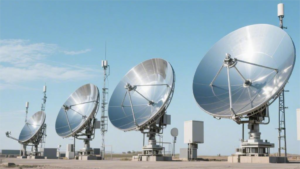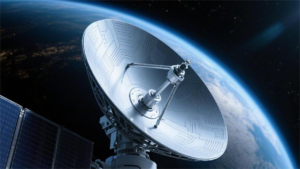
Satellites use high frequencies (e.g., Ku/Ka bands, 12–40GHz) for wider bandwidth (hundreds of MHz vs. tens in L-band), enabling higher data rates; shorter wavelengths allow compact antennas, reducing launch weight while minimizing terrestrial interference.
Table of Contents
Why High Frequency Matters
High-frequency bands, typically classified as those above 3 GHz, such as Ku-band (12–18 GHz) and Ka-band (26.5–40 GHz), are fundamentally chosen for one reason: spectral efficiency. A higher frequency means a wider available bandwidth. For instance, a standard Ka-band transponder can offer a bandwidth of 500 MHz or more, compared to just 36 MHz commonly available in lower C-band. This is not a marginal improvement; it’s a 15x increase in potential data-carrying capacity. This massive bandwidth directly translates to higher data rates. Modern high-throughput satellites (HTS) using Ka-band can deliver downlink speeds exceeding 100 Mbps to a single user terminal, enabling services like broadband internet, 4K video streaming, and real-time data relay that are simply impossible with lower, more congested frequencies.
A Ka-band (30 GHz) terminal can achieve the same signal gain and performance as a C-band (4 GHz) terminal with a dish that is roughly 7.5 times smaller in area. This is a game-changer for cost and deployment. A typical consumer satellite internet antenna for Ka-band services is now a compact 45 cm to 60 cm wide unit that can be easily mounted on a roof. In contrast, achieving similar performance with C-band would require a cumbersome 2 to 3-meter wide dish, making mass-market deployment impractical and vastly more expensive.
This leads to the concept of spot beams. At higher frequencies, signals can be more precisely focused onto specific geographic areas, often as small as a few hundred kilometers in diameter. A single satellite can project dozens of these spot beams over a continent, each one reusing the same valuable block of frequencies. This spatial frequency reuse is the key to maximizing a satellite’s overall capacity. While a traditional satellite might have a total capacity of 10 Gbps, a modern Ka-band HTS with hundreds of spot beams can achieve a system capacity of over 1 Tbps (Terabit per second), a 100-fold increase.
| Feature | Lower Frequency (e.g., C-band @ 4 GHz) | Higher Frequency (e.g., Ka-band @ 30 GHz) | Impact |
|---|---|---|---|
| Typical Bandwidth per Transponder | 36 – 72 MHz | 250 – 500 MHz | ~5-7x more data capacity per channel |
| Common User Antenna Diameter | 1.8 – 2.4 meters | 0.45 – 0.6 meters | ~90% smaller area, lower cost, easier install |
| Beam Coverage Area | Wide (regional, 1000+ km) | Narrow Spot Beam (100-300 km) | Enables frequency reuse, multiplying total satellite capacity |
| Typical Data Rate per User | 10 – 20 Mbps | 100+ Mbps | Supports high-bandwidth applications (video, broadband) |
A heavy rainstorm can cause a signal fade (attenuation) of over 20 dB in the Ka-band, which is enough to completely disrupt a link if not planned for. To combat this, satellite systems employ robust link budgets with significant power margins and adaptive techniques. During bad weather, modems can automatically lower their transmission data rate and apply more powerful forward error correction (FEC) coding to maintain the connection, ensuring reliability despite a temporary drop in speed. This proactive system design ensures an availability rate of 99.5% or higher for commercial services, making high-frequency satellite links not just powerful, but also exceptionally reliable.
Penetrating the Atmosphere
While high-frequency signals like those in the Ka-band (26.5–40 GHz) offer immense bandwidth, their journey to and from a satellite 35,786 km away in geostationary orbit is fraught with a challenge not faced by lower frequencies: the Earth’s atmosphere. The atmosphere is not empty space; it’s a medium filled with gases, rain, and water vapor that absorb and scatter radio waves. This phenomenon, called atmospheric attenuation, is the single biggest engineering hurdle for high-frequency satellite links.
At 30 GHz, a typical Ka-band frequency, a signal can experience over 20 dB of additional attenuation during a heavy rain event—enough to completely black out a link that wasn’t designed to compensate. This isn’t a minor inconvenience; it’s a fundamental physical constraint that dictates the entire design of the satellite’s power system, the ground antenna’s size, and the modem’s signal processing. Overcoming this is not about eliminating attenuation, which is impossible, but about building enough link margin—a reserve of signal power—to punch through the worst weather while maintaining a 99.7% or higher annual availability for the service.
Oxygen molecules cause a consistent, predictable absorption peak around 60 GHz, but for comms bands below 45 GHz, water is the main enemy. Rain attenuation increases exponentially with rainfall rate. For a Ka-band downlink at 20 GHz, a moderate rain rate of 25 mm per hour can induce approximately 6 dB of attenuation, effectively reducing the received signal power by 75%. A severe storm with 100 mm per hour rain can cause a devastating 20 dB or more loss, cutting power to just 1% of its original strength. This is quantified as a specific attenuation, measured in dB/km. For example, at 30 GHz, the specific attenuation is roughly 0.15 dB/km in clear air but can skyrocket to over 5 dB/km in heavy rain. Since a satellite signal must travel through a long atmospheric path, often 5-10 km thick at a low 5-10 degree elevation angle, these losses compound dramatically. A low elevation angle increases the signal’s path length through the atmosphere; a link at 5 degrees has a path length nearly 10 times longer than one at 90 degrees (straight up), massively increasing its exposure to rain cells.
The first line of defense is additional power margin. This means designing the system to have 10-15 dB of extra signal power under clear-sky conditions specifically to be consumed during rain fades. This margin comes from more powerful satellite amplifiers (100-200 Watts per transponder is common in HTS designs) and larger, more precise ground antennas that provide higher gain. A 75 cm antenna has roughly 4 dB more gain than a 60 cm model, significantly boosting the link’s resilience. The second critical tool is Adaptive Coding and Modulation (ACM). Modern satellite modems constantly monitor the signal-to-noise ratio (SNR).
More Data, Less Time
Lower frequency bands, like C-band, are constrained by narrow channel bandwidths, typically 36 MHz wide. In contrast, a single Ka-band transponder can operate with a 500 MHz bandwidth or more. This 14-fold increase in available spectrum directly translates to higher data rates according to Shannon’s theorem. We’re not talking about moving from 10 Mbps to 20 Mbps; we’re talking about leap from 10-15 Mbps per user on traditional systems to sustained rates of 100-150 Mbps on modern High-Throughput Satellites (HTS). This means a 4K movie that would take over an hour to download on an older system can be pulled down in less than 10 minutes, fundamentally changing the user experience from one of patience to instant gratification.
- Raw Bandwidth: A single Ka-band transponder offers 500 MHz of bandwidth compared to 36 MHz in C-band.
- User Data Rates: Terminal speeds can now consistently reach over 100 Mbps, rivaling terrestrial options.
- Latency Reduction: While propagation delay remains ~500 ms, modern protocols reduce effective latency to ~600 ms, enabling VoIP and video calls.
- Cost per Bit: Higher efficiency drives the cost to deliver a megabit of data down by over 60% in the last decade.
This massive jump in throughput is achieved through two main techniques: higher-order modulation and spot beam frequency reuse. First, high-frequency equipment can utilize more complex modulation schemes. While a legacy link might use QPSK, a Ka-band link can reliably use 16APSK or 32APSK, which encodes 4 or 5 bits of data per Hertz per second, respectively. This alone can double the spectral efficiency. Second, and more importantly, is spatial reuse. A high-throughput satellite projects dozens of narrow, focused spot beams (each ~200 km wide) over a continent. Each spot beam operates over the same 500 MHz block of frequencies. This means the same spectrum is reused 50 to 100 times across the satellite’s coverage area. The total system capacity isn’t just the 500 MHz; it’s 500 MHz multiplied by the number of beams. This is how a single HTS can achieve a system-wide capacity of 1 Tbps (Terabit per second), compared to a traditional satellite’s 10-20 Gbps. This architecture doesn’t just serve users faster; it serves more users simultaneously at high speed without congestion. For an enterprise, this means a remote mining site can transmit daily 20 GB of geological survey data back to headquarters in under 30 minutes instead of stalling the network for 8 hours, enabling near-real-time decision-making and a dramatic improvement in operational efficiency.
Smaller Antennas on Ground
The physics are governed by a key antenna principle: gain is proportional to the square of the frequency. For a given required signal strength (gain), doubling the operating frequency allows the antenna diameter to be halved. This means a Ka-band system operating at 30 GHz can achieve the same performance as a C-band system at 4 GHz with an antenna that has over 85% less surface area. This principle has enabled the standard consumer satellite internet antenna to shrink from a bulky 2.4-meter C-band dish in the 1980s to a compact, mass-produced 0.48-meter (48 cm) Ka-band unit today. This reduction directly slashes manufacturing costs from thousands of dollars per terminal to a few hundred, eliminates the need for heavy-duty mounting structures, and simplifies installation from a multi-day professional job to a 2-3 hour technician visit or even a consumer DIY project.
- Diameter Reduction: A 0.6m Ka-band antenna provides equivalent gain to a 1.8m C-band antenna, a 70% reduction in diameter.
- Cost Savings: Manufacturing and shipping costs for a 0.6m antenna are approximately 75% lower than for a 1.8m antenna.
- Weight Reduction: A typical Ka-band user terminal weighs 5-7 kg, compared to over 50 kg for a traditional C-band system.
- Installation Time: Professional installation time dropped from ~8 hours for large systems to under 2 hours for modern, compact terminals.
| Parameter | C-band (4 GHz) Typical Terminal | Ka-band (30 GHz) Typical Terminal | Reduction / Improvement |
|---|---|---|---|
| Diameter | 1.8 – 2.4 meters | 0.45 – 0.6 meters | ~75% smaller diameter |
| Surface Area | 2.5 – 4.5 m² | 0.16 – 0.28 m² | ~93% less area |
| Mass (Weight) | 50 – 100 kg | 5 – 7 kg | ~90% lighter |
| Approx. Terminal Cost | 5,000 | 600 | ~85% cheaper |
| Wind Load | Very High (>100 kg force in storm) | Low (<15 kg force) | Safer, simpler mounting |
The direct correlation between frequency and antenna size is defined by the antenna gain formula: Gain (dBi) = 10 * log10(η * (π * D / λ)²), where D is the diameter and λ is the wavelength. Since wavelength (λ) is inversely proportional to frequency, a higher frequency means a shorter wavelength, which for a fixed gain G, allows for a smaller diameter D. For example, to achieve a typical gain of 40 dBi:
- At C-band (4 GHz, wavelength 7.5 cm), you need a dish diameter of approximately 1.8 meters.
- At Ka-band (30 GHz, wavelength 1.0 cm), you need a dish diameter of just 0.48 meters.
This 78% reduction in diameter translates to a 96% reduction in the physical area and weight of the antenna structure. This miniaturization has cascading benefits. The reduced weight and wind load mean the antenna can be mounted on a simple non-penetrating roof mount or even a balcony railing, instead of requiring a costly concrete foundation. The lower manufacturing cost allows operators to subsidize or even give away the terminal, recovering the cost through service fees over a 12-18 month subscriber commitment. However, this size advantage comes with a critical engineering trade-off: beamwidth. A smaller antenna has a wider beamwidth, meaning it is less precise in pointing at the satellite. A 2.4m C-band dish might have a beamwidth of ~1.5 degrees, while a 0.6m Ka-band dish has a beamwidth of ~2.8 degrees.
Focusing the Signal Beam
At lower frequencies like C-band, a satellite’s transponder often illuminates an entire continent with a single wide beam, perhaps 3,000 km wide. This is inefficient, as most of the signal power is wasted over oceans or unpopulated areas. In contrast, a high-throughput satellite (HTS) using Ka-band employs a phased array antenna to project dozens of tightly focused spot beams, each typically 200-300 km in diameter. This concentration of power provides a massive 20-23 dB increase in signal strength within the beam’s footprint compared to a traditional broad beam. This isn’t a minor improvement; it’s the difference between lighting up a stadium with a single light bulb versus using a focused spotlight. This gain is used either to deliver higher data rates to users (e.g., boosting speeds from 50 Mbps to 150 Mbps) or to allow for the use of those smaller, cheaper consumer antennas by providing them with a stronger signal to lock onto.
- Beam Size Reduction: Single beam coverage ~3,000,000 km² vs. spot beam coverage of ~50,000 km², a 98% reduction in area per beam.
- Gain Improvement: Signal strength within a spot beam is ~20 dB higher than a wide-area beam, a 100x power increase.
- Frequency Reuse Factor: The same block of 500 MHz spectrum can be reused 50-100 times across a service area.
- Capacity Multiplication: System capacity scales from ~20 Gbps (wide beam) to over 1 Tbps (multiple spot beams).
The effective isotropic radiated power (EIRP) within a typical Ka-band spot beam can reach 55 dBW, compared to roughly 32 dBW for a traditional wide-area C-band beam. This 23 dB difference means the spot beam delivers over 200 times more power to the user terminal.
A single antenna assembly can generate ~20 independently steerable beams, each with a 3 dB beamwidth of approximately 0.3 degrees. To cover the United States, a satellite might need 50-60 such spot beams. The key benefit is spectral reuse. While a traditional satellite can only use its 500 MHz of allocated spectrum once over the entire country, an HTS uses the exact same 500 MHz block in every single spot beam. If the beams are sufficiently separated geographically to avoid interference, the total system bandwidth becomes 500 MHz multiplied by the number of beams. With 60 beams, the effective total bandwidth is 30 GHz, a 60x increase in utilization of the licensed spectrum. This is the engineering breakthrough that makes affordable, high-speed satellite internet a reality. The ground system complements this by using proprietary modulation and coding schemes that pack more data into the robust signal, achieving spectral efficiencies of 3-4 bits per second per Hertz, resulting in a single spot beam carrying a net throughput of 1.5 – 2 Gbps towards users on the ground.
Avoiding Crowded Lower Frequencies
A single 36 MHz transponder in C-band might be shared among multiple major broadcasters, leading to highly contended capacity and expensive lease rates, often exceeding $2 million per year per transponder. This congestion directly manifests as higher bit error rates (BER), typically on the order of 10⁻⁶ due to increased interference probability, compared to 10⁻⁸ or better in cleaner high-band environments. Migrating to higher frequencies like Ku-band (12-18 GHz) and Ka-band (26.5-40 GHz) is not merely an option; it’s a necessity for achieving the gigabit-scale throughput required for modern data services. These bands offer vast, contiguous blocks of spectrum. While a C-band operator might manage a total of 500 MHz of spectrum, a Ka-band operator can access 3.5 GHz of continuous spectrum or more. This 7-fold increase in available bandwidth is the primary factor enabling the shift from expensive, limited-capacity legacy services to affordable, high-speed satellite broadband.
| Parameter | Crowded Lower Bands (e.g., C-band @ 4-8 GHz) | High-Frequency Bands (e.g., Ka-band @ 26.5-40 GHz) | Advantage |
|---|---|---|---|
| Typical Available Bandwidth | 500 MHz (fragmented) | 3500 MHz (contiguous) | 7x more spectrum available for use |
| Interference Probability | High (~25% chance of adjacent-satellite interference) | Low (<2% with proper beam isolation) | >90% reduction in interference-related outages |
| Transponder Lease Cost | 3M per year | 700k per year | ~75% lower operating cost for capacity |
| Typical Spectral Efficiency | 1.5 – 2.0 bps/Hz | 3.0 – 4.0 bps/Hz | ~2x more data per unit of spectrum |
A Ka-band link can experience over 20 dB of signal loss during a heavy precipitation event, compared to less than 1 dB for a C-band link under the same conditions. To maintain 99.5% annual availability, Ka-band systems must be engineered with a significant link margin of 10-15 dB. This is achieved through higher-power satellite amplifiers (e.g., 120W Traveling Wave Tube Amplifiers versus 40W units in legacy payloads), more sensitive receivers with lower noise figures (<1.5 dB), and the use of Adaptive Coding and Modulation (ACM). ACM allows the modem to dynamically shift its modulation from high-efficiency 32APSK (4.5 bps/Hz) down to robust QPSK (1.5 bps/Hz) and increase its forward error correction (FEC) overhead from 20% to 50% during a rain fade. This trade-off ensures the link stays active at a temporary 60-70% reduction in throughput instead of failing completely.