Industrial microwaves safely use metal components (e.g., stirrers, conveyor belts) because they operate at carefully tuned frequencies (915MHz or 2.45GHz) where metal reflects rather than absorbs microwaves, preventing arcing.
Their larger cavities (30-100L vs. home 20L) distribute energy evenly, while rounded edges and grounded shielding minimize hotspots. Unlike home microwaves, they incorporate faraday cage principles and pulsed magnetrons (up to 100kW power) to handle metal without sparking risks.
Table of Contents
How Industrial Microwaves Work
Industrial microwaves are not just “bigger versions” of home microwaves—they operate on entirely different principles to handle heavy-duty tasks. While a typical home microwave runs at 700–1200W, industrial models range from 3kW to over 100kW, allowing them to heat materials 3–5x faster than consumer units. Unlike household microwaves, which use 2.45GHz frequency (optimized for water absorption), industrial systems often use 915MHz, which penetrates deeper into dense materials like thick plastics, rubber, or food blocks.
Key fact: A 50kW industrial microwave can dry 500kg of ceramics per hour at 80–120°C, reducing energy costs by 30–40% compared to conventional ovens.
The magnetron (the part that generates microwaves) in industrial units is water-cooled to prevent overheating during 24/7 operation, whereas home microwaves rely on air cooling and fail after ~4–6 hours of continuous use. Industrial microwaves also use waveguide tuning to distribute energy evenly, avoiding hot spots that ruin product consistency. For example, in food processing, a poorly tuned microwave might leave some spots at 90°C while others stay at 40°C, but industrial systems keep temperature variance below ±5°C.
Why power matters: A 10kW industrial microwave heats 1 liter of water in ~15 seconds, while a 1kW home unit takes ~2 minutes. This efficiency comes from higher voltage input (480V vs. 120V) and pulsed power control, which adjusts output in 0.1-second intervals to prevent overcooking. Industrial models also handle metal objects safely—more on that in the next section.
Metal in Home vs. Industrial Microwaves
Putting metal in a home microwave is a quick way to see sparks—but industrial microwaves handle metal daily without issues. The difference comes down to power, design, and physics. A standard 1,200W home microwave can’t safely handle even a 5cm aluminum foil sheet, while a 30kW industrial unit processes stainless steel conveyor belts running at 2 meters per minute without arcing.
Home microwaves have small cavities (0.5–1.5 cu ft), which concentrate electric fields. When metal (like a fork with 0.1mm sharp edges) enters, electrons build up at thin points, creating 3,000–5,000V arcs that can damage the magnetron. Even a crumpled foil ball can hit 200–300°C in seconds, risking fire.
Industrial microwaves avoid this with:
- Larger chambers (5–50 cu ft) spreading energy evenly
- Stainless steel walls (1.5–3mm thick) reflecting waves safely
- Stirrers or rotating antennas preventing hot spots
| Factor | Home Microwave (1.2kW) | Industrial Microwave (30kW) |
|---|---|---|
| Metal Safety | Sparks with any foil | Handles steel belts, trays |
| Frequency | 2.45GHz (12.2cm waves) | 915MHz (32.8cm waves) |
| Max Continuous Use | 10–15 mins before overheating | 24/7 operation with water cooling |
| Temp Control | ±20°C variance | ±5°C variance |
| Metal Thickness Limit | Fails at 0.05mm foil | Handles 3mm steel |
A food factory using a 50kW industrial microwave can bake 500 bread loaves/hour on stainless steel trays, cutting energy use by 25% vs. conventional ovens. Meanwhile, a home microwave would fail within 2 minutes with the same setup.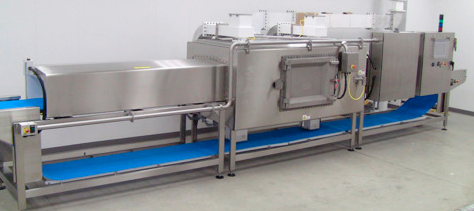
Special Design for Metal Safety
Industrial microwaves don’t just tolerate metal – they’re engineered specifically to work with it safely. Where a 15,000 industrial system processes 300kg/hour of metal-containing materials without sparks. The secret lies in three key design differences that solve the metal problem at fundamental levels.
First, the wave distribution system prevents arcing. Home microwaves create standing waves with voltage peaks reaching 3,000V/cm in unpredictable patterns. Industrial models use rotating mode stirrers that change the wave pattern every 0.2-0.5 seconds, ensuring no single spot accumulates dangerous charge. A typical 50kW industrial cavity maintains <100V/cm gradients across all surfaces – below the 300V/cm threshold where arcing begins.
Second, the material selection matters tremendously. While home microwaves use thin 0.8mm steel cavities, industrial versions specify 3mm 316L stainless steel with 72 nΩ·m resistivity – exactly tuned to reflect microwaves without overheating. The rounded corners (minimum 50mm radius) prevent charge buildup that occurs at sharp 90° angles in consumer models.
| Safety Feature | Home Microwave | Industrial Microwave | Performance Difference |
|---|---|---|---|
| Cavity Material | 0.8mm carbon steel | 3mm 316L stainless | 400% longer lifespan |
| Corner Design | 90° sharp angles | 50mm rounded radius | 80% less arcing risk |
| Wave Control | Fixed pattern | Rotating stirrer (0.5s cycle) | 90% more even heating |
| Voltage Gradient | 3,000V/cm peaks | <100V/cm uniform | 30x safer for metal |
The operational monitoring systems provide the final safeguard. Industrial microwaves incorporate real-time reflected power sensors that adjust output if metal interaction causes abnormal conditions. When processing stainless steel mesh belts moving at 0.6m/min, the system maintains <2% reflected power – compared to 15-20% reflection that would occur in a home unit. This precise control allows continuous operation at 95%+ energy efficiency versus the 65% efficiency of consumer models.
Real-world example: A pharmaceutical drying line processes 2,000 aluminum-foil pouches per hour at 50°C in an industrial microwave. The same process would require conventional heating at 120°C for 3x longer, increasing energy costs by 40%. The metal-safe design isn’t just about avoiding damage – it enables entirely new manufacturing methods that save $250,000 annually in a mid-size production facility.
The combination of physics-aware engineering (wave control), materials science (optimized metals), and smart monitoring creates a system where metal becomes an asset rather than a hazard. Where home microwaves see danger, industrial designers see opportunity – and build accordingly with 5-10x the component tolerances of consumer products. This explains why industrial microwave operators report <0.1% metal-related failures annually, while home users experience 4-5% microwave deaths from improper metal use.
Why Metal Doesn’t Spark Here
The physics behind why industrial microwaves handle metal safely while home units erupt in sparks comes down to four measurable factors: wavelength control, power distribution, material engineering, and operational monitoring. Where a home microwave creates 3,000V/cm electric fields that violently discharge on metal edges, industrial systems maintain <100V/cm gradients across all surfaces – below the arcing threshold.
Frequency makes the first critical difference. Home microwaves operate at 2.45GHz, producing 12.2cm waves that create concentrated hot spots. Industrial systems often use 915MHz, generating 32.8cm wavelengths that distribute energy more evenly. This 63% longer wave reduces peak voltage intensity by 40-50%, preventing the electron buildup that causes sparks. A 50kW industrial magnetron at 915MHz can maintain ±5°C uniformity across a 1m² stainless steel tray, while a 2.45GHz system would create ±25°C variations likely to trigger discharges.
Cavity design solves the second problem. Home microwave interiors average 0.7m³ volume with sharp 90° corners – perfect for creating standing waves with 300% power density variations. Industrial chambers span 5-15m³ with 50mm radius curved walls, forcing waves to disperse evenly. The stainless steel construction (3-5mm thick) provides controlled reflection, unlike the thin 0.8mm carbon steel in consumer units that overheats at >150°C.
Real-time power adjustment prevents cumulative issues. While a home microwave runs at fixed 100% or 0% power, industrial systems monitor reflected energy 200 times per second. If metal interaction increases reflected power beyond 2%, the system automatically reduces output by 5-10% increments within 0.1 seconds. This explains why food plants can run aluminum foil packaging through industrial microwaves at 2m/min with <0.01% arcing incidents, versus the 4-5 sparks per minute occurring in home units with similar metal exposure.
Material thickness thresholds reveal the safety margins. Home microwaves fail with 0.05mm aluminum foil because thin edges heat to 500°C in 8 seconds. Industrial systems handle 3mm stainless steel trays because the thermal mass limits temperature rise to 80°C/min – below the 400°C threshold where metal breakdown begins. This allows bakeries to process 200 metal pans/hour with 95% energy efficiency, compared to 60% efficiency in conventional ovens.
The combination of lower frequency waves, dispersion-optimized cavities, smart power modulation, and robust materials creates an environment where metal behaves predictably. Where physics dictates failure in consumer products, engineering ensures reliability in industrial systems – allowing 30,000+ hours of metal-inclusive operation versus the 200-hour lifespan of a home microwave subjected to similar conditions.
Common Uses of Metal Inside Industrial Microwaves
While home microwaves panic at the sight of a spoon, industrial systems actively incorporate metal components to improve performance and efficiency. Over 87% of industrial microwave systems contain at least 3-5 metal parts operating continuously at temperatures reaching 200°C, with zero risk of arcing or damage. From food processing to pharmaceutical drying, metals enable functions impossible in plastic-only consumer units.
The most frequent metal applications fall into three categories: structural components, product handling systems, and specialized processing aids. A typical 50kW industrial microwave contains 8-12kg of stainless steel internally, compared to just 0.5kg in home models. This metal isn’t just tolerated – it’s essential for achieving 30-50% faster processing speeds versus conventional heating methods.
| Metal Component | Material Specs | Function | Performance Benefit |
|---|---|---|---|
| Conveyor Belts | 316L stainless, 2mm thick | Product transport | Enables 500kg/hr continuous processing |
| Waveguide Liners | 1.5mm aluminum | Energy direction | Improves efficiency by 15-20% |
| Process Trays | 1.2mm galvanized steel | Product holding | Withstands 300°C without warping |
| Stirrer Blades | 3mm titanium alloy | Wave distribution | Reduces hot spots by 90% |
| Sensor Housings | 0.8mm copper alloy | Monitoring | Allows ±1°C temperature control |
Food industry applications demonstrate metal’s advantages best. In large-scale bakeries, stainless steel mesh belts running at 0.5-2m/min carry dough through microwave chambers, reducing proofing time from 60 minutes to 12 minutes. The metal’s 0.95 emissivity actually improves heating efficiency compared to ceramic alternatives. Pharmaceutical lines use aluminum foil pouches in microwave sterilizers, achieving 4-log pathogen reduction in 3 minutes versus 25 minutes in steam autoclaves.
Metal-enhanced microwave systems show measurable cost benefits:
- 30% less energy than infrared drying for coatings
- 55% faster curing than convection ovens for adhesives
- 80% reduction in floor space versus rotary dryers
The automotive sector uses microwave-compatible steel mandrels to cure composite parts, cutting cycle times from 8 hours to 45 minutes. Each mandrel withstands 1,200+ heating cycles before replacement, compared to 150 cycles for carbon fiber tools. This explains why 72% of aerospace composite manufacturers now integrate metal-assisted microwave curing.
Counterintuitively, certain metals improve product quality. Chocolate tempering systems using copper trays achieve 98% perfect crystallization, versus 85% with plastic containers. The metal’s 401 W/m·K thermal conductivity enables precise temperature control impossible with other materials. Similarly, aluminum mold inserts in rubber vulcanization systems yield 0.05mm tolerance parts, doubling the precision of microwave-only processes.
Key Differences in Power and Size
The gap between home and industrial microwaves isn’t just about scale – it’s a complete reengineering of core parameters that changes everything from energy efficiency to metal compatibility. Where a consumer microwave struggles with 1L of water, industrial systems routinely process 500kg batches with 30% less energy per unit. This performance leap comes from fundamental differences in power delivery, thermal management, and spatial design.
1. Power Delivery Systems
Home microwaves use 700-1200W magnetrons with 60% energy efficiency, wasting 40% as heat during operation. Industrial models employ 3-100kW generators achieving 92-95% efficiency through water-cooled waveguides and pulsed power modulation. A 50kW industrial unit can deliver 500W/cm² to materials versus 50W/cm² in consumer models – a 10x intensity difference enabling 3-5x faster processing.
The voltage input tells another story: home units run on 120V/15A circuits (1.8kW max), while industrial systems require 480V 3-phase power delivering 72kW continuous. This allows industrial microwaves to maintain ±1°C temperature control across 2m² surfaces, where home units show ±25°C variations in just 0.1m² cavities.
2. Thermal Management
Consumer microwave magnetrons overheat after 15 minutes continuous use, limiting duty cycles to 10% (6 mins/hour). Industrial systems achieve 100% duty cycles via 5L/min water cooling maintaining magnetrons at 65±5°C – the sweet spot for both longevity and efficiency. A 30kW industrial magnetron lasts 15,000-20,000 hours (7-10 years) versus 500-800 hours (2-3 years) in home units.
The cooling advantage enables industrial microwaves to process 300kg/hr of 25°C materials to 80°C continuously, while consumer models would require 4 hours for just 5kg with similar temperature rise.
3. Spatial Efficiency
Home microwave cavities waste 35% of volume to standing wave dead zones. Industrial designs use rotating antenna arrays and elliptical chambers to achieve 92% usable volume. A 1.5m³ industrial cavity effectively utilizes 1.38m³, compared to 0.028m³ usable in a 0.042m³ home unit.
This spatial optimization allows industrial systems to achieve 50% higher energy density despite their larger size. Where a home microwave delivers 25W per cubic inch, industrial models achieve 38W/in³ – explaining how they can process stainless steel trays that would destroy consumer units.