Dipole antennas (λ/2 length) are commonly used for radio waves, offering 1.64 dBi gain and 50-75Ω impedance, with omnidirectional radiation patterns for frequencies ranging from kHz to GHz, depending on their size and material.
Table of Contents
Basic Antenna Types
Radio antennas come in many shapes and sizes, each designed for specific frequency ranges, power levels, and applications. The most common types include dipole, monopole, loop, patch, and Yagi antennas, with variations optimized for efficiency, cost, and signal strength. For example, a simple half-wave dipole operates efficiently at 50-75 ohms impedance, covering frequencies from 3 MHz to 300 MHz, while a monopole antenna (often used in car radios) requires a ground plane and typically has a 5-10 dB lower gain than a dipole.
Loop antennas, often used in AM radios (530–1700 kHz), have a high Q factor, making them selective but narrowband. On the other hand, patch antennas, common in Wi-Fi (2.4 GHz and 5 GHz) and GPS (1.575 GHz), are compact (often 10×10 cm or smaller) and low-cost, with 5-8 dBi gain. Yagi antennas, popular in TV reception (470–862 MHz), can achieve 10-15 dBi gain but require precise element spacing (0.15–0.25 wavelengths) for optimal performance.
The radiation pattern of an antenna determines how it distributes energy. A dipole has a figure-8 pattern, while a monopole is omnidirectional but loses 3 dB efficiency due to ground dependency. Patch antennas are directional, with a 60–80° beamwidth, making them ideal for point-to-point links. Loop antennas can be small (λ/10) or large (λ/2), with larger loops offering better efficiency (up to 90%) but requiring more space.
Material choice also impacts performance. Copper and aluminum are common due to low resistance (1.68×10⁻⁸ Ω·m for copper), while fiberglass or plastic may be used for structural support. Antenna efficiency typically ranges from 50% to 95%, with losses coming from impedance mismatch, conductor resistance, and environmental factors like humidity (which can increase losses by 2-5%).
For low-power applications (under 1W), such as Bluetooth or ZigBee (2.4 GHz), small PCB trace antennas (just 5-30 mm long) are cost-effective but suffer from low gain (0-3 dBi). In contrast, high-power broadcast antennas (1 kW+) use thick aluminum elements to handle high voltage (up to 50 kV in AM towers) without arcing.
Dipole Antenna Design
A dipole antenna is one of the simplest and most widely used designs, offering good efficiency (70-90%) across a broad frequency range (3 MHz to 3 GHz). The classic half-wave dipole is λ/2 in length, meaning a 146 MHz (2-meter band) dipole would be about 1 meter long (0.5 × 2 m wavelength). Its impedance is roughly 73 ohms, making it a natural match for 50-ohm coaxial cables with minimal SWR (Standing Wave Ratio) under 1.5:1 when properly tuned.
”A dipole’s performance drops sharply if shortened beyond 90% of its ideal length—a 10% length reduction can increase SWR from 1.5:1 to over 3:1, wasting 25% of transmitted power.”
The radiation pattern of a dipole is a figure-8 shape, with maximum gain (2.15 dBi) perpendicular to the wire and nulls at the ends. For omnidirectional coverage, a vertical dipole is often used, though it loses 3 dB gain compared to a horizontal setup. Multiband dipoles, like fan or trap dipoles, can operate on 2-4 frequencies (e.g., 7 MHz and 14 MHz) by adding LC traps (inductor-capacitor circuits) that isolate segments at different wavelengths.
Material thickness matters—thicker conductors (e.g., 3-6 mm copper tubing) improve bandwidth (up to 15% wider than thin wires) and handle higher power (1 kW+) without heating. A thin wire dipole (1 mm diameter) might only handle 100W at 14 MHz before risking resistive losses (5-10% efficiency drop). Height above ground also affects performance: mounting at λ/2 (10m for 14 MHz) reduces ground reflections, boosting gain by 3-6 dB over a λ/4 (5m) installation.
For portable or temporary setups, collapsible fiberglass dipoles (weighing under 500g) are popular, though they sacrifice 5-10% efficiency versus solid metal. Feeding a dipole requires care—a balun (balanced-to-unbalanced transformer) prevents cable radiation, especially above 30 MHz, where common-mode currents can distort the pattern. A 1:1 current balun typically costs 50 and cuts RFI (Radio Frequency Interference) by 10-20 dB.
Yagi Antenna Uses
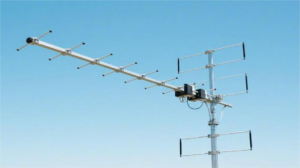
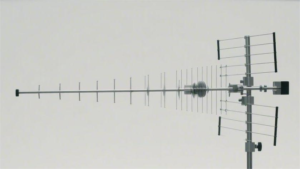
Yagi antennas are high-gain directional antennas widely used in TV reception (470–862 MHz), amateur radio (14–440 MHz), and point-to-point wireless links (900 MHz–5.8 GHz). A typical 3-element Yagi provides 8–10 dBi gain, while larger 10–15 element designs can reach 14–18 dBi, boosting range by 2–4x compared to a dipole. Their forward beamwidth is narrow (30–60°), making them ideal for long-distance communication but requiring precise alignment within ±5° for optimal performance.
| Application | Frequency | Elements | Gain (dBi) | Beamwidth | Typical Range |
|---|---|---|---|---|---|
| TV Reception | 470–862 MHz | 5–10 | 10–14 | 40–60° | 30–80 km |
| Amateur Radio (HF) | 14–30 MHz | 3–6 | 6–9 | 60–90° | 500–1500 km |
| Wi-Fi (PtP) | 2.4–5.8 GHz | 8–16 | 12–18 | 20–40° | 5–20 km |
| RFID Tracking | 865–928 MHz | 4–8 | 8–12 | 50–70° | 10–50 m |
The reflector and director elements in a Yagi are 10–20% shorter/longer than the driven element, creating phase interference that focuses energy forward. For example, a 5-element 144 MHz Yagi has a reflector (~1.05× driven length) and directors (~0.9× driven length), spaced at 0.15–0.25 wavelengths (30–50 cm). Misalignment by just 10% in spacing can drop gain by 2–3 dB and increase side lobes by 5 dB, causing interference.
Material choice affects durability and performance. Aluminum elements (3–6 mm thick) handle 100W+ transmit power with <1 dB loss, while fiberglass-encased Yagis (common in marine/aviation use) survive 150+ km/h winds but suffer 0.5–1 dB higher losses. For low-cost setups, a 300–600 for 15-element 432 MHz) offer 3–5 dB better gain and tighter beamwidths.
Mounting height is critical. A 6m mast improves line-of-sight range by 30% over a 3m install due to reduced ground absorption. For UHF (400+ MHz), even 1m height changes can alter signal strength by 2–3 dB. In urban areas, Yagis often face multipath interference, but a 10° tilt adjustment can reduce dropouts by 20%.
Loop Antenna Features
Loop antennas are compact, versatile radiators that excel in space-constrained applications (portable radios, RFID, HF reception) while offering unique directional nulls for interference rejection. Unlike dipoles, their circular/rectangular shape creates a magnetic field dominance, making them 3-5x less sensitive to nearby conductors than wire antennas. A 1-meter diameter loop tuned to 7 MHz achieves 70-80% radiation efficiency, comparable to a dipole but in 1/10th the footprint.
| Parameter | Small Loop (λ/10) | Large Loop (λ/2) | Ferrite Loop (AM Radio) |
|---|---|---|---|
| Typical Size | 0.1-0.3 m diameter | 1-3 m diameter | 0.05-0.1 m (rod) |
| Frequency Range | 3-30 MHz | 1-30 MHz | 0.5-1.7 MHz |
| Efficiency | 10-30% | 70-90% | 5-15% |
| Q Factor | 100-300 | 50-150 | 200-500 |
| Gain | -10 to -5 dBi | 0-2 dBi | -20 to -15 dBi |
Small loops (λ/10 or smaller) trade efficiency for portability—a 0.5m copper loop at 14 MHz radiates just 15% of input power but fits in a backpack, while a 2m aluminum loop at the same frequency hits 85% efficiency. The Q factor (quality factor) dictates bandwidth; a high-Q (300+) loop might cover only 10 kHz at 7 MHz, requiring precision tuning capacitors (±1 pF tolerance) to maintain SWR <2:1. This makes them ideal for narrowband applications like HF amateur radio, where 10 kHz bandwidth suffices.
Directional nulls are the loop’s killer feature. Rotating a vertically polarized loop creates 20-30 dB nulls at 90° to the plane, letting operators reject interference from specific directions—critical for MW (530-1700 kHz) DXing. A 3m diameter loop can achieve 5 μV/m sensitivity at 1 MHz, outperforming most active antennas in high-noise urban environments. However, ferrite rod loops (common in AM radios) sacrifice gain (-20 dBi) for size (10 cm rods), needing 50+ turns of wire to compensate for low permeability (μ=100-400).
Construction materials dramatically affect performance. 1/4″ copper tubing offers 0.5 dB better efficiency than 12 AWG wire at 30 MHz due to lower skin effect losses (Rac/Rdc ratio <1.1). For portable use, 3mm diameter aluminum loops weigh 300-500g and handle 100W PEP when using vacuum variable capacitors (500 units). Budget builds with PVC frames and RG-58 coax loops work but suffer 3-5 dB extra loss above 10 MHz.
Patch Antenna Applications
Patch antennas, also called microstrip antennas, dominate modern wireless systems where low profile (5-10 mm thick), lightweight (50-200g), and mass production (unit cost <$5) are critical. These flat, PCB-style antennas deliver 5-8 dBi gain with 60-80° beamwidth, making them ideal for Wi-Fi routers (2.4/5 GHz), GPS modules (1.575 GHz), and 5G small cells (3.5-28 GHz). A typical 40x40mm patch on FR4 substrate (εr=4.3) achieves 85% radiation efficiency at 2.4 GHz, while advanced ceramic-loaded patches (εr=10-20) shrink sizes to 15x15mm for wearable IoT devices.
The resonant frequency depends on patch length (≈λ/2 in dielectric), with 1% dimensional tolerance causing 5-10 MHz shifts at 5 GHz. For dual-band operation, stacked patches or slots cut 15-20% bandwidth (e.g., 2.4-2.5 GHz + 5.15-5.85 GHz) but add 0.5-1 dB insertion loss. In urban 5G deployments, 8×8 patch arrays (256 elements total) produce 24 dBi gain with ±15° electronic beam steering, enabling 1 Gbps throughput at 500m range despite building penetration losses of 20-30 dB.
Feeding methods significantly impact performance. Edge-fed patches are simplest but suffer 3-5% impedance mismatch, while probe-fed designs improve return loss to <-15 dB at the cost of narrower bandwidth (4-6% vs. 8-12%). For automotive radar (77 GHz), aperture-coupled patches achieve >90% efficiency by separating feedlines from radiators, though requiring 0.1mm precision laminates ($200+/panel).
Environmental resilience separates consumer-grade from industrial patches. Standard epoxy-coated patches degrade gain by 0.5 dB/year under UV exposure, while PTFE-based versions maintain ±0.2 dB stability across -40°C to +85°C. In drones, flexible patches (0.1mm polyimide films) survive 10,000+ bend cycles but pay 2-3 dB efficiency penalties versus rigid boards.
Choosing the Right Antenna
Selecting the optimal antenna involves balancing frequency (1 MHz to 100 GHz), gain (0 to 30 dBi), size (1 cm to 10 m), and budget (5,000) against real-world constraints like obstruction density, power limits, and deployment timelines. A 5G small cell might need a 64-element patch array (10 helix antenna for 900 MHz LoRa transmissions through crops. Mismatches here are costly—a 3 dB gain drop at 2.4 GHz Wi-Fi cuts range by 30%, and a 10° beamwidth error in a satellite ground station can lose 50% of downlink data.
| Use Case | Antenna Type | Key Parameters | Cost Range | Tradeoffs |
|---|---|---|---|---|
| Urban 5G | 8×8 Patch Array | 24 dBi gain, ±15° steering, 28 GHz | 500 | 5% efficiency loss/mmWave rain fade |
| Rural HF Comms | Dipole | 7 MHz, 73Ω, 50W PEP | 100 | Needs 10m+ height, 50m space |
| Drone FPV | Circular Polarized | 5.8 GHz, 8 dBi, 80° beamwidth | 50 | 20% shorter range if polarization mismatched |
| Smart Meter | PCB Trace | 868 MHz, -1 dBi, 10x5mm | 3 | 30% lower efficiency vs external antenna |
| Satellite TV | Offset Dish + LNB | 12 GHz, 40 dBi, 60cm diameter | 200 | 0.5° alignment error = 10 dB loss |
Frequency dictates physics—below 30 MHz, wavelengths demand 10-100m structures (dipoles, loops), while mmWave (30+ GHz) works with 5mm patches but suffers 20 dB/km atmospheric loss. A 144 MHz Yagi achieves 12 dBi gain with 1m elements, but a 5.8 GHz version needs 5cm elements for similar performance. Material conductivity matters too—copper antennas show 1-2 dB better efficiency than aluminum at UHF, but cost 3x more per kilogram.
Environment alters requirements. In forests, 900 MHz dipoles outperform 2.4 GHz patches by 8-10 dB due to foliage penetration. For marine use, stainless steel whips survive salt spray but lose 15% efficiency versus brass. Urban canyon effects can attenuate 5.8 GHz signals by 40 dB/100m, forcing high-gain sector antennas (17 dBi) just to cover 500m line-of-sight.
Power handling separates consumer from professional gear. A PCB trace antenna fries at 2W continuous, while a 3/8″ heliax dipole handles 1 kW at 50 MHz. For EMC testing, biconical antennas (8k) tolerate 100V/m fields but provide just 2 dBi gain. Always check VSWR specs—a 1.5:1 mismatch wastes 4% power, while 3:1 dumps 25% as heat.