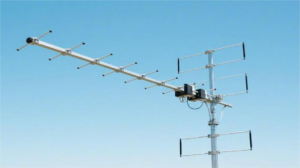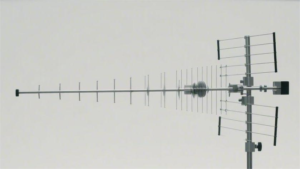
The LPDA’s theory hinges on logarithmic periodicity: dipoles shorten by 10–15% sequentially (length ratio ~0.85–0.95), spaced 20–40% apart, enabling multiple elements to resonate across octaves (e.g., 100MHz–1GHz), sustaining high gain (10–15dBi) and stable impedance via forward-wave coupling.
Table of Contents
Basic Idea and Common Uses
A typical LPDA for VHF/UHF TV reception might cover 174-230 MHz for VHF channels 7-13 and 470-862 MHz for UHF channels 21-69, all with a consistent performance. This makes it incredibly versatile. While consumer TV reception is a common application, their real value is in professional sectors. LPDAs are the workhorses of base stations for two-way radio communications, covering bands like 400-470 MHz for business radios or 800-960 MHz for some public safety systems. They are also indispensable for EMC (Electromagnetic Compatibility) testing, where a single antenna in a shielded room must scan across a massive spectrum, from 30 MHz to 6 GHz, to detect electronic emissions from a device under test.
At 200 MHz is transmitted. The shorter elements in the front are too small to interact effectively with this wavelength, while the longer elements at the back act more as passive directors or reflectors. The elements near the one that is roughly 75 cm long (half-wavelength at 200 MHz) become the active center of operation. This active region shifts along the boom as the frequency changes. For a higher frequency, say 600 MHz, the active region moves forward to where the dipoles are only about 25 cm long. This shifting focus is what enables the wide bandwidth. The geometric progression of the element lengths is controlled by a key design parameter called the scaling factor (τ), which usually has a value between 0.7 and 0.9. A higher τ value (e.g., 0.9) results in more elements packed closer together, yielding higher gain but a narrower bandwidth, while a lower τ value (e.g., 0.78) offers wider bandwidth with slightly less gain.
| Design Parameter (τ) | Typical Number of Elements | Relative Bandwidth | Typical Gain (dBi) |
|---|---|---|---|
| 0.85 – 0.9 | 12 – 16 | ~1.7:1 | 9 – 12 |
| 0.78 – 0.85 | 8 – 12 | ~2:1 | 7 – 10 |
| 0.7 – 0.78 | 6 – 9 | >2.5:1 | 6 – 8 |
This creates a 180-degree phase reversal between adjacent elements, which is essential for achieving a end-fire radiation pattern—meaning the main signal beam shoots forward off the shortest elements, not sideways. The combination of these factors allows an LPDA to maintain a consistent 50-ohm impedance with a Voltage Standing Wave Ratio (VSWR) often better than 1.5:1 across its entire range, ensuring over 95% of the power from the transmitter is effectively radiated rather than reflected back, which is critical for both transmitter safety and signal clarity. This reliable, broadband performance is why LPDAs are a default choice for applications ranging from cellular repeater systems to RF signal monitoring, where consistent performance from 700 MHz to 2700 MHz is a necessity.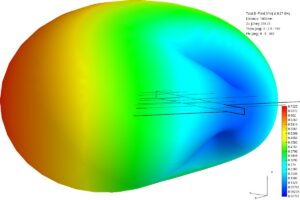
How the Elements Work Together
When you transmit a signal at a specific frequency, say 450 MHz, a specific zone of about two to three adjacent elements that are approximately resonant around that frequency springs into action. This cluster is called the “active region.” The elements in front of this region are too short to be resonant at 450 MHz and act as “directors,” while the longer elements behind it act as “reflectors.” This collaborative effect creates a focused beamwidth, typically between 60 and 80 degrees, that directs signal energy forward with a gain of 8 to 11 dBi. The precise interplay between element lengths and spacing is what allows this active region to smoothly shift along the boom as you change frequency, providing consistent performance across a 2:1 bandwidth ratio or greater.
If the longest dipole is 1 meter long, and τ is 0.85, the next dipole will be 0.85 meters long, and the spacing between them will be proportionally smaller. This geometric progression means the antenna’s electrical properties repeat periodically with the logarithm of the frequency. For a typical 12-element LPDA designed for 700-1200 MHz, the longest element will be about 21.4 cm (half-wavelength at 700 MHz), while the shortest will be around 12.5 cm (half-wavelength at 1200 MHz). The active region’s location directly correlates to the wavelength; at 800 MHz, it will be centered around the element that is roughly 18.75 cm long. The following table shows how the active region moves for different frequencies in a well-designed array.
| Operating Frequency | Approx. Active Region (Element Numbers) | Typical Element Length in Region | Effective Beamwidth |
|---|---|---|---|
| Low Band (e.g., 750 MHz) | Elements 10, 11, 12 | ~20 cm | ~75 degrees |
| Center Band (e.g., 950 MHz) | Elements 7, 8, 9 | ~15.8 cm | ~70 degrees |
| High Band (e.g., 1150 MHz) | Elements 4, 5, 6 | ~13 cm | ~65 degrees |
This cross-connected feeding introduces a 180-degree phase shift between each adjacent dipole in the active region. This phasing ensures the electromagnetic fields from the three active elements add up constructively in the forward direction (towards the shorter elements) and mostly cancel out in the reverse direction. The resulting front-to-back ratio, a measure of how well the antenna rejects signals from the rear, is typically 15 dB to 25 dB or better across the band. The input impedance is stabilized by this structure, maintaining a relatively constant 50-ohm or 75-ohm impedance.
The Role of the Feed Line
In an LPDA, the dipoles get all the visual attention, but the feed line is the unsung hero that makes the entire system work. This isn’t a standard coaxial cable; it’s a specialized parallel-wire transmission line, often with a characteristic impedance of 200 to 300 ohms, that runs the length of the boom. Its primary jobs are phasing and impedance transformation. It ensures the signal from your transmitter, typically 50 ohms, is delivered to the correct dipoles with the exact phase relationship needed to form a directional beam. A flaw in this line, like a impedance mismatch of even 10%, can degrade the antenna’s front-to-back ratio by 5 dB or more and cause the Voltage Standing Wave Ratio (VSWR) to spike above 2.0:1, reflecting over 10% of your power back towards the transmitter.
This simple cross-connection introduces a 180-degree phase shift between adjacent elements. When a signal at, say, 500 MHz is applied, the active region—comprising about three dipoles—springs into action. The feed line ensures that the signal at the second dipole in this group is 180 degrees out of phase with the first and third. This precise phasing causes the electromagnetic waves to constructively interfere in the forward direction (toward the shorter elements) and cancel out to the rear. This is what creates the antenna’s directivity, yielding a typical forward gain of 8-11 dBi and a front-to-back ratio of 15-25 dB.
The feed line acts as a distributed impedance transformer. A resonant half-wave dipole in isolation has a center-point impedance of about 73 ohms, but within the closely-coupled environment of the LPDA, the mutual coupling between elements dramatically alters this.
This impedance stability is why a well-designed LPDA can maintain a VSWR below 1.7:1 over a frequency range that is 100% or more of its center frequency. For example, an LPDA centered at 600 MHz can cover 400-800 MHz efficiently. However, this balanced 200-300 ohm feed line must be connected to an unbalanced 50-ohm coaxial cable. This requires a balun (balanced-to-unbalanced transformer). A 1:1 current balun is essential at this junction. Without it, the outer shield of the coaxial cable becomes part of the antenna, carrying RF current. This distorts the radiation pattern, reducing the front-to-back ratio to less than 10 dB, and can cause the feed line itself to radiate, leading to distorted patterns and energy loss of up to 30%. The characteristic impedance of the internal line () is a critical design parameter, calculated based on the spacing between the two wires (often 1 to 3 cm) and their diameter (typically 3-5 mm). An error of 20% in this calculation can render the entire antenna design ineffective, causing the input VSWR to exceed 3:1 and making the antenna unusable over most of its intended range.
Key Design Measurements
Designing an LPDA antenna isn’t about guesswork; it’s a precise process controlled by a few mathematical constants that determine everything from bandwidth to gain. The performance is locked in once you define three core parameters: the scaling constant (τ), the relative spacing factor (σ), and the desired bandwidth. For instance, an LPDA targeting a 2.5:1 bandwidth ratio (e.g., 400 MHz to 1000 MHz) with a gain of 9 dBi will have a specific set of τ and σ values that dictate the exact number, length, and spacing of every element. Getting these values wrong by even 5% can lead to a gain drop of 2 dB, a degraded front-to-back ratio below 15 dB, and a VSWR that peaks above 2.5:1, rendering the antenna inefficient.
- Scaling Constant (τ): This is the most important number, defining the ratio between the dimensions of successive elements. If your longest dipole is 100 cm, and τ is 0.88, the next dipole will be 88 cm long, the one after that 77.4 cm, and so on. The value of τ, typically between 0.80 and 0.98, directly trades off with performance. A lower τ value (e.g., 0.82) yields a wider bandwidth but requires fewer elements and results in lower gain, around 7-8 dBi. A higher τ value (e.g., 0.92) packs more elements into the structure, increasing the gain to about 10-11 dBi, but at the cost of a narrower usable bandwidth, perhaps only 1.7:1.
- Relative Spacing Factor (σ): This parameter sets the spacing between the elements relative to their length. It is defined as σ = (d_n) / (4 * L_n), where d_n is the distance between element n and n+1, and L_n is the length of element n. A common value for σ is between 0.04 and 0.08. A smaller σ value places elements closer together, which can improve the smoothness of the impedance transition but may reduce the overall gain by up to 0.5 dB. A larger σ value increases the boom length but can optimize the interaction between elements for peak gain. The product of τ and σ, known as τσ, is a key figure for predicting performance; an optimal design often has a τσ value around 0.06.
The number of elements (N) is not chosen independently; it’s calculated based on the desired bandwidth (B) and the chosen τ value. The formula is N = 1 + (ln(B) / ln(1/τ)). For a bandwidth of 2.5:1 and a τ of 0.88, you need approximately 1 + (ln(2.5)/ln(1/0.88)) ≈ 12 elements. The longest element must be at least a half-wavelength at the lowest operating frequency. For 400 MHz, this half-wavelength is about 37.5 cm. The shortest element must be a half-wavelength at the highest frequency; for 1000 MHz, this is 15 cm. The total boom length (L) can be estimated by summing the geometric progression of spacings: L ≈ (λ_low / 2) * (1 – τ^(-N+1)) / (1 – τ^(-1)), where λ_low is the wavelength at the lowest frequency.
For our example, the boom would be approximately 1.8 meters long. The characteristic impedance of the internal feeder line (Z_feeder) is another critical measurement, typically designed to be 200-300 ohms. This value is calculated based on the diameter of the feeder wires and the spacing between them, and it is essential for transforming the impedance of the active region down to the target 50-ohm input. A miscalculation here of just 20% can cause the input VSWR to exceed 3:1, leading to a 25% power loss.
Pros, Cons, and Comparisons
Choosing an antenna is a trade-off, and the LPDA is no exception. Its primary advantage is its exceptionally wide operating bandwidth, often achieving a 2:1 or even 3:1 frequency ratio while maintaining a consistent input impedance of 50 ohms and a VSWR typically below 1.8:1. This means a single LPDA designed for 800-2500 MHz can cover cellular bands, Wi-Fi, and GPS without needing a switch or tuner, radiating over 95% of the input power across the entire range. Its gain, while moderate, is stable; you can expect 8 to 12 dBi with less than ±1.5 dB of variation. This makes it far superior to a simple dipole, whose usable bandwidth is only about 10% of its center frequency, and more reliable than a trapped multiband antenna, which can suffer 1-3 dB of loss per trap. However, this performance comes with physical compromises. An LPDA is inherently larger and heavier than a monoband Yagi-Uda antenna for the same gain at a single frequency. A 14-element LPDA for 144-148 MHz might be 3 meters long with a gain of 9 dBi, whereas a 3-element Yagi for the same band would be only 1.2 meters long and achieve a similar gain, but would be useless outside its 5% bandwidth.
The mechanical complexity of an LPDA also impacts cost and durability. The requirement for a precisely constructed parallel-wire feed system inside the boom, alternating connections for each dipole, and a robust balun at the feed point increases manufacturing complexity. This can make a commercial LPDA 20-50% more expensive than a comparable Yagi for a single band. The larger surface area, sometimes exceeding 2 square meters, presents a significant wind load, requiring a stronger and more expensive mast capable of handling a force of over 200 Newtons in a 50 km/h wind. In terms of pattern performance, while the LPDA’s front-to-back ratio is good—generally 15-25 dB—a well-optimized multi-element Yagi can achieve a superior 25-35 dB front-to-back ratio, offering better rejection of interfering signals from the rear. The following table provides a direct comparison of key performance and physical metrics against other common antenna types for a hypothetical 400-470 MHz business band application.
| Antenna Type | Typical Gain (dBi) | Bandwidth (at VSWR<1.5:1) | Boom Length (approx.) | Key Differentiator |
|---|---|---|---|---|
| Dipole | 2.2 | ~40 MHz (~10%) | N/A | Simple, cheap, but narrowband and low gain. |
| 3-Element Yagi | 7.5 | ~10 MHz (~2.5%) | 0.8 m | Excellent gain/size for a single frequency, poor bandwidth. |
| 5-Element Yagi | 10.5 | ~8 MHz (~2%) | 1.5 m | High performance, very narrowband. |
| LPDA (9 elements) | 8.0 | >70 MHz (~16%) | 1.8 m | Wideband operation is the primary advantage. |
monitoring a single 162.400 MHz NOAA weather channel, a Yagi is unequivocally better. However, if you need to transmit and receive across a wide spectrum—such as scanning public safety channels from 450-480 MHz or covering the entire 470-862 MHz UHF TV band—the LPDA is the optimal tool. Its ±1.5 dB gain flatness ensures consistent signal strength, whereas using a discone antenna, the other common wideband choice, would mean accepting a lower gain of only 2-3 dBi, a sacrifice of 5-9 dB in signal strength. For EMI testing labs that require a single antenna to sweep from 30 MHz to 2 GHz, the LPDA’s predictable, calculable performance is worth the higher cost and size, as it provides a known, stable factor for accurate field strength measurements, with calibration data often specified to within ±0.5 dB.