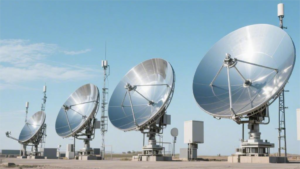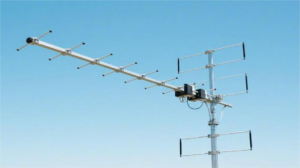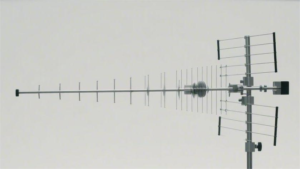
Earth station antenna sizes vary by frequency: Ku-band (12-18GHz) systems often use 1.2–4m dishes, while C-band (4-8GHz) requires larger 3–12m apertures to maintain gain for long-distance satellite signal transmission.
Table of Contents
Basic Antenna Types
For instance, a C-band (4-8 GHz) satellite link might use a 2.4-meter antenna for a decent quality signal, while a high-throughput Ka-band (26.5-40 GHz) link for in-flight internet might demand a much smaller, but more precise, 30 cm antenna on an aircraft to combat the higher free-space path loss. The most common types are parabolic reflectors (the classic “dish”), flat-panel antennas, and helix antennas, each with distinct performance trade-offs. Parabolic reflectors dominate the market for fixed ground stations larger than 1 meter in diameter, offering the best cost-to-performance ratio for high-gain applications, typically achieving 50-70% efficiency. Smaller systems, especially mobile and consumer-based (like VSAT terminals), are increasingly adopting phased-array flat-panel antennas, which are low-profile and can electronically steer beams without moving parts, though at a higher cost per unit of gain.
A standard 1.8-meter diameter dish operating at 12 GHz can achieve a gain of approximately 40.3 dBi with an efficiency of 60%. The key parameter is the f/D ratio (focal length to diameter ratio), typically between 0.3 and 0.45, which influences the positioning of the feed horn and overall efficiency. For smaller applications, like satellite TV (Direct Broadcast Satellite – DBS), offset-fed reflectors are common; these are usually 45-60 cm in diameter and operate at Ku-band (12-18 GHz), with a noise temperature of around 40-50 Kelvin for a high-quality low-noise block downconverter (LNB). At the other end of the spectrum, large C-band antennas for teleports can be 9-18 meters in diameter, with surface accuracy tolerances of less than 1 mm RMS to efficiently transmit thousands of voice and data channels.
These antennas, often less than 5 cm thick, use arrays of hundreds or thousands of tiny patch elements. A typical commercial Ka-band panel for aviation might be 60 cm x 60 cm, electronically steering its beam across a 120-degree field of view with a gain of 33-36 dBi. However, their efficiency is lower, often 40-50%, meaning a significant portion of the transmitted power is lost as heat. Helix antennas are less common for earth stations but are used for satellite telemetry, tracking, and command (TT&C) in the VHF and UHF bands (30 MHz to 3 GHz). A 10-turn helix for S-band (2 GHz) might be 30 cm tall and provide a gain of about 12 dBi with a wide beamwidth, suitable for tracking a moving satellite.
Frequency Determines Size
A dramatic real-world example is the contrast between a 2.4-meter Ku-band (12-18 GHz) VSAT dish and a massive 15-meter C-band (4-8 GHz) antenna at a teleport. Both might be designed for a similar gain of around 45 dBi, but the lower frequency C-band signal has a wavelength around 7.5 cm, compared to Ku-band’s 2.5 cm wavelength.
| Frequency Band | Typical Downlink Freq. (GHz) | Wavelength (cm) | Diameter for ~40 dBi Gain (m) | Common Application |
|---|---|---|---|---|
| C-Band | 3.7 – 4.2 | ~7.5 | 4.5 – 5.5 | Large Teleports, Cable TV Hubs |
| Ku-Band | 10.7 – 12.75 | ~2.8 | 1.2 – 1.8 | VSAT, Direct-to-Home TV |
| Ka-Band | 18.0 – 20.0 | ~1.5 | 0.6 – 0.9 | High-Throughput Satellites (HTS) |
The core physics is explained by the formula for the gain of a parabolic antenna: G = η(πD/λ)², where ‘G’ is gain, ‘η’ is efficiency (typically 50-65% for a well-designed dish), ‘D’ is the diameter, and ‘λ’ (lambda) is the wavelength. Wavelength is calculated as λ = c/f, where ‘c’ is the speed of light (300,000,000 m/s) and ‘f’ is the frequency. This means if you double the frequency (halve the wavelength), you can achieve the same gain with a dish that is half the diameter.
For instance, to get a 40 dBi gain signal at 4 GHz (C-band), you need a dish approximately 4.8 meters wide, assuming 60% efficiency. To achieve that same 40 dBi gain at 12 GHz (Ku-band), you only need a 1.6-meter dish. This is why consumer satellite TV dishes for Ku-band are so compact, typically 45-60 cm, providing ample gain (33-36 dBi) for high-quality video reception.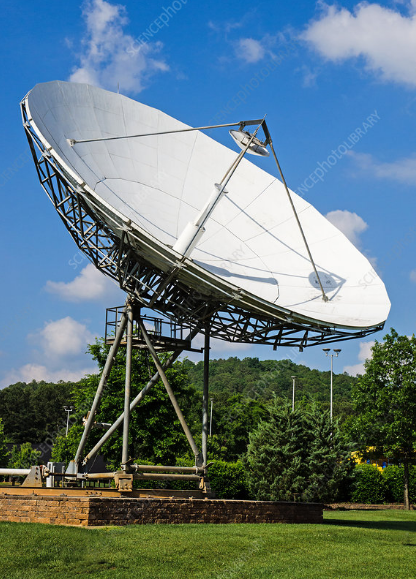
Common Size Ranges
The smallest antennas, measuring just 20 to 30 centimeters in diameter, are found on airborne platforms for Ka-band connectivity, while the largest fixed satellite teleport antennas can exceed 18 meters, costing millions of dollars. For the vast majority of commercial and industrial users, the most common sizes fall between 0.6 meters and 3.7 meters. A standard 1.8-meter Ku-band antenna, for example, is a workhorse for enterprise VSAT networks, offering a gain of approximately 42 dBi and a beamwidth of about 1.2 degrees, which is narrow enough to avoid significant interference from adjacent satellites spaced 2 degrees apart. This size provides an excellent balance between performance, cost (typically 7,000 for the antenna and RF assembly), and physical manageability for rooftop installations.
The most critical takeaway is that antenna size is not arbitrary; it is a precise engineering compromise between gain, frequency, and real-world constraints like cost, space, and wind load.
Direct-to-Home (DTH) satellite television systems almost exclusively use offset-feed parabolic dishes between 45 cm and 60 cm for Ku-band reception. These compact sizes are viable because the high-power downlink signals from broadcast satellites like DirecTV or DISH Network are designed to be received with a minimum Eb/No (energy per bit to noise power spectral density ratio) of over 6 dB using these small apertures. The gain of a 45 cm dish is roughly 33.5 dBi at 12.5 GHz, which is sufficient for decoding hundreds of digital SD and HD video channels. Moving up in size, 1.2-meter dishes are extremely common for two-way Ku-band VSAT services for small businesses and remote offices, supporting data rates from 512 kbps to 10 Mbps with availability of 99.5% or better. These systems often use a 5-watt BUC (Block Upconverter) and have a total system cost, including modem, of 10,000.
The mid-range, from 2.4 meters to 4.5 meters, is primarily the domain of C-band communications and larger enterprise or government networks. A 3.7-meter C-band antenna is a standard size for receiving and transmitting a wide range of services, from corporate data networks to video distribution. Its larger size is necessary to achieve adequate gain at lower C-band frequencies and to provide sufficient discrimination to maintain a 99.9% annual availability in regions with heavy rainfall, which attenuates signals more severely at higher frequencies. The beamwidth of a 3.7-meter antenna at 6 GHz is approximately 1.8 degrees, which helps isolate the signal from neighboring satellites.
The installed price for a robust 3.7-meter antenna system with an automatic tracking system can easily surpass $80,000. The largest antennas, 9 meters and above, are used by teleports and scientific organizations for deep-space communication or for communicating with satellites in Low Earth Orbit (LEO), requiring exceptional gain and precise 0.1-degree tracking to maintain the link.
Performance vs. Antenna Size
A 1.8-meter Ku-band antenna typically achieves a gain of 42 dBi and a 1.2-degree beamwidth, sufficient for reliable enterprise VSAT links. Simply doubling the size to a 3.6-meter antenna doesn’t just double the performance; it quadruples the effective signal collection area, boosting gain by 6 dB (to 48 dBi) and narrowing the beamwidth to approximately 0.6 degrees. This 6 dB improvement is massive—it’s equivalent to increasing the transmitter power by a factor of four without changing the antenna.
| Antenna Diameter (Ku-band) | Approx. Gain (dBi) | 3 dB Beamwidth (degrees) | Relative Cost | Typical Application |
|---|---|---|---|---|
| 0.6 m | ~35.5 dBi | ~3.2° | $ | Consumer DTH TV |
| 1.2 m | ~39.5 dBi | ~1.6° | $$ | SOHO/SMB VSAT |
| 1.8 m | ~42.0 dBi | ~1.2° | $$$ | Enterprise VSAT |
| 2.4 m | ~44.0 dBi | ~0.9° | $$$$ | High-Availability Links |
| 3.7 m | ~47.0 dBi | ~0.6° | $$$$$ | Teleport, Broadcast |
On the downlink, every 1 dB of additional gain lowers the system’s G/T (figure of merit) requirement, allowing it to lock onto weaker signals from smaller or more distant satellites. On the uplink, higher gain allows a 4-watt BUC on a 3.7-meter antenna to achieve the same effective isotropic radiated power (EIRP) as a 16-watt BUC on a 1.8-meter antenna, drastically reducing power consumption and heat generation. The second critical benefit is a narrower beamwidth.
A 1.8-meter antenna’s 1.2-degree beam is adequate for geostationary satellites spaced 2 degrees apart. However, a 3.7-meter antenna’s 0.6-degree beam significantly reduces the probability of interference from adjacent satellites to less than 1%, a necessity for carrier-grade communications and frequency coordination. This precise beam also makes the system less susceptible to terrestrial interference.
Link Budget Calculations
For example, a typical two-way Ku-band VSAT link might have a downlink budget that requires a minimum received power (C/N, carrier-to-noise ratio) of 8 dB to achieve a Bit Error Rate (BER) of 1×10⁻⁶ for a 4 Mbps data stream. If the calculation shows only 6 dB, the link will fail. The antenna’s gain is the single largest variable you can control on the ground to close this budget. A 1 dB error in your calculation can mean the difference between 99.5% availability and frequent service drops during moderate rain, which can cause a 15 dB attenuation at Ka-band.
The link budget is built by adding up all the positive and negative factors in the signal path. The core equation is: Received Power (dBW) = EIRP + Path Loss + Receiver Gain + System Losses. Here’s a breakdown of the key components with real numbers:
EIRP (Effective Isotropic Radiated Power): This is the power transmitted from the satellite toward your antenna. For a typical Ku-band transponder, this value ranges from 42 to 52 dBW. You’ll find this value in the satellite operator’s technical documentation.
Path Loss: This is the massive signal loss due to the distance to the satellite, which is ~38,500 km for a geostationary orbit. This loss is calculated as 20log₁₀(4πd/λ). For 12 GHz (Ku-band), this loss is a staggering 205.5 dB.
Receiver Gain: This is primarily your antenna’s gain. A 1.2-meter antenna might have a gain of 39.5 dBi, while a 1.8-meter antenna provides 42 dBi. This is the most critical variable you control.
System Losses: This is a catch-all category that must be meticulously accounted for. It includes:
- Feed and Waveguide Loss: Typically 0.5 to 1.0 dB of signal loss in the cables and components between the antenna and the modem.
- Antenna Mispointing Loss: Even a 0.3-degree error on a 1.8-meter antenna can cause a 0.5 dB loss. Budget 0.5 to 1.0 dB for practical alignment.
- Rain Fade Margin: This is an extra cushion of power reserved to combat signal absorption during rain. The required margin depends on your location’s rainfall statistics and the frequency. For Ku-band in a temperate climate, a 3-4 dB margin is common. For Ka-band, this margin must be 6-10 dB or higher to maintain 99.8% availability.
- Contamination Loss: Snow, ice, or dust on the antenna cover can easily add 1 to 3 dB of loss.
For instance, a DVB-S2 modem using 8PSK modulation might need an Eb/No of 6.5 dB to operate. A well-designed link will have a clear-sky Eb/No of 10 dB, providing a 3.5 dB margin before the link drops below its operational threshold. If your initial calculation doesn’t meet the target with a sufficient margin, you must increase the antenna size, use a lower-noise LNB (e.g., going from a 50K to a 35K LNB improves G/T by 1.5 dB), or accept a lower data rate.
Real-World Size Examples
A standard 45-60 cm dish is perfect for one-way TV reception, while a 3.7-meter giant is necessary for reliable, high-capacity data links in rainy climates. The key is matching the physical aperture to the application’s availability target—99.5% for a small business might be acceptable, but a bank transfer hub demands 99.99%, requiring a larger antenna or a more robust frequency band. Here’s a quick list of common pairings:
- 45-60 cm: Direct-to-Home (DTH) satellite TV reception (Ku-band)
- 1.2 – 1.8 m: Two-way VSAT for enterprise, retail, and maritime (Ku-band)
- 2.4 – 3.7 m: Corporate data networks, cellular backhaul, and video contribution (C-band)
- 60 cm – 1.2 m: In-flight connectivity and on-the-move communications (Ka-band)
- 9 m and larger: Teleport hubs, scientific deep-space communication, and LEO ground stations
The most common antenna on the planet is the 45-centimeter offset-fed dish mounted on homes for Direct-to-Home (DTH) TV. This size is standardized because broadcast satellites like SES-7 or NSS-12 are designed to transmit high-power signals (50-54 dBW EIRP) specifically for these small, low-cost terminals. The antenna provides approximately 33.5 dBi of gain at 12.5 GHz, which is just enough to deliver a clear signal-to-noise ratio (C/N > 10 dB) to the low-noise block downconverter (LNB with 40K noise temperature) for decoding MPEG-4 video. The entire consumer system, including the dish, LNB, and set-top box, has a manufactured cost of under $100, making mass deployment economically viable.
For two-way data communication, the 1.8-meter antenna is the workhorse for enterprise VSAT networks. This size is chosen because it provides the optimal balance between performance and cost for a 99.7% annual availability target in a typical temperate climate. With a gain of 42 dBi, it can effectively use a 3-watt BUC to transmit data at 10-15 Mbps on the uplink while reliably receiving signals down to a C/N of 6 dB on the downlink. The total installed cost for a commercial-grade 1.8-meter system, including a modem and professional installation, ranges from 15,000. In regions with intense seasonal rainfall, such as Southeast Asia, a 2.4-meter antenna is often the minimum recommended size for Ku-band to maintain the same 99.7% availability, as its extra 2 dB of gain provides the necessary rain fade margin without requiring a more expensive 8-watt BUC.