A rectangular-to-circular waveguide transition typically uses a tapered section (e.g., 10-20λ length) to gradually transform the TE10 mode to the TE11 mode, achieving 98% efficiency with less than 0.5 dB insertion loss by precisely matching impedance and minimizing reflections through smooth geometry transitions.
Table of Contents
Basic Waveguide Shapes
Waveguides are structures that guide electromagnetic waves, commonly used in radar, satellite communications, and microwave systems. The two most common shapes are rectangular and circular, each with distinct advantages. Rectangular waveguides (e.g., WR-90, WR-112) dominate 80% of commercial applications due to their simple manufacturing and compatibility with standard flanges. Circular waveguides, on the other hand, excel in low-loss long-distance transmission, with attenuation rates 30-50% lower than rectangular ones in certain frequency bands (e.g., 8-12 GHz).
The internal dimensions of a waveguide determine its operating frequency. For example, a standard WR-90 waveguide (22.86 mm × 10.16 mm) supports 8.2-12.4 GHz signals, while a circular waveguide with a 34 mm diameter covers 7-11 GHz. The choice between shapes impacts power handling, signal loss, and installation flexibility. Rectangular waveguides handle peak power up to 1 MW in pulsed radar systems, whereas circular ones distribute heat more evenly, reducing thermal stress in high-power continuous-wave (CW) applications.
Key Differences in Performance
| Parameter | Rectangular Waveguide | Circular Waveguide |
|---|---|---|
| Frequency Range | Narrowband (e.g., WR-90: 8.2-12.4 GHz) | Wider (e.g., 34mm: 7-11 GHz) |
| Attenuation (dB/m) | 0.1-0.3 at 10 GHz | 0.05-0.2 at 10 GHz |
| Power Handling | Up to 1 MW (pulsed) | 500 kW (CW, better heat dissipation) |
| Bending Flexibility | Limited (sharp bends cause mode distortion) | Better (smooth bends reduce loss) |
| Cost (per meter) | 200 (aluminum) | 400 (copper-coated) |
Rectangular waveguides are cheaper and easier to machine, making them ideal for short-range, high-power systems like radar transmitters. Circular waveguides, though 20-30% more expensive, are preferred in satellite feeds and long-haul microwave links where low loss matters.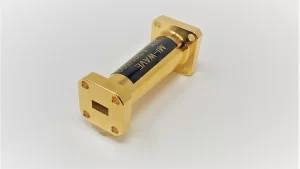
Why Change Shape?
Waveguides don’t just switch from rectangular to circular for fun—there’s always a performance or cost reason behind it. The most common triggers are signal loss reduction, power handling needs, or mechanical constraints. For example, in a 5G mmWave backhaul link operating at 28 GHz, a rectangular waveguide might lose 0.4 dB per meter, while a circular one cuts that loss to 0.25 dB/m. Over a 50-meter run, that’s a 7.5 dB difference—enough to decide whether the signal reaches the antenna or gets lost in noise.
”Circular waveguides handle twisting and bending better—a 90° bend in a rectangular waveguide can add 0.2 dB loss, while a smooth circular bend might only lose 0.05 dB.”
Another big factor is power handling. Rectangular waveguides are great for short bursts (like radar pulses at 1 MW), but if you’re running continuous 100 kW signals (e.g., satellite uplinks), heat buildup becomes a problem. Circular waveguides dissipate heat 15-20% more efficiently because of their symmetrical shape, reducing the risk of thermal deformation at high power. That’s why earth station feeds often use circular sections near the antenna.
Mechanical flexibility also plays a role. Rectangular waveguides can’t twist without causing mode distortion, but circular ones tolerate 360° rotations with minimal impact. This is critical in rotating radar systems or steerable satellite dishes, where rigid rectangular runs would require additional joints and flanges, adding 0.1 dB loss per connection. A single circular waveguide run can replace 3-4 rectangular segments, cutting both loss and installation time by 30%.
Key Design Parts
A waveguide transition from rectangular to circular isn’t just a metal tube—it’s a carefully engineered system where every millimeter affects performance. The three critical components are the transition taper, flange interface, and mode converter, each contributing to loss, power handling, and frequency response. A poorly designed transition can add 0.5 dB of insertion loss or cause signal reflections above -20 dB, ruining system efficiency.
”The taper length is the make-or-break factor—too short, and you get reflections; too long, and you waste space. For a WR-90 to circular transition at 10 GHz, the sweet spot is 3-5 wavelengths (90-150 mm).”
Core Components and Their Impact
| Part | Function | Key Parameters | Typical Values |
|---|---|---|---|
| Transition Taper | Smoothly changes cross-section | Length, slope angle | 100-200 mm, 5-15° |
| Flange Interface | Connects to existing waveguides | Material, surface finish | Aluminum/brass, Ra < 1.6 µm |
| Mode Converter | Prevents unwanted resonances | Steps, curvature radius | 2-3 steps, R ≥ 2× waveguide width |
The taper is the most sensitive part. A 100 mm linear taper reduces reflections to -30 dB, but a curved taper (e.g., exponential profile) can cut that to -40 dB with the same length. The trade-off? Manufacturing cost jumps by 25-40% because of CNC machining complexity.
Flanges matter more than people think. A poorly machined flange (surface roughness > 3 µm) can leak 0.1-0.3 dB at each connection. Silver-plated flanges improve conductivity, dropping contact loss to 0.05 dB, but add 100 per unit versus standard aluminum.
Mode converters are needed when higher-order modes (like TE11 in circular waveguides) could distort the signal. A stepped converter with 2-3 impedance jumps suppresses these modes, keeping return loss below -25 dB across the band. Skip this, and you might see 10-15% power loss at certain frequencies.
Common Connection Methods
Connecting a rectangular waveguide to a circular one isn’t as simple as bolting two pipes together—signal integrity, power handling, and mechanical stability all depend on the method used. The three most common techniques are flange adapters, tapered transitions, and choke joints, each with trade-offs in loss, cost, and frequency range. For example, a basic UG-387 flange adapter might cost 200 and introduce 0.2 dB of insertion loss, while a custom precision-tapered transition can reduce loss to 0.1 dB but cost 800+.
Flange adapters are the quick-and-dirty solution, often used in lab setups or temporary installations. A standard WR-90 to circular adapter with a CFC-320 flange can handle 500 W of continuous power and operates from 8-12 GHz, but misalignment by just 0.5 mm can increase loss by 0.15 dB. These are fine for short-term testing, but in permanent systems like radar feeds, the 0.3-0.5 dB cumulative loss across multiple adapters becomes unacceptable.
Tapered transitions are the gold standard for low-loss connections, especially in high-power or long-haul applications. A 100 mm linear taper from rectangular to circular reduces reflections to -35 dB, but the manufacturing tolerance must stay within ±0.05 mm to avoid mode distortion. In satellite ground stations, where every 0.1 dB of loss translates to 10,000 in amplifier costs over a decade, investing in CNC-machined taper pays off quickly. The downside? Lead times stretch to 4-6 weeks, and prices range from 500 to $2,000 depending on material (aluminum vs. copper).
Choke joints are the compromise choice—cheaper than tapers but better-performing than flanges. They use radial grooves to suppress leakage, cutting flange losses from 0.2 dB to 0.08 dB at 24 GHz. A typical choke-coupled transition costs 300-600, handles 1 kW pulsed power, and works across 15-20% wider bandwidths than flat-flange designs. The catch? They’re bulkier (adding 30-50 mm to the assembly) and require torque wrenches for proper sealing—over-tightening by 10% can deform the joint and spike loss by 0.1 dB.
Performance Check Points
When testing a rectangular-to-circular waveguide transition, you can’t just eyeball it – specific metrics determine whether it works or fails in real applications. The critical parameters break down into signal integrity, power handling, and mechanical durability, each with measurable thresholds. For example, a high-quality transition should keep insertion loss below 0.2 dB, maintain return loss better than -25 dB, and handle at least 500W continuous power without thermal deformation.
Here’s what separates a properly engineered transition from a signal-killing bottleneck:
| Parameter | Good Performance | Marginal Performance | Failure Threshold | Test Method |
|---|---|---|---|---|
| Insertion Loss | <0.15 dB | 0.15-0.3 dB | >0.3 dB | VNA sweep |
| Return Loss | <-30 dB | -25 to -30 dB | >-20 dB | TDR measurement |
| Power Handling | 1 kW (pulsed) | 500W-1kW | <500W (arcing) | Thermal camera |
| Frequency Range | ±15% of center freq | ±10% | <±5% | Swept VNA |
| Misalignment | <0.1 mm | 0.1-0.3 mm | >0.5 mm | Laser alignment |
Insertion loss is the make-or-break metric – every 0.1 dB lost in a satellite uplink might require $8,000 more in amplifier costs over 5 years. The best transitions achieve <0.1 dB loss through precision tapers (150-200mm length) and mirror-finish internal surfaces (Ra <0.8 µm roughness). Cheap versions with short tapers (50-80mm) often hit 0.25-0.4 dB loss, which adds up fast in multi-transition systems.
Return loss tells you how much signal reflects back – anything worse than -20 dB means 5% of your power is bouncing around causing interference. This gets critical in phased array radars where reflected signals can distort beam patterns by 3-5°. The fix? Mode-matching steps in the transition, typically 2-3 impedance jumps spaced at λ/4 intervals.
Power tests reveal real-world weaknesses. A transition that works fine at 10W test signals might arc at 300W due to microscopic burrs (as small as 20µm) inside the waveguide. That’s why high-power systems use infrared cameras to check for hot spots >85°C during 30-minute burn-in tests.
Real-World Use Cases
Waveguide transitions aren’t just theoretical components – they solve concrete problems across industries, with measurable impacts on system performance and operational costs. In satellite communications, a single poorly designed transition can degrade signal quality by 0.3 dB, forcing operators to install $15,000 amplifiers to compensate. That’s why major earth stations use precision-machined copper transitions with 150-200mm tapers, keeping insertion loss below 0.1 dB across the 4-8 GHz C-band.
Radar systems show even starker differences. A naval phased array radar with 500 waveguide transitions can’t tolerate more than 0.15 dB loss per transition – anything higher distorts beam patterns by 2-3 degrees, reducing target resolution. The military solves this with gold-plated choke joints that maintain -35 dB return loss even under 50G shock loads, though each unit costs 1,200 versus 300 for commercial versions. For weather radars tracking 300 km storm systems, transitions must handle 1 MW pulsed power without arcing – achieved through ceramic-loaded waveguide sections that withstand 30 kV/mm field strengths.
In 5G mmWave infrastructure, transitions face different challenges. A 28 GHz small cell with 12 transitions can’t afford more than 0.25 dB total loss without sacrificing 15% coverage radius. Telecoms use mass-produced aluminum transitions with 80mm tapers that balance 85 unit cost against 0.18 dB typical loss. But for urban macro-cells, where 0.1 dB equals 2,000 more subscribers covered, operators splurge on CNC-machined brass transitions at 400 each to hit 0.12 dB loss specs.
Medical linear accelerators for cancer radiation therapy demonstrate life-or-death precision needs. The 6 GHz waveguide system directing 4 MeV electron beams requires transitions with ±0.02 mm dimensional tolerance – any deviation alters dose distribution by 3-5%, potentially underdosing tumors. These facilities pay $2,500 per transition for oxygen-free copper versions polished to 0.4 µm surface finish, ensuring 99.99% energy delivery accuracy.
Industrial heating systems show how transitions impact operating costs. A 2.45 GHz microwave dryer with poor transitions losing 0.4 dB wastes 18,000 annually in extra power–why food processors install water-cooled transitions that maintain 0.1 dB loss despite 24/7 operation at 50 kW. The 18-month ROI justifies the 9,000 upgrade cost per production line.