A waveguide assembly is a hollow metallic or dielectric structure that transmits microwave signals with minimal loss, typically handling frequencies from 1 to 110 GHz and power levels up to several kilowatts. It functions by precisely confining and guiding electromagnetic waves between components like antennas and transceivers.
Table of Contents
Why Use Waveguides Instead of Cables?
At 10 GHz, a standard rectangular waveguide (like WR-90) has about 0.01 dB/m loss versus 0.5 dB/m for coaxial cable (RG-214). Waveguides work efficiently from 1-100+ GHz handling kilowatts of power, while cables typically max out below 18 GHz with lower power capacity. This makes waveguides ideal for radar systems (X-band: 8-12 GHz) and satellite communications where low loss and reliability matter most.
Frequency Range Differences
Waveguides and cables handle frequencies differently due to their fundamental physics, impacting their use in 5G, satellite, and radar systems.
How Waveguides Work Differently
Coaxial cables use TEM mode, carrying signals from DC up to a maximum frequency where problems occur. Waveguides use TE or TM modes with a critical cut-off frequency:
- Cut-off definition: The lowest frequency (fc) where signals can travel through the waveguide. Below this, signals fade quickly.
- Key difference: Waveguides act like band-pass filters with both lower and upper frequency limits.
The cut-off frequency for the main mode (TE10) in rectangular waveguides depends on width ‘a’:
fc(GHz) ≈ 15 / a(cm)
For WR-90 waveguide (X-band):
fc ≈ 15 / 2.286 cm ≈ 6.56 GHz
Meaning WR-90 can’t carry signals below 6.56 GHz effectively.
What Limits the High End
Waveguides’ upper frequency isn’t limited by loss but by higher-order modes (like TE20, TE01). When these extra modes appear (multimoding), they cause signal distortion and power loss as energy splits between modes traveling at different speeds.
- The practical upper frequency is typically twice the TE10 cut-off frequency
- Thus, standard rectangular waveguide bandwidth is about one octave (upper frequency = 2 × lower frequency)
Common waveguide examples:
| Waveguide Type | Frequency Range (GHz) | Cut-off (GHz) | Band Name | Width (mm) |
|---|---|---|---|---|
| WR-430 | 1.70 – 2.60 | 1.37 | L-band | 109.22 |
| WR-284 | 2.60 – 3.95 | 2.08 | S-band | 72.14 |
| WR-137 | 5.85 – 8.20 | 4.64 | C-band | 34.85 |
| WR-90 | 8.20 – 12.40 | 6.56 | X-band | 22.86 |
| WR-62 | 12.40 – 18.00 | 9.49 | Ku-band | 15.80 |
| WR-42 | 18.00 – 26.50 | 14.05 | K-band | 10.67 |
| WR-28 | 26.50 – 40.00 | 21.08 | Ka-band | 7.11 |
| WR-15 | 50.00 – 75.00 | 39.87 | V-band | 3.76 |
| WR-10 | 75.00 – 110.00 | 59.01 | W-band | 2.54 |
Bandwidth Comparison
Coaxial cables offer wider bandwidth (DC to max frequency), with one cable covering 0-18 GHz. But this advantage diminishes because:
- Loss increases with frequency: Cable loss grows with √f due to skin effect. A cable with 0.5 dB/m loss at 10 GHz might have 1.2 dB/m at 18 GHz.
- Signal distortion: Propagation speed varies with frequency in cables, distorting high-speed digital signals.
Waveguides have flatter loss within their band, with loss decreasing as frequency increases (following ~1/√f), opposite to cables.
Why Limited Bandwidth Works
Waveguides’ limited bandwidth is often acceptable because:
- Frequency allocations: Many systems use specific bands (e.g., radar in 8-12 GHz)
- System design: Complex systems use separate modules for different bands
- Mode control: Single-mode operation ensures predictable performance
Signal Loss Comparison
Signal loss (attenuation) critically impacts system design. Waveguides and cables lose signal differently, creating performance gaps at high frequencies.
Why Loss Happens
Cable loss mechanisms:
- Conductor loss: Increases with √f due to skin effect
- Dielectric loss: Increases linearly with f
Total cable loss: αcoax ≈ k1√f + k2f
Waveguide loss mechanisms:
Dominantly conductor loss since air dielectric has minimal loss. For TE10 mode:
αwg ≈ [Rs/(ηb)] × [1/√(1-(fc/f)2)] × [1 + (a/(2b))(fc/f)2]
Where Rs ∝ √f, η = free space impedance
Key point: Above cut-off, waveguide loss decreases with frequency (~1/√f)
Real-World Loss Comparison
| Transmission Line | 5 GHz Loss | 10 GHz Loss | 30 GHz Loss | 60 GHz Loss |
|---|---|---|---|---|
| Coax (0.141″) | ~1.0 dB/m | ~1.5 dB/m | ~3.0 dB/m | N/A |
| Low-Loss Cable | ~0.22 dB/m | ~0.35 dB/m | ~0.80 dB/m | N/A |
| WG WR-137 | N/A | ~0.06 dB/m | N/A | N/A |
| WG WR-90 | N/A | ~0.11 dB/m | N/A | N/A |
| WG WR-28 | N/A | N/A | ~0.20 dB/m | N/A |
| WG WR-15 | N/A | N/A | N/A | ~0.40 dB/m |
Practical impact:
- At 10 GHz: 10m cable loses 3.5 dB vs 1.1 dB for waveguide
- At 60 GHz: Waveguides are essential while cables fail
Power Handling Capabilities
Power capacity often determines choice between waveguides/cables for radar, broadcast, and accelerators.
Peak Power Limits
Cable limitations:
- Limited by dielectric breakdown
- Small conductor separation restricts power
Waveguide advantages:
- Air dielectric handles higher voltages
- Larger dimensions increase breakdown threshold
Peak power comparison:
| Component | Frequency Band | Peak Power |
|---|---|---|
| Coax (0.141″) | DC-18 GHz | 1-2 kW |
| N-Type Coax | DC-6 GHz | 5-10 kW |
| WG WR-90 | 8-12 GHz | >500 kW |
| WG WR-284 | 3-4 GHz | >2 MW |
Continuous Power Handling
Cable thermal limits:
- Center conductor overheating
- Poor heat dissipation through dielectric
Waveguide advantages:
- Distributed currents reduce heating
- Metal walls act as heat sinks
- Supports active cooling methods
Average power comparison:
| Component | Frequency | Avg Power |
|---|---|---|
| LMR-400 Cable | DC-6 GHz | ~1 kW |
| Large Coax Line | <4 GHz | ~10 kW |
| WG WR-90 | 8-12 GHz | 2-5 kW |
| WG WR-284 | 3-4 GHz | 10-20 kW |
Pressurization Benefits
Pressurizing with dry air or SF6 gas:
- Prevents moisture and corrosion
- Boosts power capacity 2-3x
- Standard practice for high-power radar
Main Parts of a Waveguide Assembly
The core is the rigid waveguide, a rectangular or circular hollow metallic tube, typically aluminum or copper, with internal dimensions critically tuned to specific frequency bands (e.g., a WR-90 waveguide for 8.2-12.4 GHz). This core is connected via standardized flanges (like UG-39/U) to ensure alignment and prevent leakage. To navigate physical layouts, assemblies incorporate precisely calculated bends (90° E-plane or H-plane) and twists (45° or 90°). Flexible waveguide sections, with typical insertion loss of <0.5 dB, accommodate misalignment. Finally, hermetically sealed assemblies are often pressurized with dry nitrogen or SF6 gas to >2 PSI to prevent moisture ingress and power arcing, which is critical for maintaining a Voltage Standing Wave Ratio (VSWR) of <1.10:1.
The Waveguide Pipe
The waveguide is the fundamental component of the assembly, a precision-engineered hollow pipe responsible for confining and directing electromagnetic energy. Its operation is governed by the principles of electromagnetic field theory, where energy propagates via reflection from the inner walls in specific, well-defined patterns known as modes. Unlike a simple pipe, a waveguide’s geometry, material composition, and internal surface finish are critically engineered to minimize energy loss, control propagation characteristics, and handle specified power levels. The design choices made here dictate the assembly’s fundamental frequency range, efficiency, and power handling capability.
1. Basic Physics and How Waves Travel
A waveguide functions as a high-pass filter; it will not propagate energy below a specific cutoff frequency, which is determined by its internal cross-sectional dimensions.
- Cutoff Frequency Calculation: For the dominant and most common mode, TE10 (Transverse Electric), in a rectangular waveguide, the cutoff wavelength (λc) is given by λc = 2a, where ‘a’ is the broader internal dimension. The cutoff frequency (fc) is then fc = c / λc, where ‘c’ is the speed of light. For example, a standard WR-90 waveguide, used in X-band, has an internal dimension of a = 0.9 inches (22.86 mm). This yields a theoretical cutoff frequency of approximately 6.56 GHz, with a practical operating range of 8.2 to 12.4 GHz.
- Modes of Operation: While the TE10 mode is standard, higher-order modes (TE20, TE11, TM11, etc.) can propagate at higher frequencies. The existence of these modes is often undesirable as they can cause signal distortion and power loss. The waveguide dimensions are therefore selected to ensure only the desired mode propagates within the intended frequency band, a principle known as “single-mode operation.” The maximum frequency for single-mode operation is typically just below the cutoff frequency of the second propagating mode.
2. Choosing the Right Materials
The choice of material is a critical trade-off between electrical performance, mechanical properties, environmental resistance, and cost. The primary mechanism of loss in a waveguide is resistive loss in the conductive walls, which is quantified by the material’s conductivity.
- Electrical Conductivity: This is the most critical property. Loss is inversely proportional to the surface conductivity of the material. Conductivity is often expressed as a percentage of the International Annealed Copper Standard (% IACS), where copper is defined as 100% IACS.
- Thermal Management: The coefficient of thermal expansion (CTE) is vital for systems that experience temperature fluctuations. A mismatch in CTE between joined components can induce stress and compromise mechanical integrity and electrical performance. Thermal conductivity is also crucial for dissipating heat generated by ohmic losses, especially in high-power applications.
The following table provides a quantitative comparison of common waveguide materials:
| Material | Conductivity (% IACS) | Density (g/cm³) | CTE (10⁻⁶/°C) | Primary Application & Rationale |
|---|---|---|---|---|
| Aluminum 6061-T6 | ~43% | 2.7 | 23.6 | Most common general-purpose choice. Excellent strength-to-weight ratio, good machinability, and low cost. Often used with alodine or chromate conversion coating for corrosion protection. |
| Copper C101/C102 | 101% (>100% due to purity) | 8.96 | 17.0 | Low-loss applications. Offers the lowest attenuation but is heavy and expensive. Often used in high-performance systems where minimal loss is paramount. |
| Silver-Plated Copper | ~105% (at the surface) | 8.96 | 17.0 | Premium low-loss/high-power applications. The silver plating (typically 0.0001″ – 0.0003″ thick) provides a surface conductivity higher than copper, excellent oxidation resistance, and a smooth surface finish, which is critical for high-power handling. |
| Invar 36 | ~2.5% | 8.0 | 1.2 | Precision space-borne systems. Selected exclusively for its near-zero CTE. This dimensional stability across extreme temperature cycles (e.g., -170°C to +120°C in orbit) is more important than its poor conductivity. Attenuation is high, but performance is predictable. |
| Brass 360 | ~28% | 8.5 | 20.5 | Complex machined components (e.g., bends, twists). Chosen for its excellent machinability and good corrosion resistance, despite its higher loss compared to aluminum or copper. |
3. How Waveguides Are Made and Surface Quality
The internal surface of the waveguide is as important as the material itself. Surface roughness and imperfections create obstacles for the propagating electromagnetic field, increasing attenuation and reducing power handling capability.
- Forming Processes:
- Extrusion: The most common and cost-effective method for producing long, straight lengths of rectangular waveguide. Aluminum is particularly well-suited to this process. Dimensional tolerances are typically held within ±0.001 inches (±25 µm).
- Electroforming: A precision additive process where metal (usually copper) is deposited onto a mandrel in an electroplating bath. This produces an exceptionally smooth internal surface finish (better than 8 µin or 0.2 µm Ra) and allows for complex geometries. It is used for high-frequency and double-ridge waveguides where tight tolerances are critical.
- Surface Finish Specification: The internal surface roughness is a key specification, measured in micro-inches (µin) or micrometers (µm) Ra (Arithmetic Average). A standard finish might be 32 µin (0.8 µm) Ra, while a high-performance finish would be 16 µin (0.4 µm) Ra or better. A rough surface can increase attenuation by 10-15% compared to a theoretically perfect surface.
Flanges
In a waveguide system, the flange is far more than a simple mechanical coupling; it is a precision radio-frequency (RF) interface whose quality directly dictates the overall electrical performance of the assembly. An imperfect junction between waveguide sections acts as a significant impedance discontinuity, reflecting a portion of the transmitted power back toward the source. This reflected power, measured as Voltage Standing Wave Ratio (VSWR), reduces system efficiency, generates heat, and can potentially damage sensitive transmitter components. Therefore, the design, manufacture, and mating of waveguide flanges are governed by exacting standards and tolerances to ensure a seamless electrical path, making them one of the most critically engineered components in the entire RF chain.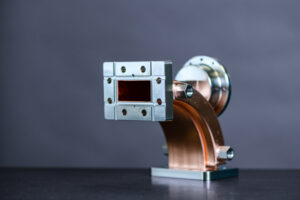
1. Why Precision Matters
The primary goal of a flange connection is to create the illusion of a continuous, unbroken waveguide. Any deviation from perfect continuity—a gap, a misalignment, or a surface irregularity—disrupts the electromagnetic field pattern.
- Flatness: The sealing surface of a flange must be exceptionally flat to prevent RF leakage. For standard flanges, flatness is typically specified to be within 0.0001 inches (2.54 micrometers). For high-frequency and millimeter-wave flanges (e.g., above 40 GHz), this requirement can be tightened to 0.00005 inches (1.27 micrometers) or better. Flatness is measured using optical flats or high-precision coordinate measuring machines (CMM).
- Surface Finish: The roughness of the mating surface is equally critical. A rough surface creates countless microscopic air gaps, which act as parasitic capacitors, increasing loss and raising VSWR. The surface finish is measured in microinches (µin) Arithmetical Average Roughness (Ra). A standard commercial finish is 32 µin (0.8 µm) Ra, while a high-performance finish for critical applications is 16 µin (0.4 µm) Ra or smoother. This is achieved through precision grinding and polishing processes.
- Dowel Pin Alignment: The alignment of the internal waveguide apertures is paramount. Misalignment, particularly a lateral offset, creates a step discontinuity that severely degrades VSWR. Hardened steel dowel pins and reamed holes are used for this purpose, with diametrical tolerances held within +0.0002/-0.0000 inches (+5.08/0 µm) to ensure a slip-fit that prevents “stubbing,” where forced misalignment during bolting can physically damage the waveguide opening.
2. A Look at Different Flange Types
The choice of flange is a systems engineering decision based on frequency, power, environmental conditions, and required reliability.
A. Cover Flange (CPR/CMR – Contact Plane/Contact Matched)
- Principle: Relies on direct, intimate metal-to-metal contact. It is the simplest design but offers no tolerance for separation or surface contamination.
- VSWR Performance: Under ideal conditions (perfectly clean, flat surfaces torqued correctly), VSWR is exceptional, typically < 1.02:1 across the band.
- Vulnerability: A gap of just 0.001 inches (25.4 µm) can degrade VSWR to 1.10:1 or worse. Dust, scratches, or oxidation on the mating surface have an immediate and significant negative impact.
- Application: Primarily used in controlled laboratory environments, test benches, and as hermetic end-seals for pressurized systems.
B. Choke Flange
- Principle: Incorporates an annular groove (the choke) machined to a precise depth of one-quarter of the guide wavelength (λg/4) at the center operating frequency. This groove acts as a short-circuited radial transmission line. A wave leaking across an inevitable small air gap travels λg/4 down and λg/4 back, a total of λg/2, which corresponds to a 180-degree phase shift. This phase-inverted wave cancels the wave leaking across the gap, creating a highly effective virtual short circuit at the aperture.
- Resilience: This design can tolerate an air gap of up to 0.005 inches (127 µm) while maintaining a VSWR of better than 1.05:1. It is inherently forgiving of thermal expansion, vibration, and minor surface imperfections.
- Tolerance Sensitivity: The choke depth is critical. A 5% error in depth can detune the choke, reducing its effectiveness by more than 50%. The machining tolerance for the groove depth is often held to within ±0.0001 inches (±2.5 µm).
- Application: The standard for high-power radar, satellite communication earth stations, and any system subject to outdoor environmental stress.
C. UG Style Flanges (e.g., UG-39/U)
- Standardization: Defined by military standards (e.g., MIL-DTL-392), UG flanges specify dimensions, bolt patterns, and performance for interoperability. They typically use a square or rectangular format with a four-bolt pattern.
- Torque Specifications: Proper mating is achieved by applying a specified torque to the coupling nuts or bolts, typically in the range of 120 to 180 pound-force inches (13.6 to 20.3 Newton-meters). This ensures sufficient pressure for a gas-tight seal without warping the flange.
- Sealing Methods: They can be implemented as:
- Metal-to-Metal: Like a cover flange.
- O-Ring Sealed: Incorporates a resilient elastomer O-ring (e.g., Viton, Silicone) in a groove for superior environmental sealing.
- Induction Sealed: Uses a soft metal gasket (e.g., annealed copper) that deforms to fill microscopic imperfections, offering the best possible seal for high-vacuum or high-pressure systems.
- Application: The workhorse for military and aerospace systems, including aircraft radars, shipboard systems, and ground vehicles.
D. Flanges for High Frequencies (OML, PBR, Millimeter-Wave)
- Design Challenge: As frequencies enter the millimeter-wave regime (Ka-band, 26-40 GHz, and beyond), wavelengths shrink to a few millimeters, making dimensional tolerances proportionally more critical.
- Connection Mechanism: Moves away from bolts to avoid torsional strain on tiny waveguide channels. Axial screws or quick-connect (push-on) mechanisms are standard.
- Alignment: Uses a precision piloted boss-and-recess design instead of dowel pins, with concentricity tolerances better than 0.0002 inches (5 µm).
- Performance: Achieving a VSWR below 1.20:1 at 110 GHz is considered excellent. Repeatability, defined as the variation in electrical performance over multiple connections, is a key metric, often specified for >500 mating cycles.
Bends and Twists
In any practical waveguide system, the requirement for a perfectly straight, unobstructed RF path is a luxury that seldom exists. The physical constraints of platforms—be it an aircraft radome, a satellite payload, or a base station tower—demand that the waveguide assembly navigate around structural members, other subsystems, and tight spaces. Bends and twists are the specialized components that enable this routing. However, unlike a simple plumbing elbow, a waveguide bend or twist is a critical impedance-matching network. An improperly designed curvature will cause a significant portion of the transmitted energy to reflect back toward the source, degrading system performance and potentially causing damage.
1. Key Challenge
The core principle governing the design of bends and twists is the maintenance of a constant characteristic wave impedance throughout the component. Any abrupt change in the waveguide’s geometry creates an abrupt change in impedance, leading to reflection. The goal is to make the transition as smooth, or “gradual,” as possible within the spatial constraints allowed.
- The Concept of Swept Bends: A sharp, mitered corner in a waveguide would be catastrophic for RF propagation. Instead, bends are always “swept,” meaning they have a continuous, curved profile. The critical design parameter is the radius of curvature (R). A larger radius results in a smoother transition and better electrical performance but requires more physical space.
- The Minimum Bending Radius: The bending radius is not arbitrary; it is directly related to the guide wavelength (λg). A standard design rule is that the mean radius of the bend should be no less than two to three times the guide wavelength at the operating frequency (R ≥ 2λg to 3λg). For a WR-90 waveguide at 10 GHz (where λg is approximately 4.0 cm), the minimum radius would be about 8-12 cm. Violating this rule leads to increased mode conversion and higher VSWR.
2. A Look at Waveguide Bends
Waveguide bends are categorized based on the plane in which the bending occurs relative to the dominant TE10 mode’s electric (E) and magnetic (H) fields.
A. E-Plane Bend (H-Bend)
- Geometry: This bend curves the waveguide in the plane parallel to the E-field vector. In a rectangular waveguide, this is the plane containing the narrow wall dimension (‘b’ dimension). The bend occurs along the shorter side.
- Electrical Characteristics: The E-plane bend is more critical to design correctly than an H-plane bend. Because the bend compresses and expands the path of the electric field lines, it is more susceptible to exciting higher-order modes and causing significant reflections if the radius is too small.
- Performance Specifications: A well-designed E-plane bend with an adequate radius will have a very low VSWR, typically specified as < 1.05:1 across the designated frequency band. The additional attenuation introduced by the bend itself is negligible, often less than 0.05 dB.
- Application: Used when the routing necessitates a bend in the “vertical” plane (relative to the waveguide’s broad wall orientation).
B. H-Plane Bend (E-Bend)
- Geometry: This bend curves the waveguide in the plane parallel to the H-field vector. This is the plane containing the broad wall dimension (‘a’ dimension). The bend occurs along the wider side.
- Electrical Characteristics: The H-plane bend is generally more forgiving and easier to design than an E-plane bend. The perturbation of the field is less severe, allowing for a slightly tighter bend radius for an equivalent VSWR performance compared to an E-plane bend.
- Performance Specifications: A standard H-plane bend can achieve a VSWR of < 1.03:1 with a radius satisfying the R > 2λg rule. The insertion loss is, for practical purposes, immeasurable in most systems (<0.02 dB).
- Application: Used when the routing necessitates a bend in the “horizontal” plane.
Comparing E-Plane and H-Plane Bends
| Parameter | E-Plane Bend | H-Plane Bend |
|---|---|---|
| Bending Plane | Plane of the Electric Field (narrow wall) | Plane of the Magnetic Field (broad wall) |
| Design Criticality | More Critical | Less Critical |
| Typical Minimum Radius | R ≥ 2.5λg to 3λg | R ≥ 2λg |
| Typical VSWR | < 1.05:1 | < 1.03:1 |
| Primary Challenge | Managing E-field compression/expansion to avoid mode conversion. | Managing the path length difference between inner and outer walls. |
3. Understanding Twists
A waveguide twist performs a function distinct from a bend: it rotates the polarization of the electromagnetic wave. In a rectangular waveguide supporting the TE10 mode, this means rotating the orientation of the E-field vector.
- Purpose: Twists are essential for aligning the polarization plane between two components that cannot be physically oriented in the same direction. For example, a radar feed horn may need to be mounted vertically while the transmitter output is horizontally polarized. A 90-degree twist would correct this.
- Design Principle: Like bends, twists must be gradual. A “linear twist” rotates the waveguide along its longitudinal axis at a constant rate. The key parameter is the twist rate, usually expressed as degrees of rotation per unit length (e.g., degrees per centimeter). A typical specification requires the twist to be gradual enough to avoid polarization mode conversion, which can create an unwanted orthogonal signal.
- Performance Metrics: The primary performance metric for a twist is polarization purity or cross-polarization discrimination. This is measured in decibels (dB) and indicates how much the unwanted cross-polarized signal is attenuated relative to the desired signal. A high-quality twist will have a cross-polarization discrimination better than 30 dB. This means the power in the incorrect polarization is at least 1000 times weaker than the power in the correct polarization. The VSWR of a good twist is comparable to a straight section of waveguide, typically < 1.02:1.
What Waveguide Assemblies Are Used For
Waveguide assemblies are critical components in systems requiring efficient, high-power transmission of microwave and radio frequency (RF) signals, typically operating within the frequency range of 2 GHz to over 110 GHz. Their primary value lies in achieving exceptionally low transmission loss, often less than 0.1 dB per meter, and handling power levels exceeding several megawatts in pulsed operation, which is unattainable with coaxial alternatives. This makes them indispensable in defense, aerospace, telecommunications, and scientific research sectors, where signal integrity and power capacity are paramount.
Radar Systems
Waveguide assemblies are not merely components within radar systems; they are the fundamental arterial network that enables these systems to function. They serve as the high-integrity pathway for electromagnetic energy, connecting the high-power transmitter to the antenna and channeling faint return echoes back to the sensitive receiver. The extreme performance requirements of modern radar—encompassing peak power, frequency bandwidth, signal integrity, and environmental resilience—make waveguide technology indispensable, outperforming alternative transmission lines like coaxial cables in nearly all high-power, high-frequency applications.
How Waveguides Work in Radar and Why They’re Better
The primary role of a waveguide assembly in a radar is to transport Radio Frequency (RF) energy from the transmitter—often located in an equipment room—to the antenna feed, which is typically mounted on a pedestal or integrated into a phased array. This journey is critically bidirectional:
- Transmit Path: The waveguide carries high-power, short-duration pulses from the transmitter to the antenna. For long-range surveillance and fire-control radars, these pulses can have peak power ratings ranging from several hundred kilowatts to multiple megawatts.
- Receive Path: The same waveguide, via a duplexer, then carries the incredibly weak signals reflected from targets back to the highly sensitive receiver. The attenuation (signal loss) of the waveguide is arguably its most critical parameter. While a typical coaxial cable might exhibit a loss of 0.5 dB per meter or more at X-band frequencies (8-12 GHz), a rectangular waveguide of the same length would have a loss of approximately 0.03 dB to 0.1 dB. This low loss directly translates to greater detection range, better target discrimination, and overall system efficiency.
The following table illustrates the performance gap between coaxial cables and waveguides across key radar parameters:
| Parameter | High-Performance Coaxial Cable (e.g., ½” Heliaxial) | Standard Rectangular Waveguide (WR-90 for X-band) | Advantage for Radar |
|---|---|---|---|
| Operating Frequency | DC to 18 GHz (with increasing loss) | 8.2 – 12.4 GHz (cutoff frequency dependent) | Waveguide is optimized for a specific band. |
| Attenuation (@ 10 GHz) | ~0.5 dB/meter | ~0.07 dB/meter | Waveguide preserves signal strength over long runs. |
| Peak Power Handling | ~10s of kW | > 1 MW | Waveguide essential for high-power radar transmitters. |
| Average Power Handling | ~kW | > 10 kW | Waveguide dissipates heat more effectively. |
| Phase Stability | Susceptible to flexure and temperature | Highly stable and rigid | Waveguide is critical for phase-coherent systems. |
Waveguides in Different Types of Radar
The design of a waveguide assembly is heavily tailored to the specific radar platform and its mission.
1. Naval Radar Systems (e.g., AEGIS Combat System)
Naval radars, such as the AN/SPY-1 used in the AEGIS system, represent one of the most demanding environments. These systems use phased-array antennas with thousands of individual elements. Waveguide assemblies are used in two primary ways:
- Feed Network: Behind the array, a complex network of waveguide power dividers and phase shifters distributes the RF energy to each radiating element. This network must maintain precise amplitude and phase relationships to electronically steer the radar beam.
- Primary Transmission Line: The generated RF power is routed from below-deck transmitter rooms to the antenna arrays mounted on the ship’s superstructure. These waveguide runs can be tens of meters long and must be pressurized with dry air or nitrogen to prevent internal arcing at high power levels in humid, salt-laden marine environments. The assemblies are manufactured from corrosion-resistant aluminum or copper alloys and feature robust, sealed flanges to withstand the harsh conditions.
2. Air Traffic Control (ATC) and Long-Range Surveillance Radars
Civilian and military surveillance radars, such as the ASR-9 (Airport Surveillance Radar) and the TPS-59, are critical for airspace management. They are typically housed in radomes on tall towers.
- Function: The waveguide assembly acts as the rigid, low-loss feeder line connecting the transmitter/receiver shelter at the base of the tower to the antenna assembly rotating at the top.
- Design Considerations: The assembly often includes a rotating joint—a precision mechanical component that allows the waveguide to transmit RF energy continuously as the antenna rotates 360 degrees. These joints are engineered for minimal electrical reflection and long-term mechanical reliability, often specified for tens of thousands of hours of operation without failure. The waveguides used are typically optimized for L-band (1-2 GHz) or S-band (2-4 GHz) frequencies, balancing long-range performance with antenna size.
3. Airborne Fire-Control Radars (e.g., AN/APG-77/81)
In fighter aircraft like the F-22 Raptor and F-35 Lightning II, space and weight are at a premium. The radars are active electronically scanned arrays (AESAs), where the transmitter/receiver functionality is distributed across the array.
- Role of Waveguide: While the final transmission is handled by integrated modules, waveguide components are often used within the array’s “backplane” to distribute a stable, low-power reference signal or a high-power pump signal to traveling-wave tube amplifiers (TWTAs). These waveguides are often miniaturized and made from lightweight, high-strength materials like beryllium copper to survive extreme vibration, shock, and temperature cycles experienced in flight.
4. Weather Radar (NEXRAD)
The WSR-88D (NEXRAD) network uses S-band (2.7-3.0 GHz) frequencies to penetrate intense weather phenomena with minimal attenuation.
- Why Waveguide? The long-range requirement (over 250 km) and the need to accurately measure differential reflectivity and Doppler shifts in precipitation demand an ultra-stable, low-loss transmission line. The large, circular waveguides used in these systems ensure that the multi-megawatt peak power pulses are delivered to the antenna with maximum efficiency, allowing meteorologists to discern between rain, hail, and tornado debris signatures.
In summary, across every domain—land, sea, and air—the waveguide assembly is a critical enabling technology for radar. Its unparalleled ability to handle high power with minimal loss makes it the definitive solution for missions where detection range, signal clarity, and system reliability are non-negotiable.
Satellite Communications
In satellite communications, the margin for error is infinitesimally small, and the cost of failure is astronomically high. Waveguide assemblies are mission-critical components in this domain, forming the reliable conduits for signals that travel thousands of kilometers through the vacuum of space. Their application is bifurcated, yet equally vital, in both the massive ground segment on Earth and within the sophisticated payloads of the satellites themselves in geostationary (GEO), medium Earth orbit (MEO), or low Earth orbit (LEO). The selection of waveguide technology over alternatives is driven by a uncompromising requirement for ultra-low signal loss, exceptional power handling, and supreme signal purity, characteristics essential for maintaining the integrity of critical communication, broadcast, and data relay links.
1. Ground Segment
Teleports and gateway stations are the terrestrial interfaces for satellite networks. These facilities feature large parabolic antennas, often exceeding 11 meters in diameter, which require the highest possible efficiency in both transmitting (uplink) and receiving (downlink) signals.
- Uplink Transmission: The primary role of the waveguide here is to carry high-power, continuous-wave signals from the ground-based high-power amplifiers (HPAs), such as Klystrons or Traveling-Wave Tube Amplifiers (TWTAs), to the antenna’s feed horn. A typical C-band (6 GHz) or Ku-band (14 GHz) uplink might require hundreds of watts to several kilowatts of power. The low attenuation of a waveguide (e.g., < 0.05 dB/m at Ku-band) is crucial; every tenth of a decibel lost in the waveguide run translates directly into reduced effective isotropic radiated power (EIRP), demanding more from the expensive HPA. For long runs from the equipment shelter to the antenna feed, circular waveguides are often pressurized with dry air or sulfur hexafluoride (SF6) to withstand high power levels and prevent atmospheric arcing.
- Downlink Reception: The same waveguide assembly is used to channel the exceptionally weak downlink signals (e.g., Ku-band at 12 GHz) from the feed to the low-noise block downconverter (LNB). The waveguide’s low loss ensures that the already faint signal—weakened by its 36,000 km journey—is preserved, maximizing the system’s G/T ratio (a key measure of receiver sensitivity).
The design of ground station waveguides must account for environmental factors. They are constructed from aluminum with protective coatings and are equipped with hermetically sealed flanges and pressurization ports to prevent moisture ingress, which can cause corrosion and catastrophic signal degradation.
2. Space Segment
Within a communications satellite, the payload’s RF subsystem is a complex assembly where waveguide components are indispensable. The environment is exceptionally demanding: a hard vacuum, extreme thermal cycling (from -150°C to +100°C in sunlight), and constant exposure to radiation.
- Low Passive Intermodulation (PIM): This is the single most critical performance parameter for on-board waveguides. PIM occurs when two or more high-power signals mix at nonlinear junctions (e.g., microscopic imperfections, contamination, or loose contacts), creating spurious interference signals that can fall directly on top of receive bands, rendering channels unusable. Waveguides, when precision-machined from a single block of aluminum and finished with special techniques, exhibit exceptionally low PIM performance, typically better than -160 dBc. This is far superior to coaxial connectors, which are prone to PIM generation.
- Output Multiplexers (OMUX): This is a quintessential waveguide application. The OMUX is the “filter bank” that combines the amplified signals from multiple individual transponders into a single output feed for the antenna. It is constructed from a series of extremely high-Q cavity filters machined directly into a waveguide block. The dimensional stability and conductivity of the waveguide material are paramount to achieving the sharp filter cutoffs required to prevent adjacent channel interference. A typical OMUX for a modern Ku-band satellite may have 12 channels, each with a bandwidth of 36 MHz, combined with a rejection of 40 dB at the band edges.
- Antenna Feed Networks: Satellites often use complex antenna systems with multiple beams for frequency reuse. Waveguide components are used to split, combine, and phase-shift signals for feeds that create shaped and spot beams, enabling coverage over specific geographical regions.
The following table contrasts waveguide requirements for different satellite communication segments:
| Application Segment | Frequency Bands | Waveguide Type & Key Features | Primary Performance Driver |
|---|---|---|---|
| Commercial Gateway Station (Uplink) | C-band (5.8-6.4 GHz), Ku-band (14 GHz), Ka-band (30 GHz) | Large, Circular, Pressurized. | Ultra-Low Loss (< 0.03 dB/m), High Power Handling (> kW CW) |
| Satellite Output Multiplexer (OMUX) | Ku-band (10.7-12.7 GHz), Ka-band (17-21 GHz) | Monolithic Aluminum Block, Cavity Filters. | Extreme Frequency Stability, High Q-factor, Ultra-Low PIM (< -160 dBc) |
| Low Earth Orbit (LEO) Constellation Satellites (e.g., Starlink) | Ka-band (26.5-40 GHz), V-band (40-75 GHz) | Miniaturized, Lightweight, often Electro-Formed. | Mass and Volume Optimization, Survival under Thermal Cycling, Reliability. |
| Inter-Satellite Links (ISL) | V-band (60 GHz) or Optical (separate technology) | Extremely Precise, Low-loss at mmWave. | Minimal Loss at Atmospheric Absorption Bands (for space-vacuum use). |
3. The Challenge of Materials and Manufacturing for Space
The manufacturing of space-qualified waveguides is a discipline in itself. Materials like aluminum 6061 are common, but require special thermal treatments and surface finishes (e.g., gold or silver plating) to ensure stability and minimize ohmic losses. For the most critical OMUX applications, Invar (an iron-nickel alloy with a near-zero coefficient of thermal expansion) is sometimes used to keep the filter’s resonant frequency locked despite large temperature swings. Components must pass rigorous testing per standards like NASA’s S-311 or ESA’s ECSS specifications, including thermal vacuum cycling, vibration, and shock tests that simulate the launch environment.