Waveguide key specs: cutoff frequency (e.g., WR-90 hits 6.5GHz for X-band), <0.3dB/m insertion loss (NIST std), and TE10 mode dominance to curb dispersion, ensuring stable high-power signal transmission.
Table of Contents
Fundamental Electrical Specifications
The electrical specs are dictated by the waveguide’s physical dimensions and the properties of the materials used. For a standard air-filled rectangular waveguide, like the ubiquitous WR-90 (used in X-band systems), the critical interplay between size, frequency, and power is absolute. For instance, that WR-90 guide has an internal broad-wall dimension of 0.9 inches (22.86 mm), which directly sets its cutoff frequency at 6.557 GHz and dictates an optimal operating band from 8.2 to 12.4 GHz.
Frequency Range & Cutoff Frequency
For a common WR-430 waveguide, used in Wi-Fi and cellular infrastructure at around 2.4 GHz, the internal broad wall width ‘a’ is 4.30 inches (109.22 mm). This single dimension directly calculates a cutoff frequency of 1.372 GHz. This means a 3 GHz signal propagates efficiently, but a 1 GHz signal experiences an attenuation exceeding 100 dB per meter, effectively vanishing within centimeters. The real-world operating band of 1.7 to 2.6 GHz isn’t arbitrary
1. The Hard Wall
The formula for the dominant TE₁₀ mode is brutally simple: f_c (GHz) = c / (2a), where ‘c’ is the speed of light (~11.8 inches/ns or 3×10^8 m/s) and ‘a’ is the broad wall width in the same units.
For a WR-90 guide (f_c = 6.56 GHz), the attenuation at 7.0 GHz might be 3 dB/m, meaning half your power is lost in the first meter. At 6.6 GHz, just 40 MHz above cutoff, the loss could jump to over 20 dB/m, rendering the waveguide useless. Operating even 10-15% above the cutoff frequency is often impractical due to these excessive losses. The lower limit of the usableband is typically set at 1.25 * f_c to ensure manageable impedance and attenuation.
2. The Sweet Spot
The official frequency range printed on a waveguide’s datasheet (e.g., 8.2-12.4 GHz for WR-90) isn’t just the zone above cutoff. It’s a trade-off between several factors where performance is optimized. This band, usually from about 1.25f_c to 1.90f_c**, represents a compromise.
- Lower Band Edge (~1.25f_c): Here, you get better power handling because the larger wavelength creates a lower electric field density for the same power level. The downside is higher attenuation per meter compared to the band’s center. A system designer might choose to operate here if they need to push 50 kW pulses and can tolerate an extra 0.5 dB* of loss on a short run.
- Center of the Band (~1.6f_c): This is often the true sweet spot. Attenuation reaches a minimum. For a WR-112 guide (f_c=5.26 GHz, band 7.0-10.0 GHz), minimum loss occurs around 9.0 GHz*. This is ideal for low-noise receiver applications or long waveguide runs where every decibel of loss directly impacts the system’s signal-to-noise ratio.
- Upper Band Edge (~1.90f_c):* Attenuation begins to increase again, but the primary concern shifts to mode suppression. You are approaching the frequency where the next simplest mode, the TE20 mode, can propagate.
3. The Ceiling
The upper frequency limit isn’t a suggestion; it’s a hard boundary defined by physics. The next higher-order mode, the TE₂₀ mode, has a cutoff frequency exactly twice that of the TE₁₀ mode: f_c(TE20) = 2 * f_c(TE10).
What happens if you operate above this frequency? You risk exciting multiple propagation modes simultaneously. This is disastrous. Different modes travel at slightly different phase velocities, causing signal distortion and unpredictable field patterns. Energy can couple unpredictably between modes, leading to hot spots that can damage the guide, and creating severe impedance mismatches (VSWR > 2.0:1) that can destroy your source oscillator. The official band stops at ~1.90f_c (12.4 GHz for WR-90) to provide a 10% safety margin* before the multi-mode region begins at 13.12 GHz.
4. The Size-Frequency Trade-Off in Practice
A system operating at 400 MHz would require a waveguide with an ‘a’ dimension of over 14.7 inches (WR-2300), making it bulky and expensive. This is why coaxial cable is used for lower frequencies. Conversely, a 110 GHz system uses a waveguide like WR-10, with an ‘a’ dimension of only 0.10 inches (2.54 mm). The tolerances on this tiny channel must be held to within ±0.0002 inches (±5 microns) to prevent performance degradation. The cost of manufacturing a precision 2-meter run of WR-10 guide can be 10-20x that of an equivalent WR-90 guide due to these tolerances.
Attenuation (Loss)
For a 10-meter run of standard aluminum WR-75 waveguide (operating at 12 GHz), a seemingly low attenuation of 0.13 dB/meter translates to a total loss of 1.3 dB. This means over 25% of your transmitted power is converted to heat before it even leaves the assembly. In a sensitive deep-space receiving array, where signals can be as weak as -150 dBm, adding even 0.5 dB of unnecessary loss by choosing the wrong material can obliterate a detectable signal.
1. Where Does the Power Actually Go?
The physics is governed by the skin effect. At microwave frequencies, current flows only in a very thin layer on the inner surface of the waveguide, with a depth typically a few micrometers. The skin depth (δ) for copper at 10 GHz is about 0.66 micrometers.
Conductor loss is the dominant factor in standard air-filled waveguides. It’s calculated using a formula that depends on the surface resistivity of the metal, the waveguide dimensions, and the operating frequency. For a given size, the attenuation constant (α_c) for the TE₁₀ mode is proportional to the square root of frequency (√f) and inversely proportional to the broad dimension ‘a’ raised to the power of 3/2.
2. The Material Make-or-Break
The choice of material for the interior surface is the single most critical design decision for controlling attenuation. The loss is directly proportional to the square root of the material’s resistivity.
- Aluminum (unplated): A common, low-cost choice with a surface resistivity of approximately 2.69 x 10⁻⁷ Ω·m at 10 GHz. A WR-90 guide made of aluminum has an attenuation of about 0.110 dB/m at 10 GHz.
- Copper (unplated): Superior conductivity with a resistivity of 1.72 x 10⁻⁷ Ω·m. The same WR-90 guide in copper sees attenuation drop to roughly 0.088 dB/m at 10 GHz—a 20% improvement over aluminum.
- Silver-Plating: The gold standard for low-loss applications. Silver has the lowest resistivity of any metal at 1.59 x 10⁻⁷ Ω·m. Silver-plating the interior of a copper or brass waveguide can reduce attenuation by an additional 5-8% compared to bare copper, bringing the WR-90 example down to approximately 0.082 dB/m. For a 50-meter run in a satellite ground station, this 0.026 dB/m difference between aluminum and silver-plated copper translates to a total power saving of over 1.3 dB, which can be the difference between a viable and a non-viable link.
3. The Devil in the Details
If the RMS surface roughness (R) is comparable to or greater than the skin depth (δ), attenuation increases significantly. The loss multiplier is often approximated by a formula involving the ratio (R/δ). For example, if the RMS roughness is 1.0 μm and the skin depth is 0.66 μm (copper at 10 GHz), the attenuation can be 30-50% higher than the theoretical value for a perfectly smooth surface. A poorly finished waveguide can completely negate the benefit of using a high-conductivity material like copper. Precision electropolishing is often used to achieve an RMS roughness of 0.1 μm or less to minimize this effect.
4. How Attenuation Changes with Frequency (It’s Not Linear)
It’s a common misconception that loss always increases with frequency. For a fixed waveguide size, the relationship is more complex. The attenuation curve is U-shaped within the operating band.
- Near Cutoff: As frequency approaches the cutoff frequency (f_c) from above, attenuation spikes towards infinity. Operating at 1.1f_c can have 5-10 times* the loss compared to the center of the band.
- Minimum Point: Attenuation reaches a minimum typically around 1.6 times the cutoff frequency. For a WR-112 guide (f_c=5.26 GHz, band 7.0-11.0 GHz), minimum loss occurs near 9.0 GHz.
- Upper Band Edge: As frequency increases further towards the multi-mode region, attenuation begins to rise again due to changes in the field distribution and the potential for mode conversion at imperfections.
5. The High Cost of Bends and Flexures
While straight rigid waveguide is efficient, any deviation from perfect straightness adds loss. A gentle, precision E-bend might add only 0.1 to 0.3 dB of excess loss. However, a tight bend or a crudely manufactured flexible waveguide can be a significant source of attenuation.
- Flexible Waveguide: A 1-foot section of high-quality flexible waveguide might have an attenuation of 0.5 dB at 18 GHz, compared to only 0.15 dB for an equivalent length of rigid guide. Using 3 feet of flexible waveguide to connect components can easily add over 1 dB of loss to your system.
- Bend Radius: The minimum recommended bend radius is typically >5 times the broad dimension ‘a’ to avoid a sharp increase in loss and VSWR. Bending a WR-90 guide tighter than a ~6-inch radius will likely cause measurable performance degradation.
Critical Mechanical
In waveguide design, the mechanical dimensions are the electrical performance. A variance of just ±0.001 inches (25.4 µm) on an internal wall can shift your cut-off frequency by tens of Megahertz and spike your Voltage Standing Wave Ratio (VSWR) from a perfect 1.05:1 to an unacceptable 1.35:1, reflecting over 2% of your power before the signal even leaves the guide. This isn’t just metalwork; it’s precision electromagnetics. For example, the common WR-90 waveguide, specified for X-band (8.2-12.4 GHz), has an internal broadwall dimension of 0.900 inches (22.86 mm). Mill that down to 0.899 inches, and you’ve just altered the entire behavior of your system.
Waveguide Size (EIA Designation)
Getting this wrong by a single digit isn’t a minor oversight—it’s the difference between a system that functions with 99% efficiency and one that fails completely. This code, like WR-90 or WR-112, is derived from a simple, physical measurement: the inner broad wall width, ‘a’, expressed in mils(thousandths of an inch). A WR-90 guide has an ‘a’ dimension of 0.9 inches (900 mils), and this single number, more than any other, dictates the absolute lowest frequency the guide can support. The relationship is governed by a straightforward physical law: the cut-off frequency for the dominant TE10 mode is f_c = c / (2a), where ‘c’ is the speed of light (11.811 x 10^9 inches/sec). For WR-90, this math results in a theoretical cut-off of 6.56 GHz. In practice, the official usable band is 8.2 to 12.4 GHz, a range carefully chosen to be 1.25 to 1.9 times f_c, ensuring efficient, single-mode operation while staying clear of the physical propagation limit.
The Number is the Map
If your system operates at 10 GHz, you immediately know you need a waveguide whose designation number corresponds to a cut-off frequency well below that. Selecting a WR-75 guide (a = 0.75 inches, f_c ≈ 7.87 GHz) for a 10 GHz signal is a fundamental design failure; the signal will be evanescent, suffering catastrophic attenuation exceeding 100 dB/m within the first few centimeters. It simply won’t pass. Conversely, using a overly large guide like a WR-137 (f_c ≈ 4.29 GHz) for 10 GHz is electrically possible, but it’s inefficient, increases the risk of exciting higher-order modes, and adds unnecessary size, weight, and cost. The EIA system, managed by standards bodies, ensures that a WR-90 component from Manufacturer A in the US will be electrically interchangeable with a WR-90 from Manufacturer B in Europe or Asia, provided mechanical tolerances are met. This interoperability is why the system remains indispensable nearly 80 years after its introduction.
More Than Just Frequency
While the ‘a’ dimension sets the frequency band, the EIA designation implies a host of other performance characteristics standardized across the industry.
- Power Handling: The peak power capacity is largely a function of the ‘b’ dimension and the guide’s ability to withstand voltage breakdown. A WR-90 guide, with a ‘b’ of 0.400 inches, might handle a peak power of 1-2 MW when pressurized. Compare this to a smaller WR-42 guide (for Ka-band, 18-26.5 GHz) with a ‘b’ of only 0.170 inches; its peak power rating drops to roughly 200-300 kW due to the significantly higher electric field density for the same power level.
- Attenuation: The attenuation constant, measured in dB/foot, is inversely related to the size of the guide. A large, low-frequency guide like WR-2300 (for 320-490 MHz) might have a minimal loss of 0.001 dB/ft at its center frequency. A tiny, high-frequency guide like WR-10 (for 75-110 GHz) experiences much higher loss, often exceeding 1.0 dB/ft, meaning a 10-foot run would attenuate 90% of the input power. The EIA number gives you a immediate order-of-magnitude estimate for this loss.
- Physical Size and Weight: This is straightforward but critical for mechanical integration. A run of WR-2300 waveguide is massive, with internal dimensions of 23.000 x 11.500 inches and can weigh over 50 pounds per foot. A run of WR-10 is delicate, with internal dimensions of 0.100 x 0.050 inches, and weighs a few ounces per foot.
The Standard Bands and Their Sweet Spots
The EIA system creates a series of overlapping “pipes” for the spectrum. The most common standard rectangular guides cover specific frequency bands recognized by IEEE standards. For example:
- WR-430: Covers the 3.3-4.9 GHz range, often used for high-power S-band applications like airport surveillance radar.
- WR-284: Covers the 2.6-3.95 GHz range, common in S-band communications and radar.
- WR-187: Covers the 3.95-5.85 GHz range, a workhorse for C-band satellite downlinks.
- WR-90: The classic X-band (8.2-12.4 GHz) guide for radar, satellite, and experimental systems.
- WR-42: Covers the 18-26.5 GHz Ka-band, used in high-resolution radar and satellite cross-links.
Each band has a “sweet spot,” typically around 1.4f_c to 1.7f_c, where attenuation is near its minimum and power handling is near its maximum. For WR-90, this sweet spot is around 10-11 GHz.
When the Standard Isn’t Enough
The most significant is the ~2:1 bandwidth ratio. To achieve wider bandwidths from a single guide, Double-Ridge Waveguide is used. These have proprietary designations (e.g., WRD-750) and are not part of the standard EIA set. They incorporate two ridges on the broad walls, which dramatically lower the cut-off frequency for a given size, enabling bandwidth ratios of 4:1 or even 6:1. The trade-off is significantly higher attenuation—often 30-50% higher than a standard guide of comparable size—and a lower power handling capacity, sometimes only 10-20% of a comparable standard guide.
Tolerances
A WR-90 guide is defined by its nominal‘a’ dimension of 0.900 inches. However, the real-world performance is dictated by the actualdimension. Standard manufacturing tolerances might be ±0.003 inches. This means a guide could be as small as 0.897 inches or as large as 0.903 inches. This ±0.33% variation in size translates to a ±~25 MHz shift in the cut-off frequency. For most applications, this is acceptable. However, in a tightly tuned filter or a multiplexer, this variation is unacceptable. Precision waveguides are held to tolerances of ±0.001 inches or better, adding 15-30% to the manufacturing cost but ensuring the electrical performance is exactly as modeled.
Internal Dimensions (a x b)
For a standard rectangular waveguide, the cut-off frequency for the dominant TE10 mode is determined exclusively by the wider dimension, ‘a’, through the formula f_c = c / (2a). A deviation of just ±0.001 inches (25.4 µm) in ‘a’ shifts the cut-off frequency by approximately ~8.2 MHz for a WR-90 guide. The narrower dimension, ‘b’, is equally consequential. It is not a free parameter; it is meticulously chosen, typically to be half of ‘a’ or less (a ratio of 2:1 is common), to suppress the next highest propagating mode (TE20) and to optimize power handling. For instance, in WR-90, ‘a’ is 0.900 inches (22.86 mm) and ‘b’ is 0.400 inches (10.16 mm). Changing this ratio directly impacts system performance: increasing ‘b’ by 10% might allow 15% more average power flow but could risk exciting unwanted modes, while decreasing it by 10% would raise the dominant mode attenuation by roughly 5% and severely limit peak power capacity.
How the ‘a’ Dimension Controls Your Frequency Gate
If you’re designing for a center frequency of 10 GHz (a wavelength of 30 mm), your ‘a’ dimension must be significantly larger than 15 mm. This is why the WR-90 guide, with its 22.86 mm broad wall, is perfectly suited. The operational bandwidth is intentionally set between 1.25f_c and 1.9f_c. Operating too close to f_c, say at 1.1f_c, leads to a dramatic increase in wave impedance and severe dispersion, distorting modulated signals. Operating at the upper end, towards 1.9f_c, you risk the propagation of the next mode, TE20, whose cut-off frequency is exactly twice that of the TE10 mode (f_cTE20 = c / a). For WR-90, this is 13.12 GHz, which is why the official band stops at 12.4 GHz, providing a 0.72 GHz safety margin.
The Critical, and Often Overlooked, Role of the ‘b’ Dimension
While ‘a’ gets most of the attention, the ‘b’ dimension is a silent but critical partner that governs three crucial performance aspects: power, spurious modes, and attenuation.
- Power Handling Capability: The peak power rating is primarily limited by the voltage breakdown between the broad walls, which are separated by the distance ‘b’. The electric field strength (E) for a given power (P) is inversely proportional to the square root of ‘b’ (
E ∝ √(P/b)). A WR-42 guide (b=0.170 inches) has a theoretical peak power handling capability roughly 40% of a WR-90 guide (b=0.400 inches) for the same operating frequency percentage, all else being equal. - Suppressing Higher-Order Modes: The height ‘b’ is strategically chosen to push the cut-off frequency of the next set of modes (TE01 and TE11/TM11) far above the operating band. The cut-off frequency for the TE01 mode is
f_cTE01 = c / (2b). In a WR-90 guide, with b = 0.4 inches,f_cTE01is approximately 14.75 GHz. By keeping the ‘a/b’ aspect ratio at 2.25:1, the guide ensures a clean, single-mode operation throughout its designated band from 8.2 to 12.4 GHz, with a comfortable margin before other modes can appear. - Attenuation Characteristics: The attenuation constant of the waveguide has a component that is inversely proportional to the cube of ‘b’ for the dominant TE10 mode. A 5% reduction in ‘b’ can lead to a measurable 2-3% increase in attenuation per foot.
The Real-World Impact of Dimensional Tolerances
A spec of a = 0.900" ±0.003"means your guide could be 0.897 inches or 0.903 inches wide. This ±0.33% variance translates to a f_cshift of about ±22 MHz. While this might seem small, in a complex system with multiple waveguide sections and filters, the cumulative effect can detune the entire assembly, leading to a passband ripple and a degraded VSWR, perhaps from 1.05:1 to 1.20:1. For millimeter-wave guides, the tolerances become even more extreme. A WR-10 guide (a = 0.100 inches) with the same absolute tolerance of ±0.003"would have a 3% size variation, making it practically unusable.
The Aspect Ratio Trade-Off
A natural question is why not use a square waveguide (a/b=1). The answer lies in the trade-off between power handling, mode separation, and attenuation. A square guide would have identical cut-off frequencies for the TE10 and TE01 modes, leading to unpredictable and unusable polarization. The standard aspect ratio of 2:1 to 2.5:1 is an industry-optimized compromise. It provides a good balance, offering a ~30% increase in power handling over a squatter guide while maintaining a clean ~2 GHz margin between the dominant mode band and the next propagating mode.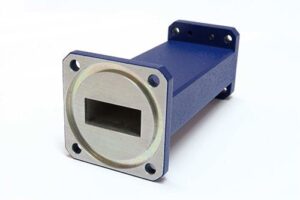
Environmental & Operational Specifications
A perfectly matched, low-loss waveguide is useless if it crumples under thermal stress, corrodes into a high-loss component within a year, or arcs over due to moisture ingress. For a system operating in a desert environment, a temperature swing of -20°C to +55°C can cause a 0.4 mm linear expansion in a 3-meter long aluminum waveguide, creating significant mechanical stress. Similarly, a tiny internal humidity level exceeding 5 grams per cubic meter can lead to a 40% reduction in peak power handling at 20 GHz due to the risk of condensation-induced arcing. These specifications are not just a checklist; they are the non-negotiable conditions for a 15-to-20-year operational lifespan in demanding applications like radar or satellite communications.
Operating & Storage Temperature Range
A 2-meter long aluminum waveguide (WR-90, Coefficient of Thermal Expansion or CTE of ~23 µm/m/°C) subjected to a 100°C temperature swing (e.g., from -40°C to +60°C) will physically expand by 4.6 millimeters. This isn’t just a theoretical concern; that expansion, if constrained, can generate over 3000 Newtons of compressive stress, enough to buckle flanges or misalign critical interfaces, spiking your VSWR from a pristine 1.05 to an unacceptable 1.50 or higher. Furthermore, the electrical properties of the waveguide itself are tied to its physical dimensions. A change of just 5 microns in the broadwall width ‘a’ at 30 GHz can cause a measurable phase shift of several degrees.
The Three Thermal Zones
When we talk about operating temperature, we’re really dealing with three distinct thermal environments that the waveguide must simultaneously withstand.
- Ambient Environment Temperature: This is the temperature of the air or medium surrounding the outside of the waveguide. This is the standard spec, like -55°C to +85°C. This range drives the mechanical expansion calculations.
- Internal Cavity Temperature: The temperature inside the waveguide cavity can be significantly different from the ambient. For high-power systems, internal I²R losses (Joule heating) can raise the temperature. A waveguide carrying 5 kW of average power with a loss of 0.02 dB/m will dissipate approximately 2.3 Watts per meter inside the guide. In a still-air environment, this can create a steady-state temperature differential of 15°C to 30°C between the inner wall and the outer skin.
- Surface Temperature of the Outer Wall: This is the critical temperature for safety and material properties. In direct desert sunlight, a dark-anodized aluminum waveguide can reach a surface temperature of 80°C even when the ambient air is only 45°C, due to solar loading of over 1000 W/m².
Quantifying the Physical Impact
The primary mechanical effect is linear expansion, calculated by the formula: ΔL = L₀ × α × ΔT.
- Material Comparison: Different waveguide materials behave differently. A 3-meter run experiencing a 90°C change (from -35°C to +55°C):
- Aluminum (CTE ~23 µm/m/°C): Expands by ΔL = 3000 mm × 23e-6 × 90 = 6.2 mm
- Copper (CTE ~17 µm/m/°C): Expands by ΔL = 3000 mm × 17e-6 × 90 = 4.6 mm
- Invar (a low-expansion alloy, CTE ~1.5 µm/m/°C): Expands by only ΔL = 3000 mm × 1.5e-6 × 90 = 0.4 mm
This expansion is not a suggestion; it’s a demand for space. If the waveguide is rigidly fixed at both ends, this expansion converts into compressive stress. For aluminum (Young’s Modulus ~69 GPa), preventing that 6.2 mm of expansion would generate a stress of approximately 160 MPa, which is dangerously close to the yield strength of many common aluminum alloys (200-250 MPa). This is why waveguide runs require strategically placed expansion loops or flexible sections, typically needing to accommodate at least ±5 mm of movement for a 20-meter roof-top run.
The Electrical Consequences
While phase shift (a change of about 10 degrees per degree Celsius for some phaseshifters) is a well-known issue, temperature affects other critical parameters:
- Frequency Sensitivity: The cutoff frequency (f_c) of the waveguide is inversely proportional to the width ‘a’. As ‘a’ expands with heat, f_c decreases. For a WR-90 guide (f_c ~ 6.56 GHz) at 75°C, the physical expansion can lower f_c by ~15 MHz. While this seems small, it can be critical for wideband systems operating close to the band edge.
- Power Handling Derating: This is a major, often overlooked, specification. The average power rating is based on the maximum safe internal temperature, often the melting point of a solder seal (~180°C) or the degradation temperature of a internal coating.
- Example Derating: A waveguide rated for 10 kW at +25°C ambient might be derated to 6.5 kW at +70°C—a 35% reduction. The derating curve is almost never linear; it’s often exponential above 50°C as radiative and convective cooling become less efficient. You must use the manufacturer’s derating chart, not a linear extrapolation.
Storage Temperature
Storage temperature (e.g., -65°C to +125°C) is about survivability, not operation. The risks are different but just as severe.
- Plating and Material Degradation: Repeated thermal cycling outside operational ranges can cause “thermomechanical fatigue.” For example, the difference in CTE between a brass waveguide body (~19 µm/m/°C) and its silver plating (~18 µm/m/°C) is small, but over thousands of cycles between -40°C and +100°C, this can lead to micro-cracking in the plating. These cracks increase surface resistivity, which directly increases attenuation. A compromised plating can increase loss by 5-10% over the component’s lifetime.
- Condensation and Corrosion: If a cold waveguide (-20°C) is brought into a warm, humid warehouse (+25°C, 60% RH), condensation will form instantly. If the waveguide is not hermetically sealed, this moisture trapped inside initiates corrosion. This corrosion layer has a much higher surface resistance, directly translating to higher attenuation. A corrosion layer only 1 micron thick can increase attenuation by 20% at 60 GHz.
Testing and Compliance
Compliance with standards like MIL-STD-883 (Method 1010.8) for thermal shock involves cycling components between extreme temperatures with a transition time of less than 1 minute. A typical test profile might be 100 cycles between -55°C and +125°C, with a 30-minute dwell time at each extreme. The component must show no mechanical failure and its VSWR must remain below 1.15 and attenuation increase less than 0.05 dB after testing.
Internal Gas Pressurization
In an unpressurized system, ambient air with a relative humidity of 60% at 25°C contains about 13.5 grams of water vapor per cubic meter. When this waveguide cools overnight to 5°C, the air inside can no longer hold that much moisture, leading to condensation that deposits a microscopic film of water on the internal walls. This film is catastrophic: it can increase attenuation by 15-25% at 10 GHz and, more critically, slash the peak power handling capacity by over 40% due to the low dielectric strength of water. A voltage standing wave (VSW) from a mismatch can easily cause this water film to ionize, leading to an arc that permanently damages the waveguide wall. Pressurization solves this by maintaining a continuous, positive pressure of dry gas—typically between 3-15 psi (20-100 kPa) above ambient—creating a barrier against moisture ingress and fundamentally altering the dielectric properties of the medium inside the guide. The choice of gas alone can be the difference between a system that handles 50 kW peak and one that handles 250 kW.
Why We Pressurize
The practice addresses two distinct, critical failure modes simultaneously.
- The Moisture Ingress War: This is a battle of pressure differential. Without pressurization, a waveguide system breathes. Daily temperature cycles of 20°C act like a piston, drawing moist air in during cooling cycles. A positive internal pressure of just 3 psi creates a constant outflow of gas, making physical ingress impossible as long as the pressure is maintained. The internal dew point is the key metric. Systems are charged with gas dried to a dew point of -40°C or lower, meaning the air inside can hold almost no water vapor (<0.1 g/m³). This ensures that even if the internal temperature plummets to -30°C, no condensation will form.
- The Peak Power Arms Race: The maximum power a waveguide can handle before arcing is determined by the dielectric strength of the medium inside. At sea level, dry air breaks down at approximately 3 kV/mm. By increasing the gas density through pressurization, you pack more molecules into the same volume, raising the voltage required for ionization. Pressurizing dry air to 10 psi can increase the peak power rating by ~50%. However, this is where gas selection becomes a performance multiplier. Switching to Sulfur Hexafluoride (SF6), with an intrinsic dielectric strength about 2.5x that of air or nitrogen, can triple the power handling capability. A system rated for 100 kW peak with nitrogen might handle 250-300 kW with SF6.
The Gas Selection Matrix
The choice of pressurization gas is a direct trade-off between performance, cost, and safety.
- Dry Air (78% N2, 21% O2): The most economical option, but the presence of oxygen makes it unsuitable for environments with high-voltage arcing risk, as it can lead to oxidation and the formation of ozone, which is corrosive over time.
- Dry Nitrogen (N2): The industry standard for most high-reliability applications. It is inert, non-flammable, and relatively inexpensive. It provides a significant improvement in power handling over air without the complexity and cost of SF6. Nitrogen bottles are readily available and cost about 20-30% more than equivalent dry air.
- Sulfur Hexafluoride (SF6): The high-performance option. Its exceptional dielectric strength makes it mandatory for very high-power systems like broadcast radio (500 kW+) and large radar arrays. However, SF6 is a potent greenhouse gas (with a global warming potential 23,500 times that of CO2), and its use is increasingly regulated. It is also significantly more expensive, with gas costs being 5-10x that of nitrogen.
The Hardware Ecosystem
A pressurization system is a closed-loop circuit with specific components, each with a quantifiable specification.
- The Pressurization Port: A sealed valve, often a 1/4-inch or 1/8-inch NPT fitting, designed for minimal leakage. It must withstand the system’s maximum pressure, typically rated for at least 1.5x the operating pressure.
- The Desiccant Dryer: This is the heart of moisture control. It contains a material like silica gel or a molecular sieve that adsorbs water vapor from the gas as it enters the system. A small, color-indicating dryer cartridge might have a capacity of 50-100 grams of water. The capacity is finite; if the indicator shows moisture saturation (often a color change from blue to pink), the cartridge must be replaced immediately.
- Pressure Regulator and Gauge: The regulator takes gas from a high-pressure cylinder (e.g., 2000-3000 psi) and reduces it to the precise operating pressure, say 8 psi ±0.5 psi. The gauge provides a local, analog reading. A drop of 1 psi per 24 hours is often the threshold for initiating a leak check.
- Continuous Pressure Monitoring Sensors: In modern systems, analog gauges are supplemented by electronic sensors that provide real-time data to a control system. These sensors can trigger alarms if the pressure deviates by more than ±0.2 psi from the setpoint, allowing for proactive maintenance before moisture can ingress.
Leakage Management
A pressurized system is only as good as its seal. Leakage is measured as a rate of pressure drop over time.
- Acceptable Leak Rates: A well-designed system should have a leak rate of less than 0.1 psi per day. A rate exceeding 0.5 psi per day indicates a significant leak that requires immediate investigation. The total allowable leak rate (Q) can be calculated using the ideal gas law, factoring in the waveguide’s internal volume (V) and the acceptable pressure drop (dP) over time (dt).
- Common Leak Points: Over 90% of leaks occur at connections.
- Waveguide Flanges: Even with sealed gaskets, imperfections can create paths. A flange torqued to 120 in-lbs might seal perfectly, while the same flange at 100 in-lbs might leak.
- Flexible Sections: The corrugated walls of flexible waveguides are potential leak paths, especially after repeated bending.
- Feedthroughs: Any point where the waveguide passes through a wall or bulkhead is a sealing interface.
The Cost of Getting it Wrong
The gradual increase in attenuation from internal corrosion can degrade system performance by 1-2 dB over a few years, effectively reducing the effective radiated power of a transmitter by 20-40%. The annual cost of maintaining pressurization—including gas bottles and desiccant changes—is typically less than 0.5% of the cost of a single major outage caused by a preventable pressure failure.