When comparing antenna ranges, key factors include transmit power (typically 1-100W affecting range exponentially), gain (6dB increase doubles range), frequency (lower frequencies like 900MHz propagate farther than 2.4GHz), and environmental conditions (urban areas may reduce range by 50-70% versus open terrain). Receiver sensitivity (-110dBm to -80dBm) and antenna height (optimal 5-30m elevation) also critically influence maximum operational distance in real-world deployments.
Table of Contents
Frequency and Wavelength
When comparing antenna ranges, frequency and wavelength are the most fundamental factors. Antennas operating at lower frequencies (e.g., 30 MHz to 300 MHz) generally have longer ranges because they suffer less signal attenuation in free space and can diffract around obstacles better. For example, a 433 MHz antenna typically achieves 1-3 km in urban areas, while a 2.4 GHz Wi-Fi antenna might struggle beyond 100-200 meters due to higher path loss. The relationship between frequency (f) and wavelength (λ) is defined by λ = c / f, where c = speed of light (~3×10⁸ m/s). A 900 MHz signal has a 33 cm wavelength, whereas a 5.8 GHz signal shrinks to just 5.2 cm, making it more susceptible to blockage.
Lower frequencies penetrate buildings better—a 700 MHz LTE signal loses ~15 dB less through walls than a 2.5 GHz signal. However, higher frequencies allow smaller antennas; a 5G mmWave (28 GHz) antenna can be 10× smaller than a sub-6 GHz counterpart. Trade-offs exist: longer wavelengths (lower frequencies) need larger antennas for efficient radiation. A quarter-wave monopole at 150 MHz requires a 50 cm radiator, while the same design at 2.4 GHz fits in 3 cm.
| Frequency Band | Wavelength | Typical Range (LOS) | Penetration Loss (Concrete Wall) |
|---|---|---|---|
| 150 MHz (VHF) | 2 m | 5-20 km | ~5 dB |
| 900 MHz (UHF) | 33 cm | 1-5 km | ~10 dB |
| 2.4 GHz (Wi-Fi) | 12.5 cm | 100-300 m | ~20 dB |
| 28 GHz (5G) | 1.07 cm | 50-200 m | ~30 dB |
In real-world deployments, frequency selection impacts coverage and hardware design. A marine VHF radio (156-174 MHz) reliably covers 20+ nautical miles, while Wi-Fi 6 (5 GHz) struggles beyond 50 meters indoors. Lower frequencies also suffer less from rain fade—a 10 GHz link loses ~0.1 dB/km in heavy rain, whereas 40 GHz loses ~5 dB/km. If maximizing range is critical, sub-1 GHz bands (e.g., 868 MHz LoRa) outperform 2.4 GHz solutions by 3-5× in open areas. However, higher frequencies enable wider bandwidths—a 5 GHz channel can deliver 500+ Mbps vs. 20 Mbps on 900 MHz.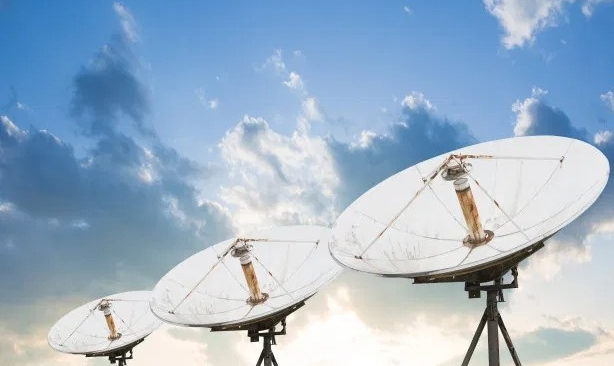
Antenna Size and Shape
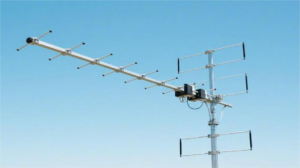
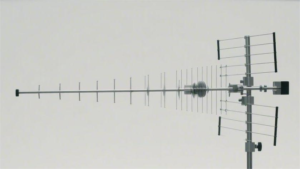
The physical dimensions and geometry of an antenna directly impact its range, efficiency, and real-world performance. A half-wave dipole for 2.4 GHz Wi-Fi is about 6 cm long, while the same antenna at 150 MHz stretches to 1 meter—making it impractical for portable devices. Smaller antennas often trade gain for compactness; a PCB trace antenna might be just 10-20 mm but suffers 3-5 dB lower efficiency than a full-sized counterpart. Directional antennas, like Yagi-Uda designs, boost range by focusing energy in one direction, achieving 10-15 dBi gain with a 60-90° beamwidth, while omnidirectional antennas spread signal 360° horizontally but lose 50-70% of their effective range compared to a directional setup.
Example: A rubber duck antenna (¼-wave, 2.4 GHz) on a router is ~3 cm tall and delivers 2-3 dBi gain, covering ~100 meters outdoors. Swap it for a 8 dBi panel antenna of the same frequency, and range jumps to 500+ meters—but only in a 30° cone.
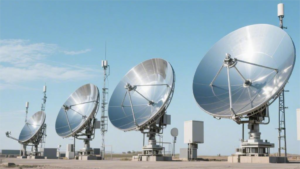
Larger antennas capture more energy. A 1-meter parabolic dish at 5.8 GHz can achieve 24 dBi gain, pushing signals 10+ km in line-of-sight (LOS) conditions. But size isn’t the only factor—shape determines radiation patterns. A helical antenna (e.g., for satellite comms) twists into a 3-5 turn spiral, offering 7-12 dBi gain with circular polarization, critical for reducing multipath interference in urban areas. Meanwhile, a flat patch antenna (common in smartphones) sacrifices 1-2 dB gain to fit into 5 mm thick devices.
Ground planes also matter. A monopole antenna needs a conductive surface at least λ/4 in radius (e.g., 17 cm for 433 MHz) to function optimally. Without it, efficiency drops by 30-50%. Even slight shape tweaks can alter performance: bending a whip antenna by 45° reduces its peak gain by 1-2 dB due to impedance mismatches.
For low-frequency applications (e.g., HF radio), size constraints force compromises. A compact magnetic loop antenna (1m diameter) at 7 MHz might only achieve 10% efficiency versus a full-sized dipole, but it’s the only option for urban balconies. Conversely, millimeter-wave antennas (e.g., 60 GHz) can pack 16-element phased arrays into 2 cm², steering beams electronically for 5G backhaul.
Power and Efficiency
When it comes to antenna performance, input power and radiation efficiency are what separate weak signals from reliable connections. A 5W handheld radio with a 50% efficient antenna effectively radiates just 2.5W, while a 90% efficient antenna pushes 4.5W—nearly double the real-world range. But efficiency isn’t just about raw power; impedance mismatches can waste 30-40% of energy as heat before it even leaves the antenna. For example, a poorly tuned 2.4 GHz Wi-Fi antenna might show a 2:1 VSWR, reflecting 11% of power back into the transmitter, reducing both range and device lifespan.
Real-world impact: A cellular base station running 40W output through a 70% efficient antenna array loses 12W as heat, requiring additional cooling costs of ~$200/year per tower. Improve efficiency to 85%, and the same system gains 6W of usable RF power—enough to boost cell edge coverage by 15-20%.
Higher power doesn’t always mean better range. Due to the inverse-square law, doubling transmit power (e.g., 1W → 2W) only extends range by ~40% in free space. Meanwhile, improving antenna efficiency from 50% to 80% delivers a 60% range boost without increasing power draw. This is critical for battery-powered devices—a LoRa module transmitting at 20 dBm (100mW) with a 3 dB antenna gain can reach 10 km, but if the antenna is only 30% efficient, actual radiated power drops to 30mW, slashing range to 5 km or less.
| Scenario | Transmit Power | Antenna Efficiency | Effective Radiated Power (ERP) | Estimated Range |
|---|---|---|---|---|
| Handheld Radio | 5W | 50% | 2.5W | 3-5 km |
| Wi-Fi Router | 1W | 70% | 0.7W | 100-150m |
| 5G Small Cell | 10W | 85% | 8.5W | 200-500m |
| Satellite Ground Station | 100W | 95% | 95W | 50,000+ km |
Losses add up quickly. A coaxial cable run of 10 meters with 3 dB/100ft loss at 900 MHz eats 1 dB of signal, cutting power by 20%. Add a cheap connector (0.5 dB loss) and a rusty joint (another 0.3 dB), and suddenly 30% of your power is gone before it hits the antenna. For UHF systems, even a 0.1 dB improvement in efficiency can mean 2-3% more coverage area—critical for emergency comms or IoT networks.
Thermal limits also play a role. A 100W amplifier driving a low-efficiency antenna can overheat, throttling output to 80W after 10 minutes of continuous use. High-efficiency antennas (>90%), like cavity-backed dipoles, run cooler, maintaining full power for hours. In mmWave systems (28+ GHz), where PCB trace losses can hit 2 dB/cm, even 1W of power becomes precious—antenna-integrated RFICs (e.g., 60 GHz phased arrays) now achieve 75-80% efficiency by eliminating feedline losses entirely.
Environment and Obstacles
The real-world performance of any antenna system depends heavily on its physical surroundings, with signal degradation varying wildly based on terrain, weather, and man-made structures. A 2.4 GHz Wi-Fi signal traveling through drywall loses 3-5 dB per wall, but that jumps to 10-15 dB for concrete reinforced with rebar. Outdoor deployments face even harsher conditions—foliage attenuation at 900 MHz can reach 0.1-0.3 dB per meter of tree cover, while heavy rain at 5 GHz adds 0.01 dB/km loss that becomes 5 dB/km at 60 GHz. Urban environments create multipath interference where signals bounce off buildings, causing 10-20 microsecond delay spreads that corrupt high-speed data transmissions.
Free-space path loss follows predictable patterns (e.g., 6 dB drop per doubling of distance), but real-world obstructions break this model. A 5.8 GHz drone video link might work flawlessly at 2 km over open fields, but fail at 500 meters in a downtown area due to 30+ dB attenuation from glass-and-steel skyscrapers. Even ground composition matters—a 400 MHz military radio achieves 50% longer range over seawater compared to dry desert due to better surface wave propagation. Temperature inversions can create ducting effects that unexpectedly carry VHF signals 300+ km, while humidity above 80% adds 0.2 dB/km loss to 6 GHz microwave links.
Material penetration tests show that brick walls (8″ thick) attenuate 2.4 GHz signals by 8-12 dB, while energy-efficient Low-E glass blocks 60-70% of RF energy at 28 GHz. These variables force tradeoffs—a sub-GHz IoT sensor network might penetrate 10+ concrete floors with 20 dB link margin, while a 60 GHz backhaul requires precise line-of-sight alignment with <1° beam misalignment tolerance. Seasonal changes also impact performance; leaf-on deciduous trees reduce UHF signal strength by 4-8 dB compared to winter months, and ice buildup on antennas can distort radiation patterns by 3-5 dB sidelobe increases.
For mobile applications, vehicle mounting positions create huge variations—a VHF antenna on a car roof has 6-8 dB better reception than one mounted behind the windshield due to metal roof shielding effects. Aircraft systems account for airframe shadowing, where a GPS antenna placed 2 meters from a comms array suffers 15 dB cross-polarization discrimination during banking maneuvers. Underwater RF is even more extreme, with 2.4 GHz signals attenuating at 0.3 dB/cm in seawater, limiting practical range to <1 meter without buoyant antennas.