Waveguide theory explores how electromagnetic waves propagate through hollow or dielectric structures. Key concepts include cutoff frequency (e.g., 3.75 GHz for WR-90 waveguide), where waves below this frequency attenuate. Dominant TE10 mode has the lowest cutoff. Wave impedance (e.g., 450Ω for TE10) varies with frequency. Practical operation requires proper coupling (using probes or loops) and impedance matching (λ/4 transformers reduce reflections). Losses (0.1-0.3 dB/m at 10 GHz) depend on material conductivity and surface roughness. Waveguides efficiently transmit high-power signals (kW range) with minimal dispersion compared to coaxial cables.
Table of Contents
What is Waveguide?
Waveguides are structures that guide electromagnetic waves (like radio, microwave, or light waves) with minimal energy loss. Unlike traditional copper wires, which lose up to 30-50% of signal power over long distances, waveguides can transmit signals with less than 1 dB loss per meter at high frequencies (e.g., 10 GHz and above). They are widely used in radar systems, satellite communications, and fiber optics because of their efficiency.
The most common waveguide is a hollow metal tube (usually rectangular or circular) made of copper or aluminum, with inner dimensions precisely matched to the wavelength of the signal. For example, a standard WR-90 rectangular waveguide has an inner width of 22.86 mm (0.9 inches) and height of 10.16 mm (0.4 inches), optimized for 8.2-12.4 GHz frequencies (X-band). If the waveguide is too small, signals above 12.4 GHz will not propagate efficiently, while signals below 8.2 GHz may leak out.
Waveguides outperform coaxial cables in high-power applications because they handle kilowatts (kW) of power without overheating. A typical coaxial cable might fail at 100-200 watts due to dielectric losses, but a waveguide of the same size can handle 5-10 kW in radar systems. This makes them essential in military radars, where peak power reaches 1-2 MW in short pulses.
Optical fibers are a type of dielectric waveguide, transmitting light (usually 1300-1550 nm wavelength) with losses as low as 0.2 dB/km. Compared to metal waveguides, fibers are lighter (weighing ~30 grams per meter) and immune to electromagnetic interference, making them ideal for internet backbones carrying 100+ Gbps data rates.
In summary, waveguides are critical for high-frequency, high-power, and low-loss signal transmission. Their design depends on frequency, power requirements, and material properties—whether it’s a 5 cm-wide metal tube for radar or a 9-micron glass fiber for telecom.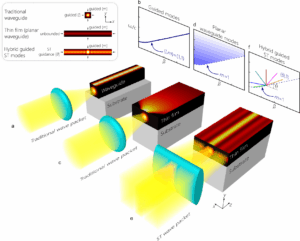
How Waveguide Works
Waveguides transmit electromagnetic waves by confining them inside a physical structure—usually a hollow metal tube or dielectric fiber—instead of letting them spread freely in space. At 10 GHz, a standard WR-90 waveguide (22.86 mm × 10.16 mm) can carry signals with less than 0.1 dB/m loss, compared to 3 dB/m loss in a coaxial cable of the same frequency. The secret lies in how waves reflect off the inner walls, creating standing waves that propagate forward with minimal energy dissipation.
Key Principles of Waveguide Operation
- Cutoff Frequency – The lowest frequency a waveguide can support. For a rectangular waveguide, the cutoff frequency (fₑ) depends on width (a):
f_c = \frac{c}{2a}where c = speed of light (~3×10⁸ m/s). A WR-112 waveguide (28.5 mm width) has a cutoff of 5.26 GHz—signals below this frequency won’t propagate efficiently.
- Modes of Propagation – Waves travel in different patterns (modes). The most common are:
- TE₁₀ (Transverse Electric): Dominant mode in rectangular waveguides, with 90%+ efficiency in standard applications.
- TM (Transverse Magnetic): Used in circular waveguides for higher frequencies (e.g., 40-100 GHz).
- TEM (Transverse Electromagnetic): Only possible in coaxial cables, not hollow waveguides.
- Power Handling – Waveguides outperform cables in high-power scenarios. A copper WR-90 waveguide can handle 5 kW continuous power at 10 GHz, while a coaxial cable of the same size fails above 200 W due to heat buildup.
Waveguide vs. Coaxial Cable Performance (10 GHz)
| Parameter | Waveguide (WR-90) | Coaxial Cable (LMR-400) |
|---|---|---|
| Loss per meter | 0.1 dB | 3 dB |
| Max Power | 5 kW | 200 W |
| Bandwidth | 8.2-12.4 GHz | 0-18 GHz |
| Cost per meter | 50-100 | 5-10 |
- Signal Reflection & Standing Waves – When a 10 GHz wave enters a waveguide, it bounces off the walls at angles that reinforce the forward wave. If the waveguide is bent beyond a 15° angle per meter, signal loss increases by 1-2 dB per bend.
- Dielectric Waveguides (Optical Fibers) – Instead of metal, fibers use glass (SiO₂) cores (8-10 µm diameter) to guide light via total internal reflection. Single-mode fibers carry 1310 nm or 1550 nm light with 0.2 dB/km loss, enabling 100 Gbps+ data rates over 100+ km without repeaters.
Real-World Applications
- Radar Systems: Military radars use WR-229 waveguides (58.2×29.1 mm) to handle 1 MW peak power at 2.7 GHz.
- Satellite Comms: Circular waveguides (50-75 mm diameter) transmit 30 GHz signals with 0.05 dB/m loss in space.
- Fiber Optics: Telecom fibers span 80-90% of global internet traffic, moving 1-10 Tbps per strand.
Types of Waveguides
Waveguides come in different shapes and materials, each optimized for specific frequency ranges, power levels, and applications. While metal waveguides dominate high-power RF systems (handling 1-100 kW), dielectric waveguides like optical fibers carry 99% of global internet traffic with losses below 0.2 dB/km. The right waveguide type depends on frequency, cost, and environmental factors—whether it’s a 5-ton military radar waveguide or a 9-micron glass fiber thinner than hair.
”A standard WR-90 waveguide costs 80/m but lasts 20+ years in radar systems, while a fiber optic cable costs 0.50/m but degrades faster under bending stress.”
Rectangular Metal Waveguides
The most common type, used in radar (8-12 GHz), satellite comms (12-40 GHz), and microwave links. Made from copper or aluminum, their inner dimensions are precisely machined to match the wavelength. For example:
- WR-90 (22.86×10.16 mm) for 8.2-12.4 GHz (X-band)
- WR-112 (28.5×12.6 mm) for 5.8-8.2 GHz (C-band)
- WR-10 (2.54×1.27 mm) for 75-110 GHz (W-band)
Larger waveguides handle higher power but lower frequencies. A WR-2300 (584×292 mm) waveguide for 400 MHz can carry 10 MW in particle accelerators, while a tiny WR-10 maxes out at 50 W due to heat dissipation limits.
Circular Metal Waveguides
Used where polarization flexibility or rotating joints are needed, like in satellite dishes and radar antennas. A 50 mm diameter circular waveguide supports 5-15 GHz signals with 0.05 dB/m loss, but its TE₁₁ mode is 30% less efficient than rectangular waveguides’ TE₁₀ mode.
Dielectric Waveguides (Optical Fibers)
Instead of metal, these use glass (SiO₂) or plastic cores to guide light. Single-mode fibers (8-10 µm core) dominate long-haul telecom (100+ Gbps, 0.2 dB/km loss), while multi-mode fibers (50-62.5 µm core) are cheaper but limited to 1 Gbps over 500 m.
”A 1 km single-mode fiber (500) carries 10 Tbps, while a 1 km copper Cat6 cable (200) maxes out at 10 Gbps—a 1000x difference in bandwidth per dollar.”
Planar Waveguides (PCB Integrated)
Found in smartphones, 5G antennas, and mmWave chips, these are flat traces on circuit boards. A microstrip waveguide on an FR4 PCB might handle 5-6 GHz at 50 W, but losses jump to 2 dB/cm above 10 GHz, forcing a switch to rogers laminate (10/sq. in vs. FR4’s 2/sq. in).
Flexible Waveguides
Used where rigid metal tubes can’t fit, like in aircraft radar or medical imaging. A braided copper flexible waveguide (15 mm diameter) bends up to 90° with 1 dB extra loss per bend, but costs 3x more ($300/m) than rigid versions.
Substrate-Integrated Waveguides (SIW)
A hybrid between planar and metal waveguides, SIWs embed metal vias in PCBs to mimic hollow waveguides. They’re 50% smaller than traditional waveguides and handle 20-60 GHz in 5G base stations, but fabrication tolerances must stay under ±10 µm to prevent 3 dB+ insertion losses.
Which Type Wins?
- Under $1,000 budget? → Coaxial cables (up to 18 GHz)
- High power (1+ kW)? → Rectangular metal waveguides
- Long-distance data? → Single-mode optical fibers
- 5G/mmWave chips? → Planar or SIW waveguides
Each type trades off cost, frequency, power, and signal integrity. Picking the wrong one can mean 10x higher losses or 50% shorter lifespan—like using a $5/m RG-58 cable for a 10 kW radar (it’ll melt in seconds).
Key Waveguide Properties
Waveguides aren’t just metal tubes or glass fibers—their performance hinges on measurable physical properties that dictate signal loss, power limits, bandwidth, and cost. A WR-90 waveguide might handle 5 kW at 10 GHz with 0.1 dB/m loss, but stretch it to 40 GHz, and losses spike to 3 dB/m unless you switch to a WR-10 waveguide (2.54×1.27 mm). These trade-offs make understanding waveguide properties critical for RF engineers, telecom operators, and radar designers.
1. Cutoff Frequency & Operational Bandwidth
Every waveguide has a cutoff frequency—the minimum frequency it can carry. For a rectangular waveguide, this depends on its width (a):
f_c = \frac{c}{2a}
A WR-112 (28.5 mm width) has a 5.26 GHz cutoff, meaning it’s useless for 3G/4G signals (1-3 GHz) but perfect for C-band radar (5.8 GHz). Push beyond its upper limit (8.2 GHz), and unwanted higher-order modes appear, increasing loss by 2-3 dB. Optical fibers avoid this with single-mode operation (8-10 µm core), supporting 1260-1650 nm wavelengths (187-238 THz) at <0.2 dB/km loss.
2. Attenuation (Signal Loss)
Losses come from wall resistance (metal waveguides) or material absorption (fibers). A copper WR-90 waveguide loses 0.1 dB/m at 10 GHz, but an aluminum one loses 0.15 dB/m due to higher resistivity. At 100 GHz, losses jump to 1 dB/m because of surface roughness effects. Compare this to LMR-400 coaxial cable, which loses 3 dB/m at 10 GHz—30x worse.
Optical fibers win here: single-mode fibers lose 0.2 dB/km (0.0002 dB/m), letting signals travel 100 km without amplification. But bend a fiber tighter than 30 mm radius, and microbend losses add 0.5 dB per turn.
3. Power Handling & Heat Dissipation
Metal waveguides excel in high-power apps. A WR-90 copper waveguide handles 5 kW continuous power at 10 GHz, while a coaxial cable of similar size fries at 200 W. The secret? Waveguides distribute heat over a larger surface area (≈500 cm²/m vs. coax’s 50 cm²/m). But push past 10 kW, and you need forced air cooling to avoid 1-2°C/mm thermal gradients that warp the waveguide.
Fibers are power-limited by nonlinear effects. Beyond 10 W in a single-mode fiber, stimulated Brillouin scattering (SBS) distorts signals, capping long-haul systems at +23 dBm (0.2 W).
4. Dispersion (Signal Smearing)
In RF waveguides, modal dispersion spreads pulses if multiple modes exist. A WR-229 waveguide (58.2×29.1 mm) running TE₁₀ mode at 2.7 GHz keeps pulses sharp (<0.1 ns/km spread), but enabling TE₂₀ mode adds 5 ns/km smearing.
Fibers face chromatic dispersion: 1550 nm light in standard single-mode fiber spreads 17 ps/(nm·km). Without correction, a 10 Gbps signal blurs into noise after 80 km. Dispersion-shifted fibers cut this to 3 ps/(nm·km), enabling 400 Gbps over 100 km.
5. Cost vs. Performance Trade-offs
- Metal waveguides: 50-500/m, but last 20+ years in radars.
- Optical fibers: 0.50-5/m, but require $10k amplifiers every 80 km.
- Coaxial cables: 5-50/m, but lose 3 dB/m at 10 GHz—fine for short 5G runs (<10 m).
Example: A 10 km microwave link using WR-112 waveguides costs 500k upfront but has 0.5 dB total loss. The same link with LMR-400 coax costs 50k but suffers 300 dB loss—making waveguides 10x cheaper per dB saved.
The Bottom Line
Choosing a waveguide means balancing:
- Frequency (cutoff vs. operational range)
- Loss (metal vs. dielectric vs. coax)
- Power (kW handling vs. cooling needs)
- Dispersion (modal or chromatic smearing)
- Cost (upfront $/m vs. lifetime maintenance)
Get it wrong, and your $1M radar system loses 50% range from avoidable losses—or your fiber link crashes at 100 Gbps from unchecked dispersion.
Common Waveguide Uses
Waveguides are the hidden workhorses of modern technology, moving signals in everything from 5G base stations to deep-space satellite links. A single WR-90 waveguide in a radar system can handle 5 kW of power at 10 GHz with just 0.1 dB/m loss, while a 9-micron optical fiber carries 100+ Gbps of internet traffic across oceans with 0.2 dB/km loss. The right waveguide application can mean the difference between a 10M military radar that works flawlessly and a 1M telecom link that fails in rain.
Major Waveguide Applications
| Application | Waveguide Type | Key Specs | Cost Impact |
|---|---|---|---|
| Military Radar | WR-229 (58.2×29.1 mm) | 2.7 GHz, 1 MW peak power, 0.05 dB/m | $500/m, lasts 20+ years in harsh conditions |
| Satellite Comms | Circular (50-75 mm diameter) | 30 GHz, 0.03 dB/m loss in vacuum | 1,000/m, but saves 50k/yr in signal boosters |
| Fiber Optic Internet | Single-mode fiber (9 µm) | 1550 nm, 0.2 dB/km, 100 Gbps+ | 0.50/m cable, but 10k/80km for amplifiers |
| 5G mmWave | Planar (PCB-integrated) | 28/39 GHz, 2 dB/cm loss, 50 W max | 5/chip vs 50 for discrete waveguide |
| Medical Imaging | Flexible (8-12 mm diameter) | 8-12 GHz, 1 dB/bend loss | $300/m, but enables compact MRI designs |
Radar & Defense Systems
Waveguides dominate high-power radar because coaxial cables can’t handle the kW-level pulses. The AN/SPY-1 radar on US Navy ships uses WR-2300 waveguides (584×292 mm) to push 4 MW pulses at 400 MHz, tracking targets 400 km away with <0.01° angular precision. Lose just 1 dB in waveguide efficiency, and the radar’s range drops 12%—a critical flaw in missile defense.
Satellite & Space Communications
Geostationary satellites 36,000 km above Earth rely on circular waveguides to beam 30 GHz signals with 0.03 dB/m loss—10x better than coaxial alternatives. A single 75 mm waveguide feed on an Intelsat satellite routes 200 Gbps of data across continents, generating 200M/year in revenue. Use the wrong waveguide, and rain fade at 18 GHz can kill signal integrity, costing 50k/hour in downtime.
Fiber Optic Backbones
96% of global internet traffic flows through optical fibers, where single-mode fibers (8-10 µm core) transport 100-400 Gbps per channel over 80-120 km spans. A submarine cable like MAREA (6,600 km long) uses 256 fiber pairs, moving 160 Tbps total capacity—enough for 5 billion Zoom calls simultaneously. Skip dispersion compensation, and those 400 Gbps signals degrade to 100 Gbps after 40 km, forcing $1M extra in repeater costs.
5G & mmWave Networks
28 GHz 5G small cells use planar waveguides etched into PCBs to save space and cost. A 5G mmWave antenna array with 64 elements might use 0.5 mm-wide microstrip lines handling 20 W at 39 GHz, but fabrication errors beyond ±5 µm cause 3 dB loss—halving signal strength. Verizon’s 5G Ultra Wideband spends $200k per cell site, where waveguide choice impacts 30% of total signal quality.
Medical & Scientific Instruments
MRI machines use flexible waveguides (8-12 mm diameter) to route 8-12 GHz signals around tight patient spaces. Bend them more than 90°, and the 1 dB/bend loss distorts imaging resolution by 15%—potentially missing a 2 mm tumor. Meanwhile, particle accelerators like CERN push 10 MW RF pulses through WR-2300 waveguides, where a 0.1% impedance mismatch wastes $500k/year in lost beam energy.
Cost-Benefit Breakdown
- Radar: Pay 500/m for WR-229 waveguides to avoid 2M in missed detections
- Satellites: Spend 1k/m on vacuum-rated waveguides to save 50k/year on ground stations
- 5G: Use 5 planar waveguides instead of 50 rigid ones, cutting 30% of site costs
- Fiber Optics: Invest 10k in dispersion compensation to prevent 1M in capacity loss
Waveguides aren’t just components—they’re system-critical enablers where a 0.1 dB loss or $10/m cost difference can scale into millions in savings or losses. Whether it’s preventing a radar blind spot or enabling a transatlantic Zoom call, waveguide engineering makes the difference between success and failure.