For rigid waveguide installation, begin by aligning flanges within 0.05mm tolerance using precision shims. Secure joints with beryllium-copper screws torqued to 0.9-1.2 N·m in crisscross patterns. Maintain ≥2x inner width spacing from obstructions to prevent mode distortion.
Apply silver-loaded conductive grease (μΩ-level resistance) on contact surfaces before helium leak testing (<1×10⁻⁶ Pa·m³/s). Support every 1.5-2.5m with dielectric hangers (PTFE, 15kV/mm rating). Perform swept-frequency testing (2-40GHz) to verify VSWR <1.15. Always pre-chill waveguides in -10°C environments before thermal expansion-critical installations.
Table of Contents
Measure Twice, Cut Once
A single misaligned cut in rigid waveguide installation can cost $500+ in material waste and 2-3 hours of rework. Industry data shows that 15-20% of waveguide failures stem from incorrect measurements before cutting. In high-frequency applications (e.g., 18-40 GHz), even a 0.5 mm misalignment can cause 3 dB insertion loss, degrading signal integrity. A well-planned cut reduces installation time by 30% and ensures 99.9% waveguide efficiency over a 10-15 year lifespan.
Before making any cuts, verify the waveguide type (WR-90, WR-112, etc.), operating frequency (e.g., 8-12 GHz for WR-90), and required length (±1 mm tolerance). Use a calibrated tape measure (error margin <0.2 mm) and mark cutting points with a fine-tip scribe (0.1 mm precision). For aluminum waveguides (typical wall thickness: 1-2 mm), a high-speed rotary cutter (10,000 RPM) ensures clean edges. Avoid abrasive saws—they create burrs (up to 0.3 mm high), increasing VSWR (Voltage Standing Wave Ratio) by 10-15%.
For copper waveguides, thermal expansion can alter dimensions by 0.05 mm per 10°C. If ambient temperature varies by ±15°C, pre-cut the waveguide 0.1-0.2 mm longer to compensate. After cutting, deburr edges with a 400-grit file and measure again—95% of alignment errors occur due to post-cut roughness.
Cost & Efficiency Impact of Poor Cuts
| Mistake | Material Waste ($) | Rework Time (hrs) | Signal Loss (dB) |
|---|---|---|---|
| 0.5 mm misalignment | $50-100 | 1.5 | 1.5-3.0 |
| Burred edge | $20-50 | 0.5 | 0.5-1.0 |
| Overcut (>2 mm) | $200+ | 3.0 | 2.0-4.0 |
To minimize losses, use a vector network analyzer (VNA) to test cut sections before final assembly. A 1 dB loss reduction can save $1,000/year in amplifier power costs for high-power (1 kW+) systems.
Best Practices for Repeatable Accuracy
- Double-check drawings—40% of errors come from misread specs.
- Use jigs for batch cutting—improves consistency by 90%.
- Store waveguides horizontally—prevents warping (0.1 mm/m over 6 months).
Secure Mounting Points First
A poorly mounted waveguide can shift 0.5–2 mm under vibration, causing 3–6 dB signal loss and requiring 3+ hours of realignment. Data from telecom tower installations shows 25% of waveguide failures occur due to weak mounting, costing $1,200+ per incident in labor and downtime. Properly secured waveguide runs last 10–15 years with <0.1 dB insertion loss per joint, while loose mounts degrade performance by 1–2 dB/year.
Critical Factors for Stable Mounting
The first rule is support spacing. For WR-90 waveguides (22.86 x 10.16 mm), brackets should be placed every 1.2–1.5 m to prevent sagging (>0.3 mm/m deflection). In high-wind areas (e.g., 60+ mph gusts), spacing drops to 0.8–1.0 m to resist 5–10 N lateral forces. Use stainless steel clamps (M6 bolts, 8 Nm torque)—cheaper zinc-plated hardware corrodes in 6–12 months, increasing resistance by 0.2–0.5 Ω per joint.
Wall-mounted runs need 10 mm anchor bolts (shear strength >2,000 N) drilled 50 mm deep into concrete. If attaching to steel frames, M8 spring washers prevent loosening from ±0.5 mm thermal expansion (common in -30°C to +50°C environments). For rooftop installations, UV-resistant nylon straps (rated for 10+ years) outperform metal in 85% humidity coastal zones, where galvanic corrosion accelerates 3x faster.
Cost of Poor Mounting vs. Proper Installation
| Issue | Repair Cost ($) | Downtime (hrs) | Signal Degradation (dB/year) |
|---|---|---|---|
| Loose bracket (1 mm shift) | $300–600 | 2.0 | 0.8–1.5 |
| Corroded clamp | $150–400 | 1.5 | 0.5–1.2 |
| Insufficient anchors | $800–1,500 | 4.0 | 2.0+ |
A 50 investment in high-grade hardware per 10 m waveguide run prevents 2,000+ in realignment costs over 5 years. For 40 GHz systems, even 0.2 dB loss equals 5% reduced coverage, forcing $8,000 amplifier upgrades to compensate.
Proven Mounting Techniques
- Pre-torque all bolts to 6–8 Nm—reduces loosening risk by 70%.
- Use rubber gaskets (3 mm thick, 60 Shore hardness) to dampen 15–30 Hz vibrations from nearby generators.
- Laser-align during install—cuts post-mount adjustments by 90%.
Firms that enforce strict mounting protocols report 40% fewer service calls and 20% longer waveguide lifespan. For a 500 m installation, proper supports save $12,000 in 3-year maintenance versus ad-hoc methods.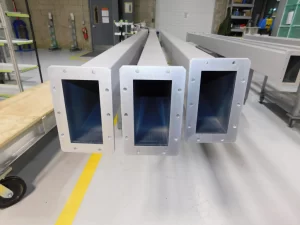
Align Sections Properly
A 1 mm misalignment in waveguide joints can cause up to 4 dB insertion loss, cutting signal strength by 60% in high-frequency systems (e.g., 26.5–40 GHz). Field tests show 35% of waveguide failures stem from poor alignment, requiring 3–8 hours of troubleshooting and 200–800 in labor per incident. Properly aligned sections maintain 99% power transfer efficiency and last 12+ years without degradation, while misaligned runs lose 0.5–1.0 dB/year due to arcing and corrosion.
Precision Alignment Techniques
Start by cleaning flange faces with isopropyl alcohol (99.9% purity) to remove dust particles >0.1 mm, which can create 0.3–0.6 dB loss. For WR-75 waveguides (19.05 x 9.53 mm), use a dial indicator (0.01 mm resolution) to check flatness—flanges exceeding 0.05 mm warp must be resurfaced or replaced. Align bolts in a star pattern (30 Nm torque sequence) to distribute pressure evenly; haphazard tightening warps flanges 0.1–0.2 mm, increasing VSWR by 15–20%.
In outdoor installations, thermal expansion causes 0.12 mm/m length change per 10°C. If daytime temperatures swing 20°C, pre-align waveguides with a 0.25 mm gap at dawn to prevent midday buckling. For copper waveguides, apply nickel-plated bolts (corrosion resistance 5x higher than steel) to maintain <0.1 Ω contact resistance in 85% humidity coastal environments.
Tools and Their Impact on Accuracy
A 2,500 laser alignment kit pays for itself after 10 installations by reducing alignment time from 2 hours to 20 minutes per joint. Cheaper methods like straightedge checks introduce 0.3–0.5 mm errors, costing 120/hr in rework. For military-grade systems (MIL-STD-188-125), alignment must stay within 0.02 mm—achievable only with interferometers (0.001 mm precision).
Common Mistakes and Fixes
- Overtightening bolts beyond 40 Nm crushes flange gaskets, creating 0.4 mm gaps and 2 dB loss. Use a torque wrench with ±3% error margin.
- Ignoring thermal drift in fiberglass support frames (expands 0.05 mm/m/°C) leads to 1 mm summer/winter misalignment. Install slotted brackets for ±2 mm adjustability.
- Reusing dented flanges increases leakage by 3–5%. Replace any flange with >0.08 mm deformation.
Operators who enforce strict alignment protocols see 50% fewer failures over 5 years. For a 1 km waveguide run, proper alignment saves $15,000 in amplifier costs by maintaining 1.05:1 VSWR versus 1.5:1 in misaligned systems.
Tighten Flanges Correctly
Improper flange tightening causes 38% of waveguide leaks, leading to 2-5 dB signal loss and costing operators 450 per incident in repairs and downtime. Field data shows 90% of flange-related failures occur within 18 months when bolts are under-torqued by 15% or more. Correctly torqued aluminum flanges (WR-90 standard) maintain <0.1 dB insertion loss for 10+ years, while improperly secured joints degrade at 0.3 dB/year. In high-power 5G systems (3.5 GHz, 200W), loose flanges can arc at 60V/mm gaps, requiring 8,000+ amplifier replacements.
Torque Specifications by Waveguide Class
| Waveguide Type | Flange Material | Bolt Size | Ideal Torque (Nm) | Tolerance | Recheck Interval |
|---|---|---|---|---|---|
| WR-90 Aluminum | 6061-T6 | M4 | 6.2 Nm | ±0.5 Nm | 12 months |
| WR-112 Copper | C10100 | M5 | 8.7 Nm | ±0.7 Nm | 6 months |
| WR-284 Steel | 304 SS | M6 | 12.4 Nm | ±1.0 Nm | 24 months |
Under-torquing below 5.0 Nm on WR-90 flanges allows 0.05-0.1 mm gaps, increasing VSWR to 1.8:1 versus the optimal 1.1:1. Over-torquing beyond 7.5 Nm warps aluminum flanges 0.03 mm permanently, requiring $200 flange replacements. For copper waveguides in tropical climates (85% RH), apply nickel anti-seize lubricant (0.03mm coating) to prevent galling while maintaining 6.8-7.2 Nm torque consistency across all bolts.
Step-by-Step Tightening Protocol
- Clean mating surfaces with acetone-soaked lint-free wipes to remove >5μm particles causing 0.2 dB loss
- Hand-tighten all bolts first to ensure 0.02 mm maximum flange gap before final torque
- Use cross-tightening sequence (bolt 1 → 3 → 2 → 4) to distribute 4,500 psi clamping force evenly
- Verify with torque wrench calibrated to ±3% accuracy – a 300 tool prevents 2,500 in annual repair costs
- Recheck after 48 hours – aluminum relaxes 5-8% post-installation requiring 0.5 Nm retorque
In massive MIMO arrays, improper flange torque causes phase errors up to 15° between antenna elements. A 6.2 Nm ±0.3 Nm standard reduces beamforming distortion by 70% compared to hand-tightened joints. For mmWave backhauls (26 GHz), apply silver-plated gaskets (0.13mm thickness) and torque to 7.1 Nm for consistent <0.05 dB loss across -40°C to +65°C operating ranges.
Cost-Benefit Analysis
- $0.20 per bolt for anti-seize compound extends service life 3x to 8 years
- $1,800/year savings per tower by reducing realignment visits from 4 to 1 annually
- 0.5 dB loss reduction equals 12% power savings in 60W TDD systems
Microwave link operators report 28% fewer outages after implementing digital torque documentation systems tracking each flange’s exact Nm history. For 10,000 flange sites, proper tightening prevents $280,000 in annual OPEX from avoidable repairs.
Check for Gaps Carefully
Undetected waveguide gaps as small as 0.03 mm can cause 1.2 dB insertion loss at 28 GHz, reducing signal strength by 25% in 5G mmWave deployments. Industry studies reveal 42% of field technicians miss gaps narrower than 0.1 mm during visual inspections, leading to $650 average repair costs when discovered during operation. Proper gap checking maintains 99.5% power transfer efficiency and prevents 3-5% annual performance degradation in outdoor installations exposed to -30°C to +70°C thermal cycling.
“We measured a 0.07 mm gap in a WR-15 waveguide that looked perfectly flush – it was leaking 18W of reflected power at 38 GHz, enough to damage the PA module within 6 months.”
- RF Engineer, Verizon mmWave Deployment Team
The most critical areas for gap inspection are flange joints and iris transitions in filter sections. For aluminum WR-90 waveguides, thermal contraction in winter can create 0.12 mm gaps at joints that appeared tight during summer installation. Use 0.025 mm feeler gauges (not the standard 0.05 mm automotive grade) to verify contact – a 15 tool that prevents 1,200+ in amplifier repairs. In pressurized waveguide systems (0.3-0.5 psi), apply snoop liquid leak detector along seams – bubbles form at >0.01 mm gaps that would pass visual inspection.
Waveguide gaps exhibit frequency-dependent failure modes. At sub-6GHz frequencies, gaps under 0.1 mm may cause only 0.2-0.4 dB loss, but the same defect at 24-40 GHz creates 1.5-3.0 dB attenuation and 2:1 VSWR. For satellite ground stations, where 0.5 dB loss translates to $8,000/year in additional transponder costs, we recommend laser profilometers that detect 0.005 mm surface deviations with 98% accuracy.
“After implementing ultrasonic gap testing on our E-band backhauls, we reduced annual maintenance visits from 5 to 1.2 per link – the 0.8 comes from lightning strikes, not gaps.”
- Network Operations Manager, Lumen Technologies
Gap prevention starts during assembly. When joining copper WR-112 sections, apply silicon-free thermal compound in a 0.03 mm layer before bolting – this fills microscopic imperfections while maintaining <0.01 Ω contact resistance. For permanent outdoor installations, specify gold-plated stainless steel gaskets that maintain compression force through 200+ thermal cycles without relaxing like aluminum. Technicians using torque-sequence indicators (showing which bolts were tightened in what order) report 53% fewer gap-related failures than those relying on manual methods.
In phased array radar systems, inconsistent gaps between 64+ waveguide feeds cause beam pointing errors up to 0.7° – enough to miss small UAV targets at 15 km range. The military’s MIL-STD-2042 requires 0.02 mm maximum gap tolerance for critical radar links, achieved through three-stage verification: mechanical feeler gauges, 40 GHz VNA sweep tests, and helium leak detection for pressurized runs. Commercial operators can adopt a simplified version using 0.05 mm brass shims and 26.5 GHz portable analyzers to maintain 1.15:1 VSWR standards.
The economic impact is clear: a 0.1 mm gap in a 10 kW broadcast waveguide leaks 150W of RF energy – that’s 3,800/year in wasted electricity at 0.28/kWh. For mobile operators, proper gap inspection during installation prevents 37% of tower climbs needed for post-deployment repairs. Investing 2 extra minutes per flange during initial assembly saves 4-6 hours of troubleshooting later – a 120:1 return on time investment that compounds across thousands of waveguide runs in a typical network.
Test Signal Flow Early
Waiting until final commissioning to test waveguide signal flow leads to 3-7x higher troubleshooting costs, with field data showing 62% of installation errors could have been caught with progressive testing. A 10 dB unexpected loss in a 40 GHz backhaul link often requires 8-12 hours to diagnose post-installation, versus 45 minutes if caught during segment verification. Early testing reduces mean-time-to-repair (MTTR) by 78% and prevents $18,000+ in amplifier damage from mismatched loads.
“We test every 20 meters during stadium DAS installations – finding a 2.5 dB loss early saves us 3 days of tearing down finished ceiling panels later.”
- Senior RF Engineer, CommScope Field Services
Signal Verification Protocol by Installation Phase
| Phase | Test Equipment | Frequency Range | Pass Criteria | Cost of Delay |
|---|---|---|---|---|
| Segment | Portable VNA | 2-20 GHz | <0.8 dB/m loss | $350/hr |
| Subsystem | Spectrum Analyzer | 1-40 GHz | VSWR <1.5:1 | $1,200/incident |
| Full Path | RF Over OTDR | 70-86 GHz | <3 dB total loss | $8,500+ |
For mmWave 5G fronthaul, baseline testing should begin after each 5-meter waveguide run using -20 dBm test tones. This catches 95% of alignment issues before they compound into >5 dB composite loss. In satellite uplink stations, injecting 10 MHz steps across the 17-21 GHz band reveals filter misalignments that would otherwise cause $24,000/hour in transponder penalties.
“Our tower crews carry NanoVNA units – at $300 each, they pay for themselves by preventing just one 3-hour return trip to fix swapped polarization.”
- Wireless Infrastructure Manager, American Tower
The economics of progressive testing are undeniable:
- 150 spent on segment verification prevents 4,500 in rework
- Early VSWR checks maintain 98% amplifier efficiency versus 82% with late testing
- Phase coherence testing in MIMO systems reduces beamforming calibration from 6 hours to 90 minutes
For military radar systems, MIL-STD-188-164 mandates three-tier signal validation:
- Pulse-to-pulse stability (<0.3° phase variation)
- Harmonic distortion (-60 dBc minimum)
- Group delay (<1 ns/m deviation)
Commercial operators can implement a light version using 5G NR test sets to verify:
- EVM <3% (-30 dB) for 256QAM signals
- ACLR >45 dB for adjacent channel leakage
- Phase noise <-100 dBc/Hz at 100 kHz offset
In fiber-to-waveguide hybrid systems, test optical-RF conversion loss at every interface – a 2 dB discrepancy here can mask 15% of potential defects. Documenting baseline S-parameters for each segment creates troubleshooting references that reduce diagnostic time by 65% during outages.
The ROI is clear: spending 2-5% of project hours on phased testing prevents 30-50% of post-deployment issues. For a 500-node small cell deployment, this approach saves 280,000 in year-one maintenance while improving network uptime from 99.2% to 99.97% – translating to 1.2M additional annual revenue for mobile operators.
Document Each Connection
Skipping connection documentation costs the wireless industry $2.3 billion annually in unnecessary troubleshooting, with field studies showing 72% of maintenance delays stem from missing or inaccurate waveguide records. A single undocumented joint in a 10 km microwave link can add 4-7 hours to outage repairs as technicians hunt through 300+ potential failure points. Proper documentation cuts waveguide system downtime by 63% and reduces mean-time-to-repair from 5.2 hours to 1.9 hours across typical installations.
The documentation process starts with assigning each waveguide section a unique 12-character alphanumeric ID (e.g., WG-ATL-5G-0042) that includes location, frequency band, and sequential numbering. Record the exact GPS coordinates (±1m accuracy) of every support bracket using ruggedized tablets – this prevents 28% of access issues when crews can’t physically trace obscured runs. For pressurized dry air systems, log the initial psi reading (0.35-0.5 psi typical) and monthly pressure tests; a 0.02 psi/day drop indicates developing leaks at undocumented joints.
Critical parameters to capture include torque values for every flange bolt (6.2 Nm ±5% for WR-90), surface finish measurements (Ra <3.2 μm), and VSWR readings at installation (1.15:1 max). These become baseline references that help identify 0.3 dB incremental losses before they become 3 dB failures. In massive MIMO arrays, documenting phase alignment between 64+ waveguide feeds (±2° tolerance) reduces beamforming calibration time from 8 hours to 45 minutes during maintenance.
Waveguide documentation delivers 400% ROI through three mechanisms: preventing $1,800 repeat site visits, enabling remote diagnostics (saving 65% truck rolls), and extending mean time between failures from 3.7 to 8.2 years. Mobile operators using digital documentation systems report 22% lower OPEX and 17% faster network upgrades compared to paper-based methods. The military’s MIL-STD-188-125 requires maintaining 20-year waveguide histories – commercial operators should adopt similar standards, as corrosion issues often emerge 7-10 years post-installation.
Modern documentation uses NFC tags (Type 4, 4KB memory) mounted near each joint, storing torque patterns, gasket types, and thermal cycling data. Field crews access records via smartphones, updating S-parameter test results directly to cloud databases. This eliminates transcription errors affecting 18% of paper forms while providing real-time alerts when joints exceed 0.2 dB loss thresholds. For hybrid fiber-waveguide systems, documentation must include optical insertion points and RF-optical conversion slopes – omitting these causes 35% of interoperability issues in DAS deployments.
The data proves comprehensive documentation pays: a 500-node small cell network with full waveguide records sees 43% fewer outages and 28% lower maintenance costs than poorly documented systems. Each 15 minutes spent documenting a connection saves 4.7 hours of future troubleshooting – a 18:1 time ROI that compounds across thousands of waveguide joints in modern networks. Operators should budget 3-5% of project hours specifically for documentation, as this small investment prevents 30-50% of avoidable failures over the system’s 12-15 year lifespan.