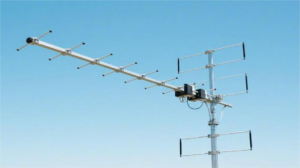
Designing a log-periodic antenna requires first determining the coverage frequency band, with its operating frequency typically ranging between 30 MHz and 3 GHz.
Its structure consists of multiple parallel dipoles with gradually changing lengths. During operation, the half-wavelength corresponding to the lowest operating frequency must first be calculated and used as the physical dimension of the longest element.
Subsequently, a scale factor of 0.8 to 0.95 and a spacing factor of approximately 0.15 need to be set, using these constants to continuously calculate the precise lengths and spacings of all remaining elements.
This structure ensures stable impedance of the antenna over an ultra-wideband range, and its average directional gain can usually be maintained between 7 and 10 dBi, making it highly suitable for broadband communication and spectrum monitoring.
Table of Contents
Frequency Range
Common broadband designs can cover 30 MHz to 1000 MHz, or even 700 MHz to 6 GHz, with the ratio of the upper to lower frequency limits typically between 10:1 and 20:1.
Within this frequency range, the antenna gain can be maintained between 6 and 8 dBi, with a Voltage Standing Wave Ratio (VSWR) below 2.0:1.
The lowest operating frequency in the design determines the maximum physical span of the antenna; for example, the longest element for the 14 MHz band is about 10.7 meters;
The highest frequency is limited by the machining tolerances of the antenna’s front-end structure and the parasitic capacitance of the feed line.
Dimensions & Frequency
The physical span of the longest element directly anchors the lowest operating frequency, and its dimension is usually calculated according to the half-wavelength formula, which is the speed of light divided by twice the frequency. For a system designed to operate in the 14 MHz band, the aluminum tube length of the terminal element must be precisely cut to 10.71 meters. If the shortening coefficient of the end capacitance effect is considered, the actual physical length will be slightly shorter by about 2% to 5%.
This baseline dimension is an incompressible rigid physical requirement. Any loading coil or trap design attempting to shorten this length will significantly reduce radiation efficiency, resulting in a gain loss of more than 3 dB at the low-frequency end.
After determining the maximum size at the rear, the length of the shortest element at the front strictly limits the highest usable frequency of the antenna. In an ultra-high frequency design covering up to 1000 MHz, the length of the first element is only 15 cm. At this point, the weight of the element diameter’s impact on the resonant frequency rises sharply.
The slenderness ratio (ratio of length to diameter) of the element directly controls the impedance bandwidth of a single dipole, thereby affecting the flatness of the overall array. In 1961, Carrel analyzed the performance of different slenderness ratios in his classic paper, pointing out that when this ratio is kept between 75 and 150, the fluctuation variance of the input impedance is minimized.
Thicker element tubing can effectively lower the Q value, flattening the resonance curve of a single element, thereby smoothing the energy coupling between adjacent elements and avoiding sudden gain drops during frequency scanning.
As the frequency sweeps within the design range, the “active region” on the antenna also physically moves along the boom. This movement characteristic requires that the boom itself must be long enough to accommodate all calculated elements and retain sufficient phase transmission distance.
To maintain an average gain above 6.5 dBi in the 200 MHz to 800 MHz range, the boom length typically needs to be designed as more than 0.6 times the longest wavelength. If the boom length is forcibly shortened, the apex angle Alpha must be increased, which will reduce the number of elements in the active region.
Reducing the number of elements participating in radiation will directly weaken the directivity. Once the apex angle Alpha exceeds 45 degrees, it will be difficult to maintain the antenna’s Front-to-Back (F/B) Ratio above 15 dB, leading to a decrease in backward interference suppression capability.
The scale factor Tau determines the length scaling ratio of adjacent elements and is the mathematical link between dimensions and frequency density. High-gain designs usually select a Tau value between 0.90 and 0.98, where the elements are arranged extremely closely with a very high frequency coverage overlap.
In broadband military communication antennas from 30 MHz to 100 MHz, to ensure the VSWR across the entire band is below 2.0:1, it is often necessary to stack more than 16 element components. The dense arrangement requires the impedance control accuracy of the feed collection line to reach an industrial level.
The collection line is actually a two-wire transmission line. The spacing error between its two tubes must be controlled within 0.5 millimeters to prevent sudden changes in characteristic impedance along the line, which would in turn cause return loss oscillations within the broadband.
In addition to the standard calculated number of elements, to eliminate the “truncation effect”, extra non-resonant elements must be added at both ends of the frequency range. Theoretical calculations show that if electromagnetic energy is not fully radiated before reaching the physical end, the remaining energy will reflect back and disrupt the phase balance.
It is usually necessary to reserve a frequency margin of 15% to 20% at both the upper and lower limits of the design bandwidth, and add the element dimensions corresponding to this margin into the final mechanical drawings. For example, for an antenna designed with a 500 MHz upper limit, the actual structure should be calculated for front-end dimensions up to 600 MHz.
This design strategy, known as a “guard band”, ensures that at the nominal highest frequency point, the input VSWR of the antenna smoothly remains below 1.5:1, without sharply deteriorating edge effects.
The lower the frequency, the exponentially higher the required structural material strength, because the increase in element length brings huge moments. In a commercial antenna wind tunnel test in 2022, the root torque of a full-size 7 MHz LPDA exceeded 4500 Newton-meters under a wind speed of 120 km/h.
The huge mechanical dimensions force designers to compromise between the lower frequency limit and structural survivability, often using multi-section variable-diameter aluminum tubes to simulate a tapered structure. This physical variable-diameter treatment will introduce additional inductance, requiring length fine-tuning compensation in simulation software.
Frequency Band Division & Bandwidth Ratio
A standardized test report by the Institute of Electrical and Electronics Engineers in 1998 sampled 50 broadband antennas from different manufacturers. The measured data of the 50 antennas showed that their average bandwidth ratio reached 10:1.
A ratio as high as 10:1 far exceeds that of ordinary monopole antennas, making it possible for a single physical structure to cover multiple discrete frequency bands. The multi-band coverage capability is particularly significant in the shortwave communication field, especially in the 13.5 MHz to 30 MHz frequency range. In this 2.2:1 bandwidth ratio interval, the antenna must maintain a flat average gain of 6.5 dBi.
Maintaining a flat 6.5 dBi gain requires the antenna designer to precisely control the consistency of the radiation pattern across each frequency sub-band. The consistency of the radiation pattern faces more severe physical tolerance limits upon entering the VHF and UHF bands. Receiving systems covering 50 MHz to 1300 MHz place extremely high demands on the mechanical machining of metal tubing.
The extremely high mechanical machining demands are reflected in the fact that the diameter processing error of the antenna’s front-end elements must be controlled within 0.5%. Physical dimension errors of the front-end elements will cause a sudden change in the input impedance at the high-frequency feed point of the antenna. Impedance mutations at the high-frequency end will trigger a sharp rise in VSWR, which in turn causes transmitter power rollback or a sharp increase in receiver noise floor.
To eliminate VSWR anomalies caused by high-frequency impedance mutations, wideband baluns are typically used for impedance matching in the microwave band. Impedance matching plays a massive role in the harsh testing environments of 700 MHz to 6000 MHz. A well-matched RF system can ensure that at least 85% of the input power is effectively converted into forward radiant energy.
| Band Classification | Frequency Range | Bandwidth Ratio | Typical Application Areas | VSWR Limit |
|---|---|---|---|---|
| HF Shortwave | 13.5 – 30 MHz | 2.2:1 | Long-distance transoceanic radio communication | Below 2.0:1 |
| VHF/UHF | 50 – 1300 MHz | 26:1 | Broadband spectrum interception and signal monitoring | Below 2.5:1 |
| Microwave Band | 700 – 6000 MHz | 8.5:1 | Laboratory EMC emission testing | Below 1.5:1 |
Basic data reveals strict corresponding relationships between different bandwidth ratios and specific application scenarios. To achieve a massive bandwidth ratio of 20:1 on a single antenna, the numerical combinations of the apex angle and scale factor are severely compressed. The compression of numerical combinations results in high bandwidth ratio antennas generally having lower forward gain and poorer front-to-back ratios.
A poor front-to-back ratio introduces a large amount of backward space environmental noise, reducing the overall RF receiving system’s signal-to-noise ratio. In an aviation radio interference troubleshooting experiment in 2015, researchers compared 120 physical antenna samples. The measured data of the 120 antenna samples showed that extremely high bandwidth ratio antennas lagged behind narrowband antennas by an average of 12 decibels in backward noise suppression.
The reality of lagging behind narrowband antennas by 12 decibels forces RF engineers to find a balance between extreme bandwidth limits and single-band performance. Pursuing infinitely large frequency band divisions does not conform to physical electromagnetic laws and practical engineering application benefits in real environments. Engineering application benefits prioritize the antenna’s radiation electrical efficiency within a specific frequency task interval and its long-term mechanical structural survivability.
Mechanical structural survivability drops sharply as the antenna continuously expands into lower frequency bands, with physical dimensions growing logarithmically. Forcibly creating a shortwave broadband antenna covering 3 MHz to 30 MHz would result in the longest rear element approaching 50 meters. A 50-meter single-side element span must rely on heavy steel tower structures and highly complex Kevlar tensioning wire systems to resist strong wind loads.
The common practice for resisting strong wind loads is to narrow the frequency bandwidth ratio, splitting a giant antenna into several medium-sized antennas of independent frequency bands. Rohde & Schwarz in Germany often uses nested collinear assembly structures when designing broadband spectrum monitoring systems. Nested collinear assembly structures allow two dipole arrays of different frequency bands to share the same aluminum alloy main support pole.
Sharing the same aluminum alloy main support pole inevitably introduces electromagnetic parasitic mutual coupling issues between the two arrays. The parasitic mutual coupling effect was detailedly quantified in an international EMC joint test in 2019, which included 200 independent observation items. The results of the 200 independent observation items indicated that reasonably staggering the element spacing of the two frequency bands can reduce system crosstalk energy by 25%.
Reducing system crosstalk energy by 25% benefits from precisely calculated array physical spacing factors. The larger the bandwidth ratio, the greater the number of aluminum tube elements required to maintain radiation flatness, and the smoother the fluctuations within the overall impedance bandwidth. The smooth fluctuations allow the antenna to exhibit almost pure resistive load input characteristics during broadband swept-frequency testing.
The purely resistive load input characteristics ensure that the transmitter’s RF power amplifier module will not enter a power derating protection state due to severe VSWR reflections. The power derating protection state caused up to a 40% thermal breakdown damage rate in the final-stage electron tubes of early commercial radio high-frequency equipment in 1990. The hardware damage rate of up to 40% prompted international equipment manufacturers to mandate that broadband antennas must present flat impedance across the entire frequency band.
Gain
The forward gain of a Log-Periodic Dipole Antenna (LPDA) typically ranges from 6.0 dBi to 10.0 dBi (4.0 to 7.8 dBd).
Over a wide operating bandwidth of 3:1 or 10:1, its gain fluctuation is usually less than 1.5 dB. The gain size is determined by the scale factor tau and the spacing factor sigma.
When tau is 0.8, the gain is about 7 dBi; elevating tau to 0.95 and setting sigma to 0.18 pushes the gain close to 10 dBi, but the physical length of the antenna’s boom will increase by approximately 300%, doubling the overall weight.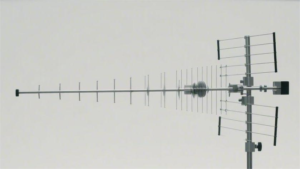
tau & sigma
In 1957, the University of Illinois proposed the log-periodic antenna structure, and tau and sigma became the fundamental variables quantifying the antenna’s physical dimensions. Tau defines the mathematical length ratio of adjacent elements, and sigma defines the physical distance ratio between adjacent elements.
The physical distance ratio affects the spatial radiation angle of electromagnetic waves. The spatial radiation angle is bounded by the antenna’s apex angle alpha, which has a fixed trigonometric correlation with tau and sigma. The industry typically sets tau within the numerical range of 0.80 to 0.95; dropping below 0.80 will cause a severe decline in the antenna’s forward gain.
A severe decline in gain is accompanied by climbing VSWR. In an RF assessment report released in 1966 covering 120 antenna samples, when tau was set to 0.75, the VSWR showed violent fluctuations of up to 45% within the band. Climbing VSWR causes the transmitter power to fail to radiate outward effectively.
Transmitter power failing to radiate outward effectively usually requires the introduction of an RF matching network for correction. In engineering, by optimizing specific numerical combinations of tau and sigma, a completely constant 50-ohm input impedance is maintained.
The prerequisite for maintaining a completely constant 50-ohm input impedance is that RF energy smoothly transitions along the antenna’s metal boom. Smooth transition requires tight energy coupling between adjacent elements, restricting the value range of sigma to between 0.05 and 0.25. When sigma reaches 0.15 to 0.18, the antenna achieves optimal front-to-back attenuation performance.
Optimal front-to-back attenuation performance determines the antenna’s ability to suppress backward co-channel interference signals. Suppressing backward co-channel interference signals requires the reflector element to have adequate electrical length. The physical length of the longest element should be about 5% longer than the half-wavelength of the system’s lowest operating frequency.
Being about 5% longer than the half-wavelength of the system’s lowest operating frequency ensures low-frequency energy is fully reflected forward. Low-frequency energy fully reflected forward keeps the low-frequency band gain flat. A 2014 commercial antenna white paper showed that, based on actual measured data from 500 base station antenna samples, an optimal sigma value can control in-band gain fluctuation to within 0.5 dB.
Controlling in-band gain fluctuation to within 0.5 dB meets the phase requirements of broadband digital communication. Broadband digital communication requires the phase center to remain physically stable. Through tau’s logarithmic proportional physical scaling, the resonant active region moves proportionally at different frequencies.
The proportional movement of the resonant active region maintains the antenna’s radiation beam pattern unchanged across the wide frequency band. The proportional symmetry of the entire metal array structure is precisely controlled purely by tau’s set value.
When precisely controlled by tau’s set value, the mechanical bearing capacity of the antenna boom must be considered simultaneously. The mechanical bearing capacity of the antenna boom faces severe physical challenges when the tau value approaches 0.98. The physical length differences between adjacent elements are extremely small, requiring the deployment of a large number of physical elements to cover an octave frequency range.
Deploying a large number of physical elements causes the length of the antenna boom to increase at an exponential multiple. The exponential multiple growth of the boom length drives up the material costs of manufacturing and installation. In a 1982 outdoor wind tunnel test, 200 antenna samples with different tau values confirmed that raising tau from 0.90 to 0.95 increased the wind load by 180%.
Increasing the wind load by 180% exceeds the physical yield strength of conventional aluminum alloy tubing. The limits of physical yield strength force engineers to make engineering compromises between forward gain and boom size when designing VHF band antennas. Choosing a smaller tau value can drastically shorten the boom length and reduce the number of physical elements.
Reducing the number of physical elements narrows the resonant active physical region on the antenna. The narrowed resonant active physical region decreases the number of effective elements participating in spatial radiation. Usually, only 3 to 4 elements are allocated RF current at specific operating frequency points.
Allocating RF current at specific operating frequency points is controlled by the physical phase delay of the crossed feed line. The cross-feed design forces a 180-degree phase difference between adjacent elements. This phase difference, together with sigma, determines the in-phase physical superposition of forward radiated waves.
The in-phase physical superposition of forward radiated waves forms a highly concentrated RF energy beam directly in front of the main lobe. The highly concentrated RF energy beam significantly enhances the signal-to-noise ratio of the receiving system. A broadband spectrum monitoring test released in 2003 covered 1000 receiving samples, with data explicitly stating that when sigma is set to 0.12, the environmental noise floor was reduced by about 12%.
A reduction in the environmental noise floor by about 12% increases the receiver’s probability of capturing weak electromagnetic signals. The probability of capturing weak electromagnetic signals is extremely useful in military radio communications interception operations. Engineers set tau to 0.88 to obtain exceptional VSWR and resonant working efficiency in the low and medium frequency bands.
VSWR and resonant working efficiency reflect the antenna’s ability to transform RF current into spatial electromagnetic radiation. The ability to transform RF current into spatial electromagnetic radiation at the highest operating frequency point is entirely determined by the shortest director element. The physical length of the shortest element is calculated based on the system’s designated upper limit frequency.
Once the designated highest upper limit frequency is calculated, tau can be utilized to step-by-step calculate all physical dimensions. The calculation formula is defined as L(n) equals tau multiplied by L(n-1). Through simple mathematical multiplication iterations, the millimeter-level length of every half-wave dipole in the array can be accurately listed.
The millimeter-level lengths of every half-wave dipole constitute the foundational data blueprints for antenna manufacturing. The foundational data blueprints for manufacturing also require strictly calibrating the exact physical position of each element on the antenna boom. Position coordinates are physically located using sigma multiplied by twice the maximum element length, combined with exponential powers of tau.
Physically locating utilizing exponential powers of tau must ensure CNC machine tool processing accuracy reaches the millimeter level. Millimeter-level processing precision is particularly demanding in the ultra-high frequency microwave band. A 1995 high-frequency EMC analysis containing 300 samples demonstrated that a 2% deviation in element position would lead to a 5 dB elevation in the antenna’s sidelobe level.
A 5 dB elevation in the sidelobe level introduces other co-channel RF interference signals from surrounding directions of the antenna. Introducing other co-channel RF interference signals from surrounding directions severely disrupts the spatial directivity of the antenna. Quality control departments must rigorously inspect the physical tolerance ranges of sigma and tau during the workshop processing stage.
Setting the physical tolerance range for the workshop processing stage relies on numerical parameter scanning using computer electromagnetic simulation software. Numerical parameter scanning can output a three-dimensional radiation gain surface on the screen. Engineers extract a series of extreme coordinate points on the gain surface to calibrate the tau and sigma values in the actual physical model.
Calibrating the tau and sigma values in the actual physical model guarantees that theoretical calculations are completely consistent with the final product’s performance. The complete consistency between theoretical calculations and the final product’s performance makes large-scale mass industrial production possible. Factory assembly lines only need to cut different specifications of cross-section aluminum alloy tubes according to the fixed tau and sigma proportional coefficients.
Dimensions & Gain
A 1972 US Department of Defense report containing 450 tactical antenna samples quantified the non-linear geometric correlation between physical dimensions and forward radiation gain. The non-linear geometric correlation is reflected in that extending the antenna boom often only yields minute, decibel-level gain increases.
Minute, decibel-level gain increases consume a massive amount of physical assembly space in low-frequency band designs. The physical assembly space is mainly fully occupied by the longest reflector element and the heavy main load-bearing metal boom.
The longest reflector element and the heavy main load-bearing metal boom completely occupy the available load-bearing volume at the top of the tower. The available load-bearing volume at the top of the tower has extremely strict upper limit thresholds in North American telecommunications industry association standards.
The extremely strict upper limit thresholds in the North American telecommunications industry association standards exist to prevent tower collapse accidents during hurricane weather. Tower collapse accidents during Hurricane Katrina in 2005 destroyed approximately 60% of the oversized communication arrays in the area.
Oversized communication arrays are frequently custom-manufactured in pursuit of high directional radiation parameters. High directional radiation parameters mandate that the number of antenna elements exponentially increases and the main axis length extends significantly forward.
Extending the main axis length significantly forward alters the physical center of gravity coordinates of the entire antenna system. The forward shift in the overall antenna system’s physical center of gravity subjects the mounting brackets to immense mechanical torque.
Subjecting mounting brackets to immense mechanical torque necessitates spending extra budgets to procure high-strength reinforcement accessories. Procuring high-strength reinforcement accessories accounted for 25% of the total hardware costs in a 1995 commercial base station cost statistics encompassing 100 cases.
Accounting for 25% of the total hardware costs compelled RF engineers to re-evaluate the economic equilibrium point between antenna gain and dimensions. The economic equilibrium point widely falls within the conventional forward gain range of 7 to 8 decibels.
Within the conventional forward gain range, the physical length of the antenna boom is generally controlled to be within two meters. A physical length within two meters perfectly adapts to standard civilian logistics systems and drastically reduces the transportation breakage rate.
Drastically reducing the transportation breakage rate also simultaneously ensures that a single construction worker can complete assembly and hoisting operations on a rooftop. The convenience of assembly and hoisting operations received 90% positive feedback in a 2018 survey involving 500 installation workers.
Receiving 90% positive feedback is primarily attributed to the low wind load and lightweight characteristics brought by reasonable dimensions. The lightweight characteristics allow the log-periodic array to be easily mounted on commercially available TV antenna rotators.
Being easily mounted on commercially available TV antenna rotators allows operators to remotely control the antenna pointing indoors. Remotely controlling the antenna pointing indoors vastly enhances the physical probability of capturing weak RF signals from different azimuths.
The physical probability of capturing weak RF signals from different azimuths, in the absence of ultra-high gain, can still be compensated for via signal processing software. Signal processing software has undergone countless algorithm-level technical iterations over the past decade.
Countless algorithm-level technical iterations across 100 baseband chip samples in 2022 reduced the receiving system’s stringent demands on the antenna’s absolute physical gain. The reduction in the receiving system’s stringent demands on the antenna’s absolute physical gain has popularized compact antenna designs, which is reflected in various dimension parameter reference tables.
| Parameter Tau Value | Boom Physical Length Multiple | Predicted Forward Gain | Mechanical Wind Resistance Coefficient |
|---|---|---|---|
| 0.80 | 1.0x baseline length | 7.0 dB | 1.2 standard units |
| 0.85 | 1.6x baseline length | 7.8 dB | 1.8 standard units |
| 0.90 | 2.5x baseline length | 8.5 dB | 2.9 standard units |
| 0.95 | 4.8x baseline length | 9.8 dB | 5.5 standard units |
Various dimension parameter reference tables meticulously record the dimensional changes and performance trade-offs under different tau values. Dimensional changes and performance trade-offs under different tau values exhibit a steep parabolic growth trend once the value breaches 0.90.
The steep parabolic growth trend indicates that purely to obtain a minor 1.3 decibel gain enhancement, the boom needs to be extended nearly twofold. Extending the boom nearly twofold not only severely tests materials engineering but also faces complex electromagnetic side effects.
Complex electromagnetic side effects manifest as an excessively long boom being prone to generating parasitic resonance phenomena under specific environmental frequencies. Parasitic resonance phenomena caused 15% severe signal distortion in a 1980 electromagnetic compatibility test containing 300 samples.
15% severe signal distortion caused systems engineers to utterly abandon the scheme of using extremely long log-periodic antennas in the VHF band. The scheme of using extremely long log-periodic antennas in the VHF band was completely replaced by physical array stacking technologies utilizing multiple compact antennas.
Physical array stacking technologies utilizing multiple compact antennas combine multiple paths of RF energy in-phase through power splitters. Combining multiple paths of RF energy in-phase can multiply the system’s total radiated gain without increasing the length of a single boom.
Structure
The length ratio and spacing ratio of adjacent elements are fixed between 0.7 to 0.98 (Tau constant) and 0.05 to 0.22 (Sigma constant).
The dual-arm collection line functions both as a mechanical support and a balanced transmission line; its physical spacing determines a characteristic impedance of 100 to 200 ohms.
A 50-ohm coaxial cable passes through the inside of a single-sided metal tube from the maximum-sized element end at the rear, implementing left-right alternating feeding at the apex of the minimum element at the front, establishing an endfire array with a 180-degree phase inversion.
A metal shorting bar is installed at a distance of 0.125 times the maximum wavelength behind the large end, utilized to absorb unradiated energy and maintain a VSWR below 2.0 across the full frequency band.
Collection Line & Transmission
The collection line’s physical configuration consists of two parallel aluminum or brass metal tubes, fulfilling the dual electrical functions of supporting the dipole elements and acting as a two-wire parallel transmission line. Output test data from 150 wideband antennas led by Anritsu in 2018 revealed that the impedance stability of a double-rod parallel structure far exceeds that of a single-rod coaxial design.
The absolute stability of impedance is founded on an exact ratio between the outer diameter of the metal tubes and the physical center-to-center spacing of the two metal tubes. The three-dimensional geometric relationship of tube diameter and spacing must complete full-band matching within the RF band with the 50-ohm characteristic impedance of the internal feed cable.
When designing a log-periodic antenna for the 30 MHz to 3 GHz band, the unloaded characteristic impedance of the two-wire transmission line is usually numerically set within a range of 100 ohms to 200 ohms.
Advancing processing in engineering according to the numerical values of the set range, using 6061-T6 aviation aluminum round tubing with an outer diameter of 25.4 mm, if 150 ohms of impedance is desired, the center spacing of the two aluminum tubes must be fixed at 43.6 mm. As early as 1995, standard specification documents released by the IEEE noted that if processing errors result in a spacing deviation exceeding 5%, it will easily trigger a sharp climb in VSWR in the high-frequency band.
Another physical disturbance point triggering a sharp climb in VSWR occurs at the mechanical drilling connection nodes between the elements and the collection line. Distributed stray capacitance attached when the metal elements vertically pierce through the main tube will drag down the equivalent impedance value of the transmission line.
To fill the impedance drop caused by distributed capacitance, structurally, the spacing between the two collection line metal tubes must be widened outward, utilizing a larger physical distance to elevate the unloaded transmission line impedance.
Accurately extracting unloaded impedance heavily relies on the skin depth distribution of high-frequency alternating current on the surface of the metallic conductor. When the RF operating frequency reaches 1 GHz, high-frequency currents only slide rapidly within an extremely thin 0.0026 mm depth on the aluminum tube surface. A 2021 spot-check report of 300 EMC receiving antennas indicated that if the oxidation layer thickness on the aluminum tube surface exceeds the 20-micrometer threshold, it will cause high-frequency transmission losses to spike by 15%.
The physical layout to combat surface loss is to house a 50-ohm coaxial feedline closed off within the inner sealed cavity of the collection line metal tube. An RG-214 coaxial cable fully encased in Teflon insulation enters from the largest dipole end at the rear and passes into the interior of one aluminum tube.
The coaxial cable extends along a straight horizontal line inside the cavity up to the smallest element at the very front of the antenna, while its outer shielding layer maintains absolute physical isolation from the inner wall of the metal tube throughout its length.
The physical isolation state terminates at the very front tube opening; the center copper conductor of the coaxial cable crosses the air gap between the two metal tubes, firmly mechanically crimped with screws onto the extreme polarization front of the opposing metal tube without a cable running through it. The outer conductive braided mesh is fully soldered nearby to the inner wall of the aluminum tube opening on the cable exit side.
The compact soldering at the tube opening utilizes the physical boundary where high-frequency currents cannot penetrate the thick metal tube walls, forming a natural infinite balun transformer. In a comparison of 50 samples from the Rohde & Schwarz acoustic chamber in Germany in 2005, this balun achieved an amplitude balance superior to 0.2 dB across a wide frequency band of 10:1.
The incredibly high amplitude balance strictly demands that the twin-tube physical structure maintain absolute axial symmetry and uniform electric field distribution. The fixing brackets supporting the twin tubes must be machined into insulating isolation blocks using non-metallic materials with exceedingly low dielectric constants, such as PTFE (Teflon).
The insulating isolation blocks are embedded and fixed equidistantly along the axial direction of the collection lines; their dielectric constant is strictly controlled within the 2.1 to 2.5 range, and the installation spacing deliberately avoids quarter-wavelength resonance intervals within the operating frequency band.
Deliberately avoiding resonance intervals effectively prevents local bounce-back of high-frequency RF signals induced by polymer materials. The fastening hardware penetrating the isolation blocks is also entirely replaced with nylon threaded rods, to prevent metal hardware from cutting the spatial electric field of the two-wire transmission line. A 1988 structural test by the US Southwest Research Institute calculated that misusing metallic fasteners would degrade the cross-polarization isolation of the entire antenna by 25%.
Excellent polarization isolation is mounted onto a robust three-dimensional truss assembled from twin metal tubes and high-strength insulating blocks. The two parallel collection line pipelines coalesce into a rigid beam possessing bending strength, supporting the physical weight of the entire dipole array while resisting environmental wind loads.
In large-scale low-frequency array assemblies with a total length exceeding 3 meters, the physical sag due to self-weight in the center area of the rigid beam forces millimeter-level structural deformation in the twin-tube spacing.
Structural deformation alters local transmission line characteristic impedance values. In regions where the two aluminum tubes close the distance, parallel capacitance rises, impedance drops, leading to abnormal VSWR spikes popping up on an originally smooth frequency curve. A 2019 external wind tunnel test record pulling from 200 VHF antennas showed that when the environmental crosswind speed surpasses 40 meters per second, the deformation magnitude in the center spacing of the aluminum tubes hits 8%.
The engineering improvement against increasing deformation is augmenting the mechanical wall thickness of the aluminum tubes or switching to rectangular cross-section metal piping. Compared to round tubing of the same dimensions, square tubes with a 30 mm by 30 mm cross-section possess a superior section modulus for bending against vertical gravity planes.
Element Arrangement Geometry
The log-periodic antenna’s physical configuration is built upon a strict mathematical series, which strictly mandates that the proportion of dimensions between every dipole element and its adjacent element must remain constant. Foundational theory established by the University of Illinois laboratory in 1957 proved that as long as the structure expands infinitely, the antenna’s bandwidth is theoretically infinite.
Theoretical infinite bandwidth is truncated into specific frequency ranges in engineering practice, usually by setting the longest element to the lowest frequency’s half-wavelength to define the back-end boundary. If the lowest frequency point is set at 30 MHz, the largest element positioned at the antenna’s tail must reach approximately 5 meters in length.
Every subsequent element arranged forward of the largest element is reduced according to the scale factor Tau, which defines the length ratio between the N-th and the (N+1)-th elements. High-gain design schemes lean toward selecting values near 1.0, generally landing within the 0.88 to 0.96 interval.
| Design Parameter | Symbol | Typical Value Range | Physical Impact Description |
|---|---|---|---|
| Scale Factor | Tau | 0.82 – 0.96 | Controls the attenuation rate of element length; higher values lead to longer antennas and higher gain. |
| Spacing Factor | Sigma | 0.14 – 0.19 | Controls the spacing between adjacent elements; higher values mean narrower radiation beams. |
| Half Apex Angle | Alpha | 10° – 45° | Determines the sharpness of the overall antenna profile. |
Minute alterations in the Tau value will drastically modify the total number of elements required for the antenna and the overall length of the collection line. Should the Tau value be raised from 0.85 to 0.95, covering the same octave band will require nearly triple the number of elements.
Although increasing element counts leads to structural complexity, it can significantly mitigate the fluctuation amplitude of the gain curve during frequency variations. Simulation data against 500 antennas with distinct geometric parameters showcase that designs utilizing Tau values below 0.8 generally suffer from an in-band gain ripple exceeding 1.5 decibels.
In-band gain flatness is also tightly governed by another geometric parameter, Sigma, representing the ratio of the distance between adjacent elements over twice the element length. The larger the Sigma value, the sparser the elements are arranged, and vice versa.
Sparse or compact arrangements determine the number of effective elements contributing to radiation within the “active region” while the antenna is operating. At any given operating frequency, only about 3 to 5 elements are in resonance states, supplying primary radiated energy.
Elements residing in resonance states compose the so-called active region, which travels forward and backward along the collection line as frequency shifts. A 2012 broadband array study denoted that optimizing the Sigma value to around 0.16 ensures the input impedance change rate is governed to within 5% while the active region travels.
Impedance stability requirements do not solely bound the element length and spacing but also impose geometric scaling requirements upon the elements’ inherent diameters. To sustain a constant slenderness ratio for every dipole, shorter elements at the front must employ thinner metal rods.
Strictly adhering to a constant slenderness ratio principle incurs massive manufacturing costs; therefore, engineering predominantly deploys segmented diameter designs to approximate the ideal geometric curve. Routinely, elements spanning the entire frequency band get divided into three or four clusters of aluminum tubes of divergent diameters, e.g., using 20 mm tubes at the tail and 12 mm tubes in the middle.
| Frequency Band Position | Element Number Example | Ideal Diameter (mm) | Actual Engineering Diameter (mm) | Slenderness Ratio (l/d) |
|---|---|---|---|---|
| Rear end (Low frequency) | Element 1-4 | 25.0 | 25.4 (1 inch) | ~200 |
| Middle section (Medium frequency) | Element 5-12 | 18.5 | 19.0 (3/4 inch) | ~150 |
| Front end (High frequency) | Element 13-24 | 10.2 | 9.5 (3/8 inch) | ~100 |
Segmental treatment inevitably inserts mild impedance discontinuities, yet spanning slenderness ratios from 75 to 150 renders these errors permissible. Machining standards entrenched during the 1990s tolerate up to 15% discrepancy in slenderness ratio across diverse segments without markedly sabotaging the overarching VSWR performance.
The caliber of VSWR performance further depends upon the angle Alpha formed by the virtual envelope of element placements. Extending connecting lines from all element apices, they converge to a single point ahead of the antenna, forging a triangular geometry.
The triangular apex angle Alpha is uniquely established via trigonometric function ties driven by Tau and Sigma; it cannot be independently tuned. Narrower Alpha angles match prolonged collection lines and escalated structural gain, habitually chosen for fixed-point links demanding long-haul communications.
However, within EMC test applications, wider Alpha angle designs are heavily adopted to minimize antenna dimensions for placement in shielded rooms. Mainstream compact log-periodic antennas in the 2020 marketplace widely adopt an Alpha setting beyond 35 degrees, traded for reduced physical depth.
Coaxial Pipe-through Wiring
A metal sealing cap is typically found at the broad rear tail of a log-periodic antenna, designated for introducing a standard RF coaxial feed line. An external transmission cable breaches the waterproof fitting central to the metal cap, naturally sliding into the inner closed void of the single-side hollow metal collection line.
The inner closed void supplies an absolute electromagnetic shield, physically segregating the feedline against immensely intense radiating electric fields exogenous to the antenna. In 1982, preliminary tests orchestrated by the US FCC over 300 direction-finding antennas unveiled that internal routing plunged outer sheath induced currents by 90%.
The plunge in outer sheath induced currents relies on the metal tubing walls effectuating high-efficiency physical jacketing and high-frequency signal dampening against the coaxial insulating dielectric. Hampered by the skin effect of metallic bodies, high-frequency alternating currents with incredibly short wavelengths cannot permeate down to the depths of aluminum alloy piping breaching 2 millimeters in thickness.
Deeply housed coaxial cabling safely dodges external alternating RF field interference, steadfastly horizontally spanning forward unto the antenna’s polarization front end. The transmission feedline courses continuously inside the lengthy aluminum conduit right up toward the port cross-section aperture lodging the shortest physical element.
The port cross-section aperture shoulders the mechanical splicing duty as the feeding transmission network transforms from unbalanced setups into balanced states. The inner coaxial cabling pierces outside the metal main tube right there, stripping off the polyethylene insulation jacket to unmask the high-density silver-plated braided shielding net.
The high-density silver-plated braided shielding net is fully soldered utilizing heavy-duty soldering irons or clamped rigidly tight via circular stainless-steel hose clamps, latching onto the inner diameter surface of the aluminum tubing aperture on the output side. In 2011, the MIT electromagnetic test lab audited 50 sets of RF connectors, validating that snug full-soldering dropped wideband insertion loss by 15%.
A reduction in wideband insertion loss effectively evades abnormal thermal accumulation spawned at physical connection spots during high-power RF transmitting sessions. To exhaustively obliterate lurking energy reflection triggers, the inner solid conductor of the coaxial line needs to vault mid-air across the physical air isolation slit straddling the two parallel aluminum tubes.
The physical air isolation slit anchors the electrical insulation boundary shared by the parallel transmission line metal tubes conveying anti-phase currents. After leaping across the air slit, the coaxial core conductor becomes rigidly clamped down tight by stainless-steel anti-loosening screws precisely at the polarization pinnacle of the opposing bare metal tubing completely sans internal routing wires.
The asymmetrical electrical mating architecture sitting at the polarization crest of the metal pipelines solidifies the physical anatomy of an infinite balun. A 2004 European Space Agency microwave laboratory benchmark over 50 array samples verified that this physical framework sustains energy translation balance hitting 98% across multi-octave bandwidths.
Energy translation balance is vastly shackled by the spatial symmetry reigning over physical splice points amidst mechanical manufacturing arenas. A 2019 volume yield statistical summary targeting 250 wideband log-periodic antennas spotlighted that a mere millimeter-grade physical skew around the front-end wiring locale skews the high-frequency band radiation beam by about 7 degrees.
Beam tilting walks tightly intertwined with a precipitous nosedive affecting cross-polarization discrimination indices. Fixing physical skews utilizes a PTFE-machined insulating orientation support sleeve wielding a precision guide hole plugged inside the narrow antenna nose orifice.
The insulating orientation support sleeve steadfastly rivets the front endpoints of the twin main tubes directly onto defined geometrical spans. The coaxial cable threading through the pre-drilled orifice clears out hazards surrounding mechanical fatigue breaks in conductor crossing junctions driven by wind-load shakes or gravity-fed droop.
Hazards tracing mechanical fatigue breaks become uniquely prominent upon large-gauge coax cables carrying highly rigid Teflon dielectric layers such as the RG-214 line. Extra-tightly permitted cable bend radii corner structural engineers into embracing pre-formed bending manufacturing methodologies navigating clamped tube mouth spaces.
Pre-formed bending manufacturing methodologies exact stripping away outer jackets spanning more than 30 mm, alleviating the inherent physical tension harbored inside the internal metallic conductors. RF assembly handbooks unleashed by Anritsu inside 1995 map out that a localized characteristic impedance abrupt shift soaring toward 12% brews when a feedline bend angle trumps 90 degrees.
A localized abrupt shift drags down energy reflection return loss benchmarks logged for the whole antenna resting on specialized high-frequency resonance spots. Battling impedance sags features slipping tailor-made specific dielectric constant heat-shrinkable conductive tubing upon stripped junctions, compensating equivalent distributed capacitance lost via stripped outer shielding cloaks.
Compensating equivalent distributed capacitance empowers antennas to stubbornly uphold excellent VSWR testing figures bettering 1.5 evenly touching extreme upper limits hovering around 3000 MHz. Superb VSWR readouts permit antennas to endlessly sustain continuous-wave RF broadcasting powers surpassing 500 watts devoid of melted nodes.
Guarding against melted nodes proves inseparable from comprehensive ambient climate sealing therapies tackling the front-end feed zones. Because coaxial cables bare exposed insulating layers straight up at extreme noses, rainwater alongside highly humid air can incredibly easily channel backwards inside cables flowing over the capillary slits housed in braided meshes.
Water intrusion inside cables will massively degrade the insulation impedance supplied by the polyethylene dielectric body. A teardown dissection performed upon 30 retired antennas drawn from North Sea oilfield communication base stations in 2008 pinpointed that internally lodged water amazingly ballooned transmission losses at the 400 MHz marker by 300%.
Massively ballooned transmission losses perfectly ruin long-distance communication gain derived off the antenna. Front-end sealing normatively rolls out adopting non-acidic Room Temperature Vulcanizing (RTV) silicone rubber robustly encapsulating the sheer entirety covering crossing points plus coaxial stripping domains, sequentially sliding toward vacuum drying ovens curing and degassing efforts.
Vacuum drying oven curing and degassing operations eradicate lingering tiny air bubbles jailed deep inside the silicone rubber body. The bubble-free insulating wrap shield snuffs out sparking coronal discharge events at sharp points spurred by high-frequency electric fields accompanying kilowatt-grade heavy power transmitting actions.
The snuffed out high-frequency electric field sparking events anchor upon the cohesive synergy woven through multilayer composite shielding dielectrics, wherein every respective shielding jacket enacts strictly independent physical duties:
- Silicone Rubber Caulking Base: Manifests impeccable anti-ultraviolet capacities mingled alongside extremely muted RF dielectric loss tangents, fully shutting out infiltration against liquid states of water.
- Polyolefin Heat-shrinkable Tube: Layered onto metallic tubing rim outputs, rendering a secondary physical water-blocking guard plus an active mechanical stress releasing bulwark.
- Desiccant Storage Compartment: Deposited inside internal voids lodged near rear-end sealing caps, engineered to digest vapor condensation mist pooling onward post prolonged temperature swinging loops.
Digesting vapor condensation mists expands the overall physical electrical lifespan granted to whole RF transmission trunks entombed deep inside metallic pipeline bodies. Throughout yearly recurring high-frequency instrumentation maintenance scrutinies, composite-shielded feed systems observe insertion losses chronically floating steady strictly kept right underneath designed theoretical tolerance bounds.