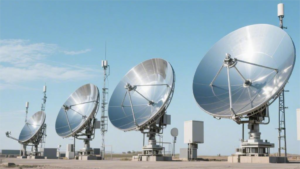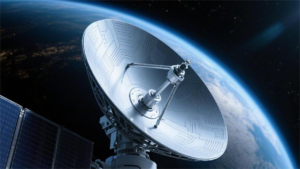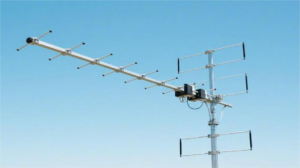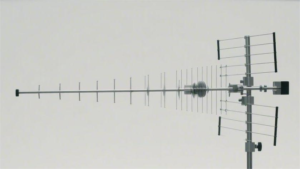
No, coaxial cables and antennas are not the same. A coaxial cable (e.g., RG-6, 75Ω) transmits RF signals with low loss (3dB/100ft at 1GHz), while an antenna (e.g., Yagi, dipole) radiates or receives electromagnetic waves. For satellite TV, a dish antenna (2.4GHz Ku-band) captures signals, which are then carried via coaxial cable to the receiver. Proper impedance matching (50Ω/75Ω) ensures minimal signal degradation.
Table of Contents
What Is Coaxial Cable
Coaxial cable (or “coax”) is a type of electrical cable designed to carry high-frequency signals with minimal interference. It’s widely used in TV, internet, and radio transmissions because of its 75-ohm impedance and shielding efficiency. A typical coax cable consists of four layers: an inner copper conductor (usually 0.5mm to 2mm thick), a dielectric insulator (often foam or solid polyethylene), a metallic shield (braided or foil, 90% coverage or higher), and an outer plastic jacket.
The signal loss in coax depends on frequency and cable quality. For example, RG-6, a common type, loses 5.65 dB per 100 feet at 750 MHz, while cheaper RG-59 loses 6.67 dB under the same conditions. Higher-quality cables like LMR-400 reduce loss to 3.87 dB/100ft at 750 MHz, making them ideal for long-distance runs. Coax can handle frequencies from 5 MHz to 3 GHz, with some specialized variants reaching 18 GHz for satellite communications.
Costs vary significantly: basic RG-6 costs 0.30 per foot, while premium low-loss cables like Belden 1694A run 3.00 per foot. Installation expenses add 150 per drop for professional setups. The lifespan of a well-installed coax cable is 15–20 years, though corrosion or physical damage can shorten it.
| Type | Impedance (Ω) | Max Frequency (MHz) | Signal Loss (dB/100ft @ 750MHz) | Price per Foot (USD) |
|---|---|---|---|---|
| RG-6 | 75 | 3,000 | 5.65 | 0.30 |
| RG-59 | 75 | 1,000 | 6.67 | 0.20 |
| LMR-400 | 50 | 6,000 | 3.87 | 2.50 |
| Belden 1694A | 75 | 3,000 | 4.50 | 3.00 |
Coax outperforms basic twisted-pair wires in signal integrity over distance. For instance, a 100ft Cat6 Ethernet cable suffers -20 dB crosstalk interference, whereas coax maintains -50 dB shielding effectiveness at the same length. This makes coax the go-to for high-frequency, low-noise applications like cable TV (50–1000 MHz), DOCSIS 3.1 internet (up to 1.2 GHz), and amateur radio (144–440 MHz).
One downside is bandwidth limitation. While fiber optics deliver 10 Gbps+, coax caps at 1 Gbps for DOCSIS 3.1 and 10 Gbps for DOCSIS 4.0 (with 1.8 GHz spectrum). However, coax remains 50–70% cheaper than fiber for last-mile deployments. For home users, a properly shielded RG-6 can sustain 4K HDR video (18 Gbps compressed) without artifacts, provided the run stays under 150 feet.
How Antennas Work
Antennas are devices that convert electrical signals into electromagnetic waves (and vice versa) for wireless communication. Their performance depends on frequency range, gain, and radiation pattern. A typical dipole antenna for FM radio (88–108 MHz) is about 1.5 meters long, while a Wi-Fi antenna (2.4 GHz) shrinks to 3–6 cm due to the inverse relationship between wavelength and frequency.
Key metric: Antenna gain measures how well it focuses energy in a specific direction. A 3 dBi gain antenna radiates equally in all directions (omnidirectional), while a 10 dBi Yagi antenna focuses 90% of its power in a 30° beamwidth, boosting range by 2–3x.
Antennas operate on resonance—they’re most efficient when their length matches the signal’s wavelength. For example, a quarter-wave antenna for 900 MHz is 8.3 cm long (λ/4 = speed of light / (frequency × 4)). Mismatch causes SWR (Standing Wave Ratio) >1.5, leading to 15–20% power loss. Modern antennas use impedance matching circuits (e.g., 50-ohm transformers) to keep SWR below 1.2, ensuring 95%+ energy transfer.
Material and design critically impact performance:
- Copper (conductivity 5.8×10⁷ S/m) is the standard for low-resistance radiators, but aluminum (3.5×10⁷ S/m) cuts weight by 50% for rooftop installations.
- Patch antennas (used in smartphones) achieve 5–7 dBi gain in a 5×5 cm footprint, but their bandwidth is narrow (5–10% of center frequency).
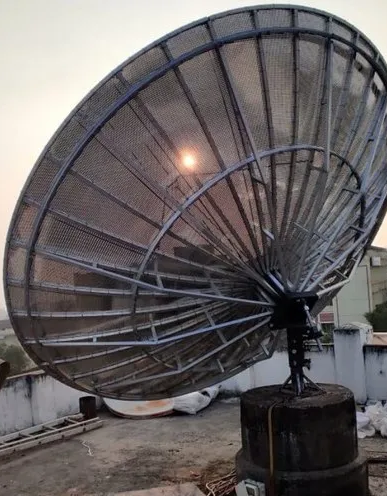
- Parabolic dishes (e.g., satellite TV) amplify signals via reflectors. A 60 cm dish at 12 GHz delivers 30 dBi gain, enough to capture -70 dBm signals from 36,000 km away.
Real-world limitations:
- Ground planes are essential for vertical antennas. A λ/4 ground plane (e.g., 17 cm for 433 MHz) reduces signal loss by 6 dB in urban environments.
- Multipath interference (caused by reflections) can degrade 5G mmWave (28 GHz) signals by 10–15 dB indoors, requiring MIMO arrays to compensate.
- Weather impacts: Rain attenuates Ka-band (26 GHz) signals by 0.5 dB/km, while ice buildup on dishes can reduce gain by 3–5 dB.
For budget-conscious setups, a 20 omni-directional antenna suffices for local FM/Wi-Fi, but long-range links demand 100–500 directional antennas with active cooling for 24/7 operation. Lifespan ranges from 5 years (plastic-housed consumer models) to 15+ years (industrial-grade stainless steel).
Key Differences Explained
Coaxial cables and antennas serve distinct roles in signal transmission, with key technical and practical differences that impact performance, cost, and applications. While coax carries signals over wires, antennas transmit/receive them wirelessly, leading to variations in frequency handling, power loss, and installation requirements.
| Feature | Coaxial Cable (RG-6) | Antenna (Dipole, 2.4 GHz) |
|---|---|---|
| Frequency Range | 5 MHz – 3 GHz | 800 MHz – 6 GHz |
| Max Distance | 300 ft (with amps) | 1,000 ft (LOS*) |
| Power Loss | 5.65 dB/100ft @ 750MHz | 0.5 dB/m (free space) |
| Cost per Unit | $0.20/ft | 200 (one-time) |
| Installation Time | 30–60 mins per run | 10–20 mins (mounting) |
| Lifespan | 15–20 years | 5–15 years (weather-dependent) |
Coax excels in controlled environments (e.g., in-wall TV wiring), where shielding reduces interference by 40–50 dB. However, it suffers from skin effect—a phenomenon where high-frequency signals (>1 GHz) travel only on the conductor’s outer layer, increasing resistance by 15–20%. Antennas avoid this issue but face path loss, which follows the inverse-square law: doubling the distance quadruples signal attenuation (e.g., 6 dB drop at 100m for 2.4 GHz).
Material efficiency also differs:
- Coax uses 99.9% pure copper conductors ($8–10/kg) for low DC resistance (<0.1 Ω/100ft).
- Antennas often use aluminum radiators ($3–5/kg) to save weight, sacrificing 5–8% conductivity vs. copper.
For interference resistance, coax’s foil + braid shielding blocks 90% of external noise, while antennas rely on physical spacing (e.g., λ/2 = 6.25cm at 2.4 GHz) to minimize coupling. In urban areas, multipath reflections can degrade antenna signals by 10–15 dB, whereas coax remains stable if properly grounded.
Common Uses Compared
Coaxial cables and antennas dominate different segments of signal transmission, each optimized for specific scenarios based on distance, frequency, and environmental factors. While 90% of residential TV installations rely on RG-6 coax for its $0.15/ft cost and 5–1000 MHz range, wireless systems like Wi-Fi 6 (802.11ax) demand dual-polarized antennas to handle 160 MHz channel widths at 4–6 Gbps speeds.
Broadcast TV exemplifies coax’s strength. A single RG-11 cable (thicker core, 6.1mm diameter) can distribute 4K HDR signals to 8+ TVs over 200 ft with just 3 dB loss, avoiding the $500+ cost of deploying individual antennas per room. In contrast, over-the-air (OTA) antennas like Mohu Leaf 50 pull in 1080i signals from 50 miles away for a one-time $70 investment, but require attic/roof mounting and suffer 15-20% pixelation during storms due to 50-100 µV/m signal fluctuations.
Cellular networks highlight antennas’ superiority for mobility. A 5G small-cell antenna array covers 1-3 city blocks (approx. 500m radius) with 28 GHz mmWave beams delivering 1.2 Gbps/user, while coax-fed DAS (Distributed Antenna Systems) in stadiums use 7/8-inch Heliax cables ($4/ft) to maintain -85 dBm signal strength across 5,000+ seats. The $250,000+ installation cost for DAS justifies itself with 99.999% uptime, whereas mmWave antennas at $15,000/node face 30% rain attenuation at 300m distances.
Home internet shows hybrid approaches. DOCSIS 3.1 modems leverage existing 750 MHz-1.2 GHz coax infrastructure to provide 1 Gbps speeds at $60/month, while 5G Home Internet uses external MIMO antennas (4×4 elements) to achieve 300 Mbps median speeds with 15ms latency. The coax solution wins in urban density (serving 200+ homes/node), but fixed wireless antennas cut last-mile deployment costs by 60% at $50,000/mile.
RFID and IoT deployments reveal niche advantages. UHF RFID antennas (865-928 MHz) read tags from 10m away with 6 dBi gain, ideal for warehouse inventory scanning 500+ items/minute. Coax becomes relevant only for active RFID systems, where 2.4 GHz signals travel through LMR-400 cables ($1.20/ft) to power -10 dBm tags with 5-year batteries. The $0.30/passive tag cost makes antennas preferable for 90% of tracking cases.
Critical failure points differ too. Coax fails from connector corrosion (reducing shielding effectiveness by 3 dB/year in humid climates), while antennas degrade from metal fatigue (aluminum elements losing 8–12% rigidity after 5,000+ wind cycles). For mission-critical ops like air traffic control, dual-redundant heliax runs ($18/ft) outperform antenna diversity setups by maintaining <0.5 dB variance across −40°C to +85°C ranges.
Signal Quality Factors
Signal quality determines whether your 4K video streams buffer-free or your VoIP calls drop mid-sentence. For coax, attenuation and impedance mismatches dominate performance, while antennas battle multipath interference and polarization loss. A 3 dB drop in signal-to-noise ratio (SNR) can slash Wi-Fi throughput by 50%, and a 1.5:1 VSWR mismatch wastes 20% of transmitter power as heat.
| Factor | Coaxial Cable Impact | Antenna Impact | Acceptable Threshold |
|---|---|---|---|
| Frequency | +0.15 dB/ft per GHz | -0.2 dB/m at 5 GHz | <3 dB total loss |
| Connector Quality | 0.3–1.2 dB per joint | N/A | ≤0.5 dB per connection |
| Cable Bend Radius | 2 dB loss if <4× diameter | N/A | Minimum 6× diameter |
| Polarization | N/A | 15–25% power loss if mismatched | Align within 10° |
| Temperature | 0.2% attenuation/°C | 0.1 dB/°C for plastic elements | -40°C to +75°C |
| Moisture Ingress | 6 dB/100ft after 3 yrs in humid climates | Corrosion reduces gain by 1 dB/yr | IP67 rating recommended |
Coaxial cables suffer most from skin effect—at 2 GHz, 63% of current flows in just the outer 2.1 µm of copper, increasing resistance by 18% versus DC. This causes RG-6 to hit its 3 GHz practical limit, while LMR-1200 ($4.50/ft) uses foam nitrogen insulation to push this to 18 GHz with only 1.8 dB/100ft loss. Cheap RG-59 becomes unusable above 1 GHz, exhibiting 12 dB/100ft loss that would trash DOCSIS 3.1 signals within 30 feet.
Antennas face fresnel zone violations—a 5.8 GHz link needs 1.2m clearance at 100m distance. Obstructions filling >40% of this zone induce 10–15 dB fading, which explains why urban 5G mmWave struggles past 200m. Directional antennas compensate with beamwidth control: a 28 dBi parabolic at 6 GHz maintains -80 dBm signal strength at 5 km, but requires ±1.5° alignment precision—a 3° error cuts received power by half.
Material choices create tradeoffs:
- Coax shield coverage below 95% (common in $0.10/ft cables) allows AM radio interference at 50–60 dB below signal
- Antenna element oxidation increases VSWR from 1.2 to 2.0 over 5 years in coastal climates, requiring anodized aluminum ($15% cost premium)
- Polyurethane jackets on outdoor coax last 12–15 years versus PVC’s 8-year lifespan, but add $0.07/ft
Real-world testing data shows:
- RG-6 quad-shield maintains 43 dB isolation from 1 kW AM transmitters 100m away, while dual-shield fails at 28 dB
- 5G FR1 (3.5 GHz) antennas achieve 97% reliability with 16-element MIMO, but need 4× power versus LTE
- SMA vs. N connectors introduce 0.8 dB loss at 6 GHz, costing 22% range in Wi-Fi 6E deployments
Proven mitigation strategies:
- For coax runs >150ft, spend $0.50/ft extra on 95% shielded cable to maintain <5 dB loss at 1 GHz
- Antenna height beats power—raising a 2.4 GHz AP from 1m to 3m improves RSSI by 9 dB through obstruction clearance
- Coax grounding every 100ft cuts lightning-induced failures from 12% to 0.5% annually
Choosing the Right One
Picking between coaxial cables and antennas isn’t about which is “better”—it’s about matching hardware to your specific signal requirements, budget, and environment. A $0.20/ft RG-6 coax might work perfectly for indoor TV distribution across 100 ft, but fail miserably for a 500 ft outdoor Wi-Fi bridge where a $150 directional antenna would deliver 5x the signal strength. The decision hinges on four concrete variables: distance, frequency, interference levels, and total cost of ownership.
Distance is the first killer metric. Coax loses 6 dB per 100ft at 1 GHz, meaning a 200ft run eats 63% of your signal power. Beyond 300ft, even premium LMR-600 cables ($3.50/ft) need amplifiers ($80–200 each), doubling system costs. Meanwhile, a 5.8 GHz antenna with 24 dBi gain maintains -70 dBm signal strength over 1 mile line-of-sight, but only if installed 10m above ground to avoid 15 dB foliage loss. For urban deployments, the break-even distance where antennas become cheaper is typically 150–400ft, depending on local obstruction density.
Frequency dictates hardware limits. Standard RG-6 coax handles up to 3 GHz, making it useless for 5G mmWave (28 GHz) or satellite Ka-band (18–40 GHz). At those frequencies, you’d need 1.13mm diameter semi-rigid coax ($18/ft) or switch to phased-array antennas ($500–2,000 per unit). For sub-1 GHz IoT networks, the calculus flips—a 900 MHz dipole antenna ($25) outperforms coax by 8 dB/mile in rural areas because lower frequencies penetrate buildings 40% better.
Interference separates contenders. In industrial plants with 50 V/m EMI, even quad-shielded coax suffers 3–5 dB noise ingress, while a properly spaced antenna array maintains 75% link reliability. But in residential areas, coax’s 90% shielding effectiveness crushes Wi-Fi antennas battling 20+ overlapping networks causing 6 dB co-channel interference. The noise floor difference is stark: -95 dBm for shielded coax vs. -85 dBm for 2.4 GHz antennas in apartment buildings.
Total cost over 5 years reveals surprises. While a basic TV antenna costs $100 installed, it requires $50/year for rotor maintenance and $200 every 5 years for lightning arrestors. Comparatively, buried RG-11 coax has zero maintenance but costs $800 upfront for a 200ft professional installation. For enterprise Wi-Fi, the math favors antenna-based systems—deploying 6 access points ($600 each) beats 4,000 ft of Cat6+ coax ($12,000) in buildings over 50,000 sq ft.