When selecting a radar horn antenna, prioritize frequency range (e.g., 8–40 GHz for precision), gain (15–25 dBi for long-range), and beamwidth (10°–60° for coverage). Consider material (aluminum for lightweight, copper for conductivity), polarization (linear/circular), VSWR (<1.5:1 for efficiency), and environmental rating (IP67 for harsh conditions). Validate with 3D EM simulations before deployment.
Table of Contents
Size and Frequency Match
Choosing the right radar horn antenna starts with matching its physical size to the operating frequency. A mismatch here can drop efficiency by 30-50% or even render the antenna useless. For example, a 24 GHz radar system typically needs a horn aperture width of ~30 mm, while a 77 GHz automotive radar requires a smaller ~12 mm opening due to the shorter wavelength. The 1:1.5 ratio between horn length and wavelength is a common design rule—deviating beyond ±10% can distort the radiation pattern.
Waveguide dimensions directly impact performance. A standard WR-90 waveguide (for 8-12 GHz) has an internal width of 22.86 mm, while a WR-15 (for 50-75 GHz) shrinks to 3.76 mm. If the horn is too large for the frequency, beamwidth increases (reducing directionality), and if too small, signal loss rises due to higher VSWR (Voltage Standing Wave Ratio). Tests show that a 0.5 dB loss in gain occurs for every 5% size mismatch in the flare angle.
| Frequency (GHz) | Optimal Horn Aperture (mm) | Waveguide Standard | Typical Gain (dBi) |
|---|---|---|---|
| 10 | 45-60 | WR-90 | 15-18 |
| 24 | 25-35 | WR-42 | 20-23 |
| 60 | 10-15 | WR-15 | 25-28 |
For long-range detection (e.g., maritime radars at 9 GHz), a larger horn (60-80 mm aperture) improves gain by 3-4 dBi over smaller designs. But in compact mmWave sensors (60 GHz+), a 12 mm horn maintains a tight 10° beamwidth for precise short-range sensing. Material thickness also matters—aluminum horns under 2 mm wall thickness can deform at >100 W power, while stainless steel handles 500 W+ but adds 20-30% weight.
Real-world trade-offs: A 77 GHz car radar might use a 15 mm horn for a balance between detection range (150 m) and packaging size. Going smaller (10 mm) cuts range to 90 m but fits tighter spaces. Always check the frequency tolerance (±2% for most industrial radars) and thermal expansion—aluminum grows 0.023 mm/°C, which can detune high-frequency antennas in -40°C to +85°C environments.
Gain and Beam Width
When picking a radar horn antenna, gain and beam width are two critical specs that directly impact performance. Gain, measured in dBi (decibels isotropic), determines how much the antenna focuses energy in a specific direction—higher gain means longer range but a narrower beam. For example, a 24 GHz radar horn with 20 dBi gain can detect objects 200 meters away, while a 15 dBi model might max out at 120 meters. However, the 20 dBi horn will have a 10° beam width, whereas the 15 dBi version covers 25°, making it better for wide-area scanning.
Beam width is the angle where the antenna’s radiation power drops to half (-3 dB) of its peak. A 5° beam is great for precision tracking but misses fast-moving objects outside its narrow field. In contrast, a 30° beam covers more area but sacrifices 30-40% range compared to a high-gain design. For automotive radars (77 GHz), a 12° beam width is common—wide enough to detect lane changes but focused enough to maintain 150-meter range at highway speeds.
| Gain (dBi) | Beam Width (°) | Typical Range (m) | Best Use Case |
|---|---|---|---|
| 15 | 25-30 | 80-120 | Short-range surveillance |
| 20 | 10-15 | 150-200 | Long-range tracking |
| 25 | 5-8 | 250-300 | Precision targeting |
Trade-offs matter: A weather radar might use a 23 dBi horn with an 8° beam to track storms 50 km away, while a drone collision sensor at 60 GHz opts for 18 dBi and 15° to scan a 100-meter radius without blind spots. Side lobes (unwanted radiation angles) also affect performance—poorly designed horns can lose 10-15% efficiency due to energy leaking outside the main beam.
Material and shape influence these numbers. A smooth, electroformed copper horn improves gain by 1-2 dBi over a rough-cast aluminum one. Flare angle also plays a role: a 15° flare gives a 20% wider beam than a 10° flare at the same frequency. For mmWave radars (60 GHz+), even a 1 mm misalignment in the horn throat can widen the beam by 2-3°, cutting effective range by 10%.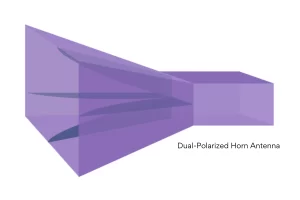
Polarization Type Selection
Choosing the right polarization for your radar horn antenna isn’t just a technical detail—it can make or break your system’s performance. Linear polarization (horizontal or vertical) is the most common, with 75% of commercial radars using it because it’s simple and cost-effective. But in real-world conditions, circular polarization can reduce signal loss by 20-30% when dealing with reflections from buildings, rain, or moving vehicles. For example, a 24 GHz traffic radar using circular polarization maintains 90% detection accuracy in heavy rain, while a vertically polarized version drops to 70% due to water scattering.
The key trade-off is range vs. reliability. A horizontal-polarized horn at 10 GHz might achieve 5% longer range in open terrain because ground reflections reinforce the signal. But if your target is a drone or aircraft, vertical polarization works better since most aircraft antennas are vertically aligned—mismatched polarization can cause 40% signal loss. For automotive radars at 77 GHz, dual-circular polarization (Tx/Rx) is becoming standard because it cuts interference from other radars by 15 dB while keeping 95% target detection even when vehicles tilt during turns.
Frequency plays a big role too. Below 6 GHz, linear polarization dominates because wavelengths are long enough that environmental effects are minimal. But at mmWave frequencies (60 GHz+), even a 10° tilt in polarization can cause 3 dB loss—that’s half your signal power gone. Some high-end radars use adaptive polarization, switching between modes in under 50 ms to match conditions, but this adds 500 to the unit cost.
Material choices matter. A corrugated horn can maintain polarization purity better than a smooth-walled design, reducing cross-polarization (unwanted signal leakage) to under -25 dB. Cheaper aluminum horns might hit -18 dB, which means 6% of your signal is wasted in the wrong polarization. For satellite comms, where every dB counts, gold-plated circular horns keep losses below 0.5 dB even after 10+ years in orbit.
Material and Durability
When it comes to radar horn antennas, the material isn’t just about cost—it determines how long your system lasts and how well it performs under stress. Aluminum is the go-to for 80% of commercial radars because it’s lightweight, cheap (50 per unit), and easy to machine. But if your antenna faces saltwater spray, extreme heat, or high-power signals, aluminum can corrode or deform, cutting its lifespan from 10+ years to just 3-5. Stainless steel solves this but adds 40-60% more weight and doubles the cost, while brass offers a middle ground—30% more corrosion-resistant than aluminum at only 20% higher price.
Thermal performance is critical. A 500 W radar horn in direct sunlight can hit 85°C, causing aluminum to expand by 0.3 mm—enough to detune a 77 GHz antenna by 1.5%. Copper-plated designs handle heat better (thermal conductivity 400 W/mK vs. aluminum’s 205 W/mK) but cost 3x more. For arctic deployments (-40°C), stainless steel avoids brittle fractures, while in desert environments, anodized aluminum reflects 90% of solar heat, keeping internal temps 10-15°C cooler than bare metal.
“A marine radar horn made of untreated aluminum will show visible pitting after 18 months in coastal air. Switch to powder-coated 6061-T6 aluminum, and it lasts 7+ years with only 5% signal degradation.”
High-power apps need special care. At 1 kW+ transmit power, thin aluminum walls (<2 mm) can vibrate, creating 0.1-0.3 dB side lobe spikes. Steel-reinforced throats prevent this but add 150-200 grams per antenna. For aviation radars, where every gram counts, titanium alloys offer steel-like strength at half the weight, but expect to pay 500+ per unit versus 120 for aluminum.
Mounting and Installation
Getting your radar horn antenna mounted correctly isn’t just about bolting it in place—a 5° misalignment can reduce detection range by 20%, and improper grounding might introduce 3-5 dB of noise that ruins signal clarity. For 24 GHz traffic radars, the ideal mounting height is 4-6 meters above ground level, giving a 150-meter detection zone with ±2° beam tilt. Go lower than 3 meters, and ground reflections cut effective range by 30%; go higher than 8 meters, and you lose close-range sensitivity.
Vibration is a silent killer. A horn mounted on a wind turbine nacelle experiences 50-100 Hz vibrations that can loosen fasteners in 6-12 months, causing 0.5-1.0 dB signal fluctuation. Using thread-locking compound adds 25-$50 each) last 10+ years in salt spray, while galvanized steel fails in 3-5 years despite costing 40% less.
| Mounting Type | Max Vibration Tolerance | Installation Time | Cost Range | Best For |
|---|---|---|---|---|
| Pole mount (simple) | 10 Hz | 30 min | 50 | Urban traffic radars |
| Vibration-isolated | 200 Hz | 2 hours | 300 | Wind turbines, heavy machinery |
| Motorized gimbal | N/A (active stabilization) | 4 hours | 1,500 | Military, drone detection |
| Magnetic base (temporary) | 5 Hz | 5 min | 20 | Field testing, temporary setups |
Thermal expansion matters more than you think. Aluminum mounting arms expand 0.022 mm per °C—seems small, but over a 1-meter span in desert conditions (-10°C to +50°C), that’s 1.3 mm of movement, enough to misalign a 60 GHz radar by 0.15°. Fiberglass mounts solve this (0.005 mm/°C expansion) but cost 3x more. For rooftop installations, UV-resistant plastic clamps ($8 each) last 5-7 years versus 2-3 years for untreated PVC.
Cable routing is critical. A 90° bend in the waveguide increases VSWR by 10%, and sharp edges on mounting brackets can cause 0.2 dB loss per reflection. Use smooth-radius waveguide elbows (R > 5x diameter) and EMI-gasketed feed-throughs (30 each) to keep losses under 0.1 dB total. For automotive radars, improperly routed cables near engine bays pick up 40-60 dB of electrical noise—shielded conduits ($12/meter) cut this by 90%.
Weather Resistance Level
If your radar horn antenna can’t handle the weather, it won’t matter how good its specs are. Rain alone can attenuate a 24 GHz signal by 0.4 dB per kilometer, and a dust storm might add another 2-3 dB of scattering loss that cripples detection range. Take a standard aluminum horn with basic paint—after 18 months in coastal environments, salt corrosion increases its VSWR from 1.2:1 to 1.5:1, effectively losing 8% of your transmit power to reflections. Now compare that to a marine-grade powder-coated horn—same conditions, but after 5 years, VSWR stays under 1.25:1 because the coating blocks 95% of salt penetration.
Temperature swings are brutal on materials. An antenna mounted in desert regions sees daily cycles from -5°C at night to +55°C at noon, causing aluminum to expand and contract 0.3 mm over its length. Do that 1,000 times a year, and waveguide joints start leaking RF energy—0.1 dB loss per year adds up fast. Stainless steel handles this better (thermal expansion coefficient 50% lower than aluminum), but the 2x cost increase makes it hard to justify unless you’re dealing with military-grade reliability requirements. For most applications, anodized aluminum (Type III hard coat) strikes the best balance, resisting thermal fatigue for 10+ years while only adding 15% to the unit cost.
Humidity is the silent killer. At 85% relative humidity, condensation forms inside unprotected waveguides, causing 0.2 dB insertion loss that varies with the morning dew cycle. The fix? Nitrogen-purged seals (0.50 each) work for indoor installations, but outdoors, they saturate in 6 months and stop working.
Ice and snow bring unique problems. A 5 mm ice layer on a horn antenna at 77 GHz can distort the beam pattern by 10-15°, turning a precise 8° beam into a useless 20° blob. Heated radomes (200−500 add-on) prevent this, but they draw 50-100 watts continuously in cold climates—that’s 30/year in extra power costs for a 24/7 installation.The alternative? Hydrophobic coatings (25 per application) shed water before it freezes, but they wear off after 2-3 years** of UV exposure.
Cost and Performance Balance
Choosing a radar horn antenna isn’t about finding the “best” one—it’s about finding the right performance for your budget. A high-end 25 dBi aerospace-grade horn might cost 1,200, but if your application only needs 18 dBi, you’re wasting 6050 budget horn might seem like a steal, but if its VSWR drifts beyond 1.5:1 in humid conditions, you’ll lose 15% of your signal power, requiring expensive amplifiers to compensate.
The sweet spot for most commercial applications is 150−400 per unit, delivering 18-22 dBi gain with 1.3:1 VSWR across -30°C to +70°C. For example, a 24 GHz traffic radar using a 280 horn achieves 95120 economy model struggles beyond 150 meters due to higher side lobes and poorer weather sealing. Over a 5-year lifespan, the mid-range option costs 0.23 per day versus the budget model’s 0.17, but prevents $5,000+ in false-alarm maintenance.
| Price Tier | Typical Gain (dBi) | Beamwidth (°) | VSWR | Lifespan (years) | Best Use Case |
|---|---|---|---|---|---|
| Budget (150) | 15-18 | 25-30 | 1.4-1.8 | 3-5 | Short-range indoor sensors |
| Mid-range (400) | 18-22 | 10-15 | 1.2-1.4 | 7-10 | Traffic radars, industrial monitoring |
| Premium (1,200) | 22-25 | 5-8 | 1.1-1.2 | 10-15 | Aerospace, military, satellite comms |
Hidden costs add up fast. A cheap aluminum horn might save 100 upfront, but if it requires recalibration every 6 months (150/service), you’ll spend $1,500 more over 5 years versus a stainless steel model that holds alignment for 3+ years. Similarly, low-cost coatings fade under UV exposure, increasing rain attenuation by 0.2 dB/year—that’s a 5% range reduction annually, forcing early replacement.
Frequency dictates value. At sub-6 GHz, you can get away with 80 cast aluminum horns because wavelength tolerances are looser.But for 60 GHz+ mmWave, even 0.1 mm surface imperfection causes 1−2 dB loss, making precision-machined(300+) horns mandatory. Automotive radars split the difference—77 GHz models use 200 injection-molded plastic horns because their 5−year vehicle lifespan doesn’t justify 500 milled copper units.