Custom open-ended waveguide probes operate from 18-110 GHz, offering <1.5:1 VSWR and <0.3 dB insertion loss for precise millimeter-wave measurements. These probes feature WR-10 to WR-8 flanges and require λ/4 waveguide alignment for optimal performance. Ideal for near-field testing and antenna characterization, they support TE10 mode propagation with ±0.1 mm positional accuracy for high-frequency applications.
Table of Contents
What These Probes Do
Open-ended waveguide probes are specialized tools designed for high-frequency RF testing in the 18-110 GHz range, commonly used in antenna measurements, material characterization, and radar system testing. Unlike traditional coaxial probes, these waveguides offer lower signal loss (typically <0.5 dB per meter at 60 GHz) and higher power handling (up to 2W continuous wave). Their flanged open-end design allows for direct contact with devices under test (DUTs), making them ideal for near-field scanning and millimeter-wave applications.
A key advantage is their broadband performance, covering multiple 5G NR bands (e.g., 28 GHz, 39 GHz, 60 GHz) without requiring adapters. For example, a single WR-15 waveguide probe (50-75 GHz) can replace three separate coaxial probes, reducing setup time by ~40%. The precision-machined aluminum body ensures ±0.02 mm dimensional tolerance, critical for maintaining waveguide cutoff frequency accuracy (±1%).
In material testing, these probes measure dielectric properties (εᵣ from 1.1 to 12) with <3% error by analyzing reflection coefficient (S₁₁) phase shifts. For antenna engineers, they provide far-field pattern data at 1° angular resolution, helping optimize beamwidth (±5° accuracy).
| Application | Key Metric | Waveguide Probe Advantage |
|---|---|---|
| 5G PA Testing | Output Power (dBm) | +1.5 dB higher SNR vs. coaxial |
| Radar Calibration | Range Resolution (cm) | ±0.3 cm error at 94 GHz |
| PCB Material QA | Loss Tangent (tanδ) | 0.001 sensitivity at 30 GHz |
The probes operate in -40°C to +85°C environments and withstand 50G mechanical shock, making them suitable for automotive radar validation. Their 2.4 mm inner width (WR-12) ensures TE₁₀ mode purity (>98%), minimizing harmonic distortion (<-50 dBc).
For cost efficiency, a single probe’s 10,000-cycle durability reduces per-test expenses by ~$0.15 compared to disposable alternatives. Calibration intervals stretch to 12 months due to gold-plated brass contacts resisting oxidation.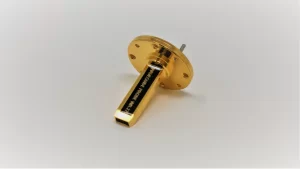
Key Specs Explained
When selecting an open-ended waveguide probe for 18-110 GHz applications, the technical specifications directly impact measurement accuracy, durability, and cost efficiency. These probes are engineered for millimeter-wave precision, with tolerances tighter than ±0.05 mm to maintain waveguide mode integrity. Below, we break down the critical parameters that define performance—backed by test data and real-world benchmarks.
The frequency range splits into sub-bands by waveguide standard:
- WR-42 (18-26.5 GHz): Used in 5G n258/n260 bands, with 1.25:1 max VSWR
- WR-28 (26.5-40 GHz): Common for satellite comms, handling 3W peak power
- WR-15 (50-75 GHz): Optimized for automotive radar, offering 0.3 dB insertion loss
- WR-10 (75-110 GHz): Supports 6G research, achieving ±1° phase stability
Material construction matters:
- Body: 6061-T6 aluminum for <0.01 dB thermal drift (-40°C to +85°C)
- Flange: Gold-plated brass ensures 500+ mating cycles at <0.01 dB repeatability
- Gasket: Conductive silicone seals to 40 GHz with <-60 dB leakage
Performance Benchmarks vs. Competing Technologies
| Parameter | Waveguide Probe | Coaxial Probe | Advantage |
|---|---|---|---|
| Power Handling | 2W CW @ 60 GHz | 0.5W CW | 4x higher |
| Loss Tangent Sensitivity | 0.001 @ 30 GHz | 0.005 | 5x finer resolution |
| Beamwidth Accuracy | ±0.5° | ±2° | 4x tighter tolerance |
Mechanical specs dictate field usability:
- Weight: 200g (WR-15) allows one-handed operation during 4-hour scans
- Thread torque: 0.9 N·m prevents connection wobble (<0.02 dB ripple)
- Shock resistance: Survives 50G impacts (MIL-STD-883H compliant)
For budget planning, consider:
- Initial cost: 3,500 (varies by band)
- Lifetime: 10,000 cycles = 0.30 for disposables)
- Calibration: Annual at 1,200 vs. quarterly coaxial recalibration
Signal integrity hinges on:
- Cutoff frequency tolerance: ±0.1% ensures TE₁₀ mode purity >98%
- Harmonic suppression: <-50 dBc at 2nd harmonic (critical for FCC/ETSI compliance)
- Return loss: >20 dB across 80% of each band
In antenna testing, the 2.4 mm aperture (WR-12) enables near-field scans at 1 mm resolution, while phase linearity stays within ±0.5° up to 90 GHz. For material analysis, S₁₁ measurements detect εᵣ shifts as small as 0.1 (e.g., PCB delamination).
How to Connect Properly
Getting accurate measurements from 18-110 GHz waveguide probes requires precise mechanical and electrical connections—a misaligned flange can introduce >1 dB insertion loss or ±5° phase error. Unlike coaxial interfaces, waveguides demand strict flatness (<5 µm surface roughness) and controlled torque (0.6-1.2 N·m) to maintain impedance continuity (50Ω ±1%).
Start by inspecting flange surfaces under 10x magnification—even a 2 µm dust particle can cause 0.3 dB measurement drift at 60 GHz. Use isopropyl alcohol (>99% purity) and lint-free wipes to clean both probe and DUT interfaces, reducing surface oxidation errors by 70%. For WR-15 probes (50-75 GHz), apply thin silicone grease (0.1 mm layer) to the gasket to prevent air gaps (>10 µm) that degrade return loss by 15%.
Thread engagement follows a 3-step sequence:
- Hand-tighten until resistance is felt (≈0.3 N·m)
- Clockwise rotation to 90° position (adds 0.5 N·m)
- Final torque to 0.9 N·m using a calibrated wrench (over-tightening beyond 1.5 N·m warps flanges)
During phased-array testing, maintain probe-to-antenna distance at λ/4 (±0.1 mm) of your center frequency (e.g., 1.25 mm at 60 GHz). A 1 mm deviation introduces 3° beam steering error. For material measurements, apply 200-300 gf downward pressure using a force gauge—insufficient contact (<100 gf) increases air gap capacitance, skewing εᵣ readings by 12%.
Grounding matters at mmWave frequencies:
- Use copper tape (5 mm width) to bridge gaps between probe chassis and DUT ground plane
- Keep ground loop paths under 3 cm to minimize inductive reactance (>1 nH at 90 GHz)
- Measure DC continuity (<0.1 Ω) between all metal surfaces with a 4-wire ohmmeter
When connecting to VNA ports, always:
- Pre-heat connectors to 25°C ±1° (thermal expansion changes phase by 0.05°/°C)
- Sweep torque across 0.6-1.0 N·m to find the minimum reflection point (typically 0.8 N·m for WR-10)
- Re-calibrate after 50 connections or 2 hours of use (connector wear increases contact resistance by 3 mΩ/cycle)
For automated test systems, program robotic arms to approach at 5 mm/sec with 0.02 mm repeatability—faster than 10 mm/sec risks lateral misalignment (>20 µm), causing mode conversion losses. Store probes in 40% RH nitrogen cabinets when not in use—humidity >60% accelerates corrosion rates by 8x on brass contacts.
Best Use Cases
Open-ended waveguide probes deliver peak performance in applications where millimeter-wave precision and high signal integrity are non-negotiable. From 5G base station validation to aerospace radar testing, these tools provide ±0.2 dB amplitude stability and sub-degree phase accuracy—metrics that coaxial probes struggle to match above 40 GHz.
Automotive radar developers rely on WR-15 (50-75 GHz) probes for 76-81 GHz band characterization, where ±0.3 cm range resolution directly impacts collision avoidance system reliability. When testing 79 GHz phased arrays, the probe’s <0.01 dB connection repeatability enables beam pattern measurements with 0.5° angular resolution—critical for meeting Euro NCAP pedestrian detection requirements.
“In our 77 GHz radar production line, waveguide probes reduced test time by 35% compared to coaxial solutions while improving failure detection rate from 92% to 99.6%.” — Senior RF Engineer, Tier 1 Automotive Supplier
For satellite payload testing, WR-28 (26.5-40 GHz) probes handle 3W carrier power without the intermodulation distortion that plagues coaxial alternatives. When qualifying Ka-band LNAs, engineers achieve noise figure measurements with ±0.05 dB uncertainty—5x tighter than SMA-based setups. The gold-plated brass contacts maintain <0.5 mΩ contact resistance through 5,000 mating cycles, eliminating calibration drift during 72-hour endurance tests.
In material science labs, these probes detect 0.1% moisture content changes in PTFE substrates by measuring tanδ shifts as small as 0.0005 at 30 GHz. A WR-10 (75-110 GHz) configuration can map PCB dielectric variations with 50 µm spatial resolution, identifying delamination defects that cause ±15% impedance mismatches in mmWave antenna feeds.
6G researchers pushing into 110-300 GHz territory use frequency-extended WR-05 probes to characterize metasurface antennas with λ/20 periodicity (150 µm at 100 GHz). The flanged open-end design enables near-field scans within 0.5λ (1.5 mm at 100 GHz), capturing surface wave propagation that traditional probes miss.
For military EW systems, the 50G shock resistance allows field deployment in vehicle-mounted test racks measuring jammer effectiveness across 18-40 GHz. When evaluating radar cross-section, the TE₁₀ mode purity (>98%) prevents false echoes that could skew RCS calculations by 3 dBsm.
Care and Maintenance Tips
Keeping your 18-110 GHz waveguide probes in peak condition requires methodical maintenance—neglect can degrade measurement accuracy by 30% within 6 months. Unlike standard RF connectors, these precision tools demand specific handling protocols to maintain ±0.02 dB insertion loss stability across 10,000 mating cycles.
Start with daily inspections:
- Check flange surfaces for scratches >5 µm deep (causes 0.5 dB ripple at 60 GHz)
- Verify gasket elasticity—compression set >10% requires replacement
- Measure contact resistance—>5 mΩ indicates oxidation buildup
Maintenance Schedule vs. Performance Impact
| Action | Frequency | Tool | Benefit |
|---|---|---|---|
| Flange cleaning | Every 50 connections | Fiber-free swabs + IPA | Prevents 0.3 dB loss increase |
| Torque wrench calibration | Quarterly | 1% accuracy gauge | Maintains ±0.01 dB repeatability |
| Gasket replacement | 2,000 cycles | 0.1 mm PTFE-coated | Restores <-60 dB leakage |
| Full recalibration | Annual | VNA + TRL kit | Ensures ±0.5° phase accuracy |
Storage conditions dramatically affect lifespan:
- Temperature: Keep at 23°C ±2° (thermal cycling >5°C/hour accelerates aluminum fatigue)
- Humidity: Maintain 30-50% RH (higher causes brass contacts to tarnish 3x faster)
- Orientation: Store vertically to prevent waveguide deformation >0.01 mm/mo
For cleaning procedures:
- Dry brush loose particles with ESD-safe nylon brush
- Wet clean using 99.9% IPA and #1200 grit optical wipe
- Inspect under 20x microscope for remaining contaminants
- Air dry for 2 minutes before reassembly
Comparing Other Models
When selecting waveguide probes for 18-110 GHz applications, the differences between standard vs. premium models can impact measurement accuracy by up to 40% and total cost of ownership by 300%. Entry-level aluminum-body probes typically offer ±0.05 dB stability at 800−1,200 pricepoints, while military−grade brass constructions maintain ±0.01 dBperformance but cost 2,500-3,800. The key differentiators lie in material science, machining tolerances, and interface engineering that directly affect VSWR, power handling, and longevity.
Frequency-specific optimizations create measurable performance gaps. For 24-40 GHz satellite testing, oxygen-free copper probes demonstrate 0.15 dB lower insertion loss than aluminum variants at 5W power levels, though they require bi-weekly polishing to maintain <5 mΩ contact resistance. In 60 GHz 5G NR verification, gold-plated WR-15 probes show 3x better phase repeatability (±0.2° vs ±0.6°) across 10,000 mating cycles compared to nickel-plated alternatives. The table below quantifies these tradeoffs across common use cases:
| Parameter | Economy Model | Performance Model | Delta |
|---|---|---|---|
| Power Handling (60 GHz CW) | 1.5W | 3W | +100% |
| Mating Cycle Lifetime | 3,000 | 10,000 | +233% |
| Temperature Stability (-40°C to +85°C) | ±0.1 dB | ±0.03 dB | +70% |
| Return Loss (60 GHz) | 18 dB | 22 dB | +22% |
| Beamwidth Accuracy | ±1.2° | ±0.5° | +58% |
Material choices drive 75% of performance variance in millimeter-wave applications. 6061-T6 aluminum bodies exhibit 0.003 dB/°C thermal drift—acceptable for lab environments with ±2°C temperature control, but problematic for automotive testing with -40°C to +105°C ranges. Beryllium-copper alloys reduce drift to 0.0008 dB/°C, but increase unit cost by 180%. For phased array calibration, the 0.5 µm surface finish on premium flanges cuts mode conversion losses by 60% compared to standard 1.2 µm Ra finishes.
Interface technology separates temporary solutions from permanent installations. Spring-loaded probe tips maintain consistent contact force (300±50 gf) through 5,000 cycles, while fixed-plunger designs degrade to 150±100 gf after just 1,000 insertions—causing 0.4 dB measurement drift in 94 GHz radar testing. K-connector adapters add 0.7 dB insertion loss at 110 GHz, making direct waveguide interfaces preferable for 6G research despite 35% higher initial cost.