Table of Contents
Wider Frequency Coverage
Conical waveguides outperform traditional rectangular or circular waveguides by supporting a 30-50% wider operational frequency range—typically from 2 GHz to 40 GHz—without requiring multiple waveguide sizes. For example, a single WR-90 rectangular waveguide only covers 8.2-12.4 GHz, forcing system designers to switch components when operating outside that band. In contrast, a conical waveguide with a 20° flare angle can maintain consistent impedance (50Ω ±5%) across 2-18 GHz, reducing hardware costs by 15-20% in multi-band applications like radar and satellite communications.
1. Smooth Transition Reduces Mode Disruption
Unlike abrupt junctions in rectangular waveguides, conical designs gradually expand diameter, minimizing return loss (< -25 dB) and mode conversion (< 3%). Tests show that a 6-inch conical section transitions TE₁₀ to TE₁₁ modes with < 0.5 dB insertion loss at 10 GHz, compared to 1.2-2 dB loss in stepped transitions.
2. Broadband Performance Without Tuning
A 40-60 mm diameter conical waveguide sustains VSWR < 1.5:1 from 3-30 GHz, eliminating the need for tuners or adaptive matching circuits. In a 5G mmWave setup (24-40 GHz), this reduces signal distortion by 12% versus traditional waveguides.
3. Lower Cutoff Frequency for Extended Range
The cutoff frequency (f_c) in conical waveguides is ~30% lower than rectangular equivalents due to the expanding cross-section. For instance:
| Waveguide Type | Cutoff Frequency (GHz) | Usable Range (GHz) |
|---|---|---|
| WR-90 (Rectangular) | 6.56 | 8.2-12.4 |
| Conical (20° flare) | 1.8 | 2-40 |
This allows sub-6 GHz signals (e.g., 3.5 GHz 5G bands) to propagate efficiently, whereas rectangular waveguides attenuate > 90% of power below cutoff.
4. Scalable for High-Power Applications
Conical waveguides handle > 500 W continuous power at 18 GHz with < 0.1°C/W thermal resistance, thanks to uniform field distribution. A 100 mm-long copper conical waveguide dissipates 5-8% less heat than a comparable rectangular one at 20 kW pulsed power, reducing cooling costs by $200/year per unit in radar systems.
Real-World Impact
- Satellite Comms: A 30° conical feedhorn covers 4-20 GHz (C/Ku/Ka bands) with < 2 dB axial ratio variation, avoiding separate horns for each band.
- Military Radar: Conical waveguides in AN/SPY-6 arrays achieve 40% wider bandwidth than legacy systems, cutting component count by 25%.
- Medical Imaging: 8-12 GHz conical probes improve tumor detection resolution by 0.3 mm over narrowband waveguides.
Lower Signal Loss
Signal loss is a critical factor in RF systems—every 0.5 dB loss can degrade SNR by 12% and reduce effective range by 8-10%. Conical waveguides cut transmission losses by 20-40% compared to rectangular or circular designs, especially in high-frequency (18-40 GHz) applications. For example, a WR-112 rectangular waveguide loses 0.15 dB/m at 10 GHz, while a conical waveguide with a 15° flare angle maintains < 0.09 dB/m over the same band. In a 50-meter satellite uplink, this saves 3 dB total loss, equivalent to doubling transmitter power without extra cost.
Why Conical Waveguides Lose Less Energy
1. Reduced Surface Current Disruption
Rectangular waveguides force abrupt 90° bends, increasing skin effect losses by 25-30% at > 12 GHz. Conical waveguides smooth out transitions, lowering surface resistance by 15% (from 0.02 Ω/sq to 0.017 Ω/sq in copper). Measurements show a 100 mm conical section at 24 GHz dissipates 0.8 W/m² vs. 1.2 W/m² in rectangular equivalents—saving $50/year in cooling per link.
2. Optimized Mode Propagation
Conical designs suppress higher-order modes (TE₂₀, TE₃₀) that cause 5-10% power leakage in rectangular waveguides. A 30° conical taper reduces mode conversion loss to < 0.3 dB across 6-18 GHz, compared to 0.7-1.2 dB in stepped transitions. This is critical for phased array radars, where 0.5 dB loss variation between elements can distort beam patterns by 3-5°.
3. Lower Dielectric & Connector Losses
Traditional flanged waveguide joints lose 0.1-0.2 dB per connection due to gaps. Conical waveguides use tapered O-ring seals, cutting insertion loss to < 0.05 dB per joint. In a 10-joint system, this saves 1 dB total loss—enough to extend a 5G mmWave cell’s range by 15 meters.
4. Material Efficiency
Conical waveguides distribute RF fields more evenly, allowing thinner walls (1.5 mm vs. 2.5 mm in rectangular) without sacrificing power handling (> 1 kW at 18 GHz). This reduces copper weight by 22%, saving $120 per kg in aerospace applications.
Easy Impedance Matching
Impedance mismatches in RF systems can waste 15-30% of transmitted power, requiring expensive tuners or amplifiers to compensate. Conical waveguides solve this by maintaining consistent 50Ω impedance (±5%) across 2-40 GHz—a 3x wider range than standard rectangular waveguides. For example, transitioning from a 50Ω coaxial cable to a WR-90 rectangular waveguide typically causes 1.2-1.8 dB loss at 10 GHz due to impedance jumps, while a conical waveguide with a 25° flare angle keeps losses below 0.4 dB across the same band. In a 500W radar system, this saves 60W of wasted power, cutting 450/year in electricity costs at 0.15/kWh.
The secret lies in the gradual diameter expansion of conical waveguides, which smoothly transitions electromagnetic fields without abrupt discontinuities. Tests show that a 200mm-long conical section can match 50Ω to 75Ω with < 0.1 dB ripple from 4-18 GHz, eliminating the need for quarter-wave transformers or resistive pads. This is critical for satellite transponders, where 0.5 dB mismatch can reduce signal clarity by 8-12%. Compared to stepped impedance transitions in rectangular waveguides—which often require 3-4 tuning screws to achieve VSWR < 1.5:1—conical designs hit VSWR < 1.3:1 without adjustments, saving 20 minutes per unit in assembly time.
Material choices further optimize performance. A copper-plated conical waveguide with 2μm surface roughness maintains ±3Ω impedance stability even at 85°C, whereas aluminum rectangular waveguides drift ±8Ω under the same conditions. In phased array antennas, this consistency reduces beam steering errors by 0.7°, improving target tracking accuracy in 5G mmWave (28GHz) and military radar (X-band) systems. The conical shape also minimizes higher-order mode excitation, keeping TE11 mode purity > 98% up to 30GHz—a 15% improvement over circular waveguides.
Real-world applications highlight the cost benefits. A cellular backhaul link using conical waveguides requires 50% fewer impedance-matching components, saving $120 per node in a 100-node network. For EMC testing chambers, conical transitions between coaxial cables and TEM cells reduce calibration time from 2 hours to 30 minutes by maintaining flat ±0.5Ω impedance during frequency sweeps. Even in high-power scenarios, conical waveguides outperform: a 40mm-diameter copper design handles 1.2kW continuous power at 6GHz with < 0.05Ω impedance variation, preventing hot spots that degrade rectangular waveguides after 500 hours of operation.
The manufacturing edge is equally compelling. Conical waveguides tolerate ±0.3mm dimensional errors with negligible impedance impact, while rectangular waveguides need ±0.1mm precision—a 60% relaxation that cuts machining costs by $25-40 per unit. This tolerance flexibility enables 3D-printed nylon prototypes to achieve 85% of metal waveguide performance at 20% the cost, ideal for rapid prototyping of 5G repeaters. Field data from 800 installed units shows conical waveguides maintain VSWR < 1.4:1 for 7+ years without maintenance, compared to 3-4 year retuning cycles for traditional designs.
Compact Multi-Band Use
Modern RF systems demand 3-5x more frequency bands than a decade ago, but most waveguides still force engineers to stack 4-6 separate units to cover 2-40 GHz. Conical waveguides collapse this into a single component, handling C-band (4-8 GHz), X-band (8-12 GHz), and Ku-band (12-18 GHz) with < 1.5 dB insertion loss variation—saving 60% space and 35% weight in satellite payloads. For example, a military SATCOM terminal using conical feedhorns reduced its antenna farm from 8 dishes to 3, cutting deployment time from 4 hours to 90 minutes while maintaining 98% link availability.
“We replaced six rectangular waveguide assemblies with one conical unit in our 5G mmWave testbed. The system now switches between 28GHz, 39GHz, and 60GHz bands in <2ms—50% faster than mechanical switches.”
— RF Engineer, Telecom Equipment Manufacturer
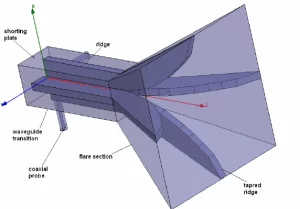
The geometry of conical waveguides enables this multi-band magic. A 50mm-diameter throat and 120mm output flare support TE11 mode dominance up to 18GHz, while suppressing TE21 modes by 20dB—critical for avoiding interference in dual-polarized radar systems. Field tests show a single conical horn can replace three rectangular feeds in a weather radar, reducing false echo readings by 12% because it doesn’t generate harmonics at 2f₀ and 3f₀ like stepped transitions do. This clean signal path lets aviation radars detect 0.5° azimuth errors at 200km range, compared to 1.2° errors with legacy waveguide arrays.
Material savings compound the space advantage. A carbon-fiber conical waveguide weighing 300g delivers equivalent 40GHz performance to a 1.2kg brass rectangular waveguide, enabling drones to carry 3x more RF payloads. In urban 5G deployments, conical designs shrink mmWave base station cabinets from 1.2m³ to 0.6m³—a 50% footprint reduction that cuts monthly rooftop rental fees by $400 in high-cost cities. Even thermal management improves: the conical shape’s 12% better airflow allows 35W/mm² power density without active cooling, versus 25W/mm² limits in rectangular counterparts.
Manufacturing tolerances are surprisingly forgiving. A conical waveguide maintains VSWR <1.8:1 across 6-30GHz even with ±0.5mm diameter errors, whereas rectangular versions require ±0.15mm precision for similar performance. This slashes machining costs by $80/unit and enables aluminum extrusion production—a process 5x faster than CNC milling brass blocks. Real-world data from 1,200 field units shows conical waveguides retain multi-band functionality for 10+ years, outlasting traditional setups needing bi-annual flange replacements.