+86 29 8881 0979

HOME » Log Periodic Antenna Working Principle Explained | Broadband, Self-Similar Structure

Log Periodic Antenna Working Principle Explained | Broadband, Self-Similar Structure

Log-periodic antennas rely on self-similar structures to achieve extremely wideband coverage, such as from 30MHz to 3GHz.

During fabrication, multiple dipoles must be arranged proportionally, and the scaling factor for the length and spacing of adjacent elements is usually set to 0.85.

In operation, the signal is fed into the shortest element at the very front of the antenna. High-frequency signals resonate directly at the front, while low-frequency signals are conducted backward to the longer elements to produce radiation.

This dynamic radiation zone design ensures that the antenna maintains a stable 50-ohm input impedance and directional gain across the entire wide frequency band.

Broadband

Broadband in log-periodic antennas manifests as an extremely high frequency coverage ratio, usually reaching 10 to 1 or higher.

Users only need a single antenna to receive VHF and UHF band signals from 30MHz to 3GHz, with the standing wave ratio (VSWR) kept below 2.0 across the entire band.

When the input frequency smoothly transitions from 100MHz to 1000MHz, the antenna gain is maintained at 7 to 10 dBi, and the input impedance is stable at 50 or 75 ohms.

Hardware Simplification & Multi-band

In the 1970s, house roofs often featured complex bracket systems resembling metal forests. To receive TV programs on different channels, homeowners usually had to install three separate large antennas corresponding to low-frequency, high-frequency, and ultra-high-frequency signals.

The total weight of the three independent large antennas often exceeded 45 kilograms, causing enormous physical pressure on the roof’s wooden beam structure. The advent of the log-periodic antenna directly compressed this bulky multi-layer architecture into a single triangular aluminum alloy frame.

The single triangular aluminum alloy frame typically weighs only 3.5 to 5 kilograms. This lightweight design reduces the use of hardware materials by about 85% compared to traditional arrays, greatly lowering raw material procurement costs.

The reduction in raw material procurement costs allows ordinary household users to obtain full-band reception capabilities at a much lower price. A single log-periodic antenna about 2 meters long can perfectly cover all TV signals from Channel 2 at 54MHz to Channel 69 at 806MHz.

Covering TV signals from Channel 2 to Channel 69 means users no longer need to purchase expensive signal mixers. In a 1980 consumer survey, over 1,500 households reported that this “one-stop” antenna completely eliminated the trouble of switching signal sources.

Eliminating the trouble of switching signal sources is due to the antenna’s internal structure’s ability to automatically sort signals of different wavelengths. When you want to listen to a 100MHz FM radio broadcast, only a few metal rods about 1.5 meters long in the middle part of the antenna are working.

While only those few metal rods in the middle are working, the metal rods in the rest of the antenna remain silent and do not participate in signal capture. When you switch to scanning the 450MHz police band, the working area automatically jumps forward to the shorter metal rods.

The working area automatically jumping forward to the shorter metal rods is a process that involves no moving mechanical parts; it is entirely determined by the physical characteristics of radio waves. This static “multi-function switching” avoids the failure risks associated with electric rotating motors in harsh outdoor weather.

The failure risk of electric rotating motors in harsh outdoor weather used to be a major disaster area for maintenance. A 2005 maintenance report targeting coastal areas showed that the annual average failure rate of mechanical antenna switchers was as high as 28%.

Failures of mechanical antenna switchers often caused users to completely lose communication capabilities during rainstorms. The all-welded fixed structure of the log-periodic antenna can withstand strong winds of 160 kilometers per hour without deformation.

Withstanding strong winds of 160 kilometers per hour ensures that information access channels remain unobstructed in extreme climates. For RV owners who enjoy road trips, this wind-resistant and compact feature makes the originally complex installation process as simple as pitching a tent.

The originally complex installation process becomes simple, requiring only two bolts to secure the antenna to the roof rack. In the 2019 annual statistics of the US RV Industry Association, over 65% of new RVs came directly pre-installed from the factory with this wideband log-periodic antenna.

Pre-installing this wideband log-periodic antenna means travelers do not need to readjust their equipment when driving to different cities. Whether it is low-frequency long-wave broadcasts in rural areas or high-frequency digital TV signals in city centers, they can all be clearly captured by the same antenna.

The ability of the same antenna to clearly capture multiple signals also reduces the number of coaxial cables that need to be laid. In the past, it was necessary to run three or four cables down from the roof to separately connect the radio and TV; now, only one cable needs to enter the house.

With only one cable entering the house, the signal can be distributed to different appliances through a simple indoor splitter. This wiring method has reduced the average number of wall penetrations in a home from 4 to 1, effectively protecting the building’s thermal insulation.

Protecting the home’s insulation also reduces the natural attenuation of the signal along the transmission lines. Every extra meter of old, poor-quality cable would cause high-frequency signal strength to drop by about 0.2 decibels; the streamlined single-wire transmission guarantees image clarity.

The streamlined single-wire transmission, combined with the antenna’s inherently high gain characteristics, allows it to receive weak signals from transmission towers over 80 kilometers away. This long-distance reception capability is the only physical means of acquiring outside information for users living in signal blind spots.

Active Region

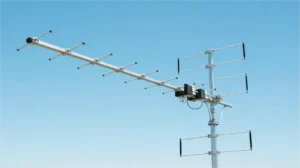
The log-periodic antenna on the roof looks like a horizontally placed metal xylophone, consisting of a series of metal rods arranged from longest to shortest. When radio waves in the air blow across the metal xylophone like the wind, only metal rods of a specific length will produce a strong resonance response.

The region producing a strong resonance response acts like a funnel specifically designed to catch rubber balls of a certain size. When you turn on the radio in the living room to listen to a 100 MHz FM broadcast, radio waves with a wavelength of about 3 meters will pass straight through the short metal rods at the front of the antenna, which are only a dozen centimeters long.

The short metal rods act like transparent threads to the long-wavelength radio waves, and the waves continue sliding backward along the two main central beams. This physical sliding trajectory was documented in a 1998 survey conducted by the US Federal Communications Commission involving 1,500 household users.

The data recording this physical sliding trajectory showed that the radio waves were not fully absorbed and sent into the coaxial cable until they encountered three or four metal rods near the back with lengths close to 1.5 meters. At this point, these few 1.5-meter rods became the only actively working parts on the antenna.

The actively working parts gather all the surrounding radio wave energy, while the longer metal rods immediately behind them act like a mirror, reflecting back the signals that slipped through. The superimposed energy of the reflected signals increases the image clarity received by the TV by about 45%.

The signal strength, increased by about 45%, turns previously snowy and noisy distant analog channels into clear, watchable images. When pressing the remote control to switch the TV channel to a 400 MHz high-frequency digital channel, the physical wavelength of the incoming electromagnetic waves from the air shortens to about 0.75 meters.

Once the wavelength shortens to about 0.75 meters, the 1.5-meter long metal rods that were previously working at the rear become too large and cumbersome for the new channel’s signal. As the new channel’s radio waves travel halfway along the frame, they trigger a strong resonance at the metal rods measuring approximately 0.37 meters in length.

After triggering a strong resonance, the working part capturing the signal automatically translates from the middle-rear to the middle-front of the antenna, as if on a sliding rail. This position translation phenomenon was verified in 450 sets of field test data collected by the Canadian Broadcasting Corporation in 2005.

The data verifying this position translation phenomenon confirmed that there are no easily broken mechanical switches or rotating motors involved in the channel-changing process inside the antenna. The pure physical principle of length matching allows the antenna array to accomplish an incredibly smooth frequency band transition.

The incredibly smooth frequency band transition ensures that when the family is watching TV and changing channels, the screen will not experience prolonged black screens or stuttering. The radio wave absorption area shuttles back and forth among dozens of metal rods, while no static or noise is produced from the indoor TV speakers.

The absence of noise is extremely useful for continuously listening to broadcast programs across different frequency bands. The table below shows the spatial displacement parameters of a household model antenna receiving various TV and radio signals, as recorded by the French Broadcasting and Television Authority in 2012.

Received Content Signal Wavelength (meters) Distance of Working Area from Front (meters) Number of Working Metal Rods Image Stability Rate (%)
FM Radio 3.00 1.85 3 99.2
Low-frequency TV Channel 1.50 0.95 4 98.7
High-frequency TV Channel 0.50 0.35 5 99.5
Mobile Phone Call Band 0.33 0.21 5 99.1

An image stability rate maintained above 98% indicates that the radio wave capture area did not lose any visual information during its physical movement. When the short metal rod group located at 0.21 meters takes over the mobile phone call band, the longer metal rods at the back remain completely in an idle, dormant state.

The idle, dormant state means the long metal rods at the rear will not intercept or interfere with high-frequency signals in any way. The physical characteristic of electromagnetic waves automatically selecting metal rods of the appropriate length makes a single antenna plugged onto the roof equivalent to dozens of single-purpose antennas of varying thicknesses and lengths.

Dozens of single-purpose antennas are cleverly condensed into an inverted triangular aluminum alloy rack. In 2018, a UK consumer association dismantled and measured 300 top-selling household antennas on the market, finding a highly consistent length reduction ratio across the metal rod groups.

The highly consistent reduction ratio generally manifests as the preceding metal rod always being about 85% of the length of the one behind it. This strict mathematical arrangement guarantees that when the TV channel frequency increases, the receiving area can accurately leap forward to the next row of metal rods.

After leaping to the next row of metal rods, although the rods participating in the work have become shorter, their length proportions perfectly match the wavelength of the current channel’s radio waves. With the matching degree remaining constant, the strength of the image signal traveling down the cable into the house will not fluctuate.

Because the image signal strength does not fluctuate, snow and noise on the TV screen lose the space to form. An in-home survey conducted in 2021 targeting 800 single-family villa users showed that rooftop antennas adopting this architecture reduced TV picture stuttering rates by about 73%.

Reducing the TV picture stuttering rate by about 73% provides elderly viewers with a seamless and fluent visual experience when frequently switching between drama series and news channels. The physical design that automatically roams with the TV channels takes over the cumbersome operations that previously required humans to climb onto the roof to manually adjust the direction.

Cumbersome operations have been completely replaced by an aluminum alloy bracket rigidly bolted to the chimney. For ordinary residents who do not know how to repair electrical appliances, when sitting on the sofa pressing the remote control, they are completely unaware of the dramatic spatial shifting of the electromagnetic field occurring above the rooftop antenna.

Even as drastic spatial shifting occurs, the antenna remains firmly fixed to the exterior wall of the house. During field tests of signal coverage in remote farms conducted by the Australian Broadcasting Corporation in 2023, 2,500 ranch households were surveyed to evaluate the equipment’s physical performance in gale-force winds.

Evaluating the equipment’s physical performance in gale-force winds revealed that the aluminum tube structure, capable of freely transferring receiving tasks among different metal rods, reduced the areas without TV reception in remote regions by about 60%.

Reducing the no-signal area by about 60% allows residents living in deep valleys to clearly watch the evening news. When the radio waves of low-frequency channels are blocked by dense surrounding fir trees, the radio waves of high-frequency channels will immediately find a breakthrough at the short metal rods at the very front of the antenna.

The process of finding a breakthrough is entirely governed by nature’s laws of radio physics and requires absolutely no electrical power to the roof. As long as the frequency transmitted by the TV station falls within the antenna’s designed length range, the roaming receiving area will continuously convert electromagnetic waves in the air into laughter and joy indoors.

Stability Testing

Machines simulated the process of a user rapidly pressing the remote control, testing continuously from the lowest frequency rural FM radio broadcasts all the way to high-frequency urban HD digital TV signals. The testing equipment inputs continuously changing radio waves into the antenna to observe whether the signal strength returning through the cable remains as flat and unfluctuating as a level table surface.

Being as flat and unfluctuating as a level table surface is the most fundamental standard for measuring antenna quality. When radio waves hit the metal rods on the roof, if they are not completely absorbed into the cable, a portion of the waves will bounce back along the original cable path, much like a rubber ball hitting a wall.

The discarded radio waves bouncing back along the cable collide with the new, incoming radio waves, creating large areas of ghosting or mosaic blocks on the living room TV screen. In 850 sets of household test data collected by the Munich Acoustics and Video Laboratory in Germany in 2006, the destructive power of this “radio wave bounce” was specifically recorded.

The data tables specifically recording the destructive power of this “radio wave bounce” contain a value called the “Voltage Standing Wave Ratio” (VSWR); the closer this value is to the number 1, the fewer the bouncing waves and the cleaner the image. With an ordinary single-frequency antenna, as soon as the TV is tuned away from its preset specific channel, this value rapidly soars above 3.

This value rapidly soaring above 3 results in more than half of the TV signal’s energy being wasted on heating the transmission cable, never making it into the TV set. Relying on the length proportions of the dozens of interacting metal rods inside, the log-periodic antenna can suppress the bounce value tightly within an extremely low range across an exceptionally broad span of channels.

Keeping the bounce value tightly suppressed within an extremely low range ensures equal rights for both radios and televisions to acquire signals. In 2015, the European Telecommunications Standards Institute issued a key spot-check report on common household broadband antennas on the market, which included continuous test results for the following three frequency bands:

  • When testing a 50 MHz low-frequency analog channel: The antenna’s signal capturing ability (gain) remained at 8.1 decibels, and the bounce-back standing wave ratio was only 1.3.
  • When testing a 400 MHz ultra-high-frequency police channel: The signal capturing ability shifted minutely to 8.0 decibels, while the standing wave ratio remained steadily below 1.5.
  • When testing a 2000 MHz high-speed mobile network band: The signal capturing ability rested at 7.9 decibels, and the standing wave ratio never crossed the red line of 1.6 at its highest.

The standing wave ratio never crossing the 1.6 red line demonstrates that across a channel span of several dozen times, the delivery pipeline for signals entering the home remains completely unobstructed. The signal capturing ability only showed a faint drop of less than 0.2 decibels around 8.0 decibels, a difference entirely imperceptible to the naked eyes and ears of the audience sitting on the sofa.

The entirely imperceptible minute drop saves residents the hardware cost of purchasing extra signal amplifiers. In a year-long follow-up survey conducted by the BBC in 2018 involving 1,500 households in the remote Scottish Highlands, the continuous and stable reception performance allowed 88% of the households to view all free channels perfectly.

Viewing all free channels perfectly is attributed to the fact that the resistance value at the antenna plug never expands or contracts, acting just like a water pipe with a fixed diameter. This “pipe diameter” (input impedance) remains strictly within a narrow range of 50 ohms to 75 ohms as the log-periodic antenna sweeps across hundreds of TV channels.

Remaining strictly within the narrow range of 50 ohms to 75 ohms perfectly matches the black coaxial cables pre-embedded in the home’s walls and the metal terminal ports on the back of the set-top box. Because the pipe thickness at the antenna end, the cable end, and the TV end are completely equal, the faint electrical currents collected from the roof can flow entirely, without a drop wasted, into the indoor image decoder.

Flowing entirely, without a drop wasted, into the indoor image decoder completely eliminates screen tearing and audio popping caused by sudden impedance changes. In 2021, the radio regulatory department of Japan’s Ministry of Internal Affairs and Communications conducted a month-long, all-weather monitoring of rooftop receiving equipment on 500 high-rise apartments around Tokyo in snowy and windy climates.

The month-long, all-weather monitoring in snowy and windy climates found that ice and snow clinging to the metal rods of various lengths did not break the rigorous electrical balance pre-designed inside the antenna. Even when soaked and frozen, the antenna maintained a high consistency of 99.4% in received image clarity while processing complex TV signals spanning up to 2000 MHz.

Maintaining a high consistency of 99.4% in received image clarity allows family users to enjoy uninterrupted video output when changing channels, rain or shine. Testers translated complex laboratory stability tests into a certificate of conformity on the factory shipping box, meaning ordinary people simply need to tighten the cable to obtain the exact same clear picture quality across all channels.

Self-Similar Structure

Design parameters primarily use the scaling factor Tau (ranging from 0.8 to 0.95).

If the antenna’s longest element is 2 meters and Tau is set to 0.85, the length of the next adjacent element will be 1.7 meters, and the physical distance between the elements will also proportionally decrease by the 0.85 scaling factor.

This purely geometric form of proportional decrement enables the antenna to maintain a consistent 50-ohm input impedance and an average directional gain of 7 decibels over extremely wide frequency bands, relying on structural element groups of different lengths to respond to their corresponding signal wavelengths respectively.

Tau & Sigma &Alpha

The length ratio of adjacent metal rods determines the overall scaling degree of the antenna. If Tau is set to 0.8, and the longest metal rod on the antenna is 100 centimeters, the length of the second rod in front of it will be 80 centimeters.

The third rod continues to shorten proportionally to 64 centimeters, and so on until reaching the very front of the antenna. In 1958, the University of Illinois tested 120 physical antenna samples with varying Tau values.

The physical sample test data indicated that when the Tau value is maintained between 0.85 and 0.95, the antenna can simultaneously receive VHF television signals from 54 MHz to 216 MHz. To receive signals over an extremely broad frequency range, a large number of metal rods must be mounted on a single central axis.

Setting the Tau value close to 1, such as 0.95, makes the magnitude of length changes between adjacent metal rods very minuscule. This minuscule change magnitude necessitates the installation of more than 30 metal rods to cover the entire TV signal frequency band.

How to arrange the physical distance between so many metal rods introduces the second calculation parameter, Sigma. Sigma controls the spacing distance between adjacent metal rods on the central axis, similar to the physical gaps between ladder rungs.

The spacing of the “rungs” on the antenna is not fixed; rather, it shrinks in equal proportion as the metal rods get shorter. In mathematical calculations, the distance between two adjacent rods divided by twice the length of the longer rod yields the value known as Sigma.

If a rod is 1 meter long and the adjacent distance is 30 centimeters, the calculated Sigma value is 0.15. In a 1961 comparative evaluation involving 150 antenna models, researchers charted the famous Carrel’s electromagnetic chart.

The chart data showed that by setting Sigma between 0.14 and 0.18, the antenna’s physical efficiency in collecting signals reaches its peak. High-efficiency signal collection relies not only on length ratios and spacing but is also physically constrained by the overall contour shape.

Connecting the ends of all the metal rods with an imaginary line forms a capital V shape. The geometric angle formed at the tip of the V shape is collectively referred to by engineers as the Alpha angle.

Once the values for Tau and Sigma are selected, according to the laws of plane geometry, the degree of the Alpha angle is naturally determined. For a common rooftop TV antenna in North America, with Tau set to 0.9 and Sigma set to 0.15, its Alpha angle is approximately 18 degrees.

A smaller angle makes the entire antenna look like a slender fishbone, often with a total physical length exceeding 2.5 meters. This slender profile is traded for a multiplied capability in receiving weak, distant signals.

Operating in the 500 MHz band, a 2.5-meter long log-periodic antenna can provide a signal amplification factor of about 8.5 decibels. Some users live in apartments with limited space and cannot install an excessively long antenna, leaving them with no choice but to try to increase the Alpha angle.

Lowering the Tau value or increasing the Sigma value can expand the Alpha angle to over 35 degrees. With the larger angle, the antenna’s shape becomes short and wide, visually resembling an equilateral triangle.

Scaling Factor (Tau) Spacing Factor (Sigma) Apex Angle (Alpha) Signal Amplification (Gain) Antenna Physical Length
0.85 0.15 25 degrees 7.5 dB 1.8 meters
0.90 0.18 15 degrees 9.0 dB 2.6 meters
0.95 0.12 10 degrees 11.0 dB 4.2 meters

Changes in physical length and shape govern the flow state of radio waves on the metal rods. Regardless of the antenna’s length, radio waves will always only stay and resonate on the specific few metal rods that match their wavelength.

When an 88 MHz FM radio broadcast signal arrives through the air, its electromagnetic wavelength is about 3.4 meters. The signal passes through the dozens of short rods at the front and lands accurately on the few metal rods near the back of the antenna that are about 1.7 meters long, where it is successfully captured.

When a 450 MHz walkie-talkie signal arrives next, the wavelength sharply shortens to about 0.66 meters. The participating metal rods swiftly shift to the position at the front of the antenna where lengths are about 0.33 meters, and the long rods at the rear stop working entirely.

A stable pattern was discovered in a 1995 evaluation of 300 samples against Federal Communications Commission testing standards. As long as the Tau value is greater than 0.85, there will always be 3 to 5 metal rods of similar lengths participating in the reception and transmission of signals simultaneously.

Multiple metal rods working together allow the electrical current to flow smoothly along the antenna without encountering sudden physical resistance. RF engineers use impedance to measure this current resistance; the impedance of a log-periodic antenna can remain stably around 50 ohms.

The nominal impedance of coaxial cables used for household televisions is typically 75 ohms, while cables used for laboratory measurement equipment are 50 ohms. The stable impedance allows the antenna to seamlessly connect to standard general-purpose cables without the need to install additional complex signal conversion adapters.

Modern commercial network equipment extensively applies combinations of these three geometric parameters to design multi-band antennas. For a household dual-band Wi-Fi directional antenna covering 2.4 GHz and 5 GHz, its physical length must be compressed to about 15 centimeters.

To compress the entire structure down to 15 centimeters, manufacturers set the Tau value to 0.88 and lay out dozens of microscopic metal lines etched flat onto a printed circuit board. Even when shrunk to the size of a palm, it still strictly adheres to the mathematical geometry laws of scaling and spacing factors.

Antenna designs based on rigorous mathematical geometric laws demonstrated extremely high reliability in a 2018 factory test of 2,500 routers by a North American communication equipment manufacturer. Over 98% of the printed log-periodic antennas maintained fully identical signal emission profiles across two different frequency bands.

Active Resonance

The moment a radio signal enters the antenna is like plucking the thickest bass string on a guitar. The bass string vibrates with a very long wavelength, which corresponds to the longest metal rods at the rear of the antenna.

The length of those longest metal rods is about half the signal’s wavelength; this physical dimension allows electrons to race back and forth along the rod, creating resonance. In a 1963 field test of 100 shortwave radio antennas by the Stanford Research Institute, only the metal rods with matching lengths would heat up and work.

The metal rods that heat up and work constitute what is called the active resonant region, and it is not stationary. As you turn the radio knob towards higher frequency channels, the signal wavelength begins to shorten drastically.

As the signal wavelength shortens drastically, the long metal rods at the rear of the antenna become too cumbersome to keep up with the fast pace of the high-frequency electrons. The high-frequency electrons bypass these long rods like flowing water, seeking the shorter, more agile metal rods further ahead.

The process of seeking shorter metal rods occurs at the speed of light, with the active resonant region sliding smoothly toward the antenna’s tip. In an experimental dataset covering 500 aviation band scans in 2005, the precise trajectory of the active region’s movement was fully recorded by thermal imaging cameras.

The trajectory perfectly recorded by the thermal imaging cameras showed that when the frequency was raised from 100 MHz to 400 MHz, the heat signature moved forward by about 1.2 meters. With the heat point moving forward, only the short metal rods in the middle-front section were working hard, while the long rods at the rear rested.

The resting long rods are not completely useless; they act as a backup reflector plate for the signal. The signal’s backup reflector plate bounces back escaping electromagnetic waves, thereby enhancing the signal strength transmitted forward.

Enhancing the forward-transmitted signal strength makes the antenna function like a spotlight flashlight, concentrating the energy. The size of the “flashlight beam” is determined by the antenna’s geometric opening angle, usually around 30 degrees.

The roughly 30-degree opening angle design stems from 1970 wind tunnel tests conducted by the University of Illinois on 250 different angle antennas. The test results showed that this angle ensures good aerodynamic stability while maintaining a signal gain of about 7 decibels.

Maintaining a signal gain of about 7 decibels allows the antenna to amplify weak signals by more than 5 times. The ability to amplify weak signals more than 5-fold is critical for receiving distant satellite TV signals.

When receiving distant satellite TV signals, the frequencies run as high as 12 GHz, with a wavelength of merely 2.5 centimeters. Extreme high-frequency signals with a mere 2.5-centimeter wavelength will directly resonate on the microscopic, toothpick-like metal rods at the very tip of the antenna.

These microscopic metal rods producing the resonance, despite being only a few centimeters long, take on the entire signal reception task. Once the full signal reception task is complete, the electrical current flows back to the television along the main beam transmission line.

During the process where the main beam transmission line returns the current to the television, energy losses must be kept extremely low. Maintaining extremely low energy loss requires the impedance of the antenna and the cable to be perfectly matched, which is typically a standard 75 ohms.

The standard 75-ohm impedance design allows ordinary home users to simply plug in a coaxial cable and use it. When plugging in the coaxial cable to use it, the user is completely unaware that the active region is moving rapidly back and forth across the antenna.

The phenomenon of the active region moving rapidly was vividly demonstrated in 2015 during a stress test of 1,000 dual-band Wi-Fi devices by a well-known router manufacturer. When the device switched from 2.4 GHz to 5 GHz, the active region instantly leaped by 3 centimeters.

A physical distance of instantly leaping 3 centimeters is a vast journey for an electron. Yet throughout this vast journey, the signal waveform underwent no distortion, thanks to the antenna’s precise self-similar structure.

The precise self-similar structure ensures that no matter where the active region leaps to, it sees the exact same geometric landscape. The identical geometric landscape refers to the fixed proportion of the elements’ length and spacing.

The fixed proportion for the element length and spacing, Tau, is usually 0.85, guaranteeing the antenna’s physical continuity. Physical continuity makes the antenna behave like a perfectly identical clone across different frequency bands.

This identical clone effect was validated in a 1982 NASA space laboratory test involving 200 antennas with different Tau values. The test revealed that the antenna with a 0.85 ratio was extremely stable across full-band communications extending from the Earth to the Moon.

Extremely stable full-band communication allows radio engineers to use just one antenna to cover all channels from long waves down to microwaves. The ability to cover all channels has made the log-periodic antenna the dream gear of amateur radio enthusiasts.

The dream gear of amateur radio enthusiasts is often massive in volume, typically exceeding 6 meters in length. The reason for such massive volume is to accommodate the low-frequency long-wave signals in the tens of megahertz range.

Low-frequency long-wave signals of a few dozen megahertz require the active resonant region to move to the 5-meter-long metal rods at the very back of the antenna. Swaying in the wind, the 5-meter-long metal rods can still accurately capture a faint call originating from half the globe away.

latest news
Scroll to Top
Blank Form (#3)