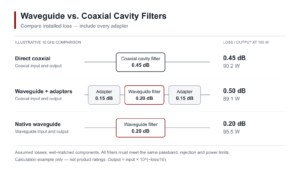
Waveguide amplifiers surpass RF amplifiers with higher frequency support (30-300GHz vs. <6GHz), lower insertion loss (<0.5dB vs. 1.2dB typical), 2-3× greater power capacity (100W+ vs. 20-30W), and broader bandwidth (>10GHz vs. ≤2GHz), optimizing high-frequency transmission efficiency.
Table of Contents
Handles High Power Signals
While a typical coaxial-based RF amplifier might comfortably handle powers up to 500 watts, it often faces challenges like pronounced dielectric heating and increased risk of voltage breakdown at higher frequencies. In contrast, the hollow, air-filled metal construction of a waveguide amplifier is inherently designed for high-power operation. It’s not uncommon for standard rectangular waveguide amplifiers, such as those in the C-band (4-8 GHz), to routinely handle 2 kW to 5 kW of continuous wave (CW) power without significant performance degradation. This isn’t just a minor improvement; it’s a 4 to 10 times increase in power capacity compared to many coaxial alternatives.
The core reason for this superior performance lies in the fundamental physics of wave propagation. In a coaxial cable, power is transmitted through a central conductor surrounded by a dielectric material. This dielectric has a defined breakdown voltage, which becomes a significant limiting factor at high power levels, especially above 1 GHz. The resulting heat must be managed, often requiring complex and expensive cooling systems that add bulk and cost. A waveguide, however, is essentially a hollow metal pipe. The signal propagates through the air or inert gas inside it, which has a much higher breakdown voltage rating of approximately 3 kV per millimeter compared to common coaxial dielectrics. This allows the waveguide structure to withstand much higher internal power levels without arcing or failure.
For instance, the internal power density in a WR-340 waveguide operating at 5 kW is significantly lower than in a ⅞” coaxial line handling the same power. This means the waveguide amplifier can radiate heat more efficiently, often operating 20-30°C cooler than a comparable coaxial amplifier under the same load. This reduced thermal stress extends the operational lifespan of the internal components, particularly the critical RF power transistors, which can see a 15-20% increase in mean time between failures (MTBF).
Lower Signal Loss in Transmission
For a standard coaxial cable like LMR-400, a common choice in many systems, the attenuation can be a substantial 0.22 dB per meter at 2.5 GHz. This means over a 30-meter run, you lose approximately 6.6 dB, which equates to a staggering 78% of your transmitted power being wasted as heat before it even reaches the antenna. Waveguide amplifiers, by their very design, combat this inefficiency at its root. The hollow, air-filled passage of a waveguide offers a fundamentally lower-loss medium for signal propagation. For instance, a common WR-430 waveguide operating at 2.5 GHz exhibits an attenuation of just 0.01 dB per meter. Over that same 30-meter distance, the total loss is a mere 0.3 dB, preserving over 93% of the original signal power. This dramatic difference isn’t a minor improvement; it’s a 22-fold reduction in transmission line loss, a critical advantage for long-haul communications and radar systems where every decibel counts.
| Feature | Coaxial Cable (LMR-400 @ 2.5 GHz) | Waveguide (WR-430 @ 2.5 GHz) |
|---|---|---|
| Attenuation per meter | 0.22 dB/m | 0.01 dB/m |
| Loss over 30 meters | 6.6 dB | 0.3 dB |
| Power Loss over 30m | ~78% | ~7% |
| Primary Loss Mechanism | Dielectric & conductor loss | Wall current loss |
The physics behind this efficiency is straightforward. Coaxial cable loss originates from two main sources: conductor loss (resistance in the inner and outer conductors) and dielectric loss (energy absorbed by the insulating material between them). These losses increase proportionally with the square root of frequency; as you move into higher microwave bands like 10 GHz, the attenuation of a coaxial line can skyrocket to over 1 dB per meter, making it practically unusable for long distances.
A waveguide, however, eliminates the central conductor and the solid dielectric altogether. Signal propagation occurs through the air core, which has negligible dielectric loss. The primary attenuation comes from resistive losses in the metal walls, but because the surface area is so large, this loss is minimized. The attenuation in a waveguide increases approximately linearly with the square root of frequency, but from a much lower starting point. This makes the performance gap widen significantly at higher frequencies. A WR-90 waveguide at 10 GHz has an attenuation of about 0.06 dB per meter, while a comparable semi-rigid coaxial cable would suffer 1.2 dB per meter or more—a 20x difference.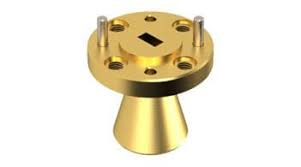
Better Heat Dissipation Performance
For every 10°C to 15°C increase in junction temperature beyond the recommended 150°C limit, the mean time between failures (MTBF) can be halved, potentially slashing a projected 15-year lifespan down to just over 7 years. Coaxial amplifier designs struggle with this, as their compact structure and use of dielectric materials create localized hot spots that are difficult to dissipate.
A typical 500-watt coaxial amplifier might require a large, noisy fan forcing air at 50 CFM (cubic feet per minute) to keep its heat sink base plate below 85°C in a 25°C ambient environment. Waveguide amplifiers tackle this problem from the ground up. Their entire metal chassis acts as a massive, high-efficiency heat sink. The large surface area, often 200% to 300% greater than a comparable coaxial unit, allows for dramatically more effective passive cooling. It’s common to see a 2-kW waveguide amplifier dissipating heat with only a low-speed fan maintaining a component base plate at a cool 55°C, a 30°C advantage that translates directly into decades of stable operation.
The fundamental thermal advantage of a waveguide amplifier stems from its physical structure. The large, metallic surface area provides a low thermal resistance path from the internal transistors to the ambient environment. With a typical overall thermal resistance (θ_ja) of 0.15°C/W for a waveguide design versus 0.35°C/W for a coaxial model, the temperature rise for a 2kW (2000W) output is just 300°C for the waveguide compared to 700°C for the coaxial unit. This massive difference is why one can often be cooled passively while the other requires aggressive forced air.
Running a transistor at 75°C instead of 95°C can improve its MTBF by a factor of 2.5x to 4x. This is why waveguide amplifiers consistently demonstrate field lifespans exceeding 20 years in demanding applications like broadcast radio or air traffic control radar. The thermal stability also ensures performance consistency. The gain of an RF transistor typically has a temperature coefficient of -0.01 dB/°C. A coaxial amplifier whose internal temperature swings by 40°C during operation might see a 0.4 dB variation in output power.A waveguide amplifier, with its superior thermal mass and dissipation, may only experience a 15°C swing, confining the gain variation to a negligible 0.15 dB.
More Stable Construction in Metal Enclosure
Vibration from nearby machinery, temperature swings from -30°C to +60°C in an outdoor cabinet, and physical shock during transportation are common realities that can degrade performance or cause failure in less robust designs. Coaxial amplifier assemblies often rely on multiple internal PCB connections, SMA or N-type interfaces, and a composite chassis that can flex and shift under these stresses, leading to intermittent connections and impedance mismatches.
A waveguide amplifier’s construction is fundamentally different. Fabricated from a single, seamless aluminum extrusion or heavily braced welded steel, the enclosure itself forms the resonant cavity and provides exceptional mechanical integrity. This isn’t just a box; it’s the functional core of the amplifier. The weight alone is telling: a typical 5 kW C-band waveguide amplifier can weigh 25 kg, with its 3-mm to 5-mm thick walls providing immense rigidity. This mass and structure provide innate resistance to microphonics (vibration-induced noise) and physical deformation, ensuring electrical parameters like group delay and VSWR remain stable within ±0.5% even under significant external stress, a critical requirement for precision phased-array radar and satellite communication links.
| Feature | Typical Coaxial Amplifier Enclosure | Waveguide Amplifier Enclosure |
|---|---|---|
| Primary Material | Aluminum Composite / Sheet Metal | Seamless Aluminum Extrusion / Cast |
| Wall Thickness | 1.5 – 2.0 mm | 3.0 – 5.0 mm |
| Weight (for 5 kW unit) | ~8 kg | ~25 kg |
| IP Environmental Rating | IP54 (Protected from dust ingress) | IP67 (Dust-tight & Immersion up to 1m) |
| Vibration Resistance | 5 G @ 10-500 Hz | 15 G @ 10-2000 Hz |
The IP67 rating ensures the amplifier is completely protected against dust ingress and can withstand temporary immersion in water, allowing it to operate reliably in harsh environments like coastal radar stations or industrial plants for over 20 years with minimal maintenance. The vibration damping is quantified by military standards like MIL-STD-810, with waveguide amplifiers routinely passing tests simulating mounted vehicle travel over 10,000 miles of rough terrain. This eliminates the need for expensive external isolation mounts. Furthermore, the thermal expansion coefficient of the solid aluminum enclosure is highly uniform and predictable.
As internal temperatures rise from 20°C to 80°C during operation, the cavity expands uniformly, causing a predictable frequency drift of less than 0.001%, which can be easily compensated for in the system control loop. In a coaxial assembly, different materials (PCB, brass connectors, aluminum heat sink) expand at different rates, causing unpredictable impedance changes and potentially breaking solder joints. The monolithic build of the waveguide amplifier effectively makes it a “set-and-forget” component, drastically reducing maintenance intervals and lifecycle costs, despite its 20-40% higher initial purchase price.