To reduce waveguide assembly insertion loss, optimize surface roughness (Ra≤0.2μm, cutting 30% loss vs. Ra=1μm), align with <λ/100 gap (e.g., <0.25mm in X-band for 15% reduction), and use low-loss materials like gold-plated copper to minimize resistive losses.
Table of Contents
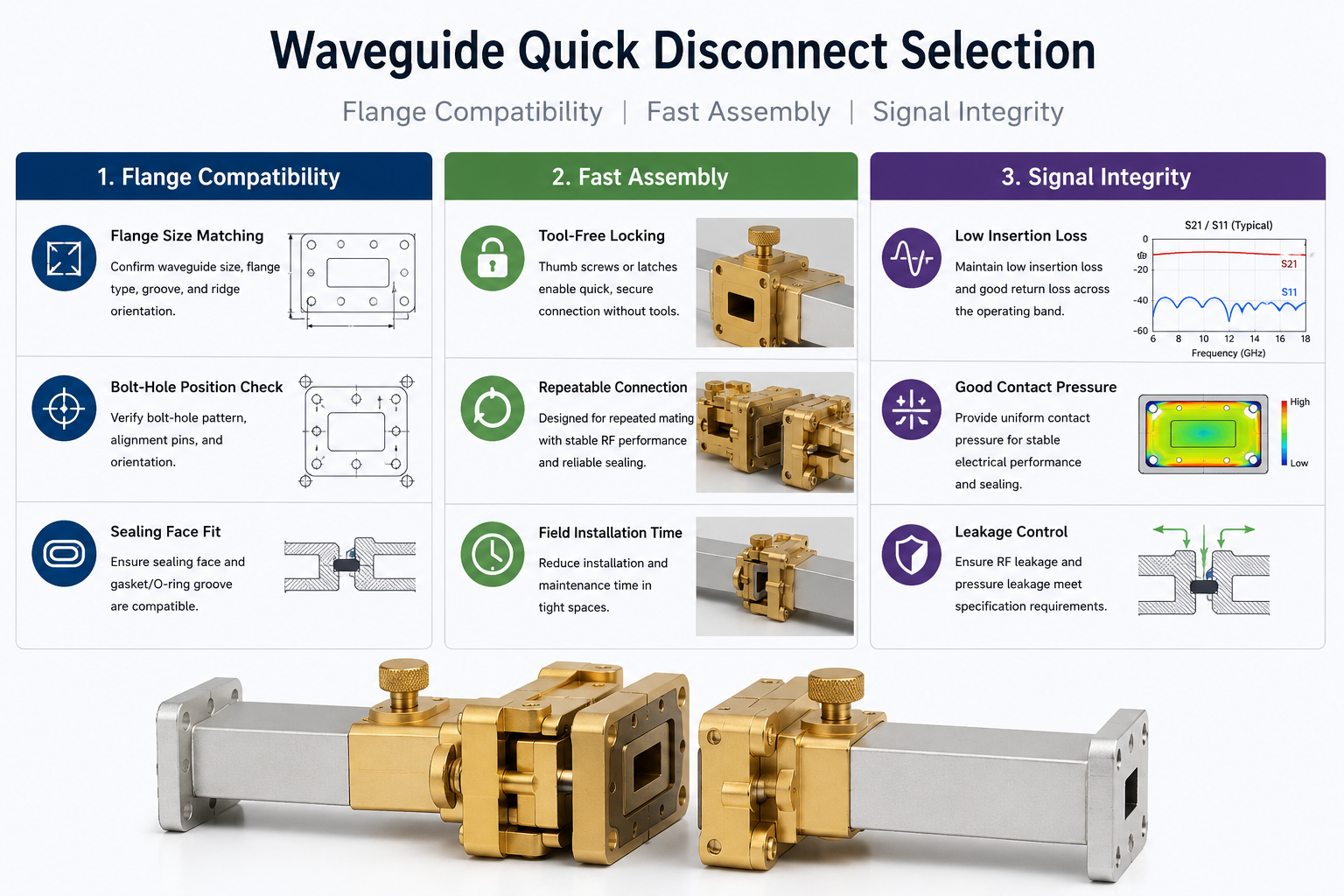
Check Connector Alignment
Studies indicate that a lateral offset of just 0.1 mm in a standard WR-90 waveguide can increase insertion loss by up to 20% at 10 GHz. In high-power systems, this misalignment not only reduces efficiency but can lead to localized heating, potentially shortening the assembly’s lifespan by thousands of hours. Precision alignment isn’t a luxury—it’s a necessity for maintaining signal integrity, especially in applications like radar or satellite communications where a 0.5 dB loss can compromise entire link budgets.
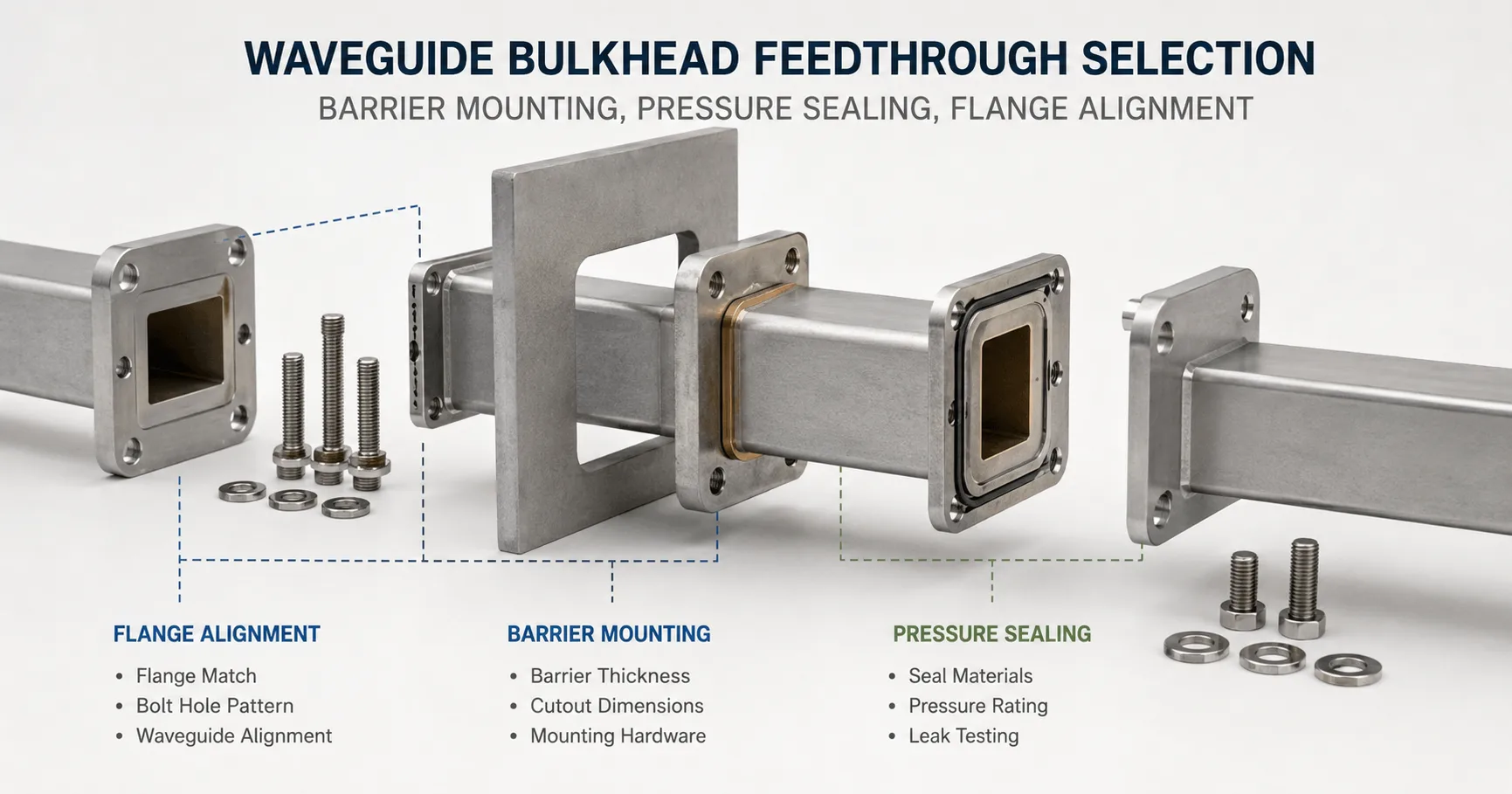
These flanges are designed with dowel pins or alignment sleeves that restrict lateral movement to within ±0.05 mm. For field installations, a go/no-go gauge can quickly verify pin engagement; if the gauge doesn’t slide freely, the misalignment likely exceeds 50 micrometers.
Always inspect flange mating surfaces under 10x magnification for burrs or debris exceeding 5 µm in height, as these can force angular misalignment.
Excessive torque—beyond 25 in-lbs for most aluminum flanges—can warp the interface, creating a gap as wide as 30 µm. Instead, use a cross-pattern torque sequence applied in three stages (e.g., 10 in-lbs, then 18 in-lbs, finally 25 in-lbs) to ensure even pressure distribution. After tightening, measure the gap between flanges with a feeler gauge; any separation over 15 µm indicates uneven contact and warrants re-assembly.
For critical systems, invest in laser alignment tools that project a beam through the waveguide bore. A deviation of more than 0.2 degrees from the optical axis typically correlates to an additional 0.3 dB loss.
Clean Connector Interfaces
Studies show that a single fingerprint oil smear, with an average thickness of 3-5 µm, can introduce up to 0.8 dB of insertion loss at 24 GHz. Dust particles as small as 40 µm—roughly the width of a human hair—can physically prevent flange faces from mating, creating an air gap and reflecting over 15% of the transmitted power. In a typical 38 GHz backhaul link, this can result in a 12% drop in data throughput. The financial impact is real: rework due to contamination-related failures can increase project labor costs by 25% and delay deployments by 2-3 weeks. Proactive, methodical cleaning isn’t just maintenance; it’s a direct contributor to system performance and project ROI.
The first step is visual inspection under adequate lighting. Use a 10x magnifying loupe or a USB microscope to examine the flange mating surface and the waveguide bore. Look for hydrocarbon films (visible as rainbow patterns), dust, or metallic splinters. For particulates larger than 20 µm, dry cleaning is often sufficient. Apply canned air—but ensure the can is held upright to avoid ejecting liquid propellant, which can leave a residue. Tilt the waveguide so debris falls away from the internal channel.
For persistent films or oils, apply high-purity isopropyl alcohol (IPA) with a concentration of 99.9% or higher to a lint-free swab. Cheaper, lower-purity IPA (e.g., 70%) leaves up to 5% residue after evaporation, defeating the purpose.
Gently wipe the flange surface in one direction only, rotating the swab to a clean area after each pass. Do not use a circular scrubbing motion, as this can grind particles into the surface. For the internal waveguide channel, use a foam swab soaked in IPA, but avoid over-saturation that could allow liquid to seep into dielectric materials. The entire cleaning process from inspection to final wipe should take less than 90 seconds per connector to minimize the open-port exposure to airborne contaminants.
After cleaning, verify with a final visual inspection. If any film remains, repeat the process with a fresh swab. For critical Q-band (40 GHz) and above applications, consider using an optical interferometer to check for surface flatness deviations exceeding λ/10 (approximately 63 nm at 15 GHz), as residual contamination can cause measurable height variations.
Verify Waveguide Dimensions
A deviation as small as 0.05 mm in the broadwall width of a WR-75 waveguide (9.525 mm nominal) can shift the cutoff frequency by over 150 MHz and increase attenuation by up to 0.4 dB/meter at 18 GHz. In high-volume production, a 2% tolerance relaxation might save 50,000+ in rework and replacement expenses. For aerospace applications operating from -55°C to 85°C, the 17 ppm/°C thermal expansion coefficient of aluminum can alter internal dimensions by over 40 µm, pushing the waveguide near its operational limits.
Use a calibrated digital micrometer with a resolution of 1 µm and an accuracy of ±3 µm to measure the internal broadwall (a-dimension) and narrowwall (b-dimension). For a WR-90 waveguide, the nominal internal dimensions are 22.86 mm ± 0.05 mm by 10.16 mm ± 0.05 mm. Measure at three points along the length—each end and the center—to check for tapering or bowing exceeding 0.02 mm. Don’t neglect the flatness of the sidewalls; a curvature radius tighter than 5 meters can concentrate fields and increase loss. For circular waveguides, measure the internal diameter at 45-degree intervals to check for circularity errors; a deviation exceeding 0.5% of the nominal diameter can convert the desired TE11 mode into lossy higher-order modes.
A 40°C temperature increase causes a 100 mm long aluminum waveguide to expand by 68 µm linearly. While this seems small, it changes the internal cross-section. For a copper waveguide, the expansion is less (~48 µm), but the critical frequency shift remains a concern. Always specify the measurement temperature; standards typically reference 20°C. If measuring in a 32°C factory, you must compensate for thermal expansion. For example, an aluminum waveguide will be 24 µm longer per 100 mm at 32°C than at 20°C, making measured dimensions appear larger.
| Waveguide Type | Nominal Int. Dimensions (mm) | Max Tol. (±mm) | Freq. Shift per +0.01mm (MHz) | Recommended Tool |
|---|---|---|---|---|
| WR-90 | 22.86 x 10.16 | 0.05 | ~15 @ 10 GHz | Micrometer |
| WR-75 | 19.05 x 9.525 | 0.04 | ~18 @ 18 GHz | Micrometer |
| WR-42 | 10.67 x 4.32 | 0.03 | ~35 @ 26 GHz | Optical Comparator |
| Circular (WC-28) | Ø7.112 mm | 0.02 | ~25 @ 33 GHz | Air Gauge |
For mass-produced waveguides, implement statistical process control (SPC). Measure a random sample of 5 units from every production batch of 50. Calculate the mean and range for the a-dimension and b-dimension. If the standard deviation (σ) exceeds 0.015 mm, the machining process is not in control and requires adjustment.
Minimize Bend and Twist
A single 90-degree bend in a WR-90 waveguide with a bend radius of less than 80 mm can add over 0.5 dB of loss at 10 GHz due to mode conversion and increased surface current density. Twisting the waveguide by just 10 degrees per meter can induce cross-polarization distortion, reducing signal-to-noise ratio by up to 3 dB in polarized systems. In a large phased array radar with 500 waveguide runs, improper bending can lead to a system-wide insertion loss variance of ±1.2 dB, crippling beamforming accuracy and requiring $200,000+ in calibration and software compensation efforts.
This radius is typically 4 to 8 times the waveguide’s broader internal dimension (‘a’-dimension). For a common WR-90 waveguide (a=22.86 mm), the absolute minimum bend radius is 90 mm, but a 120 mm radius is recommended for losses below 0.1 dB per bend. Use a bend template or a 3D-printed jig cut to the exact radius to ensure consistency during fabrication. For flexible waveguides, the MBR is much smaller—often 25 mm for a 8.4 mm diameter corrugated line—but repeatedly flexing it to this limit over 5,000 cycles can work-harden the outer conductor and increase loss by 0.05 dB per 100 cycles.
Twist is often more damaging than bend. The maximum allowable twist rate is typically 5 degrees per foot (~0.16 degrees/cm). To control it during installation, use a digital angle finder with 0.1-degree resolution on a straight section adjacent to any bend. If you must twist to align flanges, do it over the longest possible section. For example, a 15-degree rotation over 3 meters of waveguide imposes negligible stress, but the same rotation over 30 cm creates a sharp twist rate of 50 degrees/meter that can permanently deform the waveguide walls by up to 0.3 mm.
| Waveguide Type | Broadwall (a) Dimension | Absolute Min. Bend Radius | Recommended Bend Radius | Max. Twist Rate (deg/m) |
|---|---|---|---|---|
| WR-90 (Rigid) | 22.86 mm | 90 mm | 120 mm | 5 |
| WR-75 (Rigid) | 19.05 mm | 75 mm | 100 mm | 6 |
| WR-42 (Semi-flex) | 10.67 mm | 45 mm | 60 mm | 10 |
| Corrugated Flex (Ø8.4mm) | N/A | 25 mm | 35 mm | 15 |
A waveguide hanging under its own weight over a 10-meter vertical run will sag, creating an unintended bend with a radius of ~15 meters. While this seems gentle, it can still add 0.2 dB of loss per run. Support the waveguide every 1.2 meters with cushioned clamps to prevent this. In vehicles or aircraft, vibration at 5-100 Hz frequencies can slowly work-harden aluminum waveguide, causing a 10% increase in insertion loss over 5 years. Use braided strap dampeners at mounting points to absorb 90% of the vibrational energy. Finally, after any bending or routing, perform a vector network analyzer (VNA) sweep. A sharp narrowband dip in the S21 response, say a 0.8 dB drop at 18.5 GHz in a WR-42 guide, is a classic signature of a bend that is too tight and is acting as a filter.
Select Proper Waveguide Material
The skin effect at microwave frequencies means over 85% of the current flows in the first 3 µm of the conductor surface. This makes bulk conductivity paramount. While aluminum ( 61% IACS conductivity) is common, its surface oxidizes, increasing loss by up to 15% over 5 years in humid environments. Oxygen-free copper ( 101% IACS ) offers lower initial loss—about 0.006 dB/meter less at 10 GHz in WR-90 than aluminum—but costs 300% more and is 50% heavier, complicating aerial deployments. For high-power systems handling 10 MW peak, a copper-silver alloy plating just 15 µm thick can reduce resistive losses by 8% compared to bare aluminum, but adds $200 per meter to the unit price. The material choice isn’t just about the initial spec; it’s a trade-off between electrical performance, environmental durability, weight constraints, and a project’s total budget.
For a system with 20 waveguide runs each 3 meters long, switching from aluminum ( 3.8e7 S/m ) to copper ( 5.8e7 S/m ) saves ~0.36 dB of total system loss. This might justify the $12,000 material cost increase if that dB saves a costly amplifier stage. However, if the waveguide is in a temperature-fluctuating environment ( -30°C to +70°C ), aluminum’s higher thermal expansion coefficient (23.1 µm/m·°C) versus copper’s ( 16.5 µm/m·°C ) can cause misalignment at flanges unless designed with sliding joints. For these situations, a copper-clad aluminum waveguide offers a compromise, providing a 40 µm thick copper layer for 90% of the conductivity benefit at 60% of the weight and 70% of the cost of solid copper.
- Corrosive Environments: In naval applications with 95% relative humidity and salt spray, bare aluminum or copper will corrode. Silver-plating ( 15 µm min. thickness) on brass or aluminum boosts corrosion resistance and maintains conductivity above 4.5e7 S/m. The plating adds $150 per meter but prevents a 0.5 dB/meter loss increase from surface pitting over a 10-year service life.
- Weight-Constrained Systems: In airborne radar, every kilogram counts. Aluminum weighs ~2700 kg/m³, while copper weighs ~8900 kg/m³. Replacing 10 meters of copper waveguide with aluminum saves ~15 kg, reducing fuel costs by ~$2,000 annually. The trade-off is 0.3 dB more loss, which may require a more sensitive receiver.
- High-Power Handling: For pulsed power exceeding 5 MW, the primary risk is voltage breakdown, approximately 30 kV per cm in air. The smoother the surface finish, the higher the power threshold. Electropolished stainless steel ( RMS roughness < 0.4 µm ) plated with 5 µm of gold can handle 10% more peak power than unpolished copper due to fewer sharp points for arcing, despite gold’s lower conductivity.
A 3 µm thick silver plate on aluminum improves surface conductivity but can form galvanic corrosion with aluminum if scratched. An intermediate 5 µm nickel layer acts as a barrier. The cost for this dual plating is 250 per meter, but it ensures performance stability for 15+ years. For the best balance of cost and performance in most terrestrial applications, clear-anodized aluminum is sufficient. The anodizing layer is non-conductive, so it must be masked off at flange mating surfaces, but it protects the rest of the assembly, adding less than 50 per meter and extending the mean time between failures (MTBF) by 30,000 hours.
Control Environmental Conditions
A 30°C temperature swing can cause an aluminum waveguide to expand or contract by over 0.5 mm per 10 meters of length, potentially misaligning flange connections and adding up to 0.4 dB of loss at the joint. In humid environments with 85% relative humidity, condensation inside the waveguide can increase attenuation by 20% at 24 GHz within just 6 months due to surface oxidation and water film formation. Dust accumulation at a rate of 0.1 grams per month in an unsealed outdoor enclosure can block up to 5% of the waveguide’s aperture, scattering energy and reducing effective transmission power by 1-2 dB. Proactively managing these conditions isn’t just about prevention—it’s a direct method to ensure long-term performance stability and avoid costly $15,000+ system recalibrations or premature replacements.
Start by addressing thermal effects. The coefficient of thermal expansion for aluminum is 23.1 µm/m·°C. This means a 20-meter run of aluminum waveguide in a desert environment that cycles from 5°C at night to 45°C during the day will change in length by 18.5 mm daily. This constant movement stresses mounts and flanges. To mitigate this, use expansion loops or bellows sections every 15 meters that can absorb ±10 mm of axial movement. For precision systems, active temperature control is necessary. Installing a thermoelectric cooler/heater with a ±0.5°C control range around critical waveguide sections can cost $1,200 per unit but eliminates thermal drift, maintaining insertion loss within ±0.05 dB over a 50°C ambient range.
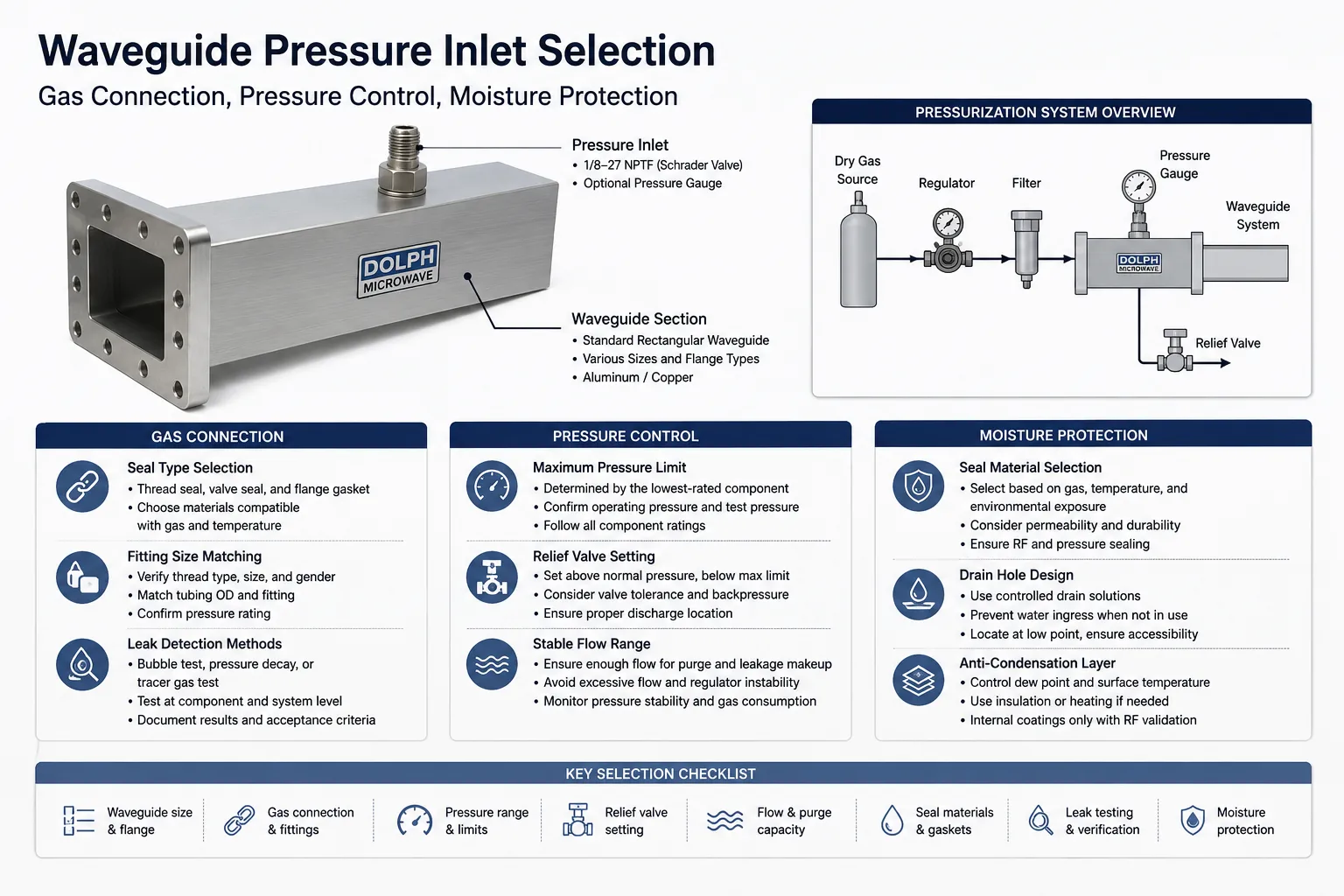
Humidity control is non-negotiable. Even in a seemingly sealed system, 0.5 standard cubic feet per hour (SCFH) of moist air can infiltrate through microscopic gaps. This moisture leads to internal corrosion, increasing surface roughness from an ideal <0.1 µm Ra to over 2 µm Ra in 3 years, which can double the attenuation per meter. The solution is a robust drying system.
- Pressurized Dry Air: Pumping -40°C dew point air into the waveguide system at a slight positive pressure of 1-2 PSI prevents moist air ingress. A small, maintenance-free diaphragm compressor and desiccant dryer system costs ~250,000 worth of radar waveguide.
- Desiccant Capsules: For shorter, sealed waveguide runs, install replaceable desiccant capsules at drainage points. A 100-gram silica gel capsule can absorb ~25 grams of water vapor before needing replacement every 6-12 months, maintaining humidity below 10% RH inside the guide.
- Hermetic Sealing: For the ultimate protection, hermetically seal the waveguide with welded flanges and O-rings rated for <1×10⁻⁸ cc/sec helium leak rates. This sealing process adds $500 per connection but guarantees a 25-year life with no humidity-induced degradation.
Vibration from nearby 1500 RPM pumps can work-harden waveguide supports, leading to fatigue cracks after 10 million cycles. Use vibration isolators with a natural frequency below 10 Hz to decouple the waveguide from the source. For aerospace applications where pressure drops to 0.2 ATM, the reduced air density lowers the voltage breakdown threshold by 40%. This means a waveguide that handles 10 MW at sea level might only handle 6 MW at altitude. Specify pressurization systems that maintain an internal pressure of 1 ATM with a safety factor of 150% to ensure reliable high-power operation. A full environmental control system might add 15% to the initial installation cost but reduces the total cost of ownership by 50% over a decade by eliminating downtime and repairs.