For waveguide components, brass is a top choice for its excellent machinability and good conductivity, often used in experimental kits. Aluminum is favored for its light weight and natural corrosion resistance, making it ideal for outdoor antennas. Copper offers the highest electrical conductivity, crucial for low-loss systems, though it is more expensive. Each material is typically plated with silver or gold to minimize surface resistance and prevent oxidation.
Table of Contents
Low-Loss Aluminum for Housings
Aluminum alloys, particularly the 6061 and 5052 grades, are the industry standard for constructing waveguide component housings. Their primary advantage lies in achieving an excellent balance between low electrical conductivity losses and high mechanical stiffness at a relatively low cost. For instance, at a common microwave frequency of 10 GHz, the skin depth in aluminum is approximately 1.3 microns, which contributes to a typical surface roughness loss of less than 0.05 dB per meter. This makes it ideal for applications where signal integrity is paramount but budget constraints exist, such as in commercial radar systems and 5G base stations.
The selection of aluminum is predominantly driven by its low density of 2.7 g/cm³ and its high yield strength, which can exceed 275 MPa for alloy 6061-T6. This combination ensures that housings are both lightweight and robust enough to withstand mechanical vibrations and thermal cycling without deformation. A typical waveguide housing might have a wall thickness of 3 mm to 5 mm to provide sufficient structural integrity, adding only a minimal weight penalty.
From a manufacturing standpoint, aluminum is highly favored for its excellent machinability. It can be easily milled, drilled, and tapped with standard CNC equipment, significantly reducing production time and cost. The material removal rate for aluminum is typically 50-100% faster than for stainless steel, directly translating to lower machining costs, often by 30-40%. Furthermore, its natural oxide layer provides decent corrosion resistance, which can be enhanced through anodization. A standard 25-micron-thick anodized layer can increase surface hardness to over 500 Vickers, drastically improving wear resistance.
A critical performance metric is thermal management. Aluminum’s high thermal conductivity, around 160 W/m·K, allows it to efficiently dissipate heat generated by internal components. This is crucial for maintaining operational stability in high-power applications, such as broadcast radio transmitters operating at 5 kW, where housing temperatures must be kept below 80°C to prevent performance drift.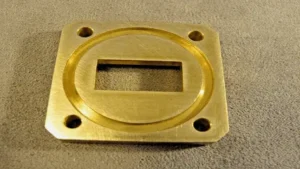
Precise Brass for Connectors
While aluminum forms the main body, the critical interface points—the connectors—rely heavily on brass alloys like C3 6000. The primary reason is machinability and wear resistance. Brass can be machined at speeds 150% faster than stainless steel, achieving surface finishes smoother than 0.8 µm Ra with minimal tool wear. This is essential for producing the complex, fine-pitched threads (e.g., 5/8-24 UNEF) and precise pin sockets that maintain electrical contact over thousands of mating cycles with a insertion force of just 5-10 N.
The fundamental role of a connector is to provide a stable, low-resistance electrical path. Brass, with a typical electrical conductivity of 28% IACS (around 16 MS/m), provides a solid balance. While not as conductive as copper, its superior mechanical properties make it the practical choice. To overcome the conductivity gap, most brass connectors are plated with a 2-5 micron layer of silver or gold. This plating reduces surface contact resistance to less than 2 milliohms, ensuring minimal signal loss, especially critical at frequencies above 18 GHz where skin effect confines current flow to the outer 1.3 microns of the material.
Durability is a non-negotiable requirement. A standard SMA connector is rated for a minimum of 500 full mating cycles before its electrical parameters, such as Voltage Standing Wave Ratio (VSWR), drift beyond the specified limit of 1.25:1. The innate springiness and yield strength of brass (up to 410 MPa in certain alloys) are what make this possible. It resists deformation and galling, ensuring that the 0.5 mm tolerance between the inner pin and outer shell is maintained, preserving the 50-ohm impedance match.
| Property | Value for C36000 Brass | Importance for Connectors |
|---|---|---|
| Machinability Rating | 100% (Free-Machining Standard) | Allows high-speed production of complex threads and features with tight ±0.05 mm tolerances. |
| Yield Strength | 410 MPa (for C37700) | Withstands repeated mating cycles (500+) without permanent deformation of the pin or socket. |
| Wear Resistance | Good (Often plated) | Base material provides support for precious metal plating (2-5 µm) that reduces wear and contact resistance. |
| Thermal Expansion | 19.5 µm/m-°C | Closely matched to many dielectric materials in the connector, reducing stress and maintaining seals. |
The choice for brass is driven by several key operational advantages:
- Superior Thread Formation: Brass produces clean, strong threads that can withstand over 100 in-lbs of torque during installation without stripping, crucial for maintaining connector alignment and pressure.
- Corrosion Resistance: While not stainless, brass resists oxidation better than plain steel. When silver-plated, the corrosion resistance is significantly enhanced, ensuring stable performance in environments with 80% humidity for over 10,000 hours.
- Cost-Efficiency for Precision: The high machinability of brass reduces CNC milling time by approximately 25% compared to less malleable metals, lowering the unit cost of a complex connector to between 45, depending on size and plating.
In essence, brass is the unsung hero of connectivity. Its unique combination of machinability, strength, and decent electrical properties—enhanced by plating—makes it the de facto material for ensuring that the critical interface between waveguides and cables is reliable, repeatable, and electrically sound over the long term.
Reliable Copper for Circuits
For the internal circuits and conductive paths within waveguide components, oxygen-free high-conductivity (OFHC) copper, like C10100 or C11000, is the undisputed material of choice. Its singular advantage is unmatched electrical performance. With a typical conductivity rating of 101% IACS (approximately 58 MS/m), copper minimizes resistive losses more effectively than any other practical metal. At 24 GHz, this translates to an insertion loss of less than 0.1 dB per meter in a standard WR-42 waveguide, directly impacting system efficiency and signal-to-noise ratio. This is non-negotiable for high-performance applications like satellite transponders and military radar, where every fractional dB of loss counts.
The primary function of these internal circuits is to guide electromagnetic waves with minimal distortion and attenuation. Copper’s superb conductivity is the key driver here. The skin depth—the depth at which current density falls to about 37% of its surface value—is approximately 1.33 microns at 10 GHz. This means the electrical performance is almost entirely dependent on the surface quality. Consequently, the interior surfaces of copper waveguides are often polished to a mirror finish of 0.4 µm Ra or smoother to reduce surface resistance and power loss.
A copper stub tuner in a radar system operating at 5.8 GHz might handle peak powers exceeding 2.5 MW in short pulses. The low resistivity of copper ensures that resistive heating (I²R losses) is minimized, keeping temperature rises during operation below 35°C and maintaining impedance stability within 1%.
While pure copper offers the best electrical performance, its softness is a significant challenge for mechanical parts. The Vickers hardness of annealed copper is only about 40 HV, making it susceptible to scratching and deformation during assembly or use. To mitigate this, copper components are often plated with a 3-5 micron layer of silver or gold. This hard coating can increase the surface hardness to over 80 HV, dramatically improving wear resistance for parts like tuning screws without sacrificing the exceptional conductivity provided by the copper substrate.
Thermal management is another critical area where copper excels. Its thermal conductivity of 400 W/m·K is among the highest of any engineering metal. This allows it to act as an integrated heat sink, efficiently pulling heat away from active devices and dissipating it. In a high-power 30 kW broadcast system, copper fins can increase the effective radiating surface area by 300%, maintaining a stable operating temperature of 65°C even under constant load.
The trade-off for this performance is cost and weight. Raw OFHC copper costs roughly $9-12 per kilogram, about 50% more than aluminum. Furthermore, its density of 8.96 g/cm³ means a component will be over three times heavier than an aluminum counterpart of the same volume. This often leads to hybrid designs where copper is used selectively for critical current-carrying paths, while structural housing is made from aluminum.