Waveguide-SMA and coaxial adapters differ in frequency range, power handling, and insertion loss. Waveguide adapters typically handle 18-110 GHz with <0.2 dB loss, while SMA coaxial versions cover DC-18 GHz but sustain higher losses (0.5 dB).
For millimeter-wave applications above 40 GHz, waveguide adapters provide better performance with VSWR <1.2:1, whereas SMA connectors degrade to 1.5:1. Proper installation requires torque wrench tightening (8 in-lbs for SMA) and waveguide flange alignment (λ/4 tolerance).
Table of Contents
Size & Shape Differences
Waveguide-to-SMA and coaxial adapters serve the same basic function—connecting different transmission line types—but their physical designs couldn’t be more different. Waveguide adapters are bulky, with rectangular or circular cross-sections typically ranging from 10 mm x 5 mm (for WR-90 waveguides at 8-12 GHz) up to 58 mm x 29 mm (for WR-22 at 33-50 GHz). In contrast, SMA coaxial adapters are compact, usually measuring 6-12 mm in diameter and 20-40 mm in length, making them ideal for tight PCB layouts or handheld test equipment. The weight difference is stark: a brass WR-90 waveguide adapter can weigh 150-300 grams, while an SMA adapter rarely exceeds 10-20 grams.
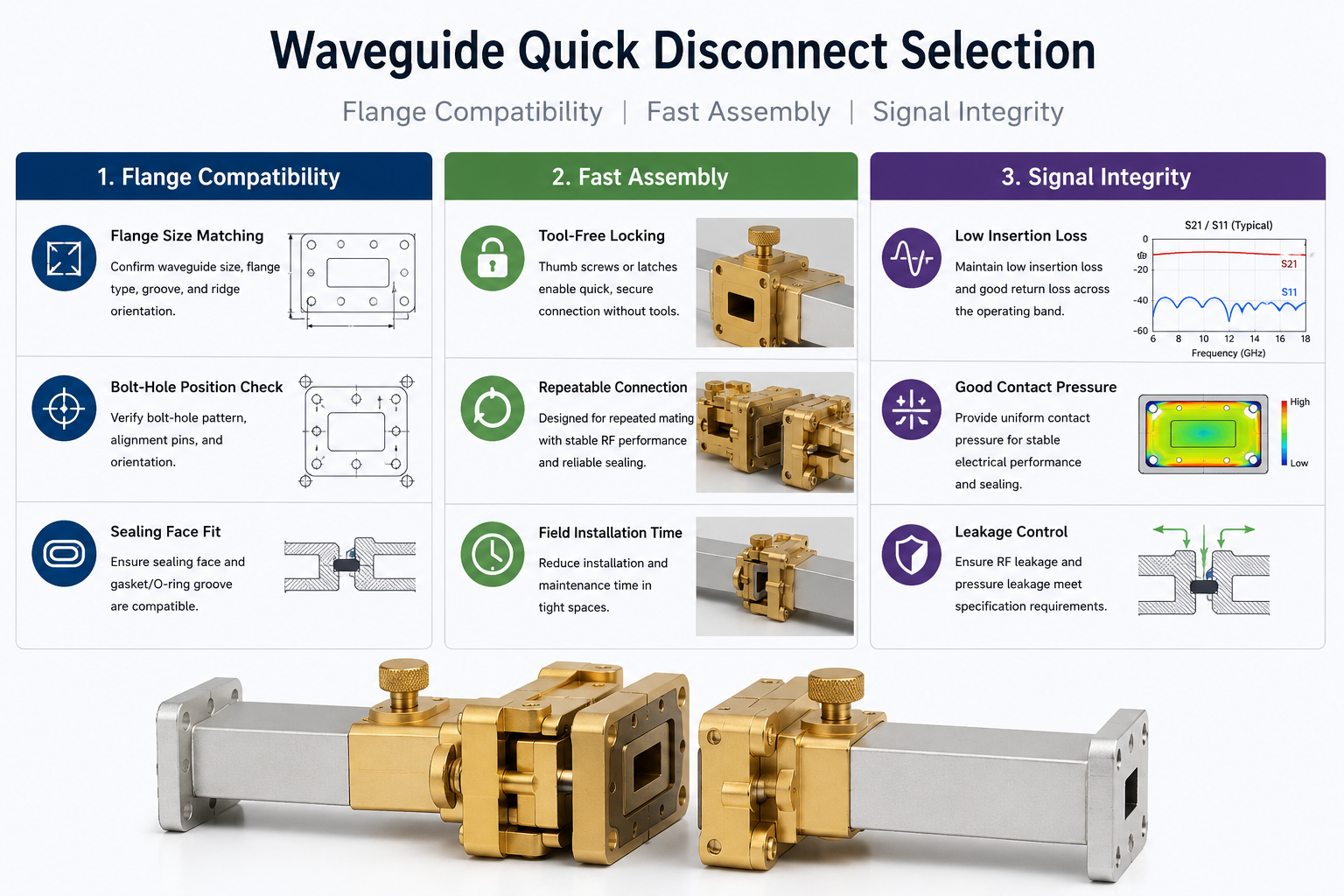
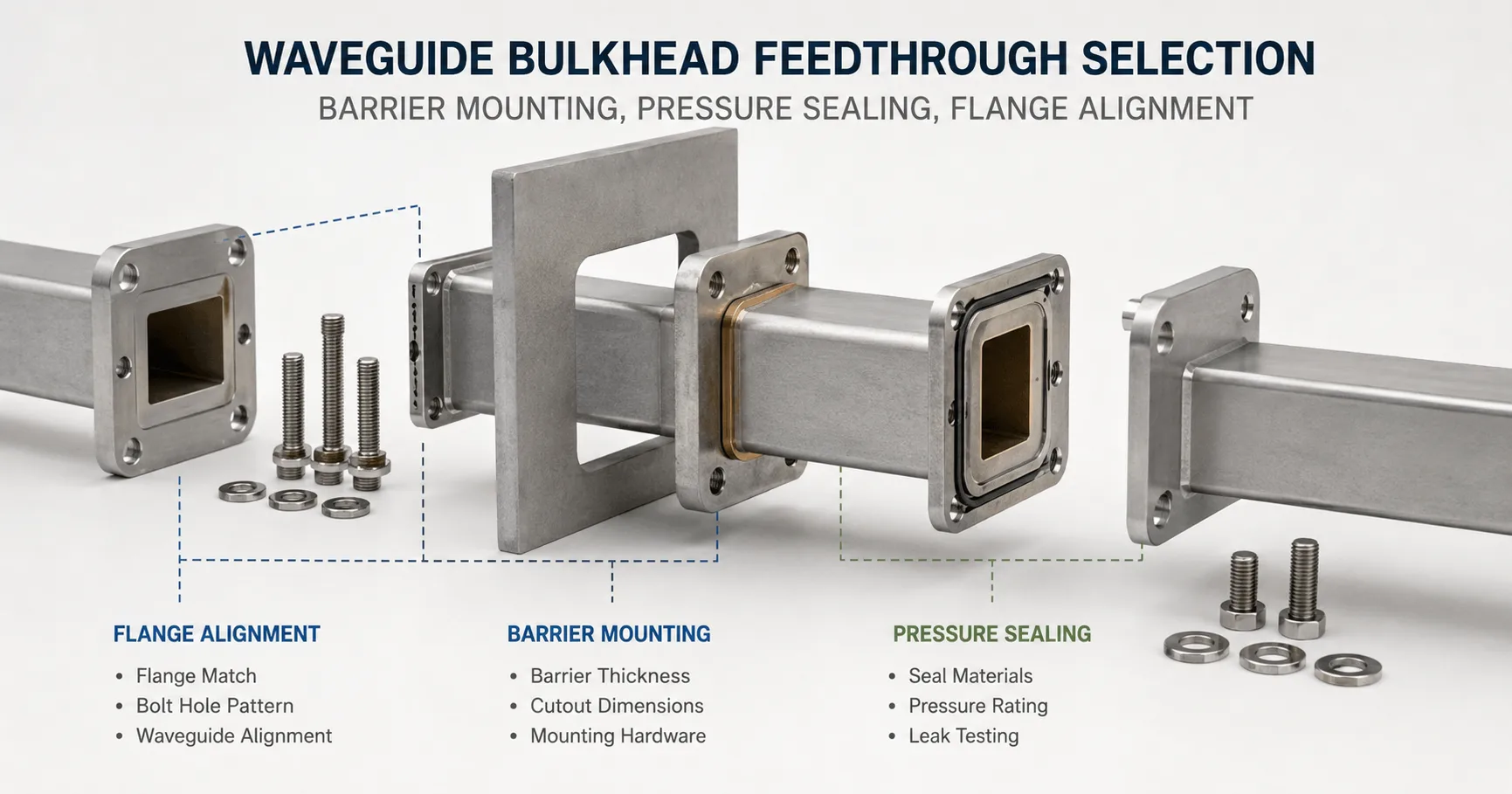
The shape directly impacts installation flexibility. Waveguide adapters require precise alignment due to their flanged mating surfaces, often secured with four to eight M3 or M4 screws at 0.5-1.2 N·m torque. SMA connectors use hex nuts or snap-on interfaces with 0.2-0.3 N·m tightening torque, enabling faster swaps. Misaligning a waveguide adapter by just 0.1 mm can increase insertion loss by 0.5 dB at 18 GHz, whereas SMA connectors tolerate ±0.5 mm offsets with minimal performance degradation.
| Parameter | Waveguide Adapter (WR-90) | SMA Coaxial Adapter |
|---|---|---|
| Cross-section | 22.86 mm x 10.16 mm | 6.35 mm diameter |
| Weight | 200-300 g | 10-20 g |
| Torque Requirement | 0.8 N·m (flange screws) | 0.25 N·m (nut) |
| Alignment Tolerance | ±0.05 mm | ±0.5 mm |
Material choices further differentiate the two. Waveguide adapters often use aluminum (6061-T6) or brass for low-loss performance, with surface roughness below 0.8 µm to minimize skin effect losses at high frequencies. SMA adapters favor beryllium copper or stainless steel contacts, plated with 1-3 µm gold over 50-100 µm nickel for durability. The larger waveguide dimensions also mean 20-30% slower heat dissipation compared to coaxial designs, limiting continuous power handling to 200-500 W versus SMA’s 100-300 W (at 3 GHz).
In field deployments, waveguide adapters demand 50-100% more installation space due to their rigid, straight-line routing requirements. SMA cables can bend at 15-30 mm radii, but waveguide bends must maintain ≥2x the guide wavelength to avoid mode distortion—a 90° bend in WR-90 needs 60-80 mm clearance. For millimeter-wave applications (e.g., 5G backhaul), this forces antenna arrays to adopt larger mounting frames (400-600 mm spacing) versus SMA-fed systems that fit in 200-300 mm enclosures.
Frequency Range Limits
Waveguide-to-SMA and coaxial adapters operate in wildly different frequency bands, and choosing the wrong one can kill your signal integrity before it even starts. Standard SMA connectors max out at 18 GHz, with precision variants (like 2.92 mm or 3.5 mm) pushing to 26.5 GHz or 34 GHz, respectively. Waveguides, however, laugh at those limits—WR-90 handles 8-12 GHz, WR-22 covers 33-50 GHz, and terahertz waveguides (e.g., WR-1.5) go beyond 500 GHz.
Real-world example: A 5G mmWave test setup at 28 GHz fails with an SMA adapter (insertion loss spikes to 2.5 dB at 25+ GHz), but a WR-28 waveguide adapter keeps losses below 0.3 dB across the band.
The physics behind this is simple: coaxial cables suffer from higher-order mode excitation above cutoff frequencies, causing erratic phase shifts (±15° at 20 GHz for SMA) and return loss degradation (worse than 10 dB beyond 18 GHz). Waveguides avoid this by design—their cutoff frequency is a hard floor, not a ceiling. A WR-12 waveguide (60-90 GHz) has negligible TE10 mode distortion as long as you stay above 55 GHz, whereas a 1.85 mm coaxial adapter at 60 GHz battles insertion loss exceeding 4 dB/m.
Material losses also diverge sharply. SMA’s dielectric (usually PTFE) absorbs 0.1-0.3 dB per meter at 10 GHz, doubling every 10 GHz increment. Waveguides use air or inert gas, so losses stay flat—0.02 dB/m at 30 GHz for WR-34. For high-power apps (e.g., radar), this matters: a 1 kW, 10 GHz signal loses 100 W in SMA after 100 meters but just 2 W in waveguide.
Manufacturing tolerances tighten with frequency. SMA’s center pin must stay within ±0.01 mm at 26 GHz to avoid impedance spikes, while waveguide dimensions allow ±0.05 mm at 50 GHz. That’s why cheap SMA adapters often fail spec above 12 GHz—a 5 µm plating defect can skew VSWR to 1.8:1 at 18 GHz.
Pro tip: Need 6-18 GHz? SMA wins on cost (200 for waveguide adapters). Beyond 40 GHz? Waveguides are your only sane choice—unless you enjoy debugging 3 dB signal drops from random coaxial resonances.
Thermal drift is another silent killer. SMA connectors shift 0.05 dB per °C at 20 GHz due to PTFE expansion, while waveguides (all-metal) drift <0.01 dB/°C. In outdoor 5G gear (-30°C to +70°C), that’s 4 dB seasonal variation for SMA vs. 0.8 dB for waveguide.
Connection Type Comparison
Waveguide-to-SMA and coaxial adapters don’t just differ in size and frequency—how they physically connect to your system can make or break your RF performance. SMA connectors use threaded couplings (10-32 UNF threads) with a typical mating cycle life of 500-1,000 connections, while waveguide flanges rely on bolted interfaces (M3-M6 screws) rated for 200-500 cycles before alignment degrades. The torque specs tell the story: SMA requires 0.25-0.3 N·m for consistent 50 Ω contact, whereas waveguide flanges need 0.6-1.2 N·m per screw to maintain airtight RF sealing.
Vibration resistance is where SMA struggles. In mobile applications (e.g., vehicle-mounted radar), loosening by just 0.1 mm can increase VSWR from 1.2:1 to 1.8:1 at 12 GHz. Waveguide flanges, with their 4-8 screw points, maintain VSWR <1.5:1 even under 5-10 G vibrational loads. But there’s a tradeoff: swapping a waveguide adapter takes 5-10 minutes (unbolting, realigning, torque-checking), while SMA disconnects in under 10 seconds.
| Parameter | SMA Connection | Waveguide Flange |
|---|---|---|
| Mating Mechanism | Threaded (10-32 UNF) | Bolted (M3-M6 screws) |
| Torque Requirement | 0.3 N·m | 0.8 N·m per screw |
| Reconnect Time | 10 sec | 5-10 min |
| Vibration Tolerance | ±0.1 mm | ±0.02 mm |
| Lifetime Cycles | 500-1,000 | 200-500 |
Contact resistance is another battlefield. SMA’s beryllium copper center pins must maintain <5 mΩ resistance across mating cycles, but wear and oxidation can push this to 20-50 mΩ after 300 insertions—a 0.5 dB loss bump at 6 GHz. Waveguide flanges avoid this by using galvanic contact-free coupling, with leakage losses dictated by flange flatness (<3 µm RMS roughness for WR-90).
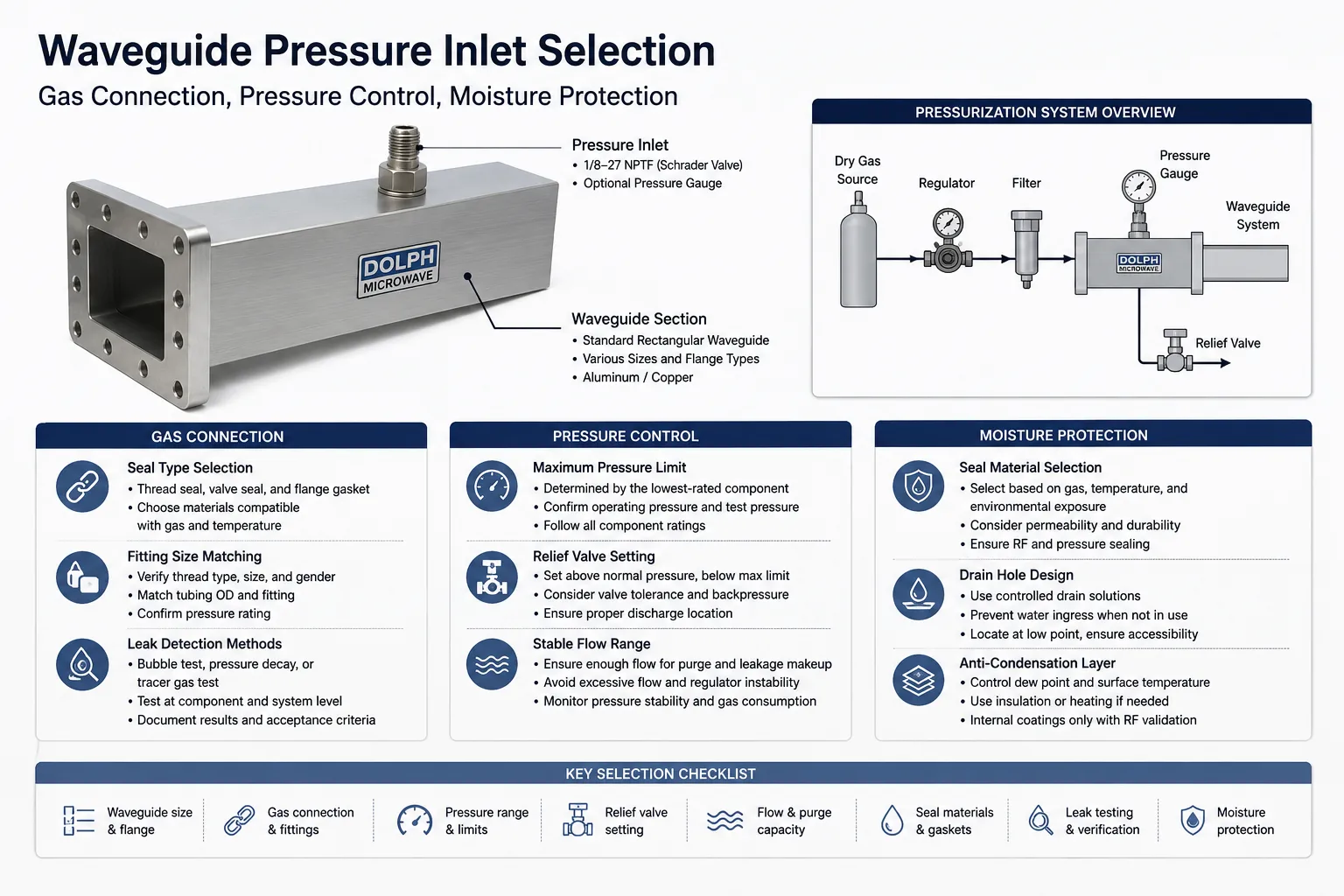
Environmental sealing favors waveguides. Their O-ring or conductive gasket seals block moisture ingress even at 100% humidity, while SMA’s threaded gap invites corrosion after 6-12 months in salt spray tests. That’s why naval systems prefer waveguides despite their bulk—a corroded SMA joint at 18 GHz can hit 3 dB loss, equivalent to 50% signal drop.