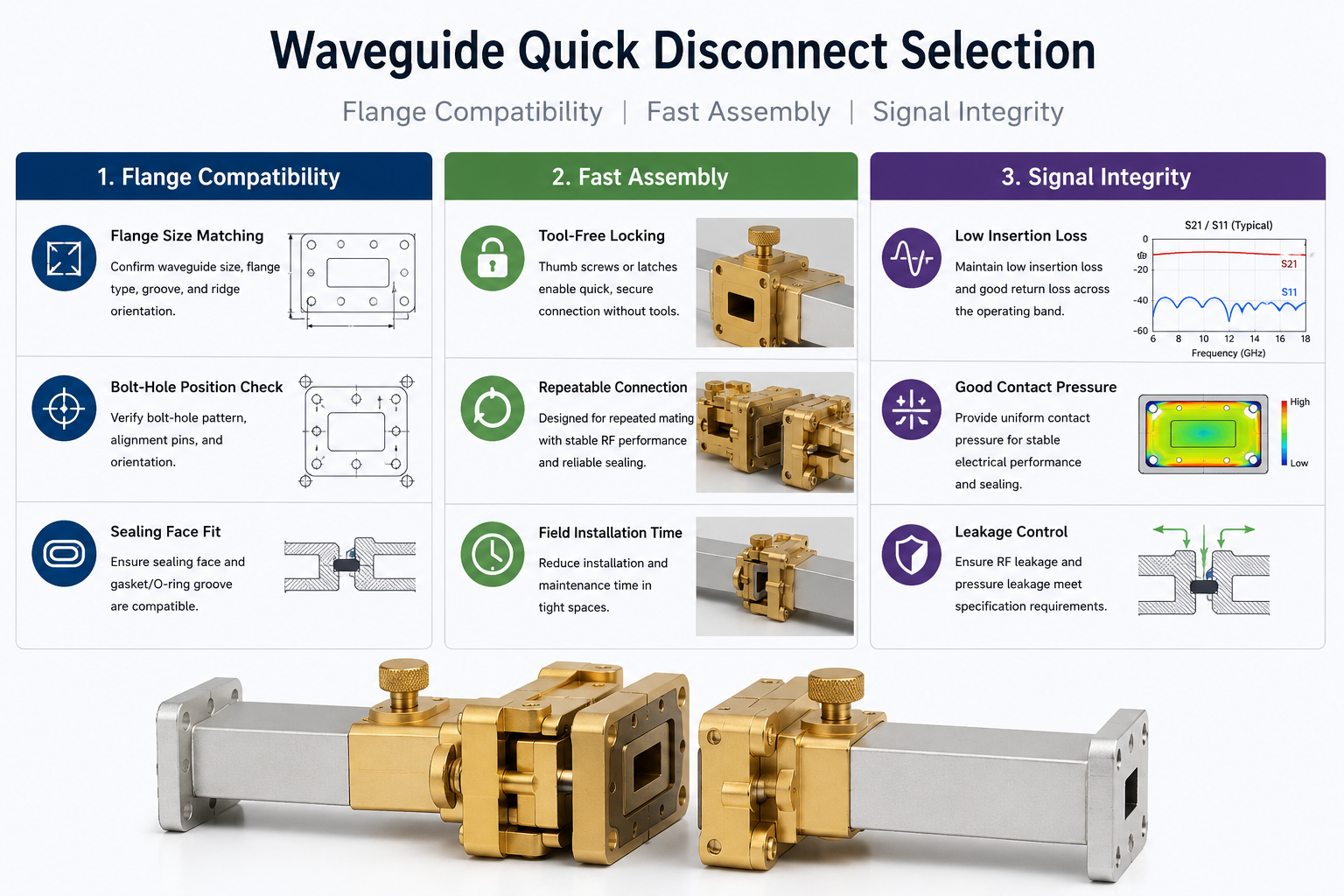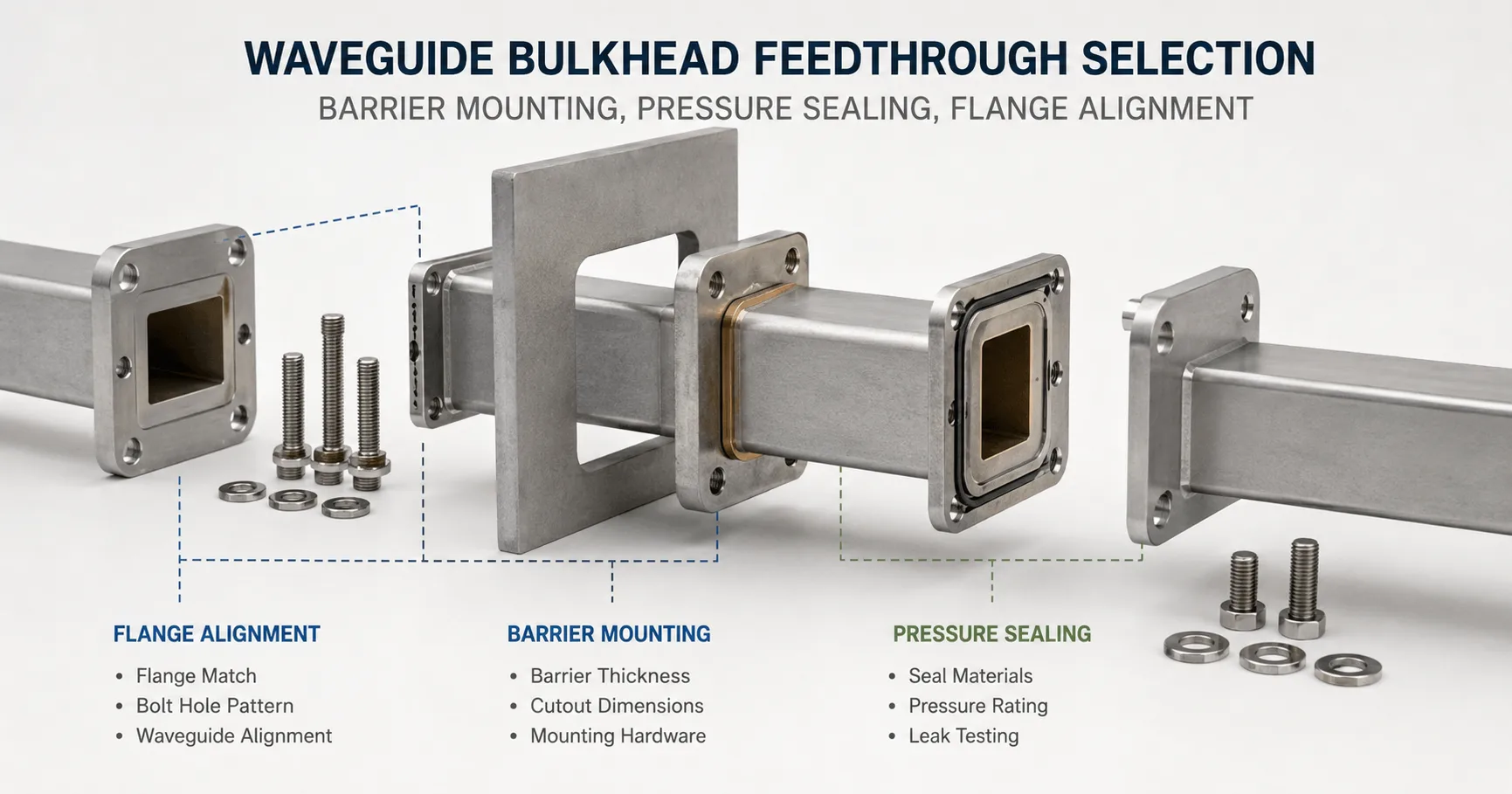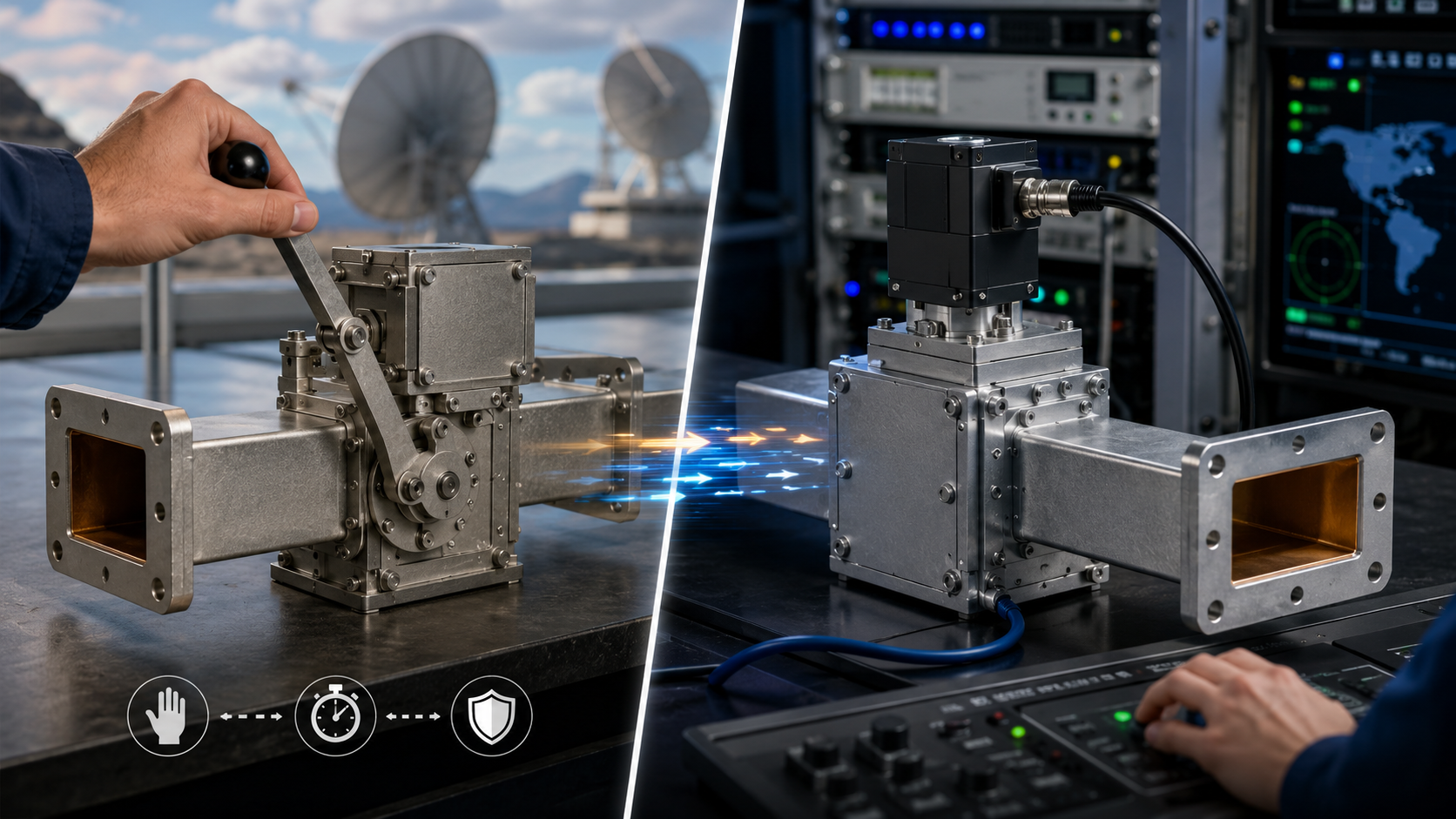
When selecting a rectangular waveguide size, consider the operating frequency (e.g., WR-90 for 8.2–12.4 GHz), cutoff frequency (ensure it’s 25–30% below the operating frequency), power handling (e.g., WR-112 handles 1.5 MW at 2.45 GHz), attenuation (lower for longer runs, like 0.1 dB/m in WR-62), and mechanical constraints (e.g., WR-430’s 4.3×2.15″ size for high power). Match the waveguide’s inner dimensions (a=2×b) to your system’s flange standards (e.g., UG-39/U).
Table of Contents
Frequency Range Limits
Rectangular waveguides are designed to operate within specific frequency ranges, and choosing the wrong size can lead to poor performance or signal loss. The usable frequency range of a waveguide is determined by its cutoff frequency—the lowest frequency at which a signal can propagate. For standard WR-90 waveguide (22.86 mm × 10.16 mm), the lower cutoff frequency is 6.56 GHz, while the upper practical limit is around 18 GHz due to higher-order mode interference. Beyond this, signal attenuation increases sharply—typically 0.1 dB/m at 10 GHz but rising to 0.5 dB/m at 18 GHz. If you try to use a WR-90 waveguide at 5 GHz (below cutoff), the signal will decay exponentially, losing 90% of its power within 1 meter. Conversely, pushing it beyond 20 GHz risks multi-mode propagation, causing phase distortion and a 15-20% drop in efficiency.
The dominant mode (TE₁₀) defines the primary operating band, but waveguides also have a recommended frequency range where performance is optimal. For example, the WR-112 waveguide (28.5 mm × 12.6 mm) supports 7.05 GHz to 15 GHz, but most manufacturers suggest keeping transmissions between 7.5 GHz and 14 GHz to avoid excessive loss. If you need dual-band operation (e.g., 8 GHz and 12 GHz), a WR-75 (19.05 mm × 9.53 mm, 10-15 GHz) might be a better fit, as it offers lower attenuation (~0.07 dB/m at 12 GHz) compared to a larger waveguide running at the same frequency.
Waveguide dimensions scale inversely with frequency—higher frequencies require smaller waveguides. A WR-10 (2.54 mm × 1.27 mm) operates at 75-110 GHz, but manufacturing tolerances become critical; even a 0.05 mm error in width can shift the cutoff frequency by 1-2%. For millimeter-wave applications (30-300 GHz), waveguides like WR-3 (0.864 mm × 0.432 mm) are used, but their attenuation jumps to 2-3 dB/m at 100 GHz due to surface roughness and ohmic losses.
If your system operates near the upper limit of a waveguide’s range, consider mode suppression techniques like corrugated walls or ridged waveguides. For instance, a ridged WR-62 (15.8 mm × 7.9 mm) extends usable bandwidth from 12.4-18 GHz to 10-22 GHz, but at the cost of higher insertion loss (~0.15 dB/m at 18 GHz vs. 0.1 dB/m in standard WR-62).
In high-power applications (e.g., radar at 10 kW), frequency limits also affect heat dissipation. A WR-284 (72.14 mm × 34.04 mm, 2.6-3.95 GHz) can handle peak power up to 3 MW, but if used at 4.5 GHz (beyond cutoff), arcing and 50% higher wall temperatures may occur. Always check manufacturer datasheets—some waveguides are rated for 10-20% wider bandwidths under controlled conditions, but real-world factors like flange misalignment (0.1 mm offset can add 0.2 dB loss) and moisture ingress (raising attenuation by 5-10%) can tighten usable limits.
For precise frequency-dependent designs, simulate the waveguide in HFSS or CST to model S-parameters, group delay, and dispersion effects before finalizing dimensions. A 1% shift in waveguide width can alter phase velocity by 0.5%, which matters in phased-array antennas where ±5° phase error degrades beam steering accuracy.
Waveguide Width vs Height
The width (a) and height (b) of a rectangular waveguide directly impact its cutoff frequency, power handling, and signal integrity. For standard WR-90 waveguide (22.86 mm × 10.16 mm), the width-to-height ratio (a/b) is 2.25, which balances low attenuation (0.1 dB/m at 10 GHz) and single-mode operation (TE₁₀ dominant mode up to 18 GHz). If the width is too narrow—say, 15 mm instead of 22.86 mm—the cutoff frequency jumps from 6.56 GHz to 10 GHz, making it unusable for S-band (2-4 GHz) signals. Conversely, a height reduction from 10.16 mm to 5 mm increases wall current density by 40%, raising ohmic losses by 15-20% at 12 GHz.
The TE₁₀ mode cutoff frequency (fc) is determined by width (a):
f_c = \frac{c}{2a}
where c = speed of light (3×10⁸ m/s). For example:
| Waveguide Type | Width (mm) | Height (mm) | Cutoff (GHz) | Max Freq (GHz) | Attenuation (dB/m @ 10 GHz) |
|---|---|---|---|---|---|
| WR-284 | 72.14 | 34.04 | 2.08 | 3.95 | 0.03 |
| WR-90 | 22.86 | 10.16 | 6.56 | 18.0 | 0.10 |
| WR-42 | 10.67 | 4.32 | 14.05 | 26.5 | 0.30 |
A wider waveguide (higher a) supports lower frequencies but risks multi-mode propagation if the height (b) isn’t scaled properly. For instance, a WR-112 (28.5 mm × 12.6 mm) works well at 7-15 GHz, but if height is reduced to 8 mm, TE₂₀ modes appear above 12 GHz, causing 10-15% power loss due to mode interference.
Height (b) affects power handling and loss:
- A taller waveguide (larger b) reduces wall current density, lowering ohmic losses by ~8% per 1 mm height increase at 10 GHz.
- However, excessive height (e.g., b > a/2) can introduce TE₀₁ modes, degrading signal purity. The optimal a/b ratio is 2.0-2.5 for most applications.
Manufacturing tolerances matter:
- A ±0.05 mm error in width shifts fc by ~0.5%, but the same error in height impacts attenuation by 3-5% due to field distribution changes.
- For millimeter-wave waveguides (WR-3, 0.864 mm × 0.432 mm), even a 0.01 mm deviation can cause 15% higher loss at 100 GHz.
Power handling scales with cross-sectional area:
- A WR-90 (22.86 mm × 10.16 mm) handles 1.5 kW average power at 10 GHz, but a WR-62 (15.8 mm × 7.9 mm) with 40% smaller area is limited to 800 W.
- For pulsed radar (100 kW peak), a WR-284 (72.14 mm × 34.04 mm) is preferred—its larger width reduces electric field density, preventing arcing at high voltages.
Trade-off for compact designs:
If space is limited (e.g., satellite comms), a WR-42 (10.67 mm × 4.32 mm) saves 60% volume vs. WR-90 but suffers 3× higher loss. For low-noise receivers, a WR-75 (19.05 mm × 9.53 mm) offers a middle ground—0.07 dB/m loss at 12 GHz with 50% smaller footprint than WR-112.
Power Handling Capacity
A waveguide’s power handling capacity determines how much RF energy it can transmit without arcing, overheating, or signal degradation. For example, a standard WR-90 waveguide (22.86 mm × 10.16 mm) can handle 1.5 kW of continuous power at 10 GHz, but this drops to 500 W at 18 GHz due to increased ohmic losses (0.5 dB/m vs. 0.1 dB/m at 10 GHz). If you push beyond these limits—say, 2 kW at 12 GHz—the electric field intensity near the narrow walls exceeds 3 kV/cm, risking breakdown in dry air. In pulsed systems (e.g., radar), peak power matters more: a WR-284 (72.14 mm × 34.04 mm) supports 3 MW peak power at 3 GHz, but only 50 kW average before thermal expansion (0.05 mm/°C) deforms the flange alignment.
Key rule: Power handling scales with waveguide cross-section. Double the width, and you quadruple the max power—but only if cooling and material tolerances allow it.
The breakdown voltage is the first bottleneck. For a WR-112 (28.5 mm × 12.6 mm), the theoretical max E-field before arcing is 4.2 kV/cm at sea level, but real-world factors like surface roughness (Ra > 0.8 µm) or moisture (50% humidity) can lower this by 20-30%. That’s why industrial 10 kW systems often use pressurized waveguides (2-3 atm nitrogen), boosting the threshold to 6 kV/cm and allowing 15% higher power transmission.
Thermal limits are just as critical. A copper WR-90 waveguide running 1 kW at 10 GHz sees 15°C temperature rise at the center of the broad wall. If the ambient exceeds 40°C, the insertion loss climbs 8% per 10°C due to increased resistivity. For high-power satellite links (5 kW, 8 GHz), aluminum waveguides with integrated heat sinks keep temps below 60°C, preventing 0.1 mm thermal warping that misaligns joints.
Material choice plays a huge role:
- Silver-plated waveguides cut ohmic losses by 30% vs. bare copper, allowing 20% higher power before thermal limits kick in.
- Stainless steel (for vacuum systems) handles 500°C without deformation, but its 5× higher resistivity means half the power rating of copper at 10 GHz.
Pulsed vs. CW makes a drastic difference:
- A WR-62 (15.8 mm × 7.9 mm) rated for 800 W continuous can handle 50 kW pulses (1 µs, 1% duty cycle) because the heat dissipates before accumulating.
- But if the pulse width exceeds 10 µs, the localized heating at 50 kW melts silver plating within 100 cycles.
Frequency impacts power handling nonlinearly:
- At 2 GHz, a WR-340 (86.36 mm × 43.18 mm) delivers 10 kW with ease—only 0.02 dB/m loss.
- The same waveguide at 8 GHz suffers 0.15 dB/m loss, forcing a 30% power reduction (7 kW max) to avoid thermal runaway.
Real-world derating is mandatory:
Manufacturers claim ”1.5 kW max” for WR-90, but after accounting for:
- Flange misalignment (0.1 mm gap adds 0.3 dB loss)
- Surface oxidation (increases loss by 5% per year)
- VSWR >1.2 (reflects 10% power, raising local E-field)
Attenuation and Loss Levels
Attenuation in waveguides determines how much signal power is lost per meter—critical for long-distance links, radar, and satellite comms. A standard WR-90 waveguide (22.86 mm × 10.16 mm) has 0.1 dB/m loss at 10 GHz, but this spikes to 0.5 dB/m at 18 GHz due to skin effect and surface roughness. If your system runs 20 meters of WR-90 at 18 GHz, you lose 10 dB (90% of power) just in waveguide loss. Compare that to WR-112 (28.5 mm × 12.6 mm), which offers 0.07 dB/m at 10 GHz—saving 30% power over the same distance.
Key insight: Every 0.01 dB/m reduction in loss saves 1% power in a 100-meter system. For 5G mmWave (28 GHz), where WR-42 (10.67 mm × 4.32 mm) suffers 0.3 dB/m, this means 3x more repeaters than lower bands.
Breaking Down Waveguide Loss Sources
1. Ohmic (Conductor) Loss
Dominates in copper/aluminum waveguides, scaling with frequency√f and surface roughness:
| Waveguide Type | Frequency (GHz) | Material | Roughness (µm) | Loss (dB/m) |
|---|---|---|---|---|
| WR-90 | 10 | Copper | 0.4 | 0.10 |
| WR-90 | 10 | Aluminum | 0.6 | 0.12 |
| WR-42 | 28 | Silver | 0.2 | 0.25 |
| WR-42 | 28 | Copper | 0.4 | 0.30 |
- Polished silver plating cuts loss by 20% vs. copper at 30 GHz.
- Surface oxidation (common in humid climates) increases loss 5% per year.
2. Dielectric Loss
Relevant in dielectric-filled waveguides (e.g., PTFE-supported flex waveguides):
- Air-filled: Near-zero dielectric loss (~0.001 dB/m).
- PTFE-filled (ε=2.1): Adds 0.02 dB/m at 10 GHz, worsening to 0.05 dB/m at 30 GHz.
3. Higher-Order Mode Loss
Occurs when operating too close to cutoff or beyond recommended bandwidth:
- A WR-112 at 7 GHz (near 7.05 GHz cutoff) has 0.12 dB/m vs. 0.07 dB/m at 10 GHz.
- If TE₂₀ modes excite (e.g., WR-90 at 18 GHz), loss jumps 50% due to field distortion.
4. Bending & Misalignment Loss
- 90° H-bend in WR-90 (R=100 mm): Adds 0.2 dB per bend.
- Flange misalignment (0.1 mm offset): Adds 0.3 dB per joint.
- Twist (10° over 1m): Introduces 0.15 dB loss at 10 GHz.
Real-World Attenuation Scenarios
- Satellite feed (50m WR-112 @12 GHz):
- Baseline loss: 3.5 dB (0.07 dB/m × 50m).
- With 4 bends + 6 flanges: +1.8 dB extra → Total 5.3 dB (70% power loss).
- Radar (10m WR-284 @3 GHz):
- Only 0.2 dB total loss—why L-band radar prefers large waveguides.
Mitigation Techniques
- Silver plating: Saves 0.02 dB/m at 10 GHz, pays back in 2 years for 24/7 systems.
- Precision alignment: ±0.05 mm flange tolerance keeps joint loss <0.1 dB.
- Smooth bends: R > 5× waveguide width reduces bend loss 3x.
Pro Tip: For low-loss 8-12 GHz systems, WR-112 is 30% better than WR-90, but costs 20% more. Calculate TCO—after 5 years, silver-plated WR-112 saves $5k in amplifier costs vs. copper WR-90.
Common Standard Sizes
Waveguides follow standardized WR (Waveguide Rectangular) sizes, each optimized for specific frequency bands. The WR-90 (22.86 mm × 10.16 mm) dominates X-band (8-12 GHz) systems with 0.1 dB/m loss at 10 GHz, while the massive WR-284 (72.14 mm × 34.04 mm) handles S-band (2-4 GHz) radar at 3 MW peak power. Between these extremes, over 30 standard sizes exist—like the WR-42 (10.67 mm × 4.32 mm) for Ka-band (26-40 GHz), where 0.3 dB/m loss at 28 GHz forces trade-offs between size and signal integrity. Choosing the wrong size wastes 20-50% of your RF budget on unnecessary loss or oversized hardware.
The IEEE 1785 standard defines waveguide dimensions to ensure flange compatibility, mode control, and repeatable performance. For example, a WR-112 (28.5 mm × 12.6 mm) isn’t just arbitrary—its 7.05 GHz cutoff aligns perfectly with C-band satellite downlinks (4-8 GHz), while its 15 GHz upper limit avoids TE₂₀ modes that plague wider designs. If you try to build a custom 25 mm × 11 mm waveguide, you’ll face 30% higher machining costs and risk VSWR >1.3 from imperfect corners.
Frequency dictates size:
Low-band (1-8 GHz): WR-340 (86.36 mm × 43.18 mm) for 2.6 GHz cutoff, handling 10 kW continuous power in broadcast towers.
Mid-band (8-26 GHz): WR-62 (15.8 mm × 7.9 mm) fits 12-18 GHz radars, balancing 0.15 dB/m loss with 800 W power handling.
High-band (26-110 GHz): WR-10 (2.54 mm × 1.27 mm) serves 75-110 GHz lab gear, but its ±0.01 mm tolerance demands $500/m precision milling.
Power and loss trade-offs:
A WR-159 (40.4 mm × 20.2 mm) for 5 GHz WiFi backhaul offers 0.05 dB/m loss, but its large size (3x WR-90 volume) makes it impractical for drones. Meanwhile, the WR-15 (3.76 mm × 1.88 mm) for 50-75 GHz loses 1.2 dB/m, forcing repeaters every 10m in 60 GHz point-to-point links.
Real-world cost drivers:
WR-90 (copper): 200/m for commercial grade, 600/m for oxygen-free high-conductivity (OFHC) with 5% lower loss.
WR-28 (7.11 mm × 3.56 mm): $1,200/m due to 0.02 mm tolerance needed for 40 GHz operation.
Flexible waveguides (WR-42 equivalent): 3x the price of rigid, but save $50k in installation where bends are unavoidable.
Legacy vs. modern choices:
Old radar sites still use WR-2300 (584 mm × 292 mm) for 350 MHz, wasting 90% of their rack space.
New phased arrays prefer WR-12 (3.10 mm × 1.55 mm) for 60 GHz, packing 8x more elements in the same area vs. WR-42.