Waveguide fabrication employs three primary methods: precision machining, electroforming, and extrusion. CNC milling achieves ±5μm tolerances for aerospace-grade aluminum WR-90 waveguides, while electroforming builds nickel-plated copper structures layer-by-layer for complex shapes with 0.1μm surface finish. Extrusion produces cost-effective aluminum waveguides in bulk (up to 6m lengths) with ±50μm dimensional accuracy, though requiring post-machining for critical interfaces. Each method balances cost against performance needs, with vacuum brazing often joining sections using silver-based alloys melting at 780°C. Surface roughness below 0.4μm RMS is critical to minimize attenuation (0.1dB/m at 10GHz).
Table of Contents
Etching Waveguide Patterns
Waveguide fabrication relies heavily on precise etching techniques to define optical pathways with minimal loss. The most common method, photolithography + dry etching, achieves feature sizes as small as 100 nm with sidewall roughness below 5 nm, critical for low-loss (<0.1 dB/cm) silicon photonic circuits. Wet etching, though cheaper (50–200 per wafer vs. 500–1,500 for dry etching), struggles with sub-micron resolution due to isotropic removal rates (~1 µm/min for KOH on silicon). Meanwhile, reactive ion etching (RIE) offers anisotropic profiles with 85–90° sidewall angles, essential for high-density integration. Modern inductively coupled plasma (ICP) etching pushes etch rates to 1–3 µm/min while maintaining <2 nm RMS roughness, but at a higher tool cost (~$1M per system). For telecom applications (1.55 µm wavelength), etch depth uniformity must stay within ±5% to prevent modal mismatch.
Photolithography Patterning starts with spin-coating a 1–3 µm thick photoresist (e.g., AZ 5214 or SU-8), exposed under 365–405 nm UV light with 10–50 mJ/cm² dose. Alignment precision must be <±50 nm for multi-layer waveguides. Poor resist adhesion increases defect density by 15–30%, forcing rework that adds 200–500 per wafer in extra lithography steps.
Dry Etching (RIE/ICP) dominates for high-aspect-ratio (>10:1) structures. A typical Cl₂/BCl₃ gas mix etches silicon at 200–500 nm/min, while SF₆/O₂ achieves 1–2 µm/min but with ~30% lower selectivity to SiO₂ masks. Over-etching by just 10% can widen waveguides by 50–100 nm, increasing insertion loss by 0.2–0.5 dB/cm. Modern ICP etchers reduce undercut to <20 nm by tuning bias power (20–300 W) and pressure (5–50 mTorr).
Wet Etching remains useful for low-budget R&D or non-critical layers. Buffered HF (6:1 NH₄F:HF) removes SiO₂ at 100 nm/min with near-zero undercut, but HF safety protocols add 10–20 per hour in PPE/ventilation costs. For silicon, KOH (30% at 80°C) etches {111} planes 100x slower than {100}, creating 54.7° sidewalls—unusable for vertical couplers but acceptable for low-frequency RF waveguides.
Post-Etch Cleaning is non-negotiable: residue >5 nm thick scatters light, spiking loss by 0.3–1 dB/cm. A 5-minute O₂ plasma ash followed by DI water rinse removes 90% of contaminants, while piranha cleaning (H₂SO₄:H₂O₂ 3:1) eliminates organics but risks 5–10 nm surface pitting.
Metrology ensures yield: SEM cross-sections measure CD (critical dimension) uniformity (±3% tolerance), and AFM checks roughness (<2 nm RMS for C-band). Skipping inspection risks 20–40% higher scrap rates in volume production.
Cost Breakdown: For 1,000 wafers/month, dry etching consumes 250–400 per wafer (tool depreciation + gases), while wet etching stays under $100. However, dry-etched devices see 10–15% higher performance in 40 Gbps+ optical links, justifying the expense for datacom markets.
Laser Writing Techniques
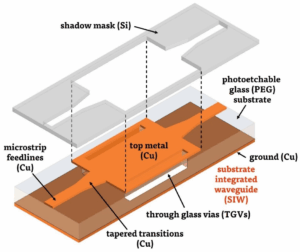
Laser writing is a direct-write method for fabricating waveguides without masks, offering flexibility for rapid prototyping and complex 3D structures. Femtosecond lasers (1030–1550 nm, 100–500 fs pulses) are the gold standard, achieving sub-micron resolution (0.5–2 µm feature size) with <0.3 dB/cm loss in silica. UV lasers (266–355 nm) are cheaper (50k–150k vs. 200k–500k for femtosecond systems) but limited to ~5 µm resolution due to diffraction. CO₂ lasers (10.6 µm) are fast (20–100 mm/s writing speed) but struggle with precision below 10 µm. For chalcogenide glass waveguides, mid-IR lasers (2–5 µm) reduce cracking risk by 40% compared to UV exposure. Average power (1–20 W) and pulse energy (0.1–50 µJ) must be balanced—too high (>5 µJ) causes microcracks, while too low (<0.5 µJ) leaves incomplete refractive index changes (Δn < 0.01).
Femtosecond Laser Inscription works by nonlinear absorption, creating permanent Δn (~0.01–0.05) in silica or doped glasses. A 1 MHz repetition rate at 0.5–2 µJ/pulse writes low-loss (<0.5 dB/cm) waveguides at 1–5 mm/s. Faster speeds (>10 mm/s) reduce Δn by 30–50%, requiring post-annealing (300–500°C, 1–2 hrs) to stabilize performance. Beam shaping (SLM or cylindrical lenses) improves mode overlap by 20%, critical for single-mode (SMF-28) coupling efficiency >90%.
UV Laser Direct Writing uses photosensitive glasses (e.g., Foturan), where 266 nm exposure (10–50 mJ/cm²) triggers crystallization + HF etching. Waveguides show 0.8–1.2 dB/cm loss but allow 3D bends (5–20 µm radius) impossible with lithography. Throughput is low (0.1–1 mm/s), making it 10x slower than femtosecond for >1 cm structures.
CO₂ Laser Annealing modifies pre-fabricated waveguides (e.g., silicon-on-insulator) by localized heating (300–800°C, spot size 10–50 µm). A 20 W laser at 1–5 mm/s reduces sidewall roughness from 10 nm to <2 nm, cutting scattering loss by 60%. However, thermal stress can warp substrates >50 µm thick if cooling rates exceed 100°C/s.
| Technique | Resolution (µm) | Speed (mm/s) | Loss (dB/cm) | Cost per Hour ($) |
|---|---|---|---|---|
| Femtosecond Laser | 0.5–2 | 1–10 | 0.1–0.5 | 150–300 |
| UV Laser | 5–10 | 0.1–1 | 0.8–1.2 | 80–150 |
| CO₂ Laser Annealing | 10–50 | 1–5 | N/A (post-proc.) | 50–100 |
Material Considerations:
- Silica: Best for femtosecond (Δn = 0.03–0.05), but UV writing needs doping (Ge, P).
- Polymers (SU-8, PMMA): UV lasers at 355 nm cure 50–100 µm features but suffer 0.5–1 dB/cm loss from organic absorption.
- Silicon: Only CO₂ annealing works—direct laser ablation causes >5 dB/cm loss from surface voids.
Cost vs. Quality:
- Femtosecond systems cost 500–1,000 per hour (maintenance + gas) but deliver <0.3 dB/cm loss.
- UV lasers run 80–200/hr but need extra etching steps (100–300/wafer).
- CO₂ lasers are cheapest ($50–100/hr) but only for post-processing.
Pro Tips:
- For femtosecond writing, pulse overlap (50–70%) prevents stitching errors (>100 nm gaps).
- UV exposure in humid air (>50% RH) increases defect density by 25%—use N₂ purge.
- CO₂ annealing on SOI wafers requires <5 W/mm² to avoid Si layer delamination.
Thin Film Deposition Steps
Thin film deposition is the backbone of waveguide fabrication, defining optical confinement layers with thickness control down to ±1 nm. Plasma-enhanced chemical vapor deposition (PECVD) dominates for silicon nitride (Si₃N₄) waveguides, growing 200–500 nm films at 5–10 nm/min with <0.5% thickness variation across 200 mm wafers. Sputtering (DC/RF) is cheaper (50–100 per wafer vs. 150–300 for PECVD) but struggles with step coverage >80% on high-aspect-ratio trenches. For low-loss silica (SiO₂), electron-beam evaporation hits 0.1 dB/cm loss but runs 3x slower (2–5 nm/min) than PECVD. Atomic layer deposition (ALD) offers pin-hole-free films at 0.1 nm/cycle precision—critical for LiNbO₃ modulators—but costs 500–800 per wafer due to slow growth rates (0.5–1 nm/min).
Rule of Thumb: A 10 nm thickness error in Si₃N₄ shifts effective refractive index (nₑff) by 0.5%, causing >1 dB insertion loss in 100 µm-long couplers.
Process Breakdown & Critical Parameters
PECVD for Silicon Nitride runs at 300–400°C with SiH₄/NH₃/N₂ gas flows (50–200 sccm). Too much NH₃ (>30% mix) increases H-content by 15–20%, raising optical loss at 1550 nm by 0.2–0.4 dB/cm. Power density matters: 1–2 W/cm² RF gives stress-controlled films (±200 MPa), while >3 W/cm² cracks >500 nm layers due to thermal expansion mismatch.
Sputtering SiO₂ for Cladding uses 99.999% pure Si targets in Ar/O₂ plasma (3–5 mTorr). Bias voltage (200–500 V) must stay below 600 V to avoid columnar growth—those 50–100 nm voids spike scattering loss by 3x. For uniformity (±2% over 150 mm), rotate substrates at 10–30 RPM; static setups suffer >5% edge-to-center thickness drift.
ALD for Precision Linbo₃ demands 200°C substrate heating and pulsed TMA/H₂O cycles (0.1 sec/pulse). Each 1 nm film takes 5–10 min, but interface traps drop by 90% vs. sputtering. Watch precursor exhaustion: >500 cycles without chamber cleaning cuts growth rate by 40% from byproduct buildup.
E-Beam Evaporation Challenges: 99.99% SiO₂ pellets vaporize at 5–10 kV beam energy, but <0.01% impurities (e.g., Na⁺ ions) migrate to film surfaces, increasing DC leakage by 100x in >1 µm coatings. For stress-free films, heat substrates to 150–200°C—higher temps >250°C induce 0.1% shrinkage upon cooling.
Cost vs. Performance Trade-offs:
- PECVD Si₃N₄: $200/wafer, 0.3–0.5 dB/cm loss, ±1 nm thickness control
- Sputtered SiO₂: $80/wafer, 0.2–0.3 dB/cm loss, ±3 nm uniformity
- ALD LiNbO₃: $700/wafer, <0.1 dB/cm loss, ±0.5 nm atomic-level accuracy
Pro Tips for High Yield:
- PECVD Si₃N₄: If refractive index (n) drifts >0.01, check SiH₄ flow decay (>5% drop/hour)—it alters film stoichiometry.
- Sputtering SiO₂: Pre-sputter targets for 30 min to remove native oxides; skipping this cuts adhesion by 50%.
- ALD Linbo₃: Purge lines for 5 sec between pulses—residual H₂O causes 10% thickness spikes at layer interfaces.
Final Warning: Film stress is a silent killer. Measure it every 100 nm deposition with laser curvature tools—>500 MPa tensile stress peels >1 µm films off SiO₂/Si wafers within 24 hrs.