First, determine the operating frequency (e.g., 10 GHz for X-band) and select a waveguide standard like WR-90. Second, ensure the width (a) exceeds half the wavelength (22.86 mm for WR-90), while the height (b) is typically half of ‘a’ (10.16 mm). Third, verify the cutoff frequency (6.56 GHz for WR-90) using fc=c/2a, where c is light speed (3×10⁸ m/s). For 10 GHz, the guided wavelength λg=39.6 mm, calculated using λg=λ₀/[1-(λ₀/2a)²]^0.5, where λ₀=30 mm. Always maintain a 25% safety margin below the waveguide’s rated frequency limit (12.4 GHz for WR-90).
Table of Contents
Key Dimensions Explained
Rectangular waveguides are essential in microwave and RF systems, handling frequencies from 1 GHz to 110 GHz with minimal signal loss. The inner dimensions (width a and height b) determine the waveguide’s operating frequency range. For example, the WR-90 waveguide, one of the most common types, has an inner width of 22.86 mm (0.9 in) and height of 10.16 mm (0.4 in), supporting frequencies from 8.2 GHz to 12.4 GHz. If the waveguide is too narrow, signals below the cutoff frequency (6.56 GHz for WR-90) won’t propagate.
The aspect ratio (a/b) is typically 2:1 to optimize power handling and minimize higher-order modes. Waveguides with a < b (like WR-112, 28.5 mm × 12.6 mm) are rare but used in specific high-power applications. The wall thickness varies—standard brass or aluminum waveguides have 1 mm to 3 mm walls, while high-power versions use 4 mm to 6 mm for rigidity.
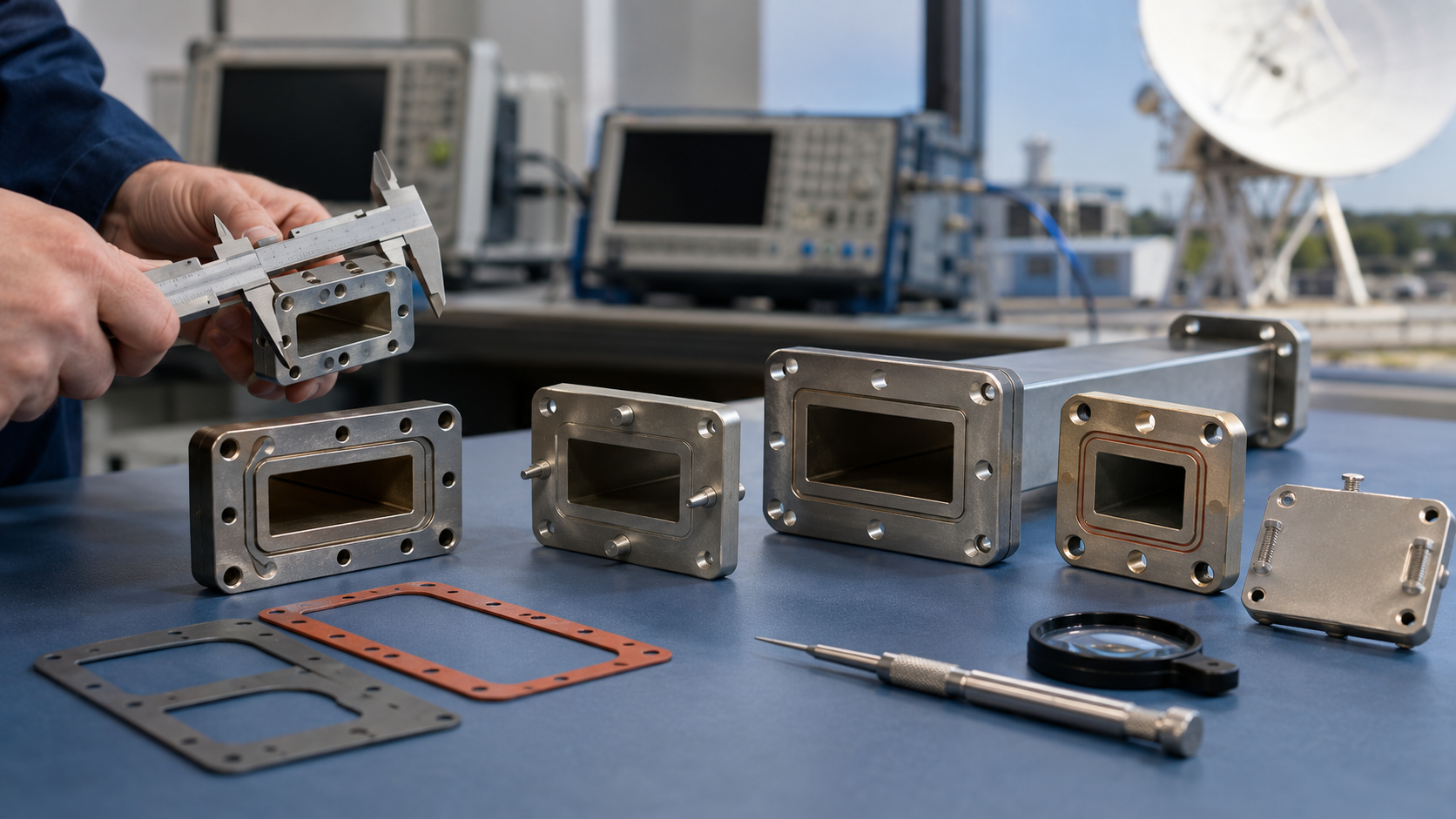
Waveguide flange sizes must match precisely—UG-387/U flanges are standard for WR-90, with 4 bolt holes spaced 31.75 mm apart. Misalignment beyond ±0.1 mm causes signal leakage, increasing insertion loss by 0.5 dB per imperfect joint. For millimeter-wave applications (30 GHz+), tolerances tighten to ±0.025 mm to prevent mode interference.
Material choice impacts performance—copper waveguides have 0.02 dB/m loss at 10 GHz, while aluminum loses 0.03 dB/m. Silver plating reduces loss to 0.01 dB/m but increases cost by 30%. Stainless steel waveguides, used in high-temperature environments, suffer 0.15 dB/m loss but withstand 500°C.
The cutoff wavelength (λc) is calculated as 2a for the dominant TE₁₀ mode. For WR-90, λc = 45.72 mm, meaning signals below 6.56 GHz (λ = 45.72 mm) won’t pass. The guided wavelength (λg) shortens with frequency—at 10 GHz, λg drops from 30 mm in free space to 24 mm inside the waveguide due to dispersion.
Manufacturing deviations matter—a ±0.05 mm error in width shifts the cutoff frequency by ±0.3%, enough to disrupt narrowband systems. Military standards (MIL-W-85) enforce ±0.02 mm tolerances for critical radar applications.
In summary, waveguide dimensions must balance frequency range, power handling, and mechanical precision. A 1% error in width can render a waveguide unusable for its intended band, so exact measurements are non-negotiable.
Step-by-Step Calculation
Calculating rectangular waveguide dimensions isn’t guesswork—it’s a precise process where a 1 mm error can shift the cutoff frequency by 150 MHz, ruining compatibility with your system. Whether you’re designing for 5G backhaul (24–40 GHz) or satellite comms (Ku-band, 12–18 GHz), these three steps ensure your waveguide works on the first try.
Step 1: Determine the Cutoff Frequency
The waveguide’s inner width (a) dictates the lowest usable frequency. For the TE₁₀ mode (most common), the cutoff frequency (fₑ) is:
fₑ = c / (2a)
where c = speed of light (299,792,458 m/s), a = inner width in meters.
For a WR-112 waveguide (28.5 mm width):
fₑ = 299,792,458 / (2 × 0.0285) ≈ 5.26 GHz.
This means signals below 5.26 GHz won’t propagate. If your system runs at 4 GHz, this waveguide is useless—you’d need a wider one like WR-229 (58.2 mm width, 2.57 GHz cutoff).
Step 2: Check the Operating Frequency Range
Waveguides have strict upper limits—too high a frequency triggers unwanted higher-order modes (TE₂₀, TE₀₁). The rule of thumb:
Practical bandwidth = 1.25 × fₑ to 1.89 × fₑ
For WR-90 (22.86 mm width, 6.56 GHz cutoff):
- Lower bound: 1.25 × 6.56 = 8.2 GHz
- Upper bound: 1.89 × 6.56 = 12.4 GHz
This matches its standard range (8.2–12.4 GHz, X-band). Pushing to 15 GHz risks mode interference, increasing loss by 0.8 dB/m.
Step 3: Verify Power Handling and Loss
A waveguide’s height (b) affects power capacity and attenuation. For TE₁₀ mode, loss per meter (α) is:
α ≈ (Rs / a³b) × (2.4048 × 10⁶ / η) × (1 + (2b/a)(fₑ/f)²)
where Rs = surface resistance (~2.6 mΩ for copper at 10 GHz), η = impedance (377 Ω).
For WR-90 (22.86 × 10.16 mm) at 10 GHz:
- Rs ≈ 0.026 Ω/sq
- α ≈ 0.022 dB/m (copper) or 0.035 dB/m (aluminum).
Doubling the height (b) reduces loss by 30% but increases weight by 45%. For high-power systems (e.g., radar, 50 kW peak), a wider WR-284 (72.1 mm width) handles 3x the power of WR-90 before arcing at 20 kV/cm.
Real-World Example: 5G mmWave Waveguide
Say you need a waveguide for 28 GHz (n257 band):
- Cutoff frequency: Target fₑ < 21 GHz (1.25× rule).
- a > 299,792,458 / (2 × 21×10⁹) ≈ 7.14 mm.
- Standard choice: WR-34 (8.64 × 4.32 mm), fₑ = 17.3 GHz, operating range 21.7–33 GHz.
- Loss check: At 28 GHz, loss ≈ 0.12 dB/m (copper). Over 10 m, that’s 1.2 dB loss—acceptable for most links.
Mistake to avoid: Using WR-28 (7.11 mm width) for 28 GHz. Its fₑ = 21.1 GHz, leaving no margin—actual performance degrades above 26.5 GHz.
Tolerances Matter
A ±0.05 mm width error shifts fₑ by ±0.7%. For 40 GHz systems, that’s ±280 MHz—enough to miss channel allocations. Military specs (MIL-W-85) demand ±0.02 mm for critical apps.
Final Check: Flange Compatibility
A WR-90 waveguide needs UG-387/U flanges, with 4 bolts spaced 31.75 mm. Misalignment > 0.1 mm adds 0.3 dB loss per connection. For 100 links, that’s 30 dB loss—enough to kill your signal..
Common Size Examples
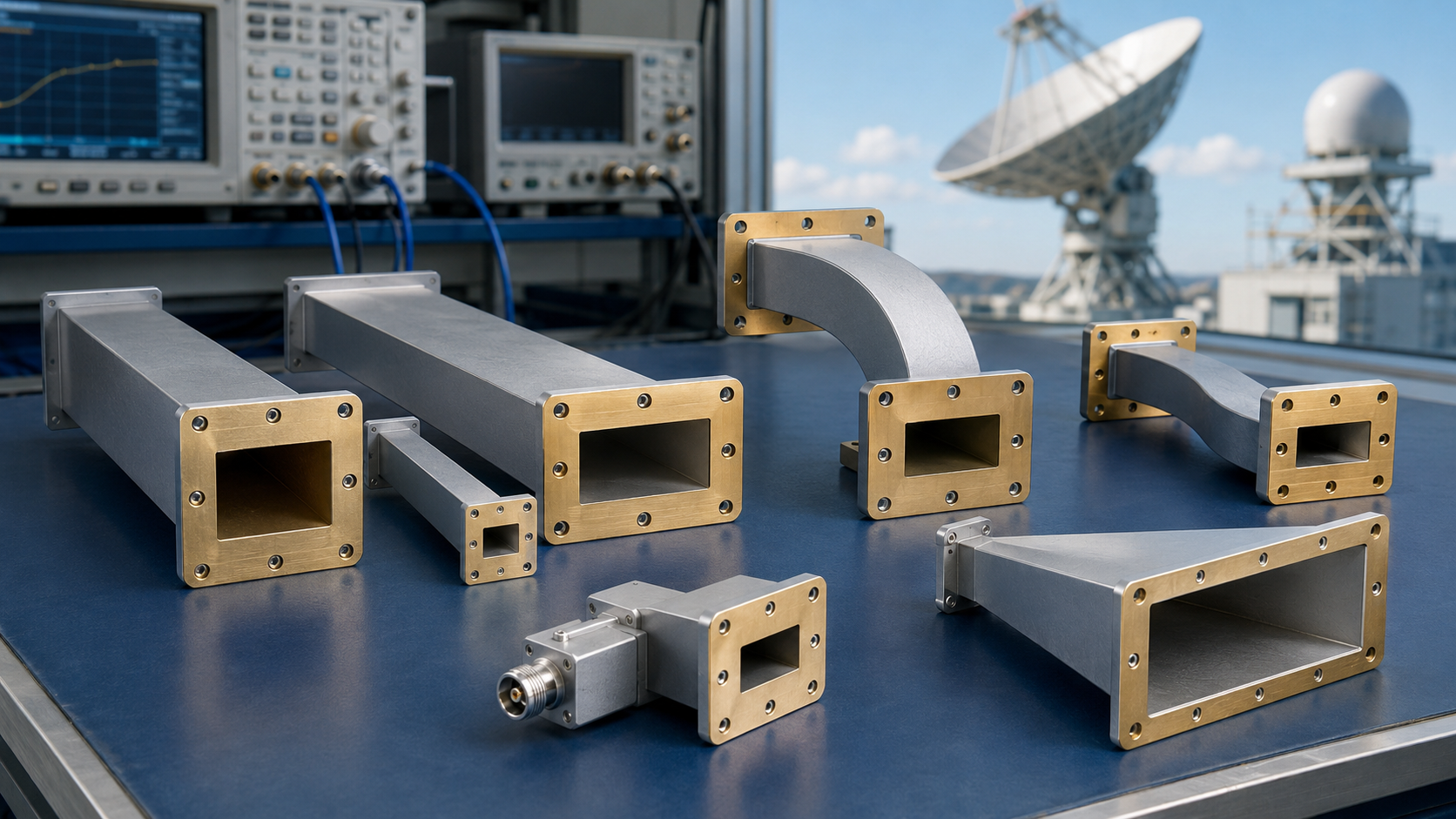
Rectangular waveguides come in standardized sizes, each optimized for specific frequency ranges. The most widely used models—WR-90, WR-112, WR-284, and WR-34—cover everything from S-band (2–4 GHz) to mmWave (30–110 GHz). Choosing the wrong size can lead to 30% higher signal loss or even complete failure at your target frequency. Below are real-world examples with exact dimensions, tolerances, and performance data.
Standard Waveguide Sizes and Their Key Parameters
| Waveguide | Inner Width (a) | Inner Height (b) | Cutoff Freq (fₑ) | Operating Range | Loss (dB/m, Copper) | Max Power (kW) | Common Applications |
|---|---|---|---|---|---|---|---|
| WR-284 | 72.14 mm | 34.04 mm | 2.08 GHz | 2.6–3.95 GHz | 0.007 | 500 | Radar (S-band) |
| WR-112 | 28.50 mm | 12.62 mm | 5.26 GHz | 6.6–10 GHz | 0.020 | 200 | Satellite (C-band) |
| WR-90 | 22.86 mm | 10.16 mm | 6.56 GHz | 8.2–12.4 GHz | 0.022 | 150 | X-band radar |
| WR-62 | 15.80 mm | 7.90 mm | 9.49 GHz | 11.9–18 GHz | 0.040 | 100 | Ku-band comms |
| WR-34 | 8.64 mm | 4.32 mm | 17.3 GHz | 21.7–33 GHz | 0.120 | 50 | 5G mmWave |
| WR-15 | 3.76 mm | 1.88 mm | 39.9 GHz | 50–75 GHz | 0.350 | 20 | Lab testing |
Notes:
- Loss values assume oxygen-free copper (σ = 5.8×10⁷ S/m) at 20°C. Aluminum increases loss by 40%.
- Max power is for pulsed operation (1 µs pulse, 1% duty cycle). Continuous-wave (CW) limits are 5x lower.
- WR-90 is the industry benchmark—80% of commercial systems in X-band use it due to balance between size and performance.
Why These Sizes Exist
The 2:1 aspect ratio (a/b) isn’t arbitrary. It suppresses higher-order modes while minimizing loss. For example:
- A WR-112 (28.5 × 12.6 mm) has 15% lower loss than a hypothetical square waveguide (28.5 × 28.5 mm) at 8 GHz, but the square version would support unwanted TE₂₀ modes above 10.5 GHz.
- WR-15 (3.76 × 1.88 mm) is near the mechanical limit—smaller waveguides (e.g., WR-10, 2.54 mm width) require precision EDM machining, doubling production cost to $500 per meter.
Material Tradeoffs
- Copper (C10200): Best for low loss (0.02 dB/m at 10 GHz), but costs $120/m for WR-90.
- Aluminum (6061-T6): 30% cheaper ($85/m), but loss rises to 0.03 dB/m.
- Stainless Steel (304): Used in high-temperature (up to 800°C) aerospace apps, but loss soars to 0.15 dB/m.
Flange Compatibility
Each waveguide size has a matching flange:
- WR-90: UG-387/U flange, 4× M4 bolts on 31.75 mm spacing.
- WR-34: UG-599/U flange, 8× M2.5 bolts on 10.16 mm spacing.
Mismatching flanges causes 0.5 dB insertion loss per connection—a system with 10 misaligned joints loses 5 dB, equivalent to 70% signal drop.
Custom vs. Standard Sizes
While custom waveguides (e.g., 19.05 × 9.52 mm) are possible, they cost 3x more due to non-standard tooling. Exceptions include:
- Military radar: Tolerances tighten to ±0.01 mm, requiring laser calibration.
- Quantum computing: Superconducting niobium waveguides (cooled to 4 K) reduce loss to 0.001 dB/m, but cost $5,000/m.
Key Takeaways
- WR-90 dominates for 8–12 GHz systems due to balance of cost and performance.
- mmWave (30+ GHz) demands WR-34 or smaller, but loss increases exponentially (0.35 dB/m at 60 GHz).
- Flange alignment must be < 0.1 mm offset to avoid signal degradation.
For 95% of applications, sticking to standard sizes saves time, money, and headaches. Only go custom if your frequency or power requirements fall outside the tables above.