RF bands span LF (30-300kHz, e.g., NDB navigation) to 5G mmWave (24-100GHz, 20dB/km loss driving small-cell densification). HF (3-30MHz, 10-100m waves) supports global shortwave; GPS L1 (1575MHz) hits 5m accuracy—physics like path loss and antenna size define each band’s role.
Table of Contents
What Are RF Bands?
The entire RF spectrum is officially defined as waves with frequencies between 3 kHz and 300 GHz. This vast range is managed globally by the International Telecommunication Union (ITU) and nationally by agencies like the FCC in the United States to prevent signals from interfering with each other. For example, a Wi-Fi router operating at 2.4 GHz must stay within a precisely defined slice of that frequency to avoid crashing into a nearby Bluetooth device, which uses a different, adjacent slice at 2.402–2.480 GHz.
- They are grouped by frequency: Bands are contiguous blocks of the radio spectrum, measured in Hertz (Hz). Common groupings include kHz, MHz, and GHz.
- They have unique physical properties: The frequency of a band dictates its wavelength, which in turn determines its range, penetration power, and data capacity.
- They are legally regulated: Governments license specific bands for specific uses to prevent chaos, similar to zoning laws for land.
A 1 MHz wave oscillates 1 million times per second, while a 2.4 GHz wave oscillates 2.4 billion times per second. This oscillation rate is the single most important factor. A band at a lower frequency, like 700 MHz used for 4G/LTE, has a wavelength of about 42.8 centimeters. This long wave can travel over 10 kilometers from a cell tower and easily pass through walls, making it excellent for wide-area coverage. Conversely, a 5 GHz Wi-Fi signal has a wavelength of about 6 centimeters.
| Band / Common Use | Frequency Range | Typical Range (Ideal) | Data Capacity (Theoretical) | Key Characteristic |
|---|---|---|---|---|
| FM Radio Broadcast | 88 – 108 MHz | ~30 – 50 km | Low (~150 kbps) | Excellent penetration, wide coverage. |
| 4G LTE / Cellular | 700 MHz, 1.7 – 2.1 GHz | 1 – 10+ km (depending on band) | Moderate to High (10-100 Mbps) | Balances coverage and capacity. |
| Wi-Fi (2.4 GHz) | 2.4 – 2.5 GHz | ~45 meters indoors | Moderate (50-150 Mbps) | Good range, but prone to interference from microwaves, etc. |
| 5G mmWave | 24 – 39 GHz | ~200 meters (requires line-of-sight) | Very High (1-10+ Gbps) | Extreme speed, easily blocked by leaves, glass, and walls. |
A single 700 MHz cell tower can cover an area nearly 4 times larger than a tower operating at 2.5 GHz, translating to significant infrastructure cost savings for a mobile carrier. This is why lower-frequency bands are often licensed for billions of dollars in government auctions. In contrast, higher-frequency bands, like the 5.8 GHz band used for some Wi-Fi or the 24 GHz band for 5G, are often unlicensed or lightly licensed.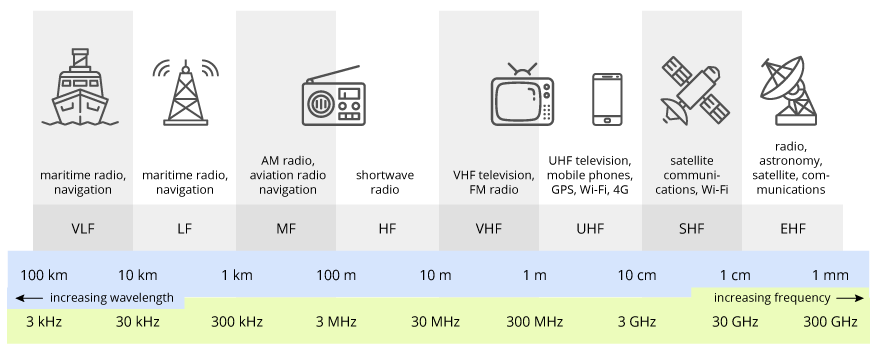
How Bands Are Numbered
You might encounter a Wi-Fi channel numbered 36 operating at 5.180 GHz, while a 5G cellular band is called n78 and uses frequencies from 3.3 to 3.8 GHz. This variation exists because each naming system was created for a specific purpose: some are based on wavelength, others on frequency, and many are simply legacy labels that have persisted. The most critical point is that a band’s number, like L-band or C-band, refers to a specific range of frequencies, not a single frequency. For instance, the C-band for satellites typically spans 3.7 to 4.2 GHz, a 500 MHz wide block of spectrum. Understanding these numbering systems is key to reading technical data sheets and comprehending why a particular piece of hardware, like a $2,500 satellite modem, is designed to operate only in a specific, numbered band.
- Multiple Systems Exist: Different organizations (IEEE, ITU, NATO) created their own numbering systems, leading to overlapping terms.
- Based on Frequency or Wavelength: Modern systems are based on frequency (GHz), while older ones (like L, S, C) are largely based on wavelength.
- The Number Defines the Range: The primary purpose of a band number is to shorthand a specific frequency range and its associated technical properties.
The most common system you’ll encounter for general wireless communication is the one established by the Institute of Electrical and Electronics Engineers (IEEE). This system groups the spectrum from 3 kHz to 300 GHz into bands with names like LF, MF, HF, VHF, UHF, SHF, and EHF.
The IEEE system originated from World War II-era radar designations, which were intentionally obscure for secrecy. The letters simply stood for “Low,” “Medium,” “High,” “Very,” “Ultra,” “Super,” and “Extremely High” frequency, creating a logical, if vague, progression.
For example, the Very High Frequency (VHF) band covers 30 to 300 MHz. A typical FM radio station at 98.1 MHz falls squarely within this band. The wavelength for a 100 MHz signal is about 3 meters, which provides a good balance of range and the ability to carry audio fidelity. Just above it is the Ultra High Frequency (UHF) band, spanning 300 MHz to 3 GHz. This band includes everything from TV broadcasting (around 470-698 MHz) to GPS (1.575 GHz) and 4G LTE (often between 700 MHz and 2.1 GHz). A key technical difference is that UHF waves, with their shorter wavelengths (around 50 cm at 600 MHz), are more susceptible to line-of-sight blockage but can support higher data rates, which is why they are the workhorse for modern mobile communication.
Common Bands in Daily Life
The 2.4 GHz band is perhaps the most crowded, serving as a shared highway for Wi-Fi, Bluetooth, and even microwave ovens. Meanwhile, the GPS system relies on a precise, uncluttered signal at 1575.42 MHz to achieve an accuracy of within 3 to 5 meters under open sky. Understanding which bands your common devices use explains why your 5 GHz Wi-Fi is faster but has less range than the 2.4 GHz network, and why your car’s tire pressure monitoring system (TPMS) at 315 MHz or 433 MHz can send a signal from the wheel well to the dashboard but can’t transmit much data.
Most home routers are dual-band, broadcasting two separate networks. The 2.4 GHz band (specifically from 2.400 to 2.4835 GHz) is divided into 11 channels in the US, each 20 MHz wide. Its primary advantage is range; a 2.4 GHz signal can cover a typical 200-square-meter home and penetrate walls reasonably well, but its maximum data rate under ideal conditions is often capped around 150-200 Mbps per stream. The 5 GHz band (5.150-5.825 GHz) offers more than twice the data capacity of 2.4 GHz, with speeds easily exceeding 500 Mbps, because it has over 20 non-overlapping 20 MHz channels, drastically reducing interference. However, its higher frequency means it is more easily absorbed by walls; its effective range is about 60% of the 2.4 GHz band’s range in the same environment. For devices like wireless security cameras, choosing the correct band is a direct trade-off: 2.4 GHz for better coverage in the backyard, or 5 GHz for a higher-resolution, stable video feed closer to the router.
| Technology | Primary Frequency Band(s) | Typical Range | Data Rate (Real-World) | Key Application |
|---|---|---|---|---|
| Wi-Fi (2.4 GHz) | 2.4 – 2.4835 GHz | ~30-45 meters indoors | 50-200 Mbps | General home internet, IoT devices |
| Wi-Fi (5 GHz) | 5.15 – 5.85 GHz | ~15-25 meters indoors | 200-1000 Mbps | HD streaming, low-latency gaming |
| Bluetooth | 2.4 GHz (2.402 – 2.480 GHz) | ~10 meters | 1-3 Mbps | Wireless audio, peripherals |
| 4G/5G (Low-Band) | 600 MHz, 700 MHz, 850 MHz | 5-15 km | 10-100 Mbps | Wide-area coverage, rural service |
| 5G (Mid-Band) | 2.5 GHz, 3.5 GHz | 1-3 km | 100-900 Mbps | Urban capacity, high-speed mobile data |
| GPS | 1575.42 MHz (L1 Band) | ~20,000 km (from satellite) | 50 bits/second (navigation message) | Positioning, navigation, timing |
| Key Fob / TPMS | 315 MHz (US), 433 MHz (EU) | 50-100 meters | A few kbps | Short-range remote control, sensor data |
A car’s adaptive cruise control system uses a 77 GHz radar band, which provides a wavelength of about 4 mm. This short wavelength allows for a compact antenna design that can be embedded in the car’s grille, capable of accurately detecting the distance and relative speed of a vehicle up to 150 meters away with a resolution precision of less than 1 meter. Similarly, a microwave oven operates at 2.45 GHz, a frequency chosen because it is readily absorbed by water molecules, causing them to vibrate and generate heat efficiently to cook food in a matter of minutes.
Wavelength vs. Frequency
A simple formula defines this inverse relationship: Wavelength (λ) = Speed of Light (c) / Frequency (f). This means a 2.4 GHz Wi-Fi signal has a wavelength of about 12.5 centimeters, while a GPS signal at 1.575 GHz has a longer wavelength of about 19 centimeters. This difference in physical size is why a GPS receiver’s antenna can be a simple patch, but an AM radio antenna for a 1 MHz signal (with a 300-meter wavelength) requires a long wire or a massive tower. The wavelength is not an abstract number; it physically determines the size of an efficient antenna, which is typically a fraction of the wavelength, such as a quarter (λ/4) or half (λ/2). A 5G mmWave antenna operating at 28 GHz has a wavelength of only 10.7 millimeters, allowing thousands of tiny antenna elements to be packed into a small panel to form a directional beam.
For a walkie-talkie operating at 460 MHz, the wavelength is roughly 65 centimeters, so an efficient antenna would be about 16 centimeters long, which matches the size of a typical handheld radio antenna. In contrast, the antenna for a Low-Power Wide-Area Network (LPWAN) device using the 900 MHz band requires a longer antenna; its wavelength is about 33 centimeters, so a quarter-wave antenna would be approximately 8 centimeters long. This physical constraint is why devices using very low frequencies, like the 135 kHz band for animal tracking tags, have coiled antennas to fit the required length into a small package. The relationship is absolute: you cannot efficiently transmit a 100 kHz signal with an antenna that is only 1 centimeter long; the physics of the wavelength make it impossible.
Beyond antenna design, the wavelength is the primary factor determining how a radio wave interacts with the environment. Longer wavelengths (corresponding to lower frequencies) diffract, or bend, around obstacles more effectively. This is why an AM radio station broadcasting at 1 MHz (300-meter wavelength) can be received reliably in a tunnel or a valley, as the massive wave bends around hills and structures. A VHF television signal at 100 MHz (3-meter wavelength) has significantly less diffraction, requiring a more direct line-of-sight path.
Rules for Each Band
A cellular carrier like Verizon pays billions to license a 10 MHz block within the 700 MHz band for exclusive use, allowing it to transmit at up to 50 watts from a cell tower. In contrast, the 2.4 GHz band is an unlicensed “free-for-all” where any device can operate, but with a strict power limit of 1 watt for point-to-point antennas and typically only 100 milliwatts for a home router, a rule designed to limit interference by making all signals relatively weak and localized.
The most significant division in spectrum regulation is between licensed and unlicensed bands. Licensed spectrum, like the 600 MHz, 700 MHz, and 1.9 GHz bands used for cellular networks, is auctioned off by governments for staggering sums. A 20 MHz license in a major metropolitan area can cost a carrier over $1 billion. This huge investment grants the licensee exclusive rights to that slice of spectrum, enabling them to build a high-power, high-quality network with guaranteed interference control. This is why your phone can maintain a call while moving at 100 km/hour; the carrier controls the entire channel. Unlicensed bands, most notably the 2.4 GHz and 5 GHz bands used for Wi-Fi and Bluetooth, are open for public use without a fee. The trade-off is that all devices must accept interference from others. The technical rules for unlicensed devices are defined under regulations like the FCC’s Part 15, which strictly limits power output. A Wi-Fi router’s Effective Isotropic Radiated Power (EIRP) is limited to about 1 watt (or 30 dBm) in the 2.4 GHz band, but in the 5 GHz band, the limit can be as high as 1 watt for the lower UNII bands and up to 4 watts for certain outdoor point-to-point links in the UNII-3 band, reflecting the different propagation characteristics and use cases.
A broadcast FM radio station at 98.1 MHz is allocated a 200 kHz wide channel. Its signal must be attenuated by a certain number of decibels (e.g., >40 dB) outside that assigned channel to avoid interfering with the station at 98.3 MHz. Similarly, a 5G base station using a 100 MHz wide channel in the 3.5 GHz band must have extremely steep “walls” on its signal to avoid polluting the spectrum. Devices must also be certified to prove compliance. The certification process for a new smartphone model, which includes testing for all its cellular, Wi-Fi, and Bluetooth radios, can take 4-6 months and cost the manufacturer over $100,000 in testing fees alone.
| Band Type / Application | Regulatory Status | Typical Maximum Power | Key Usage Rules & Constraints |
|---|---|---|---|
| Cellular (e.g., 700 MHz) | Licensed (Exclusive) | Up to 50 Watts (Cell Tower) | Carrier-owned; high-power; optimized for wide-area mobility and minimal interference. |
| Wi-Fi (2.4 GHz) | Unlicensed (Public) | 100 mW – 1 Watt EIRP | Must accept interference; uses contention protocols (CSMA/CA); many non-licensed users. |
| FM Radio Broadcast | Licensed (Exclusive) | Up to 100,000 Watts (ERP) | High-power for wide coverage; strict content and technical emission standards. |
| Bluetooth (2.4 GHz) | Unlicensed (Public) | 1 mW – 100 mW (Class 1-3) | Very low power; frequency-hopping to minimize interference; short-range personal area networks. |
| Amateur Radio (e.g., 144-148 MHz) | Licensed (Operator) | Up to 1500 Watts PEP | Operator-licensed (not frequency licensed); allows experimentation but with operational protocols. |
Furthermore, rules are not static; they evolve with technology. A prime example is the Citizens Broadband Radio Service (CBRS) band at 3.5 GHz in the US, which introduced a innovative three-tiered sharing model. Incumbent users like the Navy have top priority (Tier 1). Priority Access License (PAL) users, who win smaller 10 MHz licenses in a census-tract-based auction, get protection (Tier 2). Finally, General Authorized Access (GAA) users (Tier 3) can use any part of the band not occupied by the higher tiers. This entire system is managed by an automated Spectrum Access System (SAS) database that grants transmission permissions to devices in real-time, a complex rule set designed to maximize the efficiency of a valuable band. This contrasts with the simpler rules for a garage door opener operating in the unlicensed 315 MHz or 433 MHz bands, which may only be allowed to transmit for a few seconds at a time to minimize its impact on the shared spectrum.
Picking the Right Band
Selecting the right radio frequency band is a critical engineering decision that balances three competing factors: range, data speed, and signal penetration. There is no universal “best” band; the optimal choice depends entirely on the application’s specific requirements and constraints. For instance, a company deploying soil moisture sensors across a 5,000-acre farm will prioritize range and battery life, making a low-band technology like LoRaWAN (operating at 915 MHz in the US) ideal, as it can transmit small data packets over 10-15 kilometers for over 5 years on a single battery. Conversely, a factory automating its assembly line with high-definition wireless cameras requires immense data capacity within a confined space, making the 5 GHz or even the 60 GHz band a better fit, supporting data rates exceeding 1 Gbps but at a range limited to 50-100 meters. The decision matrix involves technical specs, regulatory costs, and physical realities; licensing a 10 MHz slice of a prime mid-band spectrum can cost a mobile operator over $1 billion, while using unlicensed 2.4 GHz spectrum is free but risks interference from countless other devices.
- Trade-off Triangle: You can typically optimize for two of the following: long range, high data speed, or excellent penetration. Sacrificing one is necessary.
- Cost of Spectrum: Licensed bands (cellular) offer guaranteed performance but at high cost. Unlicensed bands (Wi-Fi) are free but come with potential congestion.
- Physical Environment: Dense urban areas, open fields, and indoor factories each present unique challenges that favor different bands.
A 4G LTE base station operating at 700 MHz can provide a reliable signal radius of approximately 10-15 kilometers from a single tower, penetrating deep into buildings. This is why low-band spectrum is the cornerstone of wide-area mobile coverage. However, this extensive coverage comes at the cost of capacity. Lower-frequency bands are narrower; a carrier might only own 10-20 MHz of total spectrum at 700 MHz, which must be shared by all users in that large cell. This limits the maximum data speed per user, often capping realistic speeds at 20-50 Mbps during peak usage times. For applications requiring high throughput, such as fixed wireless access competing with fiber-optic internet, higher-frequency bands are mandatory. A 5G station using 100 MHz of spectrum in the 3.5 GHz band can deliver speeds over 300 Mbps to a large number of users, but its effective range drops to 1-3 kilometers, and the signal is more easily blocked by obstacles like trees and walls, suffering 10-15 dB more attenuation than a low-band signal passing through the same material.
For a massive IoT deployment involving 50,000 smart meters across a city, the unlicensed 902-928 MHz ISM band is economically compelling. The hardware is inexpensive, and there are no licensing fees. The trade-off is that the network must be designed to handle potential interference from other systems using the same band, which can reduce its effective capacity and reliability by 10-20%. For a mission-critical application like a public safety network for police and firefighters, this level of uncertainty is unacceptable. These services use exclusively licensed spectrum in bands like 700 MHz or 4.9 GHz, which costs taxpayers millions but guarantees that a channel will always be available, even during a disaster when public networks are congested. The physical size of the device also dictates the band choice.