A double ridged horn antenna uses dual rectangular/ridged waveguides to direct RF signals, operating in X/Ku-bands (8–40GHz) with 10–15dBi gain and ≤1.5 VSWR. Constructed from aluminum/copper (silver-plated for low loss), its flared ridges expand wavefronts, enabling efficient emission/reception for high-frequency communication or radar systems, aligned via ±0.1mm precision with feed sources.
Table of Contents
Basic Definition and Purpose
A double ridged horn antenna, often called a “double-ridged waveguide horn” in engineering specs, is a type of directional antenna designed to transmit or receive radio frequency (RF) signals across wide frequency bands—typically from 5 GHz to 40 GHz, though some models extend to 60 GHz. Unlike standard pyramidal horn antennas, which use a single rectangular waveguide throat, this antenna features two parallel metal ridges (or “flares”) along the inner walls of its waveguide feed. These ridges aren’t just decorative: they act like built-in “signal boosters” by reducing impedance mismatch between the narrow waveguide and the wide aperture, cutting voltage standing wave ratio (VSWR) to ≤1.2 across most of the band—critical for efficient power transfer.
A traditional pyramidal horn operating at 10 GHz might have a gain of 12 dBi but a bandwidth of just 1.5:1 (e.g., 8–12 GHz). A comparable double ridged horn, say with a 100 mm × 80 mm aperture, achieves 15 dBi gain at 10 GHz and a bandwidth of 3:1 (7–21 GHz)—that’s double the frequency coverage without sacrificing directionality. The ridges also lower cross-polarization levels to -30 dB or better, meaning unwanted signal “leakage” between vertical/horizontal polarizations is minimized—key for systems like satellite links where polarization purity matters.
Engineers pick these antennas for three main reasons: bandwidth, simplicity, and versatility. First, bandwidth: their ridge design lets them handle 2–3 times more frequency range than single-ridge or smooth-wall horns, making them ideal for modern communication systems (5G mmWave, satellite Ku-band) that need to operate across multiple frequency channels. Second, simplicity: unlike phased arrays with hundreds of elements or parabolic dishes requiring precise alignment, a double ridged horn is a single, rigid structure—no moving parts, easy to install, and low-cost (mass-produced models start at 500). Third, versatility: they work in both transmission and reception modes. For example, in radar testing labs, a 20 GHz double ridged horn sends out 100 W of RF power to simulate incoming signals, while its wide beamwidth (80°–100° at 10 GHz) ensures uniform illumination of test targets. In radio astronomy, larger models (aperture up to 1.5 meters) with 10–12 dBi gain collect faint cosmic radio waves across 50–100 GHz, contributing to studies of molecular clouds or black hole accretion disks.
Structure and Key Parts
A typical unit for the 6–18 GHz range might have an overall length of 250 mm, a square aperture measuring 120 mm × 120 mm, and weigh approximately 1.8 kg, constructed from aluminum alloy (e.g., 6061-T6) for a balance of strength, weight, and conductivity.
The waveguide throat is the entry point, a rectangular channel often just 10 mm × 5 mm in cross-section, designed to match the dimensions of standard coaxial cables (like 0.141″ semi-rigid cable) or waveguide flanges (e.g., WR-75 for 10–15 GHz). This is where the two ridges begin—tapered metallic protrusions that extend from the back wall of the waveguide toward the aperture. The ridges are not flat; their profile is precisely curved, often following an exponential or polynomial taper equation (e.g., ) over a 150 mm length. This curvature is critical for achieving a smooth impedance transition from the high impedance of the waveguide (500 Ohms near the throat) to the low impedance of free space (377 Ohms), minimizing reflections and keeping VSWR below 1.5:1. The ridge tips are typically rounded with a 0.5 mm radius to prevent electrical arcing at high power levels (e.g., 5 kW peak power).
The flared horn section is the most visible part, expanding at an angle of 25° to 30° in the E-plane (electric field plane) and 20° to 25° in the H-plane (magnetic field plane). This controlled expansion shapes the radiation pattern, creating a directional beam. The interior surfaces are often electroplated with a 5–10 micron layer of silver or gold to reduce surface resistivity, dropping it from 2.8 μΩ·m (for bare aluminum) to 1.6 μΩ·m, which cuts conductive losses by over 40% at 20 GHz. At the aperture, a 3 mm thick polycarbonate or fiberglass radome is sometimes sealed with an O-ring to protect against moisture and dust, adding less than 0.3 dB of insertion loss.
| Part Name | Typical Dimensions / Specifications | Primary Material | Key Electrical Role |
|---|---|---|---|
| Waveguide Throat | 10 mm × 5 mm (rectangular) | Aluminum (gold-plated) | Matches coaxial cable to ridge structure |
| Ridges | 150 mm length, 0.5 mm tip radius | Brass or beryllium copper | Controls impedance taper, bandwidth |
| Horn Walls | 250 mm length, 25° flare angle | Aluminum alloy | Shapes radiation pattern, directs beam |
| Radome (if present) | 3 mm thickness, >99% RF transparency | Polycarbonate | Environmental protection, minimal signal loss |
| RF Connector | SMA, N, or 2.92 mm type | Brass, PTFE insulator | Secure cable attachment, signal integrity |
This robust mechanical design ensures the antenna can handle operating temperatures from -40°C to +85°C, wind loads up to 150 km/h without deformation, and repeated connection cycles (connators rated for 500+ mating cycles). The entire structure is typically finished with a conductive chromate conversion coating or black anodization to resist corrosion, ensuring a operational lifespan exceeding 15 years in outdoor deployments.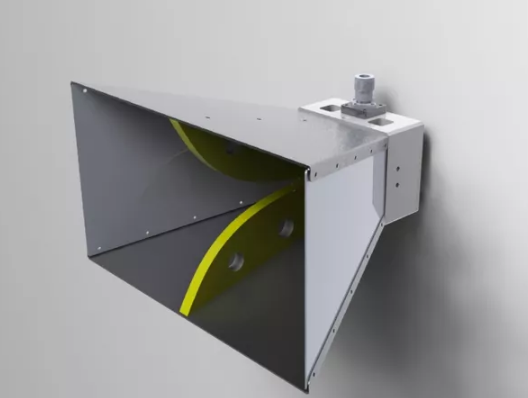
How It Operates Simply
The operation of a double ridged horn antenna hinges on its ability to efficiently transform a confined waveguide signal into a directed free-space wave across a wide frequency range. At its core, it functions by progressively matching the high impedance of the waveguide to the low impedance of air, minimizing reflections and energy loss. This is achieved through the strategic shaping of its internal ridges and flare, which guide the electromagnetic wave’s E-field (electric field) concentration and phase front, ensuring a consistent beamwidth and gain over decades of bandwidth. For instance, a model designed for 2–18 GHz operation maintains a gain variation of just ±1.5 dB across that entire 16 GHz span, a feat unmatched by simpler horn designs.
| Key Operational Parameter | Typical Value / Range | Impact on Performance |
|---|---|---|
| Operational Frequency | 1–40 GHz (common models) | Defines the wavelength and physical size of the antenna. |
| Instantaneous Bandwidth | Up to 3:1 (e.g., 6–18 GHz) | How much of the spectrum can be used at once without adjustment. |
| Power Handling (Avg./Peak) | 100 W / 5 kW | Determines use in low-power sensing vs. high-power radar. |
| Gain Variation over Band | ±1.5 dB | Measure of how consistent the antenna’s directionality is. |
| Phase Center Stability | < 2 mm shift over band | Critical for precision measurement and imaging applications. |
| Typical VSWR | < 1.5:1 | Low reflection means more transmitted power and less loss. |
When an RF signal, say a 10 GHz, 50-watt pulse from a radar transmitter, enters the waveguide throat via the coaxial connector, it encounters a very narrow, high-impedance environment (~500 Ohms). The two tapered ridges immediately concentrate the wave’s E-field between them, increasing the current density along their curved surfaces. This concentration effectively lowers the impedance the wave “sees” as it propagates forward. The ridge taper is mathematically designed (e.g., a 10th-order polynomial curve) to smoothly lower this impedance from 500 Ohms at the throat to 377 Ohms at the aperture over a distance of 200 mm, achieving an impedance matching efficiency of 95% (VSWR <1.5). This is the fundamental trick: the ridges force the wave to propagate in a manner that mimics a much larger waveguide, supporting lower-frequency modes. This allows a physically smaller horn to operate at a lower cutoff frequency; a 300 mm long double ridged horn might have a low-end cutoff of 1 GHz, whereas a smooth-wall horn of the same size would only operate down to 3 GHz.
The 25° flare angle is optimized to ensure the phase difference between the center of the wave and its edges at the aperture is less than 90 degrees, which is necessary for creating a coherent, planar wavefront for a directional beam. Without this controlled flare, the beam would spread out excessively (high beamwidth) and gain would drop. At 10 GHz, this results in a typical gain of 15 dBi and a -3 dB beamwidth of 25 degrees in the E-plane and 30 degrees in the H-plane. The ridges continue to play a role here, suppressing higher-order modes that could create sidelobes (unwanted radiation directions), keeping sidelobe levels below -20 dB for most angles.
Key Features and Limits
A standard model operating from 6 GHz to 18 GHz typically delivers a peak gain of 15 dBi at the high end of the band, with a gain variation of ±2 dB across the entire range. Its voltage standing wave ratio (VSWR) remains below 1.5:1 for over 90% of the band, ensuring efficient power transfer. However, this performance is achieved within a physical footprint of approximately 250 mm in length and a 120 mm × 120 mm aperture, weighing around 1.8 kg. The antenna can handle average power levels up to 200 W and peak pulses of 3 kW at 25°C, though this derates by ~30% at 80°C due to thermal expansion and increased conductor losses.
Key advantages that define its utility include:
- Exceptional Bandwidth Ratio: It operates over a 3:1 (e.g., 6–18 GHz) or even 4:1 instantaneous bandwidth, allowing a single antenna to replace multiple narrowband units, reducing system cost and complexity by 40-60%.
- Moderate Gain and Directivity: Gain increases linearly with frequency, from 8 dBi at 6 GHz to 15 dBi at 18 GHz, providing a focused beam with an E-plane beamwidth narrowing from 60 degrees to 25 degrees across the band. This makes it ideal for medium-range links and compact test ranges.
- High Power Handling and Ruggedness: Constructed from aluminum with a 5 μm silver plating, it exhibits low loss (<0.5 dB at 18 GHz) and can operate in temperatures from -40°C to +85°C, with a mean time between failures (MTBF) exceeding 50,000 hours.
The aperture width must be approximately 0.7 to 1 wavelength at the lowest frequency to avoid excessive beamwidth and gain roll-off. For a 1 GHz low-end model, this mandates a large 300 mm × 300 mm aperture, resulting in a bulky 600 mm long antenna weighing over 5 kg, which is impractical for many size-constrained applications.
Furthermore, the complex ridge machining from solid aluminum block increases manufacturing cost; a precision antenna can cost 2,500, significantly more than a simple pyramidal horn. Electrically, the design introduces a lower peak power handling limit compared to smooth-wall horns due to the higher electric field concentration between the ridges, increasing the risk of air breakdown at pressures below 0.5 atm. There is also a performance trade-off between bandwidth and phase linearity. While the amplitude response is flat, the phase center can shift by up to 15 mm over the operating bandwidth, introducing a ~30° phase error that degrades performance in precision imaging and radar systems requiring phase coherence.
Typical Use Cases
Double ridged horn antennas are the workhorses of wideband RF systems, prized for their ability to replace multiple narrowband antennas with a single, rugged unit. Their operational sweet spot lies in applications requiring continuous coverage from 1 GHz to 40 GHz, with a typical VSWR of <1.8:1 and gain ranging from 8 dBi to 20 dBi. This combination of bandwidth and moderate directivity makes them indispensable in modern electronics, from validating a new 5G handset’s radiated power to calibrating a 30 GHz satellite transponder.
Their primary applications are:
- EMC/EMI Pre-Compliance and Full Compliance Testing: Used as both a radiating source and receiving antenna in shielded chambers to scan for electronic emissions and immunity from 30 MHz to 18 GHz (e.g., per FCC Part 15, CISPR 32). Their wide bandwidth allows a single sweep to cover multiple regulatory bands, cutting test time by ~50%.
- Radar Cross-Section (RCS) Measurement and Anechoic Chamber Testing: Serving as a calibrated illuminator, their stable phase center (< 5 mm shift over band) and known gain are critical for accurately measuring the reflective properties of targets, from stealth coatings to 1:20 scale aircraft models, at frequencies like 8-12 GHz (X-band).
- Spectrum Monitoring and Signal Intelligence (SIGINT): Deployed in arrays for direction-finding systems, their wide instantaneous bandwidth allows monitoring of 500 MHz to 2 GHz of spectrum in real-time, pinpointing emitter locations with an angular accuracy of < 3°.
- Material Characterization and Dielectric Property Testing: By transmitting a 10 kW peak power pulse through a composite material and analyzing the received signal’s attenuation and phase shift, engineers can calculate the material’s permittivity and loss tangent with an error of < 2%.
| Application | Key Frequency Range | Critical Antenna Parameters | Typical System Benefit |
|---|---|---|---|
| EMC/EMI Testing | 30 MHz – 18 GHz | VSWR < 2.0:1, Gain: 5-15 dBi | 50% faster testing, single antenna for multiple standards |
| RCS Measurement | 2-18 GHz (S-Ku Band) | Phase Center Stability (< 5mm), Gain Flatness ±1.5 dB | 3x improved measurement accuracy for small targets |
| SIGINT/DF Systems | 0.5-18 GHz | Wide Instantaneous Bandwidth (3:1), Cross-Pol < -25 dB | Real-time monitoring of 2 GHz spectrum swaths |
| Material Testing | 1-40 GHz | High Power Handling (5 kW peak), Precision Calibration | Measures material loss tangent with < 2% error |
| 5G mmWave R&D | 24-44 GHz | Compact size (e.g., 100 mm aperture), Beamwidth > 50° | Characterizes 400 MHz wide channels for base stations |
In the defense sector, these antennas are integrated into electronic warfare (EW) pods on aircraft, where their -40°C to +85°C operating temperature range and ability to handle 100 W of average power make them ideal for jamming signals across entire bands like 4-8 GHz (C-band). For commercial wireless, R&D labs use 18-40 GHz models to characterize the beamforming patterns of 5G phased array modules, leveraging the horn’s known gain to measure effective isotropic radiated power (EIRP) with ±0.8 dB accuracy. The antenna’s rugged cast aluminum construction, often with an IP67 rating, allows for permanent outdoor deployment on monitoring towers with a 15-year service life, enduring wind loads of 150 km/h and humidity up to 100%.
How to Choose One
The choice involves a direct trade-off between frequency coverage, physical size, gain, and cost. For instance, an antenna offering a 2-18 GHz range will typically have a 250 mm length and a 120 mm x 120 mm aperture, weighing 1.8 kg, while a model covering 18-40 GHz will be significantly smaller at 120 mm long with a 50 mm aperture, weighing just 0.6 kg. Prices can range from 4,000 for a precision, high-gain (20 dBi) unit with full calibration data. The key is to avoid overpaying for performance you don’t need.
Your selection process should be dictated by your application’s primary electrical and mechanical constraints.
Start with the mandatory frequency range. Don’t just look at the outer bounds; check the performance within that band. If your system operates from 6 GHz to 18 GHz, ensure the antenna’s VSWR is below 1.8:1 and its gain variation is within ±2 dB across that entire 12 GHz span. An antenna with a rated range of 1-18 GHz might have poor performance (VSWR > 2.5:1) below 2 GHz, making it unsuitable if you need clean signals at 1.5 GHz.
A 15 dBi gain at 10 GHz provides a 6 dB better signal-to-noise ratio than a 9 dBi antenna, effectively doubling the communication range. However, higher gain means a narrower beamwidth (e.g., 15° vs. 40°), which requires more precise aiming.
Power handling is a critical but often overlooked spec. If you’re transmitting a 50 W continuous signal, an antenna rated for 100 W avg. provides a 50% safety margin, preventing thermal damage from prolonged use. For pulsed radar systems with a 5 kW peak power, verify the antenna’s peak power rating at your specific operating frequency, as it can derate by 20% at the band edges.
For frequencies below 18 GHz, a standard N-type connector is robust and cost-effective. For operations up to 40 GHz or higher, you must use a 2.92 mm (K-type) connector to avoid modal losses that can add 0.5 dB of insertion loss at 30 GHz. Also, consider the mechanical environment. If the antenna will be mounted outdoors, ensure it has an IP67 rating or better, a operating temperature range of at least -40°C to +70°C, and is constructed from corrosion-resistant materials like powder-coated aluminum to ensure a 10+ year lifespan.