Standard rectangular waveguides, e.g., WR-90 (22.86×10.16mm), operate in TE10 mode (cutoff λ=2a) with <0.05dB/m loss at 10GHz, VSWR<1.1 in copper designs, ensuring efficient microwave transmission.
Table of Contents
Shape and Standard Sizes
Unlike a simple pipe, a standard rectangular waveguide is not square; its internal width (a) is always precisely twice its internal height (b), creating a classic 2:1 aspect ratio. This specific geometry is fundamental for controlling how waves propagate. The most common model, the WR-90, has an internal cross-section of 22.86 mm (0.900 inches) wide by 10.16 mm (0.400 inches) high. This size isn’t arbitrary; it’s engineered for optimal performance in the 8.2 to 12.4 GHz frequency range, which is why it’s the go-to choice for X-band applications like radar systems.
The fundamental mode, TE10, has a cutoff wavelength of λ_c = 2a. This means for WR-90, the cutoff frequency is approximately 6.56 GHz. In practice, to ensure stable and efficient single-mode operation, the usable frequency band is typically from 1.25 to 1.9 times the cutoff frequency, hence its designation for 8.2 to 12.4 GHz. Operating too close to the cutoff or the next mode’s frequency leads to increased loss and potential instability. The industry uses a numbered “WR” (Waveguide Rectangular) system where the number often approximates the inner width in mils (thousandths of an inch). For instance, WR-90’s width is 900 mils. The attenuation loss in a standard brass WR-90 waveguide is remarkably low, typically around 0.13 dB per meter at 10 GHz, which is far superior than what a coaxial cable of comparable size could achieve at these frequencies.
| Common Waveguide Standard | Frequency Range (GHz) | Internal Width a(mm) |
Internal Height b(mm) |
Common Application |
|---|---|---|---|---|
| WR-112 | 7.05 – 10.0 | 28.50 | 12.60 | C-band Satellite Comms |
| WR-90 | 8.20 – 12.4 | 22.86 | 10.16 | X-band Radar |
| WR-62 | 12.4 – 18.0 | 15.80 | 7.90 | Ku-band Satellite |
| WR-42 | 18.0 – 26.5 | 10.67 | 4.32 | K-band |
Selecting the correct waveguide size is a direct trade-off between frequency, power handling, and physical size. A WR-42 waveguide for K-band (26 GHz) can handle less power and is more fragile than a larger WR-112, but it’s the only practical choice for its designated high-frequency band. You don’t choose a size based on convenience; you choose it based on the wavelength of your signal.
How Signals Travel Inside
Understanding how microwaves propagate inside a rectangular waveguide is key to leveraging its advantages over simple cables. Unlike in a coaxial line where a voltage signal travels on a central conductor, a waveguide supports electromagnetic fields that bounce off the interior walls in a specific, organized pattern. For the most common mode, TE10 (Transverse Electric), the electric field arcs across the narrow dimension of the guide, peaking at the center and dropping to zero at the side walls, creating a half-sine wave pattern with a maximum intensity of roughly 1000 to 5000 volts per meter for a typical 1 kW system.
The magnetic field, perpendicular to the E-field, forms closed loops within the guide. This entire field structure propagates down the length of the waveguide at a velocity slower than the speed of light, a critical distinction for system timing. The wave doesn’t travel straight down the center; it actually zigzags off the side walls at an angle, with each reflection undergoing a precise 180-degree phase shift to reinforce the main wavefront. This bouncing motion means the actual path length is longer than the physical guide, explaining the reduced propagation speed.
The phase velocity of the signal inside the waveguide is always greater than the speed of light (c ≈ 3×10^8 m/s), often by a factor of 1.2 to 1.5 for operational bands. This isn’t a violation of physics, as no information is transmitted at this speed. The energy and information itself travel at the group velocity, which is always less than c.
For a WR-90 guide at 10 GHz, the group velocity is approximately 2.15×10^8 m/s, about 72% of the speed of light. The precise value depends on the frequency, approaching zero near the cutoff frequency and nearing c at much higher frequencies. This velocity ratio directly impacts the wavelength inside the guide (λ_g), which is longer than the free-space wavelength (λ_0). At 10 GHz (λ_0 = 30 mm), the guide wavelength in WR-90 is about 40 mm, a 33% increase. This expanded wavelength is a major benefit, as it reduces the physical size of coupling elements and slots cut into the guide wall, making them easier to manufacture with tolerances around ±0.05 mm. The power handling capacity is immense, often exceeding 100’s of kilowatts peak power in pressurized systems, because the signal is distributed through the large ~230 mm² cross-section of the guide rather than being concentrated on a small conductor, minimizing voltage breakdown and heat generation per unit area.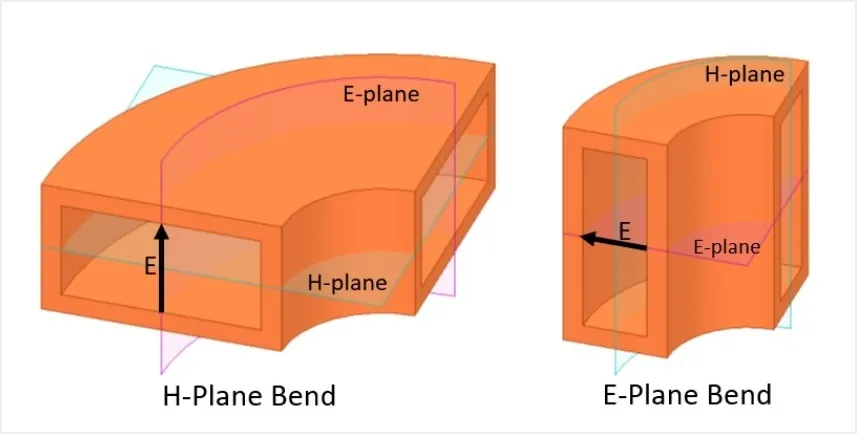
Cutoff Frequency Basics
For a standard rectangular waveguide, the dominant TE10 mode has a cutoff frequency (f_c) that is determined solely by the wider internal dimension, the width a. The fundamental formula is f_c (TE10) = c / (2a), where cis the speed of light in a vacuum (approximately 3×10^8 m/s). This means a WR-90 waveguide, with its 22.86 mm width, has a theoretical TE10 cutoff frequency of 6.56 GHz. Below this frequency, the signal cannot propagate and is instead attenuated exponentially, with the attenuation constant soaring to values exceeding 50 dB per meter, effectively making the waveguide a metal box.
In practice, a waveguide is operated 25% to 90% above this fundamental cutoff to ensure efficient single-mode propagation, which defines its usable bandwidth. For instance, while WR-90’s cutoff is 6.56 GHz, its designated frequency band is from 8.2 GHz to 12.4 GHz.
It is vital to remember that every waveguide supports an infinite number of higher-order modes (TE20, TE11, TM11, etc.), each with its own unique cutoff frequency determined by both dimensions aand b. The TE20 mode, for example, has a cutoff frequency of f_c (TE20) = c / a, which is exactly 13.12 GHz for a WR-90 guide. This creates a hard upper limit for single-mode operation. If you try to push a 15 GHz signal through a WR-90 guide, you will excite multiple modes, leading to unpredictable power distribution, phase errors, and severe performance degradation. The operational bandwidth is therefore the range between the TE10 cutoff and the next highest mode’s cutoff, which for the standard 2:1 aspect ratio is the TE20 mode.
This gives a theoretical upper frequency limit of 13.12 GHz, but the practical band is kept below 12.4 GHz to provide a safety margin of about 700 MHz against mode conversion and manufacturing tolerances. The attenuation is highly frequency-dependent; it drops to a very low minimum (around 0.1 dB/m for WR-90 at 10 GHz) in the middle of the band and then rises rapidly again as you approach the next mode’s cutoff. Operating too close to either cutoff frequency can lead to a >400% increase in attenuation, making the system highly inefficient.
Common Usage Examples
A typical airport surveillance radar might use a 4-meter long WR-90 run to feed an antenna, handling peak powers of 1 to 2 Megawatts with an average power of hundreds of watts. The attenuation loss over that 4-meter run is a mere 0.5 dB, meaning over 89% of the transmitted power reaches the antenna, a level of efficiency coaxial cables simply cannot match at these frequencies. This directly translates to longer range and better target detection for a given transmitter power.
In satellite communication ground stations, larger waveguides like WR-112 (5.85-8.20 GHz) and WR-137 (5.15-5.85 GHz) are used for C-band downlinks, often carrying signals with 500-800 MHz of bandwidth per polarization. Their rigid structure ensures stable performance over decades, with a typical service life exceeding 20 years even in harsh outdoor environments. In scientific and medical applications, waveguides are indispensable.
| Application Domain | Typical Waveguide Standard | Frequency Range | Key Performance Metric |
|---|---|---|---|
| Airborne Fire Control Radar | WR-75 | 10.0 – 15.0 GHz | Power Handling: 200 kW peak |
| Satellite Communication (Ku-band) | WR-62 | 12.4 – 18.0 GHz | Loss: <0.2 dB/m @ 15 GHz |
| Medical Linear Accelerators | WR-650 | 1.0 – 1.5 GHz | Average Power: ~5 kW |
| Radio Astronomy | WR-42 | 18.0 – 26.5 GHz | Precision: Surface tolerance <15 µm |
Cost vs. Performance: While the initial component cost of waveguide runs is higher than coaxial cable, the long-term savings in operational efficiency are significant. A system using waveguide might have 30-40% lower signal loss compared to an equivalent coaxial system. This means a 1 kW amplifier using waveguide delivers effectively 1 kW to the antenna, whereas a coaxial system might require a 1.4 kW amplifier to achieve the same radiated power, increasing both upfront hardware cost and continuous electricity consumption by hundreds of watts.
Power Density: In high-power applications like broadcasting, the power density is a critical factor. A 50-ohm coaxial cable designed for 3 GHz might handle 10-20 kW peak power before risking voltage breakdown. A comparable WR-430 waveguide at the same frequency can handle over 5 Megawatts peak power, a difference of 500 times, because the energy is distributed through a large air volume rather than concentrated across a small dielectric gap.
Key Advantages and Limits
A standard WR-90 run handles peak powers exceeding 200-500 kW and exhibits a mere 0.1 dB/m loss at 10 GHz, while a comparable coaxial cable might be limited to 10 kW peak and suffer 0.5 dB/m loss. This 80% reduction in loss directly translates to lower amplifier requirements and operating costs over a system’s 20-year lifespan. However, this comes with significant trade-offs in size, weight, and bandwidth that can make it impractical for many modern, compact designs.
- Advantages: Extremely low signal loss, very high power handling, high purity mode propagation, rigid physical structure.
- Limits: Large size and weight, narrow operational bandwidth, high cost and complexity of assembly, limited to microwave frequencies.
A 10-meter run of WR-62 at 17 GHz might have a total loss of 1.5 dB, preserving over 70% of the input power. A coaxial alternative would be effectively useless at this length and frequency. The power capacity is another key differentiator; the distributed field structure allows waveguides to handle multi-megawatt peak powers in radar systems without risk of voltage arcing, a common failure mode in coaxial lines above 100 kW. The manufacturing precision is extreme, with inner surface smoothness on the order of micrometers (µm) to minimize resistive losses, and flange alignment must be accurate to within 0.05 mm to prevent reflections.
However, the limits are just as stark. The physical bulk is immense: a WR-430 guide for 1.7 GHz operation has a cross-section of 109.2 x 54.6 mm, making it impossible to use in any compact consumer device. The usable bandwidth for single-mode operation is typically only 40-50% of the center frequency, forcing designers to use different waveguide sizes for different segments of a wideband system, increasing complexity and cost by 200-300%.
Comparing Other Waveguide Types
For instance, a double-ridge waveguide might increase the instantaneous bandwidth by 200-300% compared to a standard guide, but this comes at the direct expense of a 60-70% reduction in power handling and a ~0.5 dB increase in attenuation per meter. Conversely, a circular waveguide offers extremely low loss for specialized applications, with attenuation figures as low as 0.03 dB/m at 30 GHz, but it suffers from fundamental polarization instability. The choice between types is never about finding a “best” option, but about matching the waveguide’s physical characteristics to the precise electrical and mechanical constraints of the system, with cost variations of 200-500% between the simplest and most complex designs.
- Double-Ridge Waveguide: Very wide bandwidth, compact size, lower power handling, higher attenuation.
- Circular Waveguide: Very low loss, high power handling, polarization ambiguity, used for long-distance runs and rotating joints.
- Elliptical Flexible Waveguide: Good flexibility for routing, higher loss and VSWR, lower power capacity, used for short interconnections.
- Dielectric Waveguide: Integrated into substrates, low cost for mass production, very low loss at high mmWave frequencies, limited power.
A ridged guide might support a full 2:1 bandwidth ratio (e.g., 6-18 GHz) in a single unit, whereas you’d need three or four standard rectangular waveguides to cover the same range. However, the sharp edges of the ridges concentrate the electric field, which lowers the breakdown threshold. A standard WR-90 can handle 500 kW peak, but a comparable C-band ridged guide might be limited to 150 kW, a 70% reduction. The attenuation is also higher, often 0.3 dB/m versus 0.1 dB/m for a standard guide.
Circular waveguide is prized for its symmetry and extremely low loss, making it ideal for long-distance transmission in systems like satellite earth stations where a 50-meter run might only lose 1.5 dB of signal. Its major drawback is that it can support waves with any polarization, which can lead to unpredictable shifts in polarization orientation over long distances.
For flexible connections, elliptical waveguide is used, but its corrugated wall structure increases loss to about 0.4 dB per meter and introduces a higher Voltage Standing Wave Ratio (VSWR), typically 1.5:1, compared to the 1.1:1 of a rigid section. Finally, dielectric waveguides, which are just strips of low-loss plastic, are becoming critical for 77 GHz automotive radar and 140 GHz imaging systems integrated onto circuit boards, offering losses below 0.1 dB/cm at these extreme frequencies but handling less than 10 watts of power.