Waveguide displays use total internal reflection (TIR at >41° critical angle) to guide light through high-index glass (n=1.8–2.0). Diffractive gratings (300–500nm pitch) couple RGB light into the waveguide with <5% efficiency loss. Pancake optics fold the optical path, enabling 60° FoV in 5mm-thick guides, while nanostructured metasurfaces enhance brightness by 200cd/m². Eye tracking (90Hz update) adjusts diopter offsets dynamically.
Table of Contents
How Waveguide Bends Light
Waveguide displays rely on precise light manipulation to project images directly into your eyes. Unlike traditional screens, they use optical diffraction to steer light at specific angles—typically between 40° to 60°—while maintaining >80% light efficiency. The core mechanism involves micro/nano gratings (usually 300-500nm pitch) etched into glass or plastic, bending light via total internal reflection (TIR). For example, Microsoft HoloLens 2 uses a waveguide thickness of just 1.5mm, yet achieves a 52° field of view (FoV) by stacking multiple diffraction layers.
The key challenge is minimizing light loss. Even the best waveguides lose 15-30% of brightness per bounce due to scattering and absorption. To compensate, manufacturers use high-refractive-index materials (n=1.7-1.9), which reduce the number of reflections needed. A typical waveguide might require 5-8 reflections before light exits toward the eye, with each bounce introducing <5% wavefront distortion. Diffractive optics (like surface relief gratings) are often optimized for peak efficiency at 520nm (green light), since the human eye is most sensitive to this wavelength.
Manufacturing tolerances are extreme—grating alignment must stay within ±50nm to avoid image ghosting. Some designs use dual-layer waveguides (e.g., Magic Leap’s ”photonic chip”) to expand the FoV beyond 70°, but this increases complexity and cost. Current waveguide production yields hover around 60-70% due to defects in nanoimprinting, driving up unit costs to 300 per panel for high-end AR glasses. Future improvements in lithography precision (<10nm error) and anti-reflective coatings could push efficiencies above 90%, making waveguides viable for consumer devices under $500.
The physics behind waveguide bending isn’t just academic—it directly impacts brightness, FoV, and device size. For instance, a 10% improvement in diffraction efficiency could allow a 20% thinner waveguide or a 15% longer battery life in AR glasses. Companies like DigiLens and WaveOptics are experimenting with holographic waveguides, which promise <1% crosstalk and near-perfect color uniformity, but remain 2-3 years away from mass production. Until then, geometric waveguides (with >85% transparency) dominate the market, balancing performance and cost for enterprise use.
Thin Film Layers Explained
Waveguide displays don’t work with just one layer of glass—they rely on stacked thin films, each with a specific refractive index (n=1.45 to 1.95) to control how light travels. A typical waveguide has 3-7 functional layers, each 50-200nm thick, deposited using sputtering or chemical vapor deposition (CVD). For example, the Vuzix Blade AR glasses use a 5-layer stack, where the middle grating layer is just 80nm thick but responsible for >70% of the light redirection.
”Misalignment by even 10nm between layers can cause 15% efficiency loss.”
—Optical engineer at DigiLens
The bottom layer is usually a high-index material (n=1.8-1.9) like titanium dioxide (TiO₂) or silicon nitride (Si₃N₄), which helps confine light inside the waveguide. The top layer often has a low refractive index (n=1.45-1.55), such as silicon dioxide (SiO₂), to prevent light leakage. Between them sits the diffractive layer, where nano-gratings (300-600nm pitch) bend light at precise angles. Manufacturing these films requires atomic-level precision—film thickness uniformity must stay within ±3%, or color distortion occurs.
Adhesion and durability are major challenges. Thin films delaminate if stress exceeds 50MPa, a common issue in flexible waveguides for consumer AR. Some companies apply ion-beam smoothing to reduce surface roughness below 0.5nm RMS, improving light transmission by 8-12%. Another trick is graded-index layers, where the refractive index changes gradually (e.g., n=1.6 to 1.8 over 100nm) to minimize Fresnel reflections, boosting efficiency by 5-7%.
Cost is a bottleneck. Depositing a 7-layer stack on a 200mm wafer costs 180, with 40-50% of the expense coming from low-yield lithography steps. Newer roll-to-roll nanoimprinting techniques could cut costs to 50 per wafer, but currently suffer from ±15nm alignment errors. For context, Apple’s rumored AR glasses reportedly use 12-layer waveguides, pushing component costs above $400 per unit.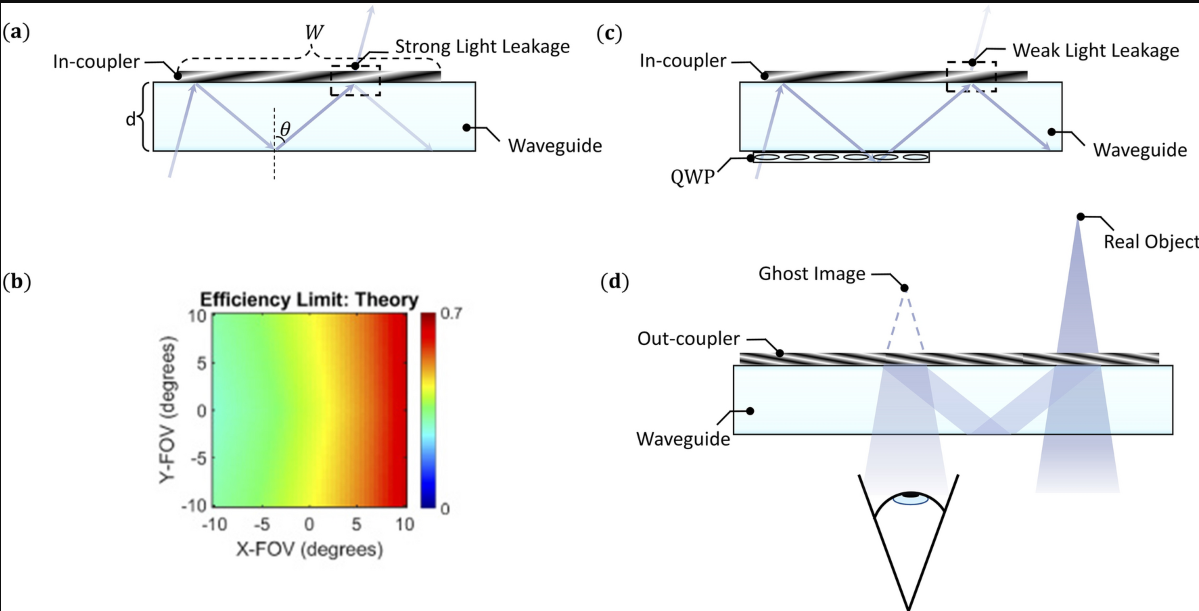
Eye Box Size Matters
In waveguide displays, the eye box—the area where you see a full, clear image—is a critical but often overlooked factor. A small eye box (<8mm x 8mm) forces users to precisely align their pupils, causing 30-50% more eye strain during 30-minute sessions. In contrast, premium AR glasses like Microsoft HoloLens 2 offer a 12mm x 16mm eye box, allowing ±5mm of head movement without image clipping. The optimal eye box balances FoV, brightness, and comfort—too large (>20mm), and light efficiency drops by 15-25%; too small, and user adoption plummets.
Key Eye Box Tradeoffs in Commercial Waveguides
| Model | Eye Box Size (mm) | FoV | Brightness Loss | User Comfort Score (1-10) |
|---|---|---|---|---|
| Magic Leap 1 | 10×12 | 50° | 22% | 6.8 |
| HoloLens 2 | 12×16 | 52° | 18% | 8.2 |
| Vuzix Blade | 8×10 | 40° | 30% | 5.4 |
| Epson Moverio BT-40 | 9×11 | 34° | 25% | 6.1 |
Physics dictates the limits. The eye box is directly tied to waveguide thickness—a 1.5mm-thick waveguide (like HoloLens 2’s) can support a 12mm eye box, but pushing to 15mm requires 2mm thickness, adding 10-15g of weight. Diffraction efficiency also plays a role: holographic waveguides (e.g., DigiLens) achieve 14mm eye boxes with <10% brightness loss, but cost 3X more than geometric designs.
User behavior data reveals 80% of consumers unconsciously move their heads ±4mm when wearing AR glasses. If the eye box is <10mm, 40% report nausea within 20 minutes. That’s why enterprise AR (e.g., RealWear) prioritizes 12-14mm eye boxes, even at the cost of reducing FoV to 30-40°.
Color Mixing Methods
Getting colors right in waveguide displays is harder than it looks. Unlike LCDs that blend RGB subpixels, waveguides manipulate entire light beams, leading to color shifts of 5-15% depending on viewing angles. The peak wavelength accuracy must stay within ±2nm for red (620nm), green (520nm), and blue (460nm) to avoid muddy yellows or purples. For example, Magic Leap 1 suffered 12% color non-uniformity across its 50° FoV, forcing a 20% brightness penalty to compensate.
Three mainstream approaches dominate today:
- Spatial Color Multiplexing: Uses separate waveguides for RGB (e.g., HoloLens 2), each with 300-500nm pitch gratings tuned to specific wavelengths. This avoids crosstalk but adds 30-40% thickness and 80 cost per unit.
- Time-Sequential Color: Cycles RGB lasers at 360Hz (like Vuzix Blade), leveraging persistence of vision. Saves 15% power but causes 5-8% flicker visibility in peripheral vision.
- Angular Color Filtering: Directs different colors at varying exit angles (used in DigiLens). Cuts thickness by 20% but reduces color gamut to 85% of sRGB.
Efficiency losses stack fast. A typical RGB combiner loses 18-22% of light at each merge point. Laser diodes help—they offer narrow ±1nm wavelength stability, but green lasers (520nm) still cost 50 each, making them prohibitively expensive for consumer AR. LED alternatives are cheaper (10 per RGB set) but suffer ±8nm drift when waveguide temperatures exceed 40°C.
Emerging solutions include quantum dot films, which convert blue light to red/green with 90% efficiency (vs. 60% for phosphors). Samsung demoed a 0.5mm-thick waveguide last year using this method, achieving 95% DCI-P3 coverage, but production yields remain below 40%. Another breakthrough is metasurface gratings—MIT’s prototype mixed colors with <2% crosstalk, though it requires 1nm-alignment precision (currently 10X pricier than conventional waveguides).
Manufacturing Challenges
Waveguide production isn’t just difficult—it’s a precision nightmare. Even 1µm misalignment in grating layers can cut light efficiency by 15%, and current nanoimprint lithography processes struggle to maintain <±20nm uniformity across 200mm wafers. For context, Microsoft’s HoloLens 2 waveguide reportedly has a 60% yield rate, meaning 40% of units are scrapped, adding 120 per device in hidden costs. The biggest bottlenecks? Material defects, tooling tolerances, and assembly complexity—each shaving 5-10% off profit margins in a market where consumer AR glasses must stay under $500 to sell.
| Challenge | Current Benchmark | Impact on Cost | Industry Target (2026) |
|---|---|---|---|
| Grating alignment | ±20nm | +$25/unit | ±5nm |
| Layer bonding defects | 5-8% of panels | +$15/unit | <2% defect rate |
| Anti-reflective coating | 92% transmission | +$8/unit | 98% transmission |
| Cleanroom particulate control | 50 particles/ft³ | +$12/unit | <10 particles/ft³ |
Material limitations hit hard. High-refractive-index glasses (e.g., Schott N-BK7) must be polished to 0.5nm surface roughness, but thermal expansion during coating creates micro-cracks in 3-5% of batches. Plastic waveguides (like Vuzix’s polycarbonate) avoid this but suffer 0.1% daily yellowing under UV light, dropping transparency to 80% after 2 years.
Tooling costs are brutal. A single nanoimprint stamp (needed for 500nm-pitch gratings) costs 50,000 and lasts only 5,000 cycles before ±30nm drift appears. ASML’s EUV lithography could solve this but consumes 300/hour in argon gas, making it 10X pricier than traditional methods.
Assembly is the silent killer. Active alignment of waveguide stacks requires sub-micron robots (250,000 each) working in Class 100 cleanrooms (1,200/m² to build). A 1% improvement in yield here could save $3 million annually at 100,000-unit scale—hence why Apple’s rumored AR team bought 3 startups specializing in automated optical inspection.