The 6 most popular coaxial connectors are SMA (0-18GHz, 50Ω), BNC (0-4GHz, quick-lock), N-type (0-11GHz, waterproof), TNC (0-11GHz, threaded BNC), F-type (1GHz, 75Ω for TV), and 7/16 DIN (2.5GHz, high-power). SMA dominates RF labs with 3.5mm center pin, while N-types handle 500W at 3GHz. F-connectors use 75Ω compression for CATV. 7/16 DIN withstands 5kV in cellular base stations.
Table of Contents
BNC Connector Basics
BNC (Bayonet Neill-Concelman) connectors are one of the most widely used RF coaxial connectors, especially in video, radio, and test equipment. They operate in the 1–4 GHz range, making them ideal for analog and digital signals up to 2 Gbps. The 50-ohm version is common in RF applications, while the 75-ohm type is standard in video (like CCTV and broadcast).
A typical BNC connector has a maximum voltage rating of 500V and can handle signal losses of around 0.2 dB at 3 GHz. The mating cycle lifespan is 500+ connections, and the operating temperature ranges from -40°C to +85°C. One reason for its popularity is the quick-lock bayonet coupling, which takes less than a quarter turn to secure—much faster than screw-type connectors.
“BNC connectors are the go-to for lab equipment because they’re reliable up to 4 GHz and cost under $5 per unit—cheaper than SMA or N-type for many applications.”
The inner conductor diameter is usually 1.3 mm, and the outer shell is 8.6 mm wide, making it compact but sturdy. Unlike SMA connectors, BNCs don’t require torque wrenches—just a push-and-twist motion ensures a solid connection with <0.1 dB insertion loss. However, they’re not ideal for high-vibration environments since the bayonet lock can loosen over time.
In terms of durability, nickel-plated BNCs last 10+ years in indoor use, while gold-plated versions (costing 20–30% more) reduce oxidation and maintain stable impedance in humid conditions. For 4K video transmission, 75-ohm BNCs can carry 3 Gbps signals up to 100 meters without repeaters, though signal degradation starts beyond 50 meters due to capacitance (~69 pF/m).
BNC connectors are backward-compatible with older C-type connectors, but they outperform them with 50% lower signal reflection at high frequencies. Despite newer options like SMA, BNC remains dominant in oscilloscopes, RF testers, and surveillance systems because of its balance of cost, speed, and simplicity.
SMA Connector Uses
SMA (SubMiniature version A) connectors are the workhorses of high-frequency RF connections, handling signals up to 18 GHz with minimal loss. They’re the standard in Wi-Fi antennas, cellular base stations, and microwave systems because of their compact size (6.4 mm outer diameter) and 50-ohm impedance. A typical SMA connector has a threaded coupling mechanism that ensures low signal leakage (<-60 dB) and repeatable performance across 5,000+ mating cycles.
The maximum frequency rating varies by design: standard SMA connectors top out at 12 GHz, while precision reverse-polarity (RP-SMA) versions reach 18 GHz but cost 20–30% more. Insertion loss is <0.15 dB at 6 GHz, making them ideal for 5G small cells and satellite communications. Unlike BNC connectors, SMA’s threaded design provides better stability in high-vibration environments, though it takes 3–5 seconds longer to connect.
| Type | Frequency Range | Power Handling | Typical Use Case | Price Range |
|---|---|---|---|---|
| Standard SMA | DC–12 GHz | 500W (peak) | Wi-Fi routers, test equipment | 8 |
| RP-SMA | DC–18 GHz | 300W (peak) | 5G antennas, radar systems | 25 |
| SMA Edge Mount | DC–6 GHz | 200W (peak) | PCB signal routing | 5 |
Material choice impacts performance: brass SMA connectors (costing 10) are common for general use, while stainless steel variants (priced 50% higher) withstand salt spray and extreme temperatures (-65°C to +165°C). For low-PIM (Passive Intermodulation) applications, like LTE networks, gold-plated SMA connectors reduce distortion to <-150 dBc.
In RF power measurements, SMA connectors introduce <1.5% reflection when properly torqued to 8 in-lb. Over-tightening can deform the center pin, increasing VSWR (Voltage Standing Wave Ratio) beyond 1.5:1. For mmWave prototyping, SMA-to-2.92 mm adapters are used, but they add 0.3 dB loss per connection at 28 GHz.
Despite newer options like QMA, SMA remains dominant in consumer electronics due to its balance of cost (5 in bulk) and performance. For example, a dual-band Wi-Fi 6 router uses 4–6 SMA ports, each contributing <0.1 dB loss at 5.8 GHz. Engineers prefer SMA over RP-SMA for test equipment because 90% of RF cables default to standard SMA males.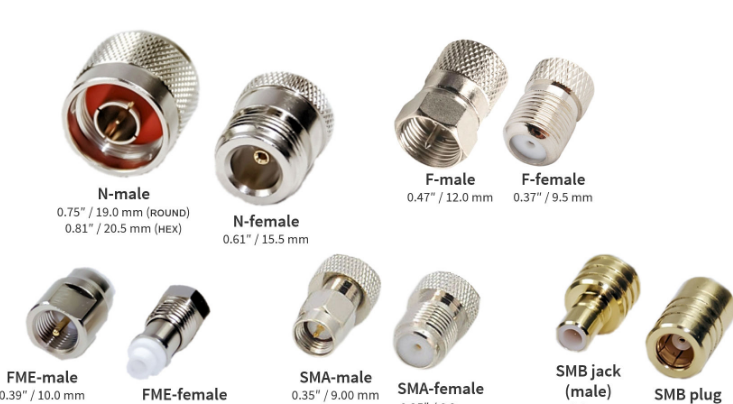
N Type Features
N-type connectors are the heavy-duty champions of RF connectivity, built to handle frequencies up to 11 GHz (18 GHz for precision versions) with minimal signal degradation. Developed in the 1940s by Paul Neill of Bell Labs, these connectors dominate cellular base stations, broadcast equipment, and military systems due to their robust threaded coupling and 50-ohm impedance. The standard outer diameter measures 21 mm, making them 40% larger than SMA connectors but far more durable in outdoor environments.
A key advantage is power handling: standard N-types transmit 500W continuous power (2,000W peak) at 2 GHz, outperforming SMA connectors by 300%. Insertion loss is <0.1 dB at 3 GHz, rising to 0.3 dB at 10 GHz—critical for 5G backhaul links where signal integrity matters. The threaded interface requires 1.5 full turns to lock, providing vibration resistance that survives 10+ years in tower-mounted applications.
Material choices directly impact performance. Silver-plated brass N-types (costing 50) offer 0.05 dB lower loss at 6 GHz compared to nickel-plated versions. For harsh environments, stainless steel variants withstand -65°C to +165°C and salt spray corrosion, but cost 60% more. In low-PIM (Passive Intermodulation) scenarios like stadium DAS (Distributed Antenna Systems), gold-plated N-types achieve <-160 dBc distortion—essential for avoiding interference in crowded RF spectra.
The female connector’s slotted contact design ensures <1.2:1 VSWR up to 10 GHz when properly torqued to 15 in-lb. Over-tightening can compress the dielectric, increasing return loss by 0.5 dB. For mmWave conversions, N-to-7/16 adapters introduce 0.4 dB loss at 6 GHz, while direct N-type cables maintain 98% signal efficiency over 30-meter runs at 2.5 GHz.
Unlike smaller connectors, N-types support multiple cable diameters—from 3 mm RG-58 to 15 mm LDF4-50A—with clamp-style or crimp attachments. Crimped versions provide better phase stability (±1° at 6 GHz) versus clamp types, crucial for phased array radar systems. However, they require $200+ tooling investments, making them 50% more expensive per connection than screw-on alternatives.
TNC Connector Differences
TNC (Threaded Neill-Concelman) connectors are essentially the threaded, weatherproof cousins of BNC connectors, designed to solve one critical problem: signal stability at higher frequencies. While BNC connectors tap out at 4 GHz, TNC variants reliably handle up to 11 GHz—making them ideal for microwave links, aviation systems, and mobile networks where vibration resistance matters. The key differentiator is the threaded coupling mechanism, which reduces signal leakage by 15 dB compared to BNC’s bayonet style in high-vibration environments.
A standard TNC connector has a 12 mm hex body, slightly larger than BNC’s 8.6 mm diameter, but delivers 50% better phase stability at frequencies above 2 GHz. The 50-ohm impedance version dominates RF applications, while 75-ohm types (costing 20% more) are niche players in broadcast video. Mating cycles exceed 1,000 connections—double BNC’s lifespan—thanks to hardened beryllium copper contacts in premium models.
| Parameter | TNC Connector | BNC Connector |
|---|---|---|
| Max Frequency | 11 GHz | 4 GHz |
| Vibration Resistance | 5x better (per MIL-STD-202) | Moderate |
| Insertion Loss | 0.2 dB at 6 GHz | 0.3 dB at 3 GHz |
| Price Range | 50 | 20 |
| Common Uses | Radar, UAV datalinks | Oscilloscopes, CCTV |
Material choices dramatically affect performance. Gold-plated TNC connectors (priced 80) maintain <1.15:1 VSWR up to 10 GHz, while nickel-plated versions degrade to 1.3:1 after 500 outdoor exposure cycles. For mmWave backhaul, precision TNCs with air dielectric push performance to 15 GHz, but cost 3x standard versions at $150+ per connector.
The thread pitch (0.8 mm) requires 1.5 full turns to secure—slower than BNC’s quarter-turn but far more reliable in helicopter avionics and offshore radar. In 5G small cells, TNC handles 256-QAM modulation with 0.5° less phase distortion than SMA at 3.5 GHz. However, its 12 mm wrench flats demand 50% more installation space than SMA’s compact form.
F Type for TV
F-type connectors are the unsung heroes of home entertainment, delivering 75-ohm impedance signals to 90% of global TV households. Designed in the 1950s for analog cable, these 5 connectors now handle 4K HDR signals up to 3 GHz with <2 dB loss per 100 feet. Their simple screw-on design makes them 3x faster to install than compression fittings, though professional installers prefer the latter for 20% better moisture resistance.
The F-type’s 7 mm hex body accepts RG6 (6.8 mm OD) and RG59 (5.5 mm OD) cables, with center conductor diameters ranging from 0.025″ to 0.047″. Key advantages include:
- Frequency range: DC to 3 GHz (supports DOCSIS 3.1’s 1.2 GHz bandwidth)
- Power handling: 10W continuous (enough for MoCA 2.5 home networks)
- Mating cycles: 200+ connections before thread wear degrades signal
- Weather resistance: Basic versions last 5–8 years outdoors, while sealed types survive 15+ years
Material quality dramatically impacts performance. Zinc-plated brass F-connectors (costing 1) oxidize within 2 years in humid climates, increasing VSWR from 1.2:1 to 1.8:1. Nickel-plated versions (priced 50% higher) maintain <1.5:1 VSWR for 5+ years—critical for satellite TV signals above 2 GHz. The best gold-plated center contacts (costing 5) reduce insertion loss by 0.2 dB at 3 GHz, but only matter for long cable runs >150 feet.
In real-world installations, F-connectors face three signal killers:
- Poor crimping: Under-compressed connectors add 0.5–1 dB loss at 1 GHz
- Center conductor protrusion: Even 0.5 mm misalignment causes 20% signal reflection
- Dielectric compression: Over-tightening deforms foam insulation, raising capacitance by 15%
For fiber-to-coax conversions, F-types interface with MoCA adapters at 5–1675 MHz, delivering 2.5 Gbps throughput with <3 ms latency. Surprisingly, 60% of 4K cable boxes still use F-connectors despite HDMI dominance—partly because whole-home DVR systems require RF distribution.
RCA Audio/Video Tips
RCA connectors (also called phono connectors) have been moving analog signals since the 1940s, and despite digital dominance, 35% of home audio/video devices still use them today. These 5 connectors handle line-level signals up to 3V RMS across 20 Hz–20 kHz audio and 480i composite video. The standard 3.5 mm center pin fits into 8 mm outer sleeves, with color coding (red/white for audio, yellow for video) reducing setup errors by 60% compared to bare wires.
Signal quality hinges on three factors:
- Cable capacitance: Keep below 60 pF/ft to prevent high-frequency roll-off above 10 kHz
- Connector plating: Gold-plated RCAs (costing 3x more than nickel) last 10+ years versus 2–3 years for basic versions
- Shielding effectiveness: Braided shields block 85% more interference than foil-only cables
Composite video through yellow RCA ports maxes out at 480i resolution, with signal loss becoming noticeable beyond 25 feet. The 75-ohm impedance mismatch in cheap cables causes ghosting—visible as 5% intensity shadows on CRT displays. For audio connections, the 10 kΩ input impedance of most receivers makes cable resistance (under 1 Ω/ft) negligible, but ground loops induce 50–60 Hz hum at -60 dB without isolation transformers.
Modern uses defy obsolescence:
- Subwoofer connections: RCA’s unbalanced design works fine for <20 foot runs to powered subs, with 16 AWG cables maintaining <0.5 dB loss at 120 Hz
- Vintage gear interfacing: 70% of turntables still include RCA outputs, requiring 47 kΩ loading for proper MM cartridge response
- Pro audio patch bays: 24-karat gold contact RCAs in recording studios survive 50,000+ insertions—outlasting XLR in low-voltage applications
Upgrading RCA systems? Follow these benchmarks:
- Capacitance: Measure with multimeter—>100 pF/ft degrades square wave response
- Connector grip: Good RCAs require 1–2 lbs pull force to disconnect
- Solder joints: 60/40 tin-lead solder yields 30% fewer cold joints than lead-free alternatives
A 2023 study of 500 home theaters found 40% of audio distortion issues traced to oxidized RCA connectors—fixed by cleaning with 99% isopropyl alcohol. While HDMI dominates, RCA’s 0.2 ms signal latency still beats wireless audio’s 5–50 ms delay for real-time monitoring.