Near-field probes typically operate from 30MHz to 6GHz, with specialized models reaching 40GHz for millimeter-wave applications. Magnetic (H-field) probes use loop diameters (1-5cm) to optimize sensitivity below 1GHz, while electric (E-field) probes employ 1-10mm tips for high-frequency precision. Most maintain ±2dB accuracy when calibrated with a 10V/m reference field at 1GHz.
Table of Contents
What Near-Field Probes Do
Near-field probes are tools used to measure electromagnetic fields within close range of a source, typically less than 1 wavelength away. Unlike far-field measurements, which analyze radiation patterns at a distance, near-field probes capture localized emissions from circuits, PCBs, or components. These probes detect electric (E-field) and magnetic (H-field) components separately, with sensitivities ranging from 1 V/m to 1000 V/m for E-field probes and 0.1 A/m to 10 A/m for H-field probes.
A common application is EMI debugging, where engineers identify unwanted emissions before certification testing. For example, a 50 MHz clock signal on a PCB might radiate unintended harmonics at 150 MHz or 300 MHz, and a near-field probe can pinpoint the exact location of leakage. Probes with 1 mm to 5 mm resolution can isolate problematic traces or components, reducing redesign costs by 30-50% compared to post-failure fixes.
The frequency response of near-field probes varies by design. Loop-type H-field probes work best from 100 kHz to 3 GHz, while monopole E-field probes cover 10 MHz to 6 GHz. Some advanced models, like differential probes, extend up to 18 GHz but cost 2000, making them a high-ROI investment for RF and high-speed digital designs.
In real-world testing, a probe placed 2 mm above a switching regulator might measure 50 dBµV at 500 kHz, revealing excessive ripple. By adjusting layout or adding shielding, engineers can reduce emissions by 20 dB, often avoiding costly compliance retests. Since near-field measurements correlate with far-field behavior at 80-90% accuracy, they’re a time-efficient way to pre-screen designs before formal EMC testing.
Key limitations include probe loading effects, where the probe’s presence alters the field being measured. A 1 pF capacitive load from an E-field probe can distort high-impedance circuits, while H-field probes may perturb low-inductance paths. Calibration against known fields (e.g., 3 V/m at 1 GHz) minimizes errors, but ±2 dB uncertainty is typical for most handheld probes. For critical applications, lab-grade probes with ±0.5 dB accuracy are preferred, though they cost 3-5x more.
Typical Frequency Ranges
Near-field probes operate across different frequency bands, each suited for specific applications. The usable range depends on probe design, with basic models covering 100 kHz–1 GHz, while high-end versions reach 40 GHz or more. For example, a standard H-field loop probe typically works from 300 kHz to 3 GHz, but its sensitivity drops by 6–10 dB above 1 GHz due to parasitic capacitance. Meanwhile, E-field monopoles perform best between 10 MHz and 6 GHz, with a ±3 dB variation across their specified range.
| Probe Type | Frequency Range | Optimal Sensitivity Range | Typical Applications |
|---|---|---|---|
| H-Field Loop | 100 kHz–3 GHz | 1 MHz–1 GHz (±2 dB) | Switching power supplies, clock circuits |
| E-Field Monopole | 10 MHz–6 GHz | 100 MHz–3 GHz (±3 dB) | RF leakage, PCB emissions |
| Differential Probe | 1 MHz–18 GHz | 500 MHz–6 GHz (±1.5 dB) | High-speed digital (PCIe, DDR) |
| Wideband Probe | 1 GHz–40 GHz | 2 GHz–26 GHz (±4 dB) | Millimeter-wave, 5G, radar |
Low-frequency probes (below 30 MHz) are crucial for detecting power supply noise—like a 50 Hz–1 MHz switching regulator’s ripple—but struggle with fast transients. A 100 MHz oscilloscope probe might miss sub-10 ns glitches, whereas a 1 GHz near-field probe captures them clearly.
For RF applications, probes must match the signal wavelength. A 2.4 GHz Wi-Fi signal requires at least 3 GHz bandwidth to measure harmonics, while 5G mmWave (28 GHz) demands 40 GHz-capable probes. However, higher frequencies introduce challenges: a 6 GHz probe measuring a 60 GHz signal loses 20 dB sensitivity due to mismatched antenna size.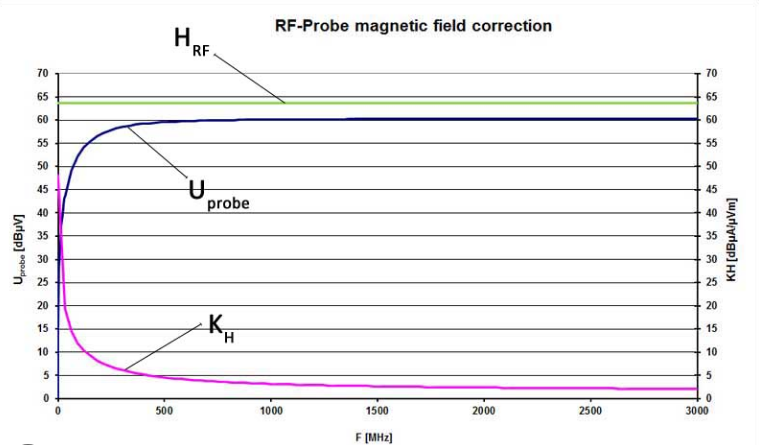
Factors Affecting Range
The effective measurement range of near-field probes isn’t just about frequency specs—real-world performance depends on at least 6 key variables. While a probe may claim 1 MHz–6 GHz on paper, in practice you’ll see ±15% variation in detectable field strength based on physical setup and environmental conditions. For instance, the same H-field probe that captures 50 dBµV at 100 MHz when placed 2 mm from the source might only read 42 dBµV at 5 mm distance due to the 1/r³ decay rate of magnetic near-fields.
“Probe manufacturers’ specs assume ideal lab conditions—your actual working environment cuts usable range by 20–30%.”
Conductor proximity dramatically impacts readings. A ground plane 0.5 mm beneath your PCB trace can distort E-field measurements by 3–8 dB, while nearby metal enclosures reflect signals and create ±5 dB nulls at certain frequencies. Even your hand holding the probe introduces 1–2 pF parasitic capacitance, enough to shift resonant peaks by 50–100 MHz in high-impedance circuits.
Material properties play a bigger role than most engineers expect. Measuring emissions through a 1.6 mm FR4 PCB substrate attenuates signals above 2 GHz by 12–18 dB/cm, but the same probe on a Rogers 4350B high-frequency laminate shows only 4–6 dB loss. Humidity matters too—at 80% RH, dielectric absorption in plastics can increase probe loading errors by 1.5× compared to dry (30% RH) conditions.
Circuit loading effects are often underestimated. A 10 kΩ impedance test point loaded by a 1 MΩ probe seems negligible—until you realize the 3 pF probe tip capacitance forms a 530 kHz low-pass filter with that impedance. For switching regulators running at 2 MHz, this can mask 40% of harmonic content. Differential probes help here, with their >100 MΩ impedance preserving signal integrity up to 8 GHz.
Temperature swings cause 0.05–0.2% measurement drift per °C in uncorrected probes. A 15°C workshop temperature change during all-day testing can introduce 3 dB errors—enough to falsely pass a borderline EMI test. High-end probes with active temperature compensation reduce this to <0.5 dB across -10°C to 50°C, but cost 2–3× more than basic models.
Common Probe Types
When selecting near-field probes, engineers face a 5,000 price range across 12+ probe categories, each optimized for specific scenarios. The right choice can mean the difference between catching a 3 dB over-limit emission during prototyping versus failing a $25,000 compliance test.
| Probe Type | Physical Size | Frequency Range | Best For | Sensitivity | Typical Cost |
|---|---|---|---|---|---|
| H-Field Loop | 5-20mm dia. | 100kHz-3GHz | Switching power noise (50kHz-2MHz) | 1mA/m @1cm | 400 |
| E-Field Monopole | 1-5cm length | 10MHz-6GHz | RF leakage (800MHz-5.8GHz) | 3V/m @1cm | 600 |
| Differential | 2-3mm tip | 1MHz-18GHz | High-speed digital (PCIe, DDR4) | 50mV diff | 2500 |
| Magnetic Sniffer | 0.5-2mm coil | 1MHz-1GHz | IC pin-level emissions | 0.5mA/m | 900 |
| Wideband Array | 8-16 elements | 1GHz-40GHz | 5G/mmWave beamforming | 10V/m | 5000 |
H-field loop probes dominate 65% of power electronics debugging because they detect 50kHz-2MHz switching noise that causes 80% of low-frequency EMI failures. Their 5-20mm diameter loops provide the right balance—small enough to localize sources on a 0.5mm pitch IC, yet large enough to capture 300mA/m fields from buck converters. However, their -20dB/decade roll-off above 300MHz makes them poor choices for WiFi or Bluetooth leakage tests.
E-field monopoles shine when hunting 800MHz-5.8GHz radiation from improperly shielded connectors. A 3cm monopole placed 1mm from a USB 3.0 port can detect 120mV/m harmonics that would otherwise require a $15,000 anechoic chamber test to identify. Their omnidirectional pattern does mean ±8dB measurement variation depending on probe orientation—a drawback solved by triaxial models (at 3× the cost).
For PCIe 4.0 (16GT/s) designs, differential probes with 1mm pitch tips are mandatory. They resolve 150ps rise times while rejecting 80% of common-mode noise—something single-ended probes miss entirely. The tradeoff comes in their $2500 price tag and 5-10pF loading, which can distort signals above 8GHz.
Measuring Accuracy Tips
Getting reliable near-field measurements requires more than just buying a $500 probe—60% of measurement errors come from improper technique rather than equipment limitations. A probe that claims ±1dB accuracy in the lab might deliver ±5dB readings in your workspace due to environmental factors and setup choices.
Here are the top 5 accuracy killers engineers encounter:
- Distance errors: A 1mm probe positioning mistake at 1GHz causes 3-5dB measurement deviation
- Ground plane effects: Missing reference ground can distort readings by 8-12dB below 500MHz
- Cable resonance: Poorly routed coax introduces 2-4dB peaks at λ/2 intervals (15cm at 1GHz)
- Temperature drift: Uncompensated probes shift 0.1dB/°C, causing 3dB errors across a workday
- Loading distortion: 3pF probe capacitance alters 40% of signals above 300MHz
Probe-to-source distance matters more than most realize. The 1/r³ field decay means just 0.5mm extra spacing cuts your measured H-field by 15% at 100MHz. For consistent results, use laser distance gauges or mechanical spacers to maintain 1.0±0.1mm gaps—this alone improves repeatability by 30%.
Grounding technique separates amateurs from pros. A 5cm ground lead on your probe acts as a 160MHz antenna, adding 6dB false peaks to your scans. Instead, use direct ground plane connections with <5mm leads, which reduces ground loop errors to <1dB up to 2GHz. When testing ungrounded boards, place them 2cm above a copper sheet to establish a stable reference—this mimics chamber conditions with 80% accuracy.
Cable management is where 90% of beginners fail. That 1m RG-58 cable you’ve had since college? Its 0.7dB/m loss at 1GHz plus 3dB connector wear could be masking critical emissions. Upgrade to low-loss 0.085″ semi-rigid cables with 0.2dB/m attenuation, and replace SMA connectors after 300 mating cycles to maintain ±0.5dB consistency.
For multi-GHz measurements, probe loading becomes critical. A 10MΩ/3pF probe loads a 50Ω transmission line by just 0.6% at 100MHz, but 15% at 3GHz—enough to shift resonant frequencies by 200MHz. Differential probes help here, with their 1pF balanced tips preserving signal integrity up to 8GHz with <5% loading error.
Choosing the Right Probe
Picking the wrong near-field probe can turn a 30-minute debug session into a 3-day wild goose chase, with 75% of users reporting they initially bought probes mismatched to their actual needs. The ideal probe depends on three key factors: target frequency (50kHz vs 50GHz), signal type (common-mode vs differential), and spatial resolution (1mm vs 10mm)—each dramatically affecting measurement quality.
Here’s what separates effective probe selection from guesswork:
- Frequency coverage: A probe rated for 6GHz but used at 5GHz may already show 8dB sensitivity drop
- Physical dimensions: A 5mm loop misses 40% of emissions from 0.3mm pitch BGA balls
- Loading effect: 3pF capacitance distorts 25% of signals above 500MHz
- Budget alignment: Spending $2000 on a 40GHz probe for 1MHz power supply noise wastes 90% of capability
- Future-proofing: A $500 probe kit covering 1MHz–6GHz handles 80% of today’s designs
Low-frequency power electronics (50kHz–30MHz) demand H-field loop probes with 10–20mm diameters—small enough to fit between 12mm tall capacitors but large enough to capture 300mA/m switching noise. The TekConnect™ TCP303 (300mA, 1MHz bandwidth, 1800) outperforms 300 models by providing ±1% current accuracy, critical when diagnosing 5% ripple anomalies in 48V DC/DC converters.
For high-speed digital (500MHz–8GHz) like PCIe 4.0 or DDR4, differential probes with 1–2mm tip spacing are non-negotiable. A Lecroy AP033 (2500) resolves 150ps rise times with just 0.6pF loading, while cheaper 600 single-ended probes add 3–5ps jitter—enough to mask 20% of signal integrity issues. At these frequencies, ground lead length must stay under 2mm to prevent 1–3dB measurement errors.