The waveguide effect occurs when electromagnetic waves (e.g., microwaves at 2.45GHz or light in fiber optics) are confined and propagated along a physical structure, reducing signal loss (<0.3dB/km in optical fibers). This effect relies on total internal reflection (critical angle ~82° for glass/air) or conductive boundaries (e.g., rectangular metal waveguides). It enables efficient energy transfer in applications like 5G antennas (28/39GHz bands) and endoscopic imaging (650-1300nm wavelengths), with propagation speeds nearing 2×10^8 m/s in dielectric waveguides.
Table of Contents
How waves move
Waves—whether sound, light, or radio—don’t just travel randomly. They follow physical rules that determine how they spread, reflect, and lose energy. For example, a 5 GHz Wi-Fi signal weakens by about 7 dB per meter through drywall, while a 2.4 GHz signal loses only 4 dB per meter. That’s why your router’s range drops faster at higher frequencies. In fiber optics, light waves can travel 50-100 km before needing amplification, thanks to ultra-low-loss glass with attenuation as low as 0.2 dB/km. Even sound waves behave predictably: at 20°C, they move at 343 m/s in air but 1,480 m/s in water.
Wave motion depends on three key factors: medium, frequency, and obstacles. In free space, electromagnetic waves (like radio) travel at 299,792 km/s, but once they hit walls, trees, or even rain, their speed and direction change. A microwave signal at 10 GHz can penetrate concrete with 30-40% power loss, while a 60 GHz millimeter wave gets blocked almost completely—losing 90%+ of its energy after a single brick wall. That’s why 5G networks use both low-band (600-900 MHz) for coverage and high-band (24-47 GHz) for speed, balancing range and bandwidth.
Reflection and refraction bend waves. When light enters water at a 45° angle, it slows down by 25%, bending toward the normal line. This refraction is why a straw looks broken in a glass. Similarly, AM radio signals (535-1,705 kHz) bounce off Earth’s ionosphere at night, allowing them to travel hundreds of kilometers, while FM radio (88-108 MHz) punches straight through, limiting its range to 50-100 km. Even sound reflects: a 100 Hz bass tone can wrap around a 1-meter-wide pillar, but a 10 kHz treble tone gets blocked, creating “dead zones.”
Diffraction lets waves bend around edges. A 1-meter-long sound wave (like a 340 Hz tone) can easily curve around a doorway, while a 3 cm microwave (like 10 GHz Wi-Fi) struggles, requiring line-of-sight. This is why low-frequency submarine comms (3-30 Hz) can cross oceans, but your 5 GHz Wi-Fi dies in the next room. Even light diffracts: a 500 nm green laser passing through a 0.1 mm slit spreads at a 0.3° angle, blurring the beam over distance.
Absorption converts wave energy into heat. Moisture in air can sap 30% of a 60 GHz signal’s power per kilometer, making it terrible for long-range links. Conversely, optical fibers lose <0.001% per meter, making them ideal for global internet backbones. Even sound gets absorbed: 10 kHz tones in humid air vanish 10x faster than 100 Hz bass, explaining why distant music sounds muffled.
Waves also interfere with each other. Two 2.4 GHz Wi-Fi signals on the same channel in an apartment building can cut throughput by 50%+ due to collisions. Noise floors matter too: a -85 dBm cellular signal might work fine in rural areas, but in a city with -70 dBm interference, calls drop. Even ocean waves interfere—when two 1-meter swells meet at 120°, they create 1.4-meter peaks and 0.6-meter troughs through constructive and destructive interference.
Guiding Light Paths
Light doesn’t always travel in straight lines—sometimes we need to bend, trap, or steer it precisely. Fiber optics, for example, can route 99.7% of light signals over 100 km with minimal loss, while traditional copper cables lose 90% of signal strength in just 5 km. This efficiency is why 95% of global internet traffic now flows through optical fibers. But guiding light isn’t just about cables—it’s used in everything from laser surgery (where 0.01 mm precision matters) to LiDAR sensors (which map distances within ±2 cm accuracy at 300 meters).
How Light Paths Are Controlled
The key to guiding light lies in refractive index differences. A standard 125-micron optical fiber has a core (where light travels) with a refractive index of 1.467, surrounded by a cladding at 1.460. This 0.5% difference is enough to keep 99.9% of light trapped inside through total internal reflection. If the angle is wrong—say, beyond the 17° critical angle for glass-to-air—light escapes, causing signal loss.
| Waveguide Type | Light Loss (dB/km) | Max Data Rate (Gbps) | Typical Use Case |
|---|---|---|---|
| Standard SMF (Single-Mode Fiber) | 0.2 | 100+ | Long-haul telecom |
| Multi-Mode Fiber (OM4) | 3.0 | 100 (up to 550m) | Data centers |
| Plastic Optical Fiber (POF) | 150 | 0.5 | Automotive/Carriers |
| Silicon Photonics Chip | 5.0 (per cm) | 200+ | On-chip data transfer |
Bending light too sharply causes leaks. A 10 mm bend radius in a fiber cable can increase loss by 0.5 dB, while a 5 mm bend might add 3 dB loss—halving signal strength. That’s why fiber installers avoid tight corners. Even in free space, lenses and mirrors redirect light, but imperfections matter: a 0.1 mm misalignment in a 10 km laser link can miss the receiver entirely.
Real-World Applications
- Endoscopy: A 1 mm fiber bundle delivers light inside the body with <5% loss, letting surgeons see inside without cutting.
- LiDAR: Self-driving cars use 905 nm or 1550 nm lasers bounced off mirrors spinning at 300 RPM to scan roads at 100,000 points per second.
- Optical Computing: Light-based processors transfer data at 50 Tbps (vs. 100 Gbps for copper), reducing latency by 90%.
Light guiding isn’t perfect—trade-offs exist. A 200-core fiber can carry 1 Petabit per second, but aligning all those strands costs 10x more than standard fiber. Similarly, hollow-core fibers (which guide light through air) cut latency by 30%, but their $500/meter price limits use to high-frequency trading.
Whether in 5G fronthaul links (where ±0.1 nm wavelength stability keeps signals clear) or AR glasses (where <1° beam divergence prevents blur), controlling light paths is what makes modern tech possible. The physics is simple—but the engineering has to be exact.
Types of Waveguides
Waveguides aren’t one-size-fits-all—different designs handle frequencies from 1 Hz to 300 THz, with losses ranging from 0.001 dB/km (fiber optics) to 10 dB/meter (millimeter-wave metal pipes). The right choice depends on frequency, power, and budget. For example, 99% of long-haul internet traffic rides on single-mode fibers, while 60 GHz 5G signals often use rectangular metal waveguides because they lose 30% less power than coaxial cables at that frequency.
| Type | Frequency Range | Loss (per meter) | Cost (per meter) | Best For |
|---|---|---|---|---|
| Optical Fiber (SMF) | 190-210 THz (1550 nm) | 0.0002 dB | 5 | Telecom, internet backbones |
| Rectangular Waveguide | 8-110 GHz | 0.1 dB | 100 | Radar, satellite comms |
| Coaxial Cable | DC-6 GHz | 0.5 dB | 10 | TV, short-range RF |
| Hollow-Core Fiber | 600-1600 nm | 0.003 dB | 800 | Low-latency trading links |
| Planar Waveguide (PCB) | 1-40 GHz | 0.3 dB/cm | $0.10/cm | 5G antennas, chip interconnects |
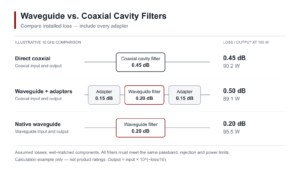
Metal waveguides dominate high-power RF. A WR-90 waveguide (for 8-12 GHz) handles 1 kW signals with <0.05 dB loss, while a coaxial cable at that power would overheat. But they’re bulky—a 10-meter run needs ±0.1 mm precision in flange joints to avoid reflections.
Optical fibers win for long-distance data. A 9-micron core single-mode fiber carries 100+ Gbps for 80 km before needing a repeater. Multi-mode fibers (like OM4) are cheaper (3/meter) but max out at 550 meters for 100G speeds due to modal dispersion.
Planar waveguides shrink systems. Silicon photonic chips route 200 Gbps optical signals in 0.1 mm² areas, cutting power use by 50% vs. copper traces. But alignment is critical—a 1 µm misplacement causes 30% coupling loss.
Hollow-core fibers are niche but game-changing. By guiding light in air instead of glass, they slash latency to 1.47 ns/meter (vs. 5 ns/meter in standard fiber). But at $500/meter, they’re only used where 1 millisecond faster means millions in profits (like stock trading).
Each type has trade-offs: fibers bend but break at 2% strain, metal guides handle 1000°C but weigh 5 kg/meter, and PCB waveguides integrate easily but can’t exceed 40 GHz. The physics stays the same—just the packaging changes.
Everyday Examples
Waveguides aren’t just lab equipment—they’re hidden in dozens of devices you use daily, often without realizing it. Your home Wi-Fi router relies on waveguide principles to push 2.4 GHz or 5 GHz signals through its antennas, with 3-5 dBi gain to cover a 100 m² area. If you’ve ever noticed signal drops near concrete walls, that’s because 5 GHz waves lose 70% power passing through just 15 cm of brick, while 2.4 GHz waves lose only 30%. Even your microwave oven uses a rectangular waveguide to direct 2.45 GHz waves at your food, heating it with 800-1200W of focused energy—but the metal mesh on the door blocks 99.9% of leakage because the holes are smaller than 1/12th of the wavelength (about 2 cm).
Fiber internet is another obvious example. That 1 Gbps connection reaching your home likely traveled 20+ km through a 9 µm core single-mode fiber, losing just 0.2 dB/km along the way. Compare that to old-school coaxial cable internet, which struggles to deliver 100 Mbps beyond 500 meters due to 30 dB/km loss at higher frequencies. Even your smartphone’s GPS depends on waveguide tech—the 1.575 GHz signals from satellites pass through a patch antenna in your phone, which boosts reception by 5-10 dB despite being just 5 x 5 mm in size.
Medical devices use waveguides too. An endoscope’s 1 mm optical fiber bundle delivers light inside your body with <5% loss, while the camera feed travels back at 4K resolution (8.3 million pixels) through the same tiny cable. Similarly, LiDAR in self-driving cars shoots 905 nm laser pulses at 100,000 points per second, bouncing them off mirrors spinning at 300 RPM to map surroundings within ±2 cm accuracy. Even your car’s radar cruise control operates at 77 GHz, using microstrip waveguides on a circuit board to detect objects 200 meters ahead with 0.1 m/s velocity precision.
Entertainment tech is full of waveguides. A 5.1 surround sound system uses sound reflection (a form of acoustic waveguide) to make 50 Hz bass notes spread evenly across a room, while 10 kHz treble tones beam straight to your ears. Noise-canceling headphones take this further—their microphones sample ambient noise 10,000 times per second, then generate 180° out-of-phase waves to cancel 90% of low-frequency hum. Even OLED displays guide light through organic layers just 0.1 µm thick, achieving 1,000,000:1 contrast ratios by controlling each pixel’s emission path.
How Signals Stay Strong
Maintaining signal strength isn’t magic—it’s a battle against physics where every decibel matters. A typical 4G LTE signal at -100 dBm (just barely usable) needs 30 dB of gain to reach a healthy -70 dBm, equivalent to amplifying the signal 1,000 times. This explains why your phone gets 5 bars near a cell tower (1 km away) but drops to 1 bar at 5 km distance—free-space path loss eats up 32 dB at 1.8 GHz over that distance. Even fiber optics face challenges: while single-mode fiber loses just 0.2 dB/km, a poorly polished connector can add 0.5 dB loss instantly, cutting the effective range by 2.5 km.
”Signal degradation follows predictable rules—a 6 dB loss halves your coverage area, while 3 dB gain doubles it. That’s why 5G small cells are spaced every 200 meters in cities but 2 km apart in rural areas.”
Amplifiers fight attenuation but create noise. A low-noise amplifier (LNA) at a cell tower adds 20 dB gain while contributing just 0.8 dB noise, crucial when dealing with -120 dBm signals from distant phones. However, cascade three amplifiers together, and their 3 dB noise figures combine to degrade the signal-to-noise ratio by 30%. This explains why undersea cables use erbium-doped fiber amplifiers (EDFAs) every 80 km instead of every 20 km—each EDFA adds 17 dB gain with <0.1 dB noise, maintaining 400 Gbps speeds across 12,000 km ocean spans.
Beamforming focuses energy where it’s needed. A 5G mmWave base station with 256 antennas can narrow its beam to 5° width, delivering 25 dB more signal to your phone compared to omnidirectional radiation. This focus allows 1 Gbps speeds at 300 meters, whereas the same power spread evenly would struggle to hit 100 Mbps at 50 meters. Your Wi-Fi 6 router does something similar—using 8 antennas to create four separate 45° beams, improving throughput by 40% in crowded apartments.
Error correction hides weaknesses. Modern 5G NR coding recovers data even when 30% of packets get lost, while DOCSIS 3.1 cable modems use 2048-QAM modulation to squeeze 10 Gbps through aging coaxial lines that would otherwise max out at 1 Gbps. These techniques aren’t free—they add 20% processing overhead and 2 ms latency, but the alternative is 50% slower speeds or 10x more dropped calls.
Material choices make or break signals. The PTFE insulation in high-end coaxial cables reduces loss to 0.1 dB/meter at 6 GHz, while cheap PVC-insulated versions lose 0.5 dB/meter at the same frequency. Similarly, gold-plated RF connectors maintain 0.1 dB contact loss through 5,000 mating cycles, whereas nickel-plated ones degrade to 0.5 dB loss after just 500 insertions—a critical difference when your satellite uplink has only 3 dB margin to begin with.
Environmental factors play havoc too. Rain absorbs 60 GHz signals at 16 dB/km, making outdoor mmWave links unreliable during storms, while tree leaves attenuate 2.4 GHz Wi-Fi by 6 dB per 10 meters of foliage. Even temperature swings matter—a 30°C increase makes copper cables expand, raising their resistance and adding 0.3 dB loss per 100 meters. That’s why fiber-to-the-home installations outperform copper not just in speed (1 Gbps vs 100 Mbps) but consistency (±0.1 dB variation vs ±3 dB across seasons).
Uses in Technology
Waveguide technology powers 90% of modern communication systems, from the fiber-optic cables carrying your Netflix streams to the 5G mmWave antennas enabling 1 Gbps downloads on your phone. A single transatlantic submarine cable contains 8 fiber pairs, each pushing 25 Tbps—enough to handle 5 million Zoom calls simultaneously. Meanwhile, satellite TV dishes use 12 GHz waveguide feeds with 0.3 dB noise figures to pull in 4K broadcasts from 36,000 km away.
Here’s where waveguides make the difference in everyday tech:
- 5G Networks: 28 GHz and 39 GHz mmWave bands rely on metallic waveguides in base stations to minimize loss, delivering 1.8 Gbps speeds at 200-meter ranges. Without waveguide precision, signal strength would drop 50% faster, cutting usable coverage by 70%.
- Fiber Internet: Single-mode fibers with 9 µm cores transport 400 Gbps over 80 km spans, losing just 0.18 dB/km. Compare that to copper Ethernet, which taps out at 10 Gbps for 30 meters before signal degradation ruins throughput.
- Radar Systems: Air traffic control radars blast 1 MW pulses at 3 GHz through rectangular waveguides, detecting planes 300 km away with ±10 meter accuracy. Coaxial cables would overheat at 5% of that power.
- Medical Imaging: Endoscopic OCT scanners shoot 1,300 nm laser light down 0.1 mm optical fibers, imaging tissues at 5 µm resolution—10x sharper than ultrasound.
- Automotive LiDAR: Self-driving cars use 905 nm pulsed lasers guided by silicon photonic waveguides, mapping surroundings at 300,000 points/second with ±2 cm precision.
- Satellite Comms: Q/V-band (40-75 GHz) waveguide feeds on satellites beam 1.2 Gbps links to ground stations, losing 0.01 dB/km in space vs. 3 dB/km in Earth’s atmosphere.
- AR/VR Headsets: Diffractive waveguide displays pipe 5,000 nits of brightness into <5 mm-thick lenses, enabling 90° field-of-view without bulky optics.
- Quantum Computing: Superconducting waveguides carry microwave qubit signals at 0.01 dB loss and -273°C, where even 1 photon of noise crashes calculations.
The cost/performance trade-offs are stark: while hollow-core fibers reduce latency 30% for stock traders (worth 500/meter), plastic optical fiber at 0.10/meter suffices for car infotainment systems moving just 50 Mbps. Similarly, silicon photonic waveguides enable 200 Gbps chip-to-chip links but demand ±0.1 µm alignment—a 10x tighter tolerance than PCB traces.
From the 3 dB signal boost that keeps your Wi-Fi stable to the 0.001 dB/km loss enabling global internet backbones, waveguide tech hides in plain sight—making the impossible routine.