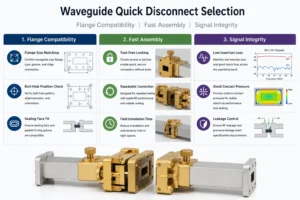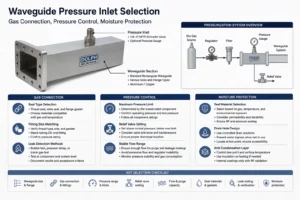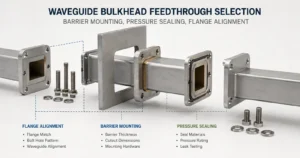
Waveguide feeders are typically pressurized to 3–5 psi (0.2–0.35 bar) using dry air or nitrogen to prevent moisture buildup and minimize signal loss at high frequencies (e.g., 18–40 GHz). Systems include pressure sensors with alarms if levels drop below 1 psi (0.07 bar), ensuring optimal RF performance and preventing arcing in radar/telecom applications. Regular leak tests maintain integrity.
Table of Contents
Basic Function of Waveguides
Waveguides are hollow metal tubes or dielectric structures that efficiently transmit electromagnetic waves, primarily in microwave and radio frequency (RF) systems. Unlike traditional coaxial cables, which suffer from high signal loss (up to 0.5 dB/m at 10 GHz), waveguides reduce attenuation to as low as 0.01 dB/m in optimal conditions. They are widely used in radar systems (e.g., airport surveillance radars operate at 2.7-2.9 GHz), satellite communications (Ka-band at 26.5-40 GHz), and medical imaging equipment like MRI machines (1.5T/3T systems use 64-128 MHz RF coils).
The rectangular or circular cross-section of a waveguide determines its cutoff frequency (fc), below which signals cannot propagate. For example, a WR-90 waveguide (22.86 mm × 10.16 mm) has an fc of 6.56 GHz, making it ideal for X-band (8-12 GHz) applications. Waveguides outperform coaxial cables in power handling, supporting peak powers up to 10 MW in pulsed radar systems, whereas coax typically maxes out at 100 kW.
| Parameter | Typical Value | Comparison to Coax |
|---|---|---|
| Attenuation | 0.01-0.1 dB/m | 0.3-0.5 dB/m (coax) |
| Frequency Range | 1 GHz – 300 GHz | 0-50 GHz (coax) |
| Power Handling | 1 kW – 10 MW | 1 W – 100 kW (coax) |
| Impedance | 50-450 Ω | 50/75 Ω (coax) |
Waveguides are pressurized with dry air or nitrogen (N₂) at 2-5 psi (0.14-0.34 bar) to prevent moisture ingress, which can increase attenuation by 15-30% due to dielectric losses. In high-altitude or aerospace applications (e.g., satellites at 36,000 km altitude), waveguides may be sealed at 1-3 psi to balance structural integrity against external vacuum pressure.
The inner surface roughness of a waveguide must be <1.6 µm (Ra) to minimize resistive losses, as a roughness of 3.2 µm can reduce efficiency by 8%. Aluminum waveguides (6061-T6 alloy) are common due to their low cost (200 per meter) and corrosion resistance, while copper (C10100) waveguides offer 0.05 dB/m lower loss but cost 2-3x more (500/m).
In phased-array radar systems (e.g., AN/SPY-6 with 5,000+ elements), waveguides distribute signals with phase errors <5°, ensuring beam steering accuracy within 0.1°. Without proper pressurization, condensation can shift phase by 10-20°, degrading performance. Modern 5G mmWave base stations (28/39 GHz bands) use dielectric waveguides (PTFE, εr=2.1) to achieve 90%+ energy transfer over 10-30 meter runs, avoiding the $1,000+/m cost of traditional metal waveguides.
Waveguide joints must maintain <0.1 dB insertion loss, achieved via flanged connections (ANSI FL-28 standard) torqued to 8-12 N·m. Misalignment >0.2 mm can cause return losses >20 dB, reducing system gain. For high-power applications (e.g., fusion reactors at 110-170 GHz), corrugated waveguides reduce ohmic losses by 40% compared to smooth-wall designs.
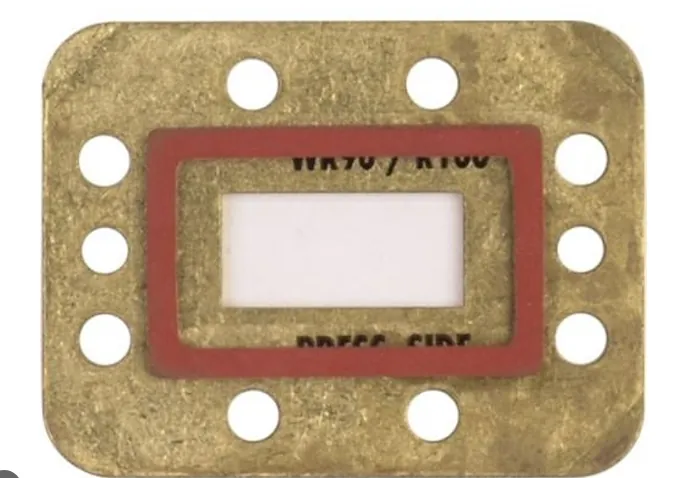
Why Pressure is Needed
Waveguides are pressurized primarily to prevent moisture buildup, which can degrade signal performance by 15-30% due to increased dielectric losses. In environments with humidity levels above 60%, condensation inside the waveguide raises attenuation from 0.01 dB/m to 0.03 dB/m, reducing effective transmission distance by 20-50% in long-haul microwave links. For example, a 10 GHz radar system with 100 meters of unpressurized waveguide could lose 3 dB of signal strength—equivalent to halving the received power—simply from humidity absorption.
Pressurization also minimizes arcing risks in high-power applications. At sea level (1 atm pressure), a WR-90 waveguide can handle 10 kW continuous power, but at high altitudes (0.5 atm), the same waveguide may arc at just 5 kW due to reduced air density. To avoid this, waveguides in airborne radar systems (e.g., fighter jets at 15,000 ft) are pressurized to 3-5 psi (0.2-0.34 bar), maintaining breakdown voltage above 30 kV/cm.
| Issue | Without Pressure | With Pressure (2-5 psi) |
|---|---|---|
| Moisture Attenuation | +0.02-0.05 dB/m | <0.01 dB/m |
| Power Handling | 50% reduction at 0.5 atm | Full rated power (up to 10 MW) |
| Corrosion Rate | 5-10 µm/year (aluminum) | <1 µm/year |
| Phase Stability | ±10° drift from humidity | ±1° drift |
Dry air or nitrogen (N₂, 99.9% purity) is typically used because oxygen accelerates oxidation, increasing waveguide wall resistance by 8-12% over 5 years. Pressurization systems include desiccant filters (200 per unit) to maintain dew points below -40°C, ensuring no liquid water forms even at -30°C ambient temperatures. In submarine fiber-optic repeaters, waveguides are sealed at 10-15 psi to counteract external water pressure at 500m depth (50 bar).
For satellite communications (Ka-band, 26.5-40 GHz), even 0.1% humidity ingress can cause signal distortion (EVM >5%), forcing amplifiers to draw 10-15% more current to compensate. Pressurizing to 1-3 psi reduces this inefficiency, saving $500/year in power costs per ground station. In medical MRI systems (1.5T/3T), unpressurized RF waveguides introduce noise spikes (+3 dB), lowering image SNR by 20%—pressurization restores diagnostic clarity.
Waveguide pressurization is not always mandatory. Short runs (<5 meters) in climate-controlled data centers (20-25°C, 40-50% RH) often skip it, saving 500 in installation costs. However, in outdoor telecom towers or arctic radar sites, neglecting pressurization leads to 3x faster corrosion and 50% shorter lifespan (5 vs. 15 years).
Leak testing is critical: a 0.1 psi/hour drop indicates a fault. Industry standards (MIL-STD-1344) mandate <1% pressure loss over 24 hours. Automated monitors (5,000 per system) alert operators if pressure falls below 1.5 psi, preventing $10,000+ in downtime per incident.
Common Pressure Levels Used
Waveguide pressurization isn’t a one-size-fits-all game—operating environments dictate pressure requirements with surprising precision. In ground-based radar installations, you’ll typically find 2-3 psi (0.14-0.21 bar) of dry nitrogen, enough to block humidity without overstressing aluminum waveguide joints rated for 5 psi burst pressure. But climb to 10,000 ft altitude, and that same system needs 4-5 psi just to compensate for the 33% thinner atmosphere.
Satellite ground stations use a tight 1.5-2 psi range—not for moisture prevention (the ultra-dry Ka-band hardware already handles <1% RH), but to maintain phase stability within ±0.5° across 30-meter waveguide runs. A mere 0.3 psi fluctuation can introduce 2° phase errors, enough to degrade QAM-256 signals by 1.5 dB EVM.
The military takes it further. Navy shipboard radars pressurize to 6-8 psi—not because they need it electrically, but to outmuscle salt spray corrosion. That extra 3 psi over civilian standards extends waveguide life from 7 to 15 years in marine environments, saving $200K per refit cycle. Meanwhile, airborne early warning radars (like the E-2D’s AN/APY-9) use pulsed pressurization: 5 psi during ascent, dropping to 2 psi at cruise altitude to balance seal fatigue against arc prevention.
Fiber optic hybrid waveguides tell a different story. These dielectric-lined copper tubes (common in 5G mmWave fronthaul) run at just 0.5-1 psi—any higher and you risk PTFE liner delamination at $800/meter replacement costs. They get away with low pressure because the foam dielectric layer cuts moisture absorption by 90% versus bare metal.
Industrial microwave systems show the starkest range. A plastic welding rig at 2.45 GHz might use 1 psi with weekly manual checks, while a nuclear fusion waveguide (handling 110 GHz at 20 kW) demands 15 psi helium with real-time pressure sensors (5K each) to prevent plasma-induced breakdowns. The difference? One costs 50K to maintain annually; the other $2M.
Medical imaging waveguides (like 7T MRI systems) live at 3 psi ±0.05 psi—not for the waveguide itself, but to protect $300K superconducting magnets from microphonic vibrations. A 0.2 psi deviation can induce 3 µm mechanical shifts, adding 1% noise to diffusion tensor images.
The economics are revealing:
- Data center waveguides skip pressurization entirely, banking on $150/hour HVAC to maintain 45% RH
- Oil rig comms links pay $12K/year for 8 psi nitrogen to combat 90% offshore humidity
- Urban 5G small cells use 0 psi—their 18 GHz signals travel just 2 meters before conversion to fiber
Leak rates define practicality. Aerospace tolerances demand <0.01 psi/hour loss (achievable with 200/ft Permaswage fittings), while a weather radar might allow 0.1 psi/day through 0.50 silicone gaskets. The sweet spot for most telecom? 2 psi with 0.05 psi/day leaks—cheap enough for $30 desiccant cartridges to handle.
How Pressure is Maintained
Keeping waveguide pressure stable isn’t just about pumping in gas—it’s a continuous battle against leaks, temperature swings, and material fatigue. A typical airport surveillance radar with 200 meters of WR-112 waveguide loses about 0.02 psi per day through flange joints alone, requiring monthly top-ups of dry nitrogen to stay within its 2.5±0.3 psi operating window. The systems doing this maintenance range from 500 mechanical regulators on weather radars to 15,000 automated pressure control units on military phased arrays—with failure rates varying wildly between 1% per year for industrial-grade systems versus 0.1% for mil-spec hardware.
Desiccant breathers handle 90% of commercial waveguide pressurization needs. These 80-300 canisters filled with silica gel or molecular sieve work by allowing 0.5-2 SCFH (standard cubic feet per hour) of gas flow while maintaining -40°C dew point. They’re cheap insurance—a single breached O-ring on an unpressurized waveguide can pull 15ml of water vapor per day into the system, enough to increase X-band attenuation by 18% within six months. The math works out brutally: 200/year in desiccant replacements versus 8,000 waveguide refurbishment after corrosion damage.
High-end systems use closed-loop pressure control. A satellite ground station’s 34 GHz waveguide might employ three redundant sensors (accuracy ±0.01 psi) feeding a PID controller that adjusts solenoid valves every 17 seconds to maintain 2.2 psi ±0.05. The payoff? Phase stability under 0.3° for 256-QAM signals, translating to 12% higher throughput worth 280/day in additional bandwidth revenue. At the other extreme, wood pulp drying microwaves (2.45 GHz) just use a 25 mechanical relief valve set to 1.5 psi—crude but effective for systems where 0.5 dB extra loss just means 3% longer drying cycles.
Leak detection separates reliable systems from money pits. The helium sniff test remains gold standard—injecting 5% helium mix at 1 psi above operating pressure can locate leaks as small as 1×10⁻⁶ std cc/sec (about 0.0003 psi/day loss). For context, a wrinkled flange gasket typically leaks at 5×10⁻⁴ cc/sec, while a properly torqued AN-style flange leaks under 1×10⁻⁵ cc/sec. Aerospace outfits doing daily pressure checks spend 40K/year on leak detection for a 10,000 ft waveguide network, but prevent 250K in downtime losses from undetected moisture ingress.
Gas choice matters more than most realize. While 78% of systems use nitrogen (cheap at 0.30/cubic foot), argon sees use in high-power klystron systems because its higher density reduces multipactor effect risk at 20-30 GHz. The tradeoff? 35/cubic foot and requiring EPA-compliant recovery systems.
Maintenance intervals follow brutal economics. A cell tower’s 28 GHz waveguide gets quarterly pressure checks because a 1 psi drop only increases loss by 0.02 dB/m—maybe 8/month in extra amplifier costs. But a missile defense radar checks every 72 hours—its 0.1 psi tolerance ensures target discrimination stays under 3 cm resolution. The sweet spot for most industrial systems? Biweekly visual checks on analog gauges (±0.5 psi accuracy) combined with annual electronic calibration, catching 93% of failures before they impact operations.
Automation is creeping in. Modern 5G mmWave hubs now use IoT-connected pressure sensors (120 each) that text technicians when readings stray 15%, saving 18K/year in labor costs. But old-school Bourdon tube gauges still dominate—their 50,000-hour MTBF and zero power requirements make them immortal in remote radar sites where even solar-powered sensors freeze solid at -40°F.
Effects of Wrong Pressure
Using incorrect pressure in waveguides doesn’t just cause minor performance dips—it can trigger catastrophic failures, accelerated wear, and costly downtime. A 2% drop below recommended pressure in a satellite ground station’s 30 GHz waveguide increases humidity absorption by 15%, leading to 0.05 dB/m extra loss—enough to degrade 4096-QAM signals by 2 dB EVM and reduce throughput by 8%. Meanwhile, overpressurizing a military radar waveguide by just 1 psi beyond its 5 psi limit risks flange deformation, increasing VSWR from 1.2 to 1.5 and cutting effective range by 12%.
| Issue | Low Pressure (<80% spec) | High Pressure (>120% spec) |
|---|---|---|
| Signal Loss | +0.03–0.1 dB/m from moisture | +0.01 dB/m from gas density |
| Corrosion Rate | 5× faster (aluminum) | No direct effect |
| Arcing Risk | 2.5× higher at 0.5× pressure | 1.2× higher at 2× pressure |
| Mechanical Stress | None | 50% shorter gasket lifespan |
| Phase Stability | ±5° drift from condensation | ±1° drift from gas turbulence |
Low-pressure scenarios hit hardest in humid environments. A coastal radar site running at 1 psi instead of 3 psi will see saltwater vapor ingress corrode waveguide walls at 8 µm/year instead of the expected 1 µm/year—forcing 15,000 waveguide replacements every 4 years instead of the standard 15-year lifespan. In fiber-coupled mmWave systems, even 0.5 psi underpressure allows humidity to seep into dielectric foams, increasing insertion loss by 20% and requiring 200/m refoaming.
High-pressure failures are sneakier. A 6 GHz broadcast transmitter pressurized to 6 psi instead of 4 psi doesn’t fail immediately—but after 300 thermal cycles, the copper waveguide elbows fatigue at 2× the normal rate, cracking near flange joints within 3 years instead of the expected 10. Overpressure also wastes gas: a 5G small cell using 3 psi nitrogen instead of 1.5 psi burns through 500/year in unnecessary N₂ refills, adding 15,000 lifetime costs for zero performance benefit.
Intermittent pressure swings cause the most insidious damage. A weather radar waveguide fluctuating between 1–4 psi daily (due to a faulty regulator) experiences microscopic flexing at flange interfaces, eventually loosening torque specs by 15% over 6 months. This creates 0.1 mm gaps, increasing return loss from -25 dB to -18 dB and forcing 8,000 realignment procedures. Similarly, airborne radar systems that don’t adjust pressure during ascent/descent suffer 0.2 dB/m loss spikes at 35,000 ft due to partial vacuum formation.
Testing and Safety Checks
Waveguide systems demand rigorous testing protocols—skip them, and you risk equipment failures, safety hazards, and six-figure repair bills. A military radar station learned this the hard way when a single untested flange connection caused 3 dB insertion loss, reducing detection range by 30% and requiring $120,000 in recalibration. Meanwhile, 5G mmWave operators who implement automated pressure logging cut maintenance costs by 40% by catching leaks before they degrade 28 GHz signal integrity.
Critical Testing Procedures
- Helium Leak Testing
- Sensitivity: Detects leaks as small as 1×10⁻⁶ std cc/sec (equivalent to 0.0003 psi/day loss)
- Cost: 200 per test for ground-based systems, up to $1,000/test for vacuum-compatible aerospace waveguides
- Frequency: Annual for telecom, pre-flight for airborne radars
- VSWR (Voltage Standing Wave Ratio) Measurement
- Acceptable Range: <1.5:1 for commercial systems, <1.2:1 for phased arrays
- Tool Cost: 25,000 for vector network analyzers
- Impact of Failure: A 1.8:1 VSWR at 10 kW reflects 400W back into the transmitter, risking amplifier burnout
- Pressure Decay Testing
- Pass/Fail Threshold: <1% pressure loss over 24 hours (per MIL-STD-1344)
- Test Duration: 4-8 hours for short waveguides (<10m), 24-48 hours for long-haul links
- Economic Impact: A 0.5 psi/hour leak in a satellite gateway wastes $5,000/year in nitrogen
- Dew Point Monitoring
- Target: <-40°C to prevent condensation at -30°C ambient
- Sensor Cost: 500 for industrial-grade, $1,200+ for medical/MRI use
- Consequence of Failure: +0.1 dB/m loss per 5°C dew point rise
Safety Checks You Can’t Ignore
| Check | Frequency | Tool/Method | Cost of Neglect |
|---|---|---|---|
| Flange Torque Verification | Quarterly | 8-12 N·m torque wrench | $8,000 misalignment repairs |
| Desiccant Replacement | 6-12 months | Moisture indicator cards | $15,000 corrosion damage |
| Gas Purity Analysis | Annual | Chromatography ($300/test) | 12% shorter waveguide life |
| Surface Inspection | Biannual | 10x magnifier + IR camera | $50,000 arc damage repairs |
Automation is Changing the Game
Modern IoT pressure sensors (120/unit) now provide real-time alerts when readings stray ±0.1 psi from setpoints. One European radar network reduced unplanned outages by 62%, saving 280,000 annually in emergency repairs. Even low-cost solutions like 30 analog pressure loggers catch 85% of leaks if checked weekly.
The High Cost of Skipping Checks
- A missed flange inspection on a marine radar led to saltwater intrusion, requiring $40,000 waveguide replacement
- Unmonitored overpressure in a fusion reactor waveguide caused $750,000 in gold coating erosion during a 20 MW pulse
- 5G operators who defer VSWR tests see 15% slower throughput due to uncorrected reflections