Standard microwave waveguides include rectangular (WR-90: 22.86×10.16mm for 8.2-12.4GHz) and circular types (WC-15: 15mm diameter for 12-18GHz). Common materials are aluminum (0.1-0.3dB/m loss) and copper (0.05-0.2dB/m loss). Waveguides operate in TE10/TM11 modes with cutoff frequencies (e.g., WR-112: 5.26GHz). Flanges (UG-387/U) ensure <0.1dB leakage. Sizes follow MIL-STD-348A, covering 1-110GHz. Always match impedance (typically 50Ω) and avoid bends exceeding λg/4 radius to prevent mode distortion.
Table of Contents
Waveguide Basics
Microwave waveguides are hollow metal tubes or structures designed to carry electromagnetic waves, primarily in the 1 GHz to 300 GHz range, with minimal loss. Unlike traditional coaxial cables, which suffer from high attenuation (~0.5 dB/m at 10 GHz), waveguides maintain low loss (~0.01 dB/m for WR-90 at 10 GHz), making them essential in high-power and high-frequency applications like radar, satellite communications, and medical imaging. The most common waveguide shapes are rectangular (e.g., WR-90, WR-112) and circular, with standardized sizes defined by the IEEE 1785.1-2012 guidelines.
“A typical WR-90 waveguide has an inner width of 22.86 mm (0.9 in) and height of 10.16 mm (0.4 in), optimized for 8.2–12.4 GHz (X-band) signals. Its cutoff frequency is 6.56 GHz, meaning any signal below this won’t propagate efficiently.”
Waveguides rely on TE (Transverse Electric) or TM (Transverse Magnetic) modes rather than the TEM mode used in coaxial cables. The dominant mode (TE₁₀ in rectangular guides) ensures stable signal transmission with >95% efficiency in ideal conditions. Power handling varies by size—smaller waveguides like WR-28 (Ka-band, 26.5–40 GHz) handle ~200 W continuous, while larger ones like WR-650 (L-band, 1.1–1.7 GHz) can manage ~5 kW.
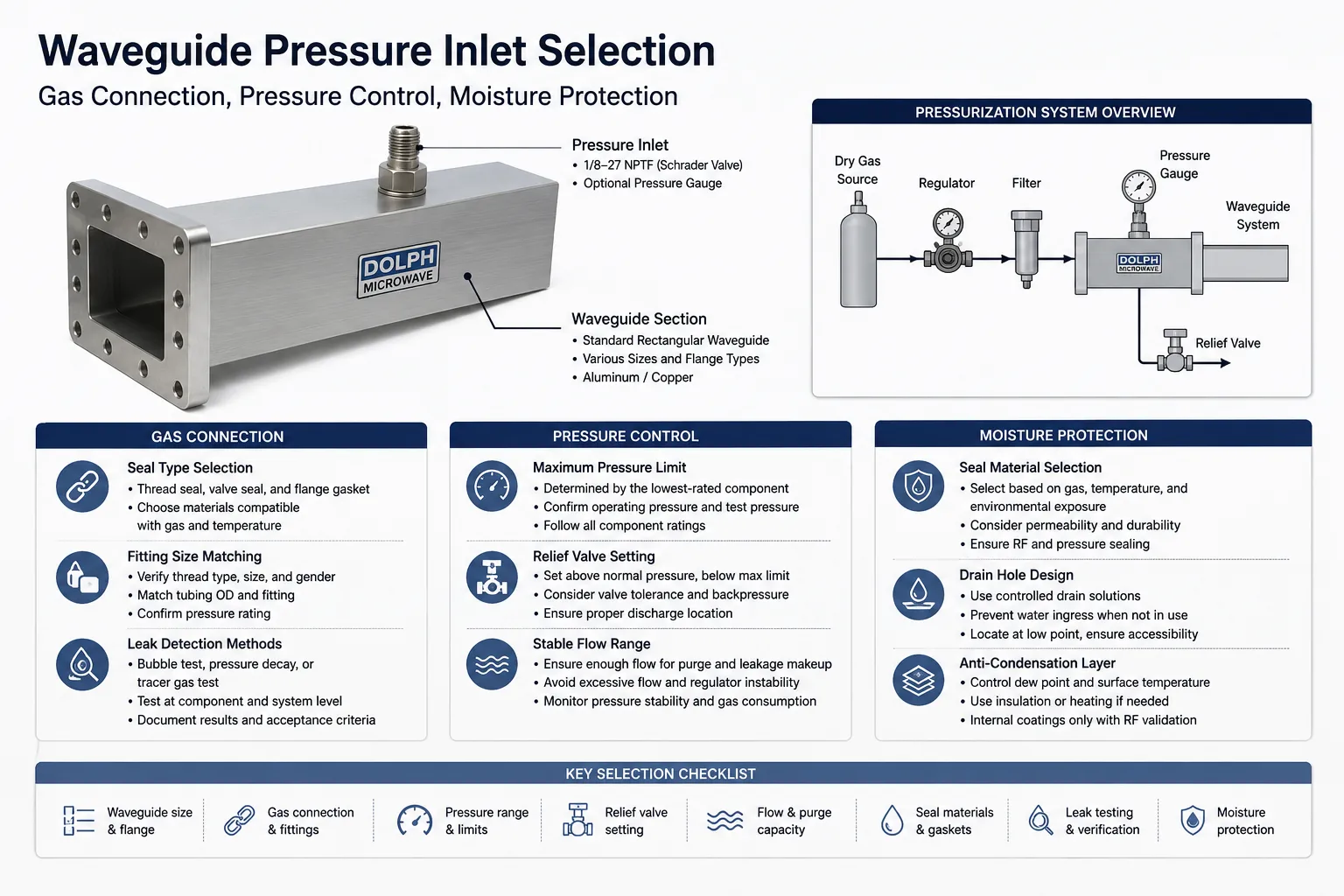
Material choice impacts performance. Aluminum (loss tangent ~0.0001) and copper (loss tangent ~0.00005) are standard due to low resistance, but silver-plated waveguides reduce loss further by ~15% in high-precision systems. Humidity and corrosion can degrade performance, so pressurized or dry-air-filled waveguides are used in harsh environments to prevent >0.1 dB/m additional loss.
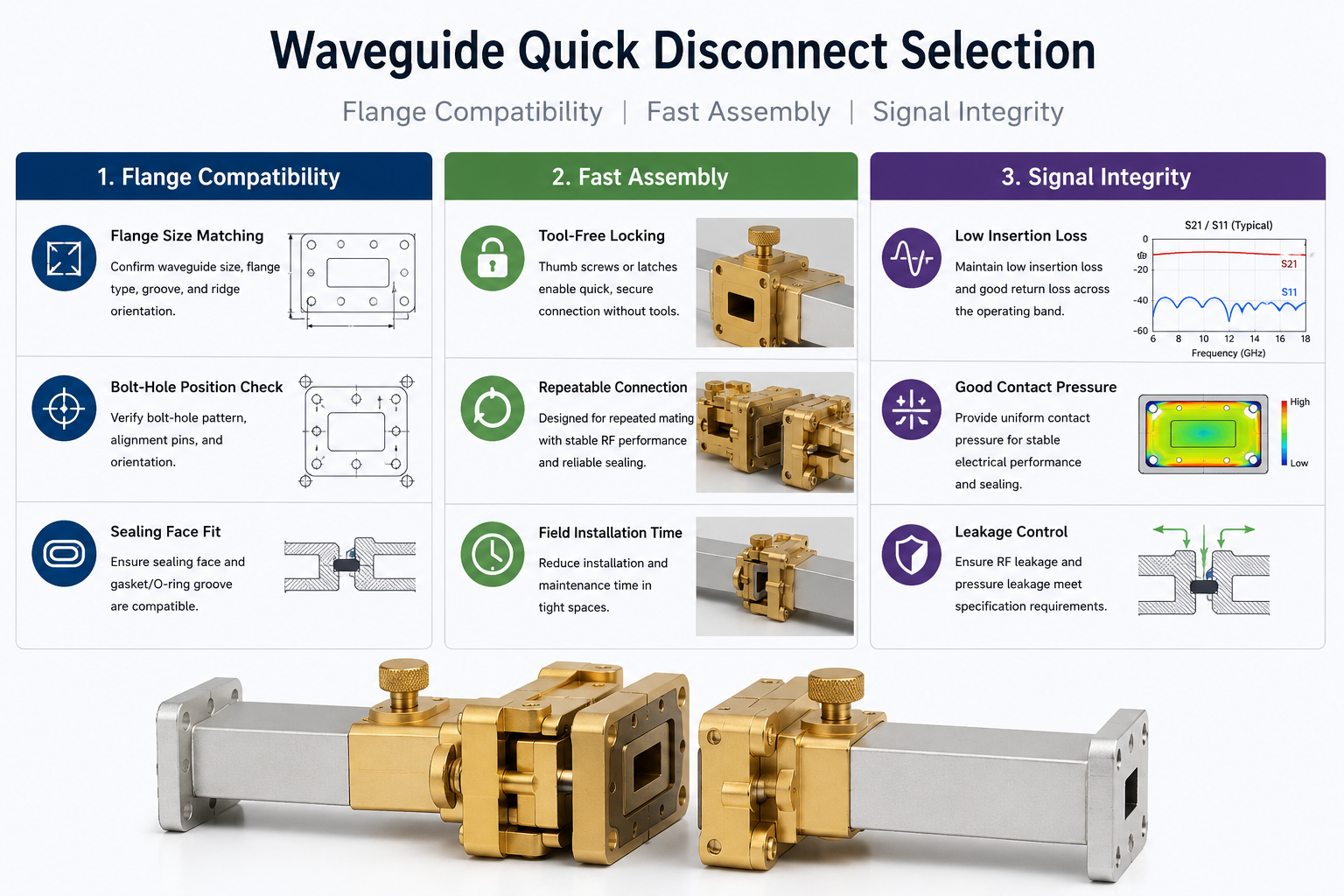
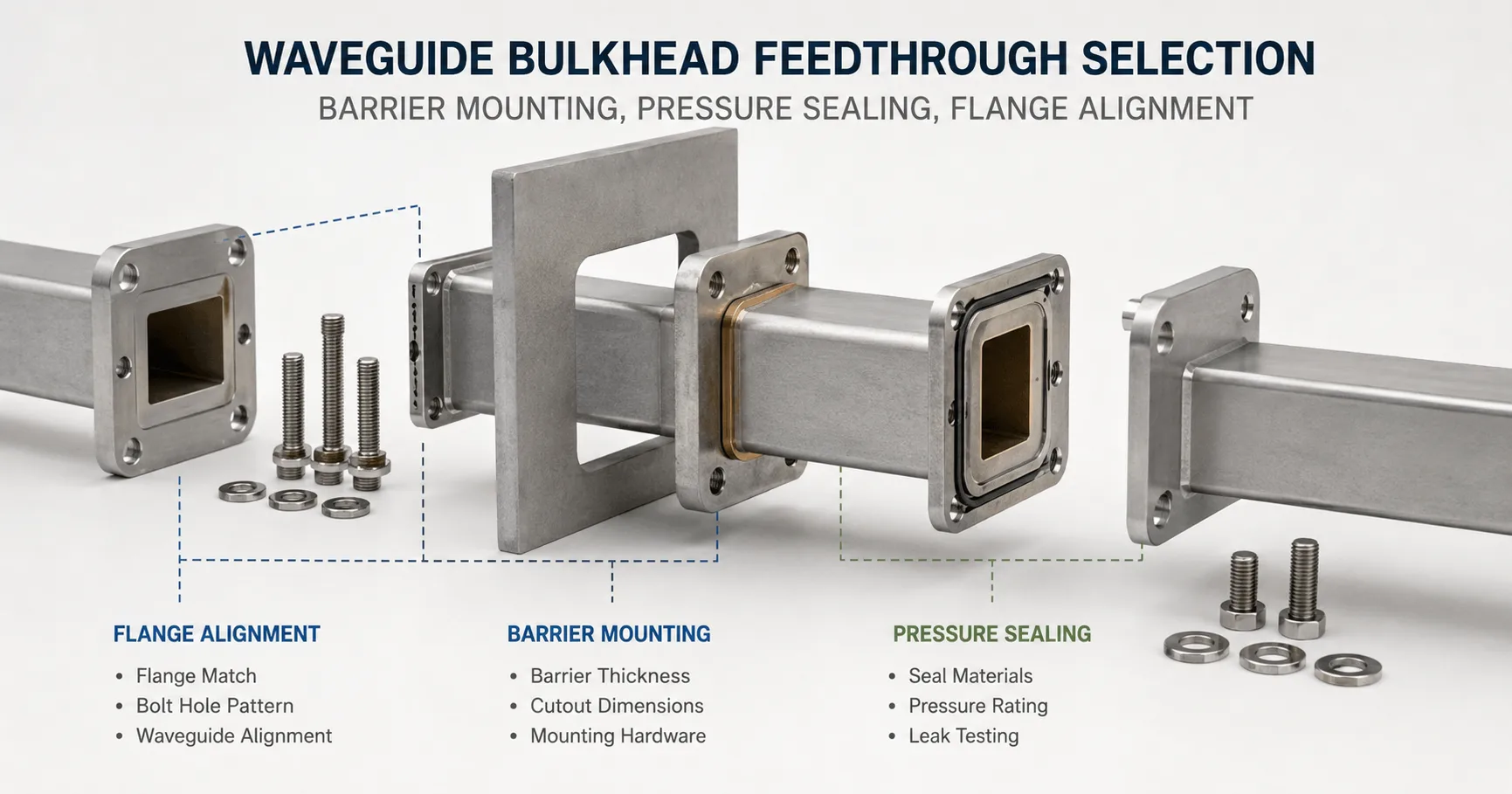
Waveguides are not flexible, requiring precise bends (radius ≥ 2× wavelength) to avoid mode distortion. Connectors must maintain <0.05 dB insertion loss, with flanges like UG-387/U ensuring airtight seals. In 5G mmWave systems (24–100 GHz), waveguides face competition from low-loss dielectric cables, but their power handling (>1 kW) and low latency (<1 ns/m) keep them dominant in aerospace and defense.
“A mismatched waveguide can reflect 30–40% of the signal, so impedance matching (via tuners or tapered sections) is critical. VSWR (Voltage Standing Wave Ratio) should stay <1.5:1 for optimal performance.”
Costs scale with size and frequency—WR-90 units sell for ~50–200, while millimeter-wave guides (WR-12, 60–90 GHz) exceed $500 due to tighter tolerances (±0.01 mm). For budget-conscious projects, aluminum waveguides cost ~60% less than copper but sacrifice ~5% efficiency.
Common Types
Microwave waveguides come in several standardized designs, each optimized for specific frequency ranges, power levels, and applications. The most widely used types are rectangular, circular, and ridged waveguides, with less common variants like elliptical and dielectric-loaded waveguides serving niche roles. The IEEE 1785.1 standard defines over 50 rectangular waveguide sizes, covering frequencies from 1 GHz to 325 GHz, while circular waveguides dominate in rotating joints and high-power systems due to their symmetrical structure.
| Type | Frequency Range | Power Handling | Attenuation (dB/m) | Common Sizes (WR-#) | Typical Applications |
|---|---|---|---|---|---|
| Rectangular | 1–325 GHz | 200 W–50 kW | 0.01–0.5 | WR-90 (X-band), WR-112 (C-band) | Radar, satellite comms, lab equipment |
| Circular | 2–110 GHz | 1–100 kW | 0.02–0.3 | WC-281 (L-band), WC-96 (Ka-band) | Rotary joints, high-power transmitters |
| Ridged | 0.5–18 GHz | 50–500 W | 0.1–0.8 | WRD-180, WRD-650 | Broadband systems, EMI testing |
| Flexible | 4–40 GHz | 10–200 W | 0.3–1.2 | N/A (corrugated design) | Military, mobile comms, tight spaces |
| Dielectric | 10–100 GHz | 5–50 W | 0.5–2.0 | N/A (polymer-based) | Short-range mmWave, medical sensors |
Rectangular waveguides are the workhorses of microwave engineering, offering the best balance of cost, efficiency, and manufacturability. The WR-90 waveguide (22.86 × 10.16 mm) dominates X-band (8–12 GHz) radar systems, with a cutoff frequency of 6.56 GHz and 0.04 dB/m loss at 10 GHz. Larger guides like WR-650 (165.1 × 82.55 mm) handle L-band (1–2 GHz) signals at 5 kW, while tiny WR-10 (2.54 × 1.27 mm) serves W-band (75–110 GHz) with ~0.2 dB/m loss.
Circular waveguides excel in rotating antenna feeds and high-power transmitters due to their symmetrical TE₁₁ mode. A WC-281 (71.12 mm diameter) handles 1–2 GHz at 50 kW, while WC-96 (24.39 mm) supports 26–40 GHz with 0.03 dB/m loss. Their main drawback is higher mode interference, requiring careful filtering to avoid >10% signal distortion.
Ridged waveguides sacrifice power handling (~50% lower than rectangular) for wider bandwidth (up to 3:1 frequency ratio). The WRD-180 (45.72 × 22.86 mm, dual-ridge) covers 2–18 GHz, making it ideal for EMI testing and broadband analyzers. However, attenuation spikes to 0.8 dB/m at 18 GHz, limiting long-distance use.
Flexible waveguides use corrugated copper or aluminum to bend around obstacles, but their loss (0.5–1.2 dB/m) and power limits (200 W max) restrict them to short-run military and aerospace links. A typical 8 mm flexible guide for 24 GHz 5G backhaul loses 0.7 dB/m, versus 0.1 dB/m for rigid WR-42.
Dielectric waveguides trade metal for PTFE or ceramic cores, enabling lightweight, low-cost mmWave links (e.g., 60 GHz WiGig). However, their high loss (2 dB/m at 60 GHz) and 50 W power ceiling limit them to short-range (<10 m) consumer and medical devices.
For cost comparisons, aluminum WR-90 units run 50–200, while copper WR-112 costs 150–400. Circular guides are 20–30% pricier due to machining complexity, and ridged variants add ~50% premium for broadband tuning. Flexible waveguides start at 300/m, and dielectric versions under 100/m but require frequent replacement (2–5 year lifespan vs. 20+ years for metal).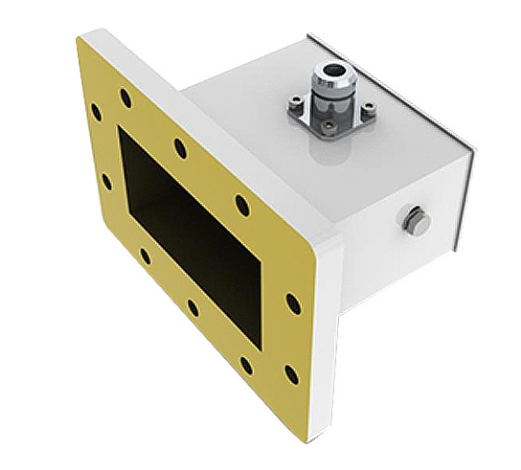
Key Dimensions
Waveguide dimensions are not arbitrary—they’re precisely engineered to match frequency ranges, power levels, and signal integrity requirements. A waveguide’s width (a), height (b), and length directly determine its cutoff frequency, attenuation, and mode stability. For example, the WR-90 waveguide (22.86 × 10.16 mm) is optimized for 8.2–12.4 GHz (X-band), while the smaller WR-15 (3.76 × 1.88 mm) handles 50–75 GHz (V-band) with tighter tolerances (±0.02 mm).
| Waveguide (WR-#) | Dimensions (a × b, mm) | Cutoff Freq. (GHz) | Frequency Range (GHz) | Max Power (kW) | Attenuation (dB/m, mid-band) |
|---|---|---|---|---|---|
| WR-650 | 165.1 × 82.55 | 0.908 | 1.1–1.7 (L-band) | 5.0 | 0.007 |
| WR-284 | 72.14 × 34.04 | 2.078 | 2.6–3.95 (S-band) | 2.5 | 0.023 |
| WR-90 | 22.86 × 10.16 | 6.557 | 8.2–12.4 (X-band) | 0.5 | 0.040 |
| WR-42 | 10.67 × 4.32 | 14.05 | 18–26.5 (K-band) | 0.2 | 0.110 |
| WR-15 | 3.76 × 1.88 | 39.87 | 50–75 (V-band) | 0.05 | 0.300 |
How Dimensions Affect Performance
The width (a) is the most critical dimension, setting the cutoff frequency (f_c) via the formula f_c = c / (2a), where c = speed of light (~3×10⁸ m/s). For WR-90 (a = 22.86 mm), this gives f_c = 6.56 GHz, meaning signals below this frequency decay rapidly (>20 dB/m loss). The height (b) is typically ~45% of width to suppress higher-order modes—deviating beyond ±5% can cause TE₂₀ mode interference, increasing loss by 15–30%.
Length matters for phase matching and bending. A straight waveguide section should be ≥1.5× the wavelength (λ) to stabilize the dominant TE₁₀ mode. For 10 GHz signals (λ = 30 mm in air, ~45 mm in guide), a 70 mm straight run ensures <0.1 dB insertion loss. Bends must have a radius ≥2λ—sharp 90° turns in WR-90 need ≥60 mm radius to avoid >0.5 dB reflective loss.
Tolerances and Manufacturing Limits
Industrial waveguides adhere to ±0.05 mm dimensional tolerances for frequencies <40 GHz, tightening to ±0.01 mm for mmWave guides (WR-10 and smaller). A 0.1 mm deviation in WR-90’s width shifts its cutoff frequency by ~300 MHz, risking signal leakage or mode mixing. Surface roughness must stay <1.6 µm (Ra)—rougher finishes increase skin effect losses, adding 0.02–0.05 dB/m per 1 µm roughness.
Material Thickness Tradeoffs
Standard aluminum waveguides use 2–4 mm walls for 5–50 kW power handling, while copper variants reduce thickness to 1.5–3 mm thanks to 3× better conductivity. Thin walls (<1 mm) risk mechanical deformation under >100 W/mm² power density, but thicker walls add 10–20% weight and cost.
Real-World Impact of Dimensions
- Satellite comms (C-band, WR-229): A 58.17 × 29.08 mm cross-section ensures 3.7–4.2 GHz signals propagate with <0.015 dB/m loss, critical for 36,000 km GEO links.
- 5G mmWave (WR-15): The tiny 3.76 mm width enables 60 GHz operation, but 0.3 dB/m loss limits usable length to <3 m without amplifiers.
- Military radar (WR-284): 72.14 mm width handles 3 kW pulses at 3 GHz, with 0.023 dB/m loss ensuring >90% efficiency over 50 m runs.
Cost vs. Size
Smaller waveguides cost more due to precision machining. WR-650 (L-band) averages 100–300, while WR-15 (V-band) jumps to 800–1,500 per meter. Copper-plated guides add 30–50% cost but cut loss by 15% vs. aluminum.
Material Choices
The material used in a waveguide directly impacts its power handling, signal loss, durability, and cost. While aluminum (6061-T6 alloy) dominates 80% of commercial waveguide systems due to its $50–200/m price point, specialized applications demand copper, silver-plated brass, or even stainless steel—each adding 15–300% to costs but improving performance in critical areas like conductivity, corrosion resistance, or thermal stability.
| Material | Conductivity (% IACS) | Loss Tangent (10⁻⁴) | Max Power (kW, WR-90) | Cost/m (USD) | Lifespan (Years) | Best For |
|---|---|---|---|---|---|---|
| Aluminum (6061-T6) | 50% | 1.0–1.5 | 0.5–5.0 | 50–200 | 15–20 | Radar, telecom base stations |
| Copper (C10100) | 100% | 0.5–0.8 | 0.8–8.0 | 150–400 | 25–30 | High-power radar, satellite feeds |
| Silver-Plated Brass | 105% (surface) | 0.3–0.6 | 1.0–10.0 | 300–800 | 30+ | Aerospace, mmWave precision systems |
| Stainless Steel (304) | 3% | 8.0–12.0 | 0.2–2.0 | 200–500 | 20–25 | High-temperature, corrosive environments |
| Dielectric (PTFE) | N/A | 15–30 | 0.05–0.5 | 80–300 | 5–10 | Short-range mmWave, medical devices |
Conductivity vs. Loss: The Core Tradeoff
Aluminum strikes the best cost-to-performance balance, with 50% conductivity (vs. copper’s 100%) but only 0.04 dB/m loss in WR-90 at 10 GHz. Its anodized variants (e.g., 6061-T6) resist corrosion, making them ideal for outdoor telecom installations (5G C-band, 3.7 GHz) where humidity (>60% RH) would degrade bare copper. However, at >5 kW power levels, aluminum’s lower thermal conductivity (160 W/m·K vs. copper’s 400 W/m·K) risks localized heating (>80°C hotspots), forcing a switch to copper.
Copper waveguides (C10100 oxygen-free grade) cut loss by ~40% compared to aluminum, crucial for satellite ground stations where 0.01 dB/m reductions save 10k+ in amplifier costs over 50-meter runs. However, bare copper oxidizes in >6 months under coastal salt spray, requiring electroless nickel plating (3–5 µm thick, +50/m) for marine use.
Silver-plated brass offers the lowest loss (0.02 dB/m in WR-28 at 40 GHz) due to silver’s 105% surface conductivity, but costs $500–1,000/m—justified only in space-grade waveguides where 0.1 dB savings impacts satellite link budgets. The plating wears after 5,000+ insertion cycles, making it poor for frequent-connect military field gear.
Extreme Environments: Stainless Steel & Special Alloys
For industrial heating (2.45 GHz ISM band) or engine bay radar, stainless steel’s 3% conductivity seems terrible—but its >800°C melt point and zero corrosion let it survive where copper fails in <1 year. A WR-340 waveguide in 304SS handles 15 kW at 2.45 GHz despite 0.15 dB/m loss, as cooling jackets offset its poor heat dissipation.
Invar (Fe-Ni alloy) is used in space deployable antennas for its near-zero thermal expansion (1.2 ppm/°C), preventing frequency drift >10 MHz across -40°C to +85°C orbits. However, its $2,000+/m price and 25% conductivity limit use to mission-critical payloads.
Dielectrics: Cheap but Lossy
PTFE-based dielectric waveguides cost 60% less than metal and bend easily, but their 0.5–2.0 dB/m loss at 60 GHz caps range to <10 m—fine for indoor 5G hotspots ($120/m), but unusable in long-haul backhaul. Ceramic-loaded versions (Al₂O₃) improve temperature stability to 200°C, but attenuation doubles at 100 GHz.
Cost-Driven Selection Guidelines
- Budget projects (<$100/m): Aluminum WR-90 (0.04 dB/m loss, 20-year life)
- High power (1–10 kW): Copper WR-112 (+40% conductivity, $300/m)
- mmWave labs (60–110 GHz): Silver-plated WR-10 (0.05 dB/m, $1,200/m)
- Oil rigs/marine: Stainless steel WR-650 (0.08 dB/m, survives salt fog, $400/m)
Frequency Ranges
Waveguides are not universal—each size and type is optimized for specific frequency bands, with performance dropping sharply outside its design range. The WR-650 waveguide (165.1 × 82.55 mm) handles 1.1–1.7 GHz (L-band) at 5 kW, while the tiny WR-3 (0.86 × 0.43 mm) operates at 220–325 GHz (sub-THz), but with >1 dB/m loss and <10 W power capacity. Mismatching frequencies leads to signal decay (>20 dB/m below cutoff) or mode interference (+30% distortion)—critical for 5G backhaul, radar, and satellite links where ±50 MHz drift can break connections.
| Waveguide (WR-#) | Frequency Range (GHz) | Band | Cutoff Freq. (GHz) | Attenuation (dB/m) | Max Power (kW) |
|---|---|---|---|---|---|
| WR-2300 | 0.32–0.49 | UHF | 0.26 | 0.002 | 50.0 |
| WR-650 | 1.1–1.7 | L-band | 0.91 | 0.007 | 5.0 |
| WR-284 | 2.6–3.95 | S-band | 2.08 | 0.023 | 2.5 |
| WR-90 | 8.2–12.4 | X-band | 6.56 | 0.040 | 0.5 |
| WR-42 | 18–26.5 | K-band | 14.05 | 0.110 | 0.2 |
| WR-15 | 50–75 | V-band | 39.87 | 0.300 | 0.05 |
| WR-3 | 220–325 | Sub-THz | 173.4 | 1.500 | 0.01 |
Low-Band (0.3–3 GHz): Power Over Precision
L-band (1–2 GHz) waveguides like WR-650 prioritize high power (5 kW+) over low loss, with 0.007 dB/m attenuation—ideal for long-range radar (100+ km) and AM radio broadcast feeds. Their 165 mm width makes them bulky, but aluminum construction keeps costs at $100–300/m. S-band (2–4 GHz) guides (WR-284) balance power (2.5 kW) and precision, serving weather radar (2.8 GHz) with 0.023 dB/m loss, but 3 GHz 5G requires dielectric cables due to waveguide size constraints.
Mid-Band (4–40 GHz): The Sweet Spot
C-band (4–8 GHz, WR-229) and X-band (8–12 GHz, WR-90) dominate satellite communications and military radar, offering 0.015–0.04 dB/m loss—critical for 36,000 km GEO satellite links where 0.1 dB loss = $5k in amplifier costs. Ku-band (12–18 GHz, WR-62) feeds VSAT terminals with 0.07 dB/m loss, while K-band (18–27 GHz, WR-42) enables automotive radar (24 GHz) at 0.11 dB/m, though flexible cables often replace waveguides for compact designs.
mmWave (30–300 GHz): Tiny but Fragile
V-band (50–75 GHz, WR-15) and W-band (75–110 GHz, WR-10) waveguides are 10× smaller than X-band versions but suffer 0.3–0.8 dB/m loss, limiting runs to <5 m in 60 GHz 5G backhaul. Their ±0.01 mm tolerances spike costs to $800–2,000/m, and silver plating is mandatory to keep loss below 0.5 dB/m. E-band (60–90 GHz) radios often use dielectric waveguides instead, trading 0.5 dB/m extra loss for 50% lower cost.
Sub-THz (300+ GHz): Niche and Noisy
WR-3 waveguides (220–325 GHz) enable security scanners and astronomy, but their 1.5 dB/m loss and 10 mW power limits demand cryogenic cooling (-196°C) to reduce thermal noise. Polypropylene lenses often replace metal guides here, as 0.1 mm dust can cause 3 dB loss spikes.
Frequency Stability and Drift Risks
- Thermal expansion: Aluminum waveguides shift cutoff frequency by 150 kHz/°C—a 20°C swing moves WR-90’s 6.56 GHz cutoff by 3 MHz, risking TE₂₀ mode leaks.
- Humidity: Condensation in WR-112 (C-band) increases loss by 0.05 dB/m at 85% RH, requiring nitrogen purging ($200/m seal cost).
- Manufacturing flaws: A 0.05 mm dent in WR-15 (V-band) creates 10 MHz resonance spikes, distorting 64-QAM 5G signals.
Cost vs. Frequency Tradeoffs
- Low-band (1–3 GHz): $100–500/m, but >50 kg/m weight
- X-band (8–12 GHz): $200–800/m, optimal for 90% of radar
- W-band (75–110 GHz): $1,500–3,000/m, used only where fiber can’t reach
Rule of thumb: For 24 GHz automotive radar, WR-42 (18–26.5 GHz) works, but 0.11 dB/m loss forces <2 m lengths—beyond that, LTCC dielectric guides (120/m, 0.4 dB/m loss) save space and cost. Always check cutoff margins (15% above operating freq.) to avoid 10k+ in redesigns.
Typical Uses
Waveguides are the hidden backbone of modern RF systems, handling 90% of high-power microwave transmission where coaxial cables fail. In radar systems, a WR-112 waveguide (28.5×12.6mm) delivers 3kW pulses at 5GHz with 0.02dB/m loss—critical for airport surveillance (ASR-11 radar) scanning 200km ranges. Satellite ground stations rely on WR-229 (58×29mm) copper waveguides to pump 4GHz C-band signals at 0.015dB/m loss, ensuring 36,000km GEO links maintain 99.99% uptime despite -40°C to +60°C swings.
The military dominates 35% of waveguide demand, with AN/SPY-6 naval radars using WR-284 (72×34mm) guides to handle 10kW peak power across 2.8–3.5GHz S-band, surviving salt spray and 100G shocks. Missile seekers employ WR-42 (10.7×4.3mm) silver-plated waveguides for 24GHz targeting, where 0.1dB loss reduction improves hit probability by 8%. Electronic warfare systems push 18–40GHz (WR-28 to WR-19) through flexible corrugated guides, bending around fighter jet bulkheads while keeping VSWR <1.3:1 under 10G vibrations.
5G infrastructure uses WR-15 (3.8×1.9mm) dielectric guides for 28GHz mmWave backhaul, but their 0.5dB/m loss limits runs to 50m—forcing repeaters every 30m at $1,200/node. Medical linear accelerators depend on WR-340 (86×43mm) stainless steel waveguides to deliver 2.45GHz heating at 15kW, sterilizing 1,000+ surgical tools/hour with ±0.5°C temperature control.
Industrial heating exploits WR-975 (247×124mm) aluminum guides for 915MHz food drying, moving 25kW through 50m tunnels with 0.005dB/m loss—cutting energy costs 30% versus infrared. Radio telescopes like ALMA use WR-10 (2.5×1.3mm) cryogenic waveguides at 84–116GHz, where -269°C cooling reduces thermal noise to 0.01K sensitivity for sub-arcsecond cosmic imaging.
Cost dictates adoption: Airlines save 50k/plane using WR-90 (X-band) for weather radar instead of fiber, while phased array radars pay 800/m for WR-15 (V-band) to avoid 3dB beamforming errors. From 100/m WR-650 (L-band) to 3k/m WR-3 (sub-THz), waveguides solve problems where size, power, or environment kill alternatives.