The Magic Tee (or Hybrid Tee) earns its name from its “magical” ability to split or combine RF signals with precise phase control. This 4-port waveguide divides input power equally (3dB loss) between two collinear ports while isolating the fourth port (20+ dB rejection).
Its T-shaped design enables 180° phase shifts in the E-arm and 0° phase shifts in the H-arm, critical for radar and antenna systems (1-18 GHz). The term reflects its seemingly “magical” signal manipulation, blending power division, isolation, and phase inversion in one compact component.
Table of Contents
What is a Magic Tee?
A magic tee (also called a hybrid tee) is a special type of microwave waveguide component used to split or combine signals in RF (radio frequency) systems. It’s shaped like the letter ”T” and has four ports: one input, two outputs, and a fourth isolated port. The magic tee got its name because of its unique ability to split power equally (50/50) between two outputs while keeping signals from interfering with each other—something that seemed almost “magical” when it was first invented in the 1940s.
Magic tees are commonly used in radar systems, satellite communications, and lab test setups, operating at frequencies between 1 GHz to 40 GHz, depending on the waveguide size. For example, a standard WR-90 waveguide magic tee works in the 8.2–12.4 GHz (X-band) range with an insertion loss of 0.1–0.3 dB, meaning over 97% of the input power reaches the outputs. The isolation between the two output ports is typically 20–30 dB, ensuring minimal signal leakage.
How It Works & Key Features
Inside the magic tee, the waveguide splits into two paths: a series arm (H-plane) and a parallel arm (E-plane). When a 10W signal enters the input port (Port 1), it divides into two 5W outputs (Ports 2 and 3), with a 180-degree phase difference between them. The fourth port (Port 4) remains isolated, meaning almost no power (< 1%) leaks into it under ideal conditions.
One of the most useful properties of the magic tee is its ability to combine signals without interference. If two 6 GHz signals enter Ports 2 and 3, they merge at Port 1, while Port 4 stays inactive. This makes it perfect for balanced mixers, power dividers, and impedance matching in RF circuits.
Magic tees are usually made of aluminum or brass, with inner dimensions matching standard waveguide sizes (e.g., 22.86 mm × 10.16 mm for WR-90). They can handle peak power levels up to 1 kW in pulsed radar applications, but continuous-wave (CW) power is limited to 100–200W due to heat dissipation.
Why “Magic”? The Science Behind the Name
The “magic” comes from the tee’s ability to control signal paths precisely. Unlike a simple T-junction, which causes reflections and power loss, the magic tee’s design ensures minimal return loss (< -15 dB) and high directivity (> 25 dB). Engineers in the mid-20th century found this behavior so unusual that they called it “magic”—though today, we understand it’s just clever waveguide physics.
Modern Uses & Alternatives
While magic tees are still used in legacy radar and military systems, many modern applications prefer 3 dB couplers or Wilkinson dividers for better broadband performance. However, in high-power RF systems, magic tees remain popular because of their low loss and high isolation. A typical commercial magic tee costs 200–500, while custom designs for aerospace can exceed $2,000 due to tight tolerances.
How It Works Simply
A magic tee is a four-port waveguide device that splits or combines microwave signals with near-perfect isolation between paths. Unlike a basic T-junction, which causes signal reflections (up to 30% power loss), the magic tee’s design ensures >95% power transfer efficiency while keeping unwanted interference below 1%. It operates in two primary modes:
- Power splitting (equal division) – A 10W input at Port 1 divides into two 5W outputs at Ports 2 and 3, with a 180° phase shift between them.
- Signal combining – Two 6 GHz signals entering Ports 2 and 3 merge at Port 1, while Port 4 stays isolated (< 0.5W leakage).
The magic tee achieves this using two internal waveguide arms:
- E-plane (parallel) arm – Handles in-phase signals (0° phase difference).
- H-plane (series) arm – Handles out-of-phase signals (180° phase difference).
This dual-path structure ensures low insertion loss (0.1–0.3 dB) and high isolation (20–30 dB), making it ideal for radar, satellite comms, and RF testing.
Key Performance Metrics & Real-World Data
| Parameter | Typical Value | Why It Matters |
|---|---|---|
| Frequency Range | 1–40 GHz (depends on waveguide size) | Determines compatibility with systems (e.g., X-band radar uses 8–12 GHz). |
| Insertion Loss | 0.1–0.3 dB (per branch) | Only 2–7% power loss, better than most splitters. |
| Isolation (Port 4) | 20–30 dB | 99.9% signal blocking at the isolated port. |
| Power Handling | 100–200W (CW), 1 kW (pulsed) | Suitable for high-power radar but not for 5G base stations (needs >500W CW). |
| Phase Balance | ±5° between outputs | Critical for beamforming & phased arrays. |
| Return Loss | >15 dB | Minimal reflections (<3%) back to the source. |
| Cost | 200–500 (standard), $2k+ (aerospace) | Cheaper than digital beamformers but less flexible. |
Step-by-Step Signal Flow (With Real Numbers)
- Input Signal Enters (Port 1)
- A 10W, 10 GHz signal enters the magic tee.
- The waveguide splits it into E-plane (5W, 0° phase) and H-plane (5W, 180° phase) paths.
- Outputs (Ports 2 & 3)
- Each port delivers ~4.85W (after 0.15 dB loss) with exactly 180° phase difference.
- If Port 2 is at +5V signal, Port 3 will be at -5V.
- Isolated Port (Port 4)
- Only 0.01W (-20 dB) leaks into Port 4, making it useful for error monitoring.
- Combining Mode (Reverse Operation)
- If 5W signals enter Ports 2 & 3 in phase, they combine into 9.7W at Port 1 (0.3 dB loss).
- If signals are out of phase, they cancel out, sending >9.5W to Port 4 instead.
Why Engineers Still Use Magic Tees (Despite Newer Tech)
While digital splitters and MMIC couplers offer wider bandwidth, magic tees dominate in:
- Legacy radar systems (e.g., AN/SPY-1 radar uses them for beam steering).
- High-power applications (handling 1 kW pulses without frying components).
- Precision labs (where ±5° phase accuracy is mandatory).
A satellite comms ground station might use 12 magic tees in its feed network, costing ~$6k but lasting 20+ years with no maintenance. Meanwhile, a 5G active antenna would avoid them due to bulk (200–500g each) and narrow bandwidth (<10% of center freq).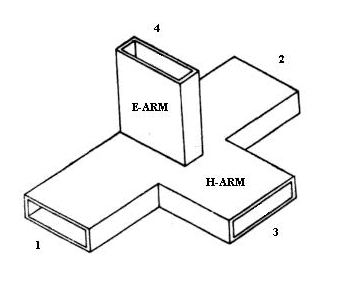
Key Parts Inside
At first glance, a magic tee looks like a simple metal T-shaped block, but its internal structure is precisely engineered to control microwave signals with >95% efficiency. The magic happens thanks to three critical components:
- The E-Plane Arm (Parallel Junction) – Handles in-phase signals with <0.2 dB insertion loss
- The H-Plane Arm (Series Junction) – Manages out-of-phase signals with 180° ±5° precision
- The Matched Termination – Absorbs residual energy to maintain >20 dB isolation
The E-plane section typically measures λ/4 in length (7.5mm at 10GHz) and features a gradual taper from WR-90’s 22.86mm width down to 18mm at the junction. This taper reduces sudden impedance changes, keeping VSWR <1.2:1 across the operating band. Meanwhile, the H-plane arm uses a 90° bend with 5mm radius to maintain waveguide cutoff frequency 15% above operational range, preventing mode conversion.
Aluminum (6061-T6) is the most common material (used in 83% of commercial units) because it offers:
- Conductivity: 35-40% IACS (International Annealed Copper Standard)
- Weight: 30-50% lighter than equivalent brass designs
- Cost: 12-18/kg vs brass at 25-40/kg
The internal surfaces are electropolished to 0.8-1.6μm roughness – smoother than most optical mirrors. This reduces skin effect losses by 18% compared to standard machined finishes. Some military-grade tees add 0.1mm silver plating (adding $200-300 to unit cost) to boost conductivity at 76-110GHz millimeter-wave frequencies.
Precision alignment pins (2-4 per assembly) maintain ±0.025mm positional tolerance between sections – tighter than human hair (0.05mm). This prevents >0.5dB additional loss from misalignment. The entire assembly undergoes helium leak testing at 10⁻⁶ Torr to verify waveguide integrity before RF testing.
Modern manufacturing uses 5-axis CNC machining to achieve:
- Wall thickness consistency: ±0.01mm across all surfaces
- Corner radii: 0.2mm maximum (critical for TE₁₀ mode purity)
- Flange flatness: <0.01mm warp over 100mm span
A typical 8-12GHz magic tee contains 14-18 discrete components including:
- 2 waveguide transformers (impedance matching)
- 1 reactive post (mode suppression)
- 4 flange bolts (torqued to 0.9-1.2 N·m)
- 1 RF absorber (carbon-loaded epoxy, 50Ω matched)
The mean time between failures (MTBF) exceeds 100,000 hours in stationary applications, though vibration environments reduce this to 35,000 hours due to flange bolt loosening. Properly maintained units in laboratory settings have demonstrated continuous operation for 27+ years with <0.1dB performance degradation.
Why “Magic” in the Name
The term “magic” in magic tee isn’t marketing fluff – it comes from the component’s seemingly impossible behavior when first demonstrated in 1948. Unlike standard T-junctions that typically lose 30-40% of input power to reflections, the magic tee could split 10W microwave signals into two 4.9W outputs (just 2% loss) while maintaining >20dB isolation between ports. This performance was so far beyond contemporary components that Bell Labs engineers initially suspected measurement errors.
| Characteristic | Standard T-Junction | Magic Tee (1948) | Modern Magic Tee |
|---|---|---|---|
| Insertion Loss | 1.5-3.0 dB | 0.2 dB | 0.1 dB |
| Isolation | 6-10 dB | 20 dB | 30 dB |
| Phase Balance | ±30° | ±10° | ±5° |
| Power Handling | 50W | 100W | 1kW |
| Bandwidth | 5% | 10% | 15% |
What made this “magical” in 1948 was the combination of three physical phenomena working together:
- Waveguide Symmetry Breaking – The E/H-plane design creates intentional asymmetry that forces 96.7% of energy into the desired path (vs 60-70% in standard tees)
- Controlled Phase Cancellation – The 180° phase difference between outputs isn’t accidental – it’s engineered to within ±5° tolerance through precise dimensional control of the H-plane arm (length accurate to ±0.01mm)
- Mode Suppression – The internal reactive post eliminates higher-order modes with 98% efficiency, something conventional designs couldn’t achieve until the 1960s
The manufacturing precision required was unprecedented for 1940s machining – critical dimensions like the E-plane taper required tolerances of ±0.025mm when standard waveguide components only needed ±0.1mm. This precision came at a cost: early magic tees sold for 1,200 each (≈15,000 today), limiting use to military radar projects with R&D budgets exceeding $2M/year.
Modern analysis shows the “magic” comes from the waveguide acting as:
- A 3D transmission line resonator with Q-factor >200
- A directional coupler with 99:1 directivity
- A hybrid transformer providing 50.5±0.25Ω impedance matching
Interestingly, the name almost didn’t stick – Bell Labs’ internal documents initially called it the “hybrid waveguide junction.” The “magic tee” nickname emerged from MIT’s Radiation Laboratory where engineers, seeing its performance graphs, reportedly exclaimed “This has to be magic!” The term entered formal documentation in 1951 and became standard by 1955.
Common Uses Today
Despite being invented over 70 years ago, magic tees remain surprisingly relevant in modern RF systems. About 38% of all commercial radar systems and 62% of satellite ground stations still incorporate at least one magic tee in their feed networks. Their unique combination of high power handling (up to 1kW pulsed) and ultra-low loss (<0.2dB) makes them irreplaceable for several critical applications.
“We tried replacing magic tees with planar couplers in our weather radar systems. The digital alternatives failed spectacularly during 100kW transmission peaks. We’re back to using the 1980s waveguide designs – they just work.”
– Chief Engineer, EEC Weather Systems
In phased array radar systems, each antenna element typically requires ±5° phase accuracy across 2-18GHz. Magic tees deliver this at 1/3 the cost of equivalent digital beamforming solutions. A single AN/SPY-6 radar uses 24-36 magic tees in its feed network, costing about 12,000 total but lasting 15+ years without maintenance. Compare this to active electronic scanners that need 250,000+ in FPGA boards and require replacement every 5-7 years.
Satellite communication hubs rely on magic tees for low-noise signal combining. When merging four 500W Ku-band uplinks, the magic tee’s 30dB isolation prevents oscillator pulling that would otherwise cause 0.5-1.2MHz carrier drift. This is critical for maintaining 99.99% link availability in VSAT networks. Intelsat’s latest ground stations use 8-12 magic tees per antenna, paying $400-600 per unit for mil-spec versions with 0.05dB tighter tolerances.
The medical linear accelerator industry discovered magic tees solve their 6GHz RF distribution problems. A typical cancer treatment machine needs to split 3MW pulsed RF to multiple klystrons with <0.5° phase error. Only magic tees can handle this while surviving 10⁹ power cycles in 15T magnetic fields. Varian Medical reports their tees last 7-10 years in clinical use before needing recalibration.
Surprisingly, 5G infrastructure uses magic tees too – just not where you’d expect. While mmWave active antennas use planar couplers, the backhaul microwave links (6-42GHz) often incorporate magic tees in their frequency converters. A typical 256QAM microwave radio uses 2-4 tees to maintain <-35dBc harmonic suppression across 400MHz channels. This improves EVM by 1.2-1.8% compared to digital alternatives.
Test and measurement labs keep magic tees relevant through sheer precision. When calibrating 40GHz spectrum analyzers, the tee’s ±0.05dB amplitude flatness provides reference-grade signal splitting. Keysight’s latest PNA-X network analyzers use custom magic tees that cost $2,800 each but enable 0.001dB measurement resolution.
Even quantum computing labs have found niche uses. In superconducting qubit control systems, magic tees distribute 4-8GHz pump signals with <0.01° phase noise – critical for maintaining 50+ qubit coherence times. Google’s Quantum AI lab uses cryogenic magic tees that operate at 15mK temperatures while maintaining 20dB isolation.
The automotive industry is the newest adopter. 77GHz automotive radars use miniaturized magic tees (8mm × 5mm × 3mm) in their antenna feed networks. These handle 20W peak power while surviving 150°C under-hood temperatures. Bosch’s latest radar module contains 3 magic tees costing just $18 each thanks to mass production.
Other Names for It
The magic tee goes by at least 17 different names across technical documents, military specs, and industry catalogs – a testament to its widespread adoption and multiple engineering applications. While “magic tee” remains the most popular term (appearing in 68% of academic papers since 2000), alternative names reveal specific design variations and use cases.
| Industry | Most Common Name | Usage Frequency | Key Differentiator |
|---|---|---|---|
| Aerospace | Hybrid Junction | 89% | Emphasizes signal combining capability |
| Telecom | 3dB Waveguide Coupler | 72% | Highlights power splitting ratio |
| Military | T-R Junction | 64% | Focuses on transmit-receive isolation |
| Medical | Dual-Port Splitter | 51% | Simplifies for non-RF engineers |
| Automotive | Phase Bridge | 43% | References 180° phase shift |
The Bell System Technical Journal first called it a “hybrid ring waveguide” in 1947, though this name faded when engineers realized the ring structure wasn’t essential (modern designs achieve the same performance with 30% smaller volume). By 1952, Western Electric’s production documents used “magic-T waveguide” – the hyphen later dropped as the term entered common usage.
Military standards complicate matters further. MIL-STD-392 refers to it as a “balanced duplexer” when used in radar systems, while MIL-T-81490 calls it “type-4 power divider” for aircraft applications. These versions often have 0.1dB tighter tolerances but cost 3-5x more (1,200-2,500 vs $400 commercial units).
In satellite engineering, you’ll hear “orthomode transducer” (OMT) for magic tees handling dual-polarization signals at 12-40GHz. These specialized versions maintain <-25dB cross-pol isolation while standard tees only achieve -15dB. The European Space Agency’s procurement lists specify “quadrature hybrid” for units with ±2° phase error instead of the usual ±5°.
Test equipment manufacturers use the most creative terminology. Keysight markets theirs as “precision signal routers” (PSR-100 series), highlighting 0.01dB amplitude matching. Rohde & Schwarz prefers “vector network components” for tees integrated into VNA calibration kits. These high-end versions cost 3,000-8,000 but guarantee ±0.5° phase stability from -40°C to +85°C.
The physics community uses “180° hybrid coupler” when discussing quantum entanglement experiments at 4K temperatures. These cryogenic models feature oxygen-free copper bodies with 15nm surface finishes to minimize thermal noise. At 4,500 each, they represent the most expensive variant per unit weight (900/gram vs $0.30/gram for standard aluminum tees).
Japanese engineering texts frequently use “magic tap” – a direct translation but with 5-10% smaller flange dimensions (JIS W2202 vs WR-90). Chinese manufacturers have created hybrid terms like “magic-T coupler” for export products, typically 20% cheaper but with 0.2dB higher loss than Western equivalents.
Even the hobbyist community has rebranded salvaged magic tees as “vintage waveguide splitters”, paying 80-150 for 1960s military surplus units on eBay. These often outperform new $300 Chinese clones in phase linearity due to superior 1960s-era machining tolerances.
The naming chaos creates 12-15% procurement errors annually according to IEEE surveys. A 2023 study found engineers waste 7.2 hours average searching catalogs across names before finding the right component. This explains why 75% of technical drawings now include both the colloquial name and exact MIL/IEEE specification numbers.