The optimal FTTH splitter ratio depends on required signal strength per user. A 1×32 splitter is common, introducing ~17 dB loss, but for longer PON reaches, a 1:16 ratio (~14 dB loss) or cascaded 1:2 + 1:8 splitters may be used to balance reach and user count.
Table of Contents
Understanding Splitter Ratios
When planning a Fiber-to-the-Home (FTTH) network, the splitter ratio is one of the most critical decisions. It determines how many end-users can share a single optical line terminal (OLT) port at the central office. The three most common splitter ratios are 1:4, 1:8, and 1:16, but others like 1:2, 1:32, and 1:64 are also used in specific scenarios.
The splitter ratio directly defines how the optical power is divided among its output ports. A higher split ratio means the light signal is distributed to more endpoints, which reduces the power available for each user. This is measured in decibels (dB) of loss. For instance, a 1:2 splitter introduces about 3.01 dB of loss, a 1:4 has approximately 6.02 dB, and a 1:8 adds close to 9.03 dB. A standard 1:16 splitter typically has an insertion loss of 12.0 dB to 13.5 dB. This optical budget is the cornerstone of your network design.
| Split Ratio | Typical Insertion Loss (dB) | Minimum Optical Power per User (approx.) | Max Users per OLT Port |
|---|---|---|---|
| 1:2 | 3.0 – 3.5 dB | -21.5 dBm | 2 |
| 1:4 | 6.5 – 7.0 dB | -24.5 dBm | 4 |
| 1:8 | 9.5 – 10.5 dB | -27.5 dBm | 8 |
| 1:16 | 12.5 – 14.0 dB | -30.5 dBm | 16 |
| 1:32 | 16.0 – 18.0 dB | -34.0 dBm | 32 |
| 1:64 | 19.0 – 21.0 dB | -37.0 dBm | 64 |
The choice isn’t just about the maximum number of users. You must balance user density, required bandwidth, and the total distance the signal must travel. A 1:4 splitter might be perfect for a small apartment building with 4 units located within 5 km of the central office, ensuring each tenant gets a strong signal for high-speed services like 2 Gbps plans. In contrast, a 1:32 splitter is often used in dense urban areas to serve a 32-home cluster, but the available bandwidth per household might be lower, averaging around 50-100 Mbps during peak usage, unless paired with a more advanced OLT.
The physical type of splitter also matters. Fused Biconical Taper (FBT) splitters are often more cost-effective for lower ratios like 1:4 and 1:8, with a price around 25 per unit. For higher ratios like 1:16 and above, Planar Lightwave Circuit (PLC) splitters are the standard due to their better performance and uniformity across output ports, costing between 40 per unit. PLC splitters also have a wider operating temperature range, typically -40°C to 85°C, making them more reliable for outdoor cabinet installations.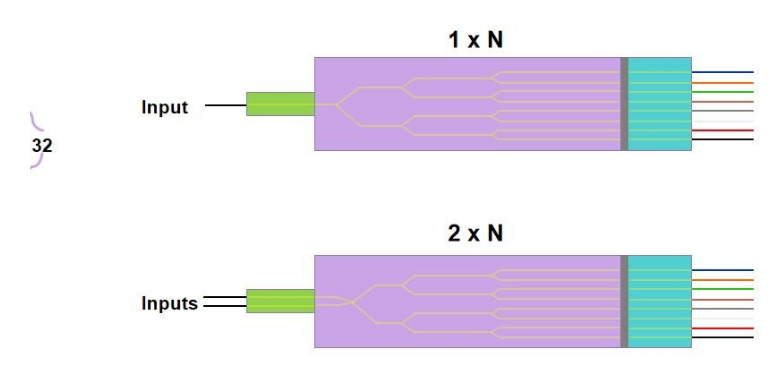
Common Use Cases Explained
Choosing the right splitter isn’t theoretical; it’s about matching the ratio to the physical and economic reality on the ground. The wrong choice can lead to slow speeds, unhappy customers, and costly network upgrades. Here’s where each ratio typically fits into the real world.
The 1:2 and 1:4 splitters are your go-to tools for low-density, high-reliability scenarios. A 1:2 splitter, with its minimal ~3.5 dB loss, is perfect for point-to-point connections in a business park where two enterprises might share a single OLT port for a dedicated 1 Gbps or 10 Gbps symmetric enterprise-grade service. The 1:4 ratio is extremely common for small Multi-Dwelling Units (MDUs) like a 4-plex apartment building or a cluster of 4 luxury homes in a gated community. This setup ensures each endpoint has a strong signal margin, allowing for future speed upgrades to 5 Gbps or even 10 Gbps without changing the physical infrastructure. The cost for a basic 1:4 PLC splitter is low, often under $20 per unit.
For the vast majority of standard suburban residential deployments, the 1:8 splitter is the workhorse. It offers the best balance, efficiently serving 8 households from a single OLT port. This is the standard ratio for a 16-port distribution hub serving two separate 8-home clusters. It supports downstream speeds of 1 Gbps to 2 Gbps per user comfortably. With an average take rate of 60-70% for services in a neighborhood of 100 homes, a 1:8 configuration means you’d need approximately 9 OLT ports (100 homes / 8 homes/port * 70% take rate). This makes capacity planning straightforward and cost-effective. The splitter itself is affordable, typically costing 28.
| Use Case Scenario | Recommended Ratio | # of Homes Served | Typical User Speed | Key Reason |
|---|---|---|---|---|
| Enterprise / Backhaul | 1:2 | 2 | 10 Gbps | Maximum Power, Low Loss |
| Small MDU / Luxury Homes | 1:4 | 4 | 2-5 Gbps | High Reliability & Bandwidth |
| Standard Subdivision | 1:8 | 8 | 1-2 Gbps | Optimal Balance of Cost & Reach |
| High-Density Urban MDU | 1:16 | 16 | 500 Mbps – 1 Gbps | Good Density for Mid-Rise Buildings |
| Large Subdivision / MDU | 1:32 | 32 | 100-500 Mbps | High User Density, Cost Savings |
| Rural / Long Reach | 1:8 or lower | 8 or fewer | 500 Mbps – 1 Gbps | Prioritizes Low Loss over High Density |
The 1:16 and 1:32 ratios are all about high density and cost efficiency per subscriber. A 1:16 splitter is ideal for a mid-rise apartment building with 16 units per floor, allowing one splitter per floor. A 1:32 splitter is common for serving an entire 32-home cul-de-sac or a large apartment building from a single port. The trade-off is optical power; these higher splits have losses of ~14 dB and ~17 dB respectively. This often limits maximum speeds to 500 Mbps for the farthest users on a 1:32 split and requires the network to be within 10 km of the central office.
However, the cost savings are significant. Deploying one 1:32 splitter (~100 total), making it essential for competitive markets with tight budgets under $500 per passed home.
How to Choose the Best
Selecting the optimal splitter ratio isn’t about picking the highest number; it’s a precise calculation based on your specific network constraints and business goals. The “best” ratio is the one that delivers the required service level at the lowest possible cost per subscriber. Ignoring your optical budget is the fastest way to a failed deployment.
Start with the total optical link loss budget. This is the single most important number. A typical GPON system might have a 28 dB to 32 dB budget. You must account for every source of loss: the ~0.3 dB per kilometer of fiber (so 3 dB for a 10 km run), ~0.2 dB for each connector (and there are 4 to 6 connectors in a path), and ~3 dB for additional margin (splices, aging, temperature changes). If your total available budget is 30 dB and your fiber plant uses 15 dB, you only have 15 dB left for the splitter. This immediately rules out a 1:32 splitter (~17 dB loss) and makes a 1:16 (~13.5 dB) a viable but tight option. The safest choice here would be a 1:8 splitter (~10 dB loss), leaving a comfortable 5 dB margin for future degradation.
Next, analyze your user density and take rate. There’s no financial sense in running a dedicated 1:4 split to a potential 32-home area if your historical take rate is only 40%. You’d be locking 8 OLT ports to serve only 13 paying customers, a poor Return on Investment (ROI). In this case, a 1:16 or 1:32 ratio is far more efficient, using 2 or 1 OLT port(s) respectively for the same group. This decision directly impacts your bottom line. An OLT port chassis can cost $2,000-$5,000, and each port has a cost. Conserving ports through higher split ratios is crucial for profitability in competitive markets with subscriber fees under $70 per month.
A 1:32 split might work today for 100 Mbps packages, but what about in 3 years when 1 Gbps is the standard? The higher loss of a 1:32 splitter can limit the ability to deliver higher power signals required for multi-gigabit services. If you’re planning to offer 2.5 Gbps PON or 10 Gbps XGS-PON in the future, opting for a lower ratio like 1:8 or a cascaded setup provides the necessary headroom. The cost of upgrading splitters later involves significant labor expenses, often over $200 per home to re-splice and re-provision, which can erase the initial savings from using a higher-ratio splitter.