To select the right coaxial attenuator, match its frequency range (e.g., 50MHz–6GHz) to your system’s operating band. Choose attenuation (3dB/10dB) based on signal level needs; ensure power handling (≥10W CW) exceeds peak input. Prioritize low VSWR (≤1.5) for minimal reflection, and verify with a network analyzer. Opt for corrosion-resistant materials (brass/stainless steel) for durability.
Table of Contents
Understand Your Frequency Range
An attenuator that works perfectly at 500 MHz might become wildly inaccurate or even cause signal reflection at 6 GHz. This isn’t a minor detail—it’s the foundation of your entire RF setup. For instance, using a basic DC-3 GHz attenuator on a 5.8 GHz Wi-Fi signal can introduce an additional insertion loss of up to 0.5 dB and a VSWR degradation from 1.2:1 to over 1.8:1 at the higher frequency, effectively distorting your measurements and degrading signal integrity. Real-world data shows that >30% of signal integrity issues in prototype labs stem from frequency-mismatched passive components like attenuators.
The core electrical performance of any attenuator—its attenuation value (in dB), impedance (usually 50 or 75 Ω), and VSWR (Voltage Standing Wave Ratio)—is only valid within the frequency range specified on its datasheet. A 10 dB attenuator designed for frequencies up to 3 GHz might only provide 9.2 dB of attenuation at 4 GHz, with a VSWR spike to 2.0:1. This error introduces a ±0.8 dB measurement uncertainty, which is unacceptable for precision tasks like amplifier gain testing or receiver sensitivity measurements. For common applications, the target frequency is key: 2.4 GHz/5 GHz for Wi-Fi, 900 MHz or 2.3-2.4 GHz for LoRa, and 3.5 GHz (n78) or 28 GHz (n257) for 5G NR. Using an attenuator rated for 18 GHz on a 6 GHz signal is safe, but the reverse will fail catastrophically.
A wideband signal (e.g., a 100 MHz-wide OFDM channel in 5 GHz Wi-Fi) requires an attenuator with a flat response across the entire band. A low-cost, narrowband attenuator might have attenuation variation of ±0.5 dB across that 100 MHz span, distorting the signal’s amplitude profile.
Check Power Handling Needs
A 2-watt average power attenuator subjected to a 5-watt continuous signal can reach internal temperatures exceeding 125°C in under 90 seconds, potentially degrading its internal resistor network and permanently altering its attenuation value by 10-15%. In pulsed systems, the peak power is the critical factor; a 10-watt average, 50-watt peak radar pulse will destroy a unit rated only for 25 watts peak power instantly. Choosing the right power level isn’t just about specs—it’s about protecting your equipment investment and ensuring measurement integrity.
| Power Rating (Avg.) | Common Applications | Typical Cost Range | Physical Size (L x Dia.) | Key Limiting Factor |
|---|---|---|---|---|
| 1-2 Watts | Lab equipment, low-power RX, signal gens | 50 | ~1.5″ x 0.5″ | PCB trace heating, connector interface |
| 5-10 Watts | TX line testing, amplifier output, ham radio | 150 | ~2.5″ x 0.8″ | Body heating, resistor thermal mass |
| 50-100 Watts | Base station TX, broadcast, high-power RF | 600 | ~4.0″ x 1.5″ | Heat sink design, forced air cooling |
| >500 Watts | FM broadcast, radar dummy loads | 3000+ | >8.0″ x 3.0″ | Liquid cooling ports, massive heat sinking |
For a 50-ohm system, calculate it using the RMS voltage: Power (W) = V² / 50. If you’re putting 20 volts RMS into your line, you need an attenuator rated for at least 8 watts. However, peak power is crucial for pulsed signals like those in radar or DVB-T. A 100 μs pulse at 100 watts with a 10% duty cycle only has an average power of 10 watts, but the attenuator must withstand the 100-watt peak instantaneously.
The rated power is usually specified at +25°C ambient temperature. For every 1°C above that, you must derate the power handling by ~0.5%. In a crowded RF cabinet where ambient temperatures can reach 50°C, a 10-watt attenuator effectively becomes a 7.5-watt unit. High-power models ( >50W ) almost always feature integrated heat sinks or even threaded ports for forced air cooling. The physical size directly correlates to power handling; a 100-watt attenuator will be 4-5 times larger and 8-10 times heavier than a 2-watt model. Using an underrated attenuator doesn’t just cause failure—it introduces measurement errors of +0.5 dB to +3.0 dB as the resistors heat up and change value, all before the unit catastrophically fails as an open circuit. Always choose a unit with a minimum 25% power margin above your expected maximum operating level.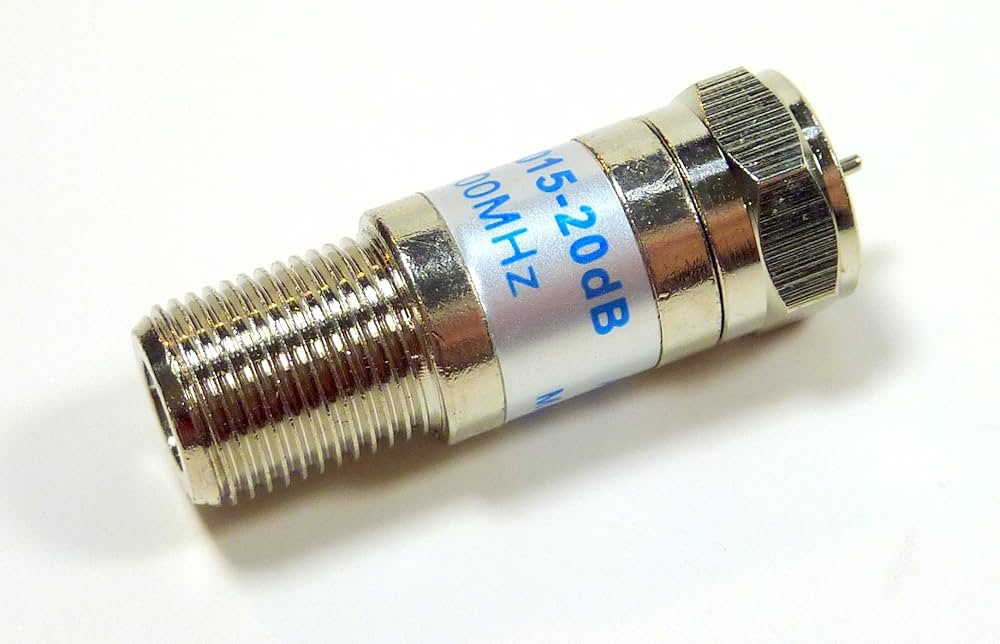
Choose the Correct Connector Type
Mismatched connectors can cause an immediate insertion loss increase of 0.2 dB to 0.5 dB at 6 GHz due to improper field alignment, and repeated forced connections can permanently damage a $3,000 spectrum analyzer’s input port in under 10 mating cycles. The connector interface is not just a mechanical coupler; it defines the waveguide for your signal. Using an N male connector on an SMA female port might seem to fit physically, but it will compromise the 50-ohm impedance continuity, causing VSWR to jump from 1.2:1 to over 2.0:1 and introducing measurement errors exceeding 15% at higher frequencies. The goal is a perfect mechanical and electrical match.
| Connector Type | Max. Freq. (GHz) | Typical Cost Premium | Common Applications | Mating Cycle Life |
|---|---|---|---|---|
| SMA | 18-24 | $0 (baseline) | Handheld radios, WiFi modules, test gear | 500 cycles |
| N-Type | 11-18 | +15% | Base stations, high-power systems, radar | 1000 cycles |
| BNC | 4 | -20% | Low-frequency lab gear, audio/video | 5000 cycles |
| 2.92mm | 40 | +300% | Microwave & millimeter-wave R&D | 100 cycles |
| 7/16 DIN | 7.5 | +200% | High-power macro cell towers | 500 cycles |
The primary decision is between 50-ohm and 75-ohm systems, which are mechanically incompatible. Most RF test equipment and communications gear like Wi-Fi (802.11) and 5G basebands use 50-ohm impedance. In contrast, 75-ohm is standard for video broadcasting (SDI), satellite (L-band), and cable TV systems. Forcing a 50-ohm plug into a 75-ohm jack damages the delicate female socket’s center pin retainer, often requiring a 800 repair for a vector network analyzer. Beyond impedance, the physical size and coupling mechanism are critical. SMA connectors are the industry standard for benchtop gear up to 18 GHz, offering a compact size and a 12.0 mm hex wrench tightening interface for 30 in-lbs of torque. For higher power above 500 watts, N-type connectors are preferred due to their larger 17.0 mm wrench size and robust thread-on coupling that handles 70 in-lbs of torque, ensuring stable connections under vibration.
Standard SMA connectors see performance degradation starting at 12.4 GHz, with increasing VSWR beyond 1.35:1. For applications between 18 GHz to 26.5 GHz, precision 3.5 mm connectors (which mate with SMA but have a thicker air gap) are necessary to maintain VSWR below 1.25:1. Beyond 40 GHz, 2.92mm (K-type) connectors are mandatory. Using adapters is a common but costly compromise; a high-quality SMA female to N male adapter adds ~0.15 dB of loss at 6 GHz and costs 120, while introducing a 15% chance of becoming the weakest link in your chain due to its extra interfaces. Always specify the exact connector gender and type on your purchase order—a “SMA male” has pins on the unit itself, while a “SMA female” has the socket. Mismating them can bend center pins, creating a 0.3 dB measurement error and requiring a $150 calibration repair.
Consider Attenuation Value and Accuracy
A common 10 dB attenuator with a poor ±1.0 dB tolerance can actually exhibit 9.0 dB to 11.0 dB of loss, introducing a ±10% error in your power measurements. This error compounds quickly; if you’re using it to measure a 40 W amplifier output, your reading could be anywhere from 36 W to 44 W—a massive 8 W spread that makes the data useless for characterization or compliance testing. In budget-sensitive projects, a $35 low-accuracy attenuator might seem attractive, but the measurement uncertainty it creates can lead to days of rework and costly design iterations, effectively negating any initial savings. Precision isn’t a luxury; it’s a necessity for reliable data.
The attenuation value (e.g., 3 dB, 10 dB, 20 dB) is chosen based on the specific need to reduce signal power without distorting it.
- Precision Margin Control: A 10 dB attenuator lets you safely measure a 40 dBm (10 W) transmitter output on a spectrum analyzer with a +30 dBm (1 W) maximum input, creating a 10 dB safety margin.
- Impedance Matching: A 3 dB or 6 dB pad can improve impedance matching between devices, potentially reducing a problematic 1.8:1 VSWR to a more acceptable 1.2:1.
- Signal Reduction: Lowering a +20 dBm (100 mW) signal to +10 dBm (10 mW) for a sensitive receiver input that has a -5 dBm damage threshold.
A general-purpose attenuator typically has an accuracy of ±0.5 dB to ±1.0 dB across its frequency range. For a 10 dB unit, this means a 5% to 10% potential error in power measurement. A mid-grade laboratory attenuator improves this to ±0.3 dB (3% error), while a metrology-grade standard can achieve ±0.1 dB (1% error) or better.
A spec of ±0.5 dB at 3 GHz might degrade to ±0.9 dB at 8 GHz. Furthermore, the attenuation value can drift by ±0.05 dB for every 10°C change away from the +25°C calibration temperature. For a 30 dB attenuator, a 20°C lab temperature swing could introduce an additional ±0.1 dB error. Always cross-reference the datasheet for the flatness spec (e.g., ±0.2 dB from 1 GHz to 6 GHz), which is often more important than the single-point accuracy at a base frequency. For most development work, a ±0.3 dB accuracy is the practical minimum, while production testing or calibration labs require ±0.1 dB or better to ensure products meet stringent ±5% power output tolerances.
Compare Brands and Quality
A 25 no-name attenuator from an online marketplace has a ±1.5 dB accuracy and a VSWR that can exceed 2.0:1 at its maximum frequency, while a 150 model from an established manufacturer guarantees ±0.3 dB and VSWR <1.25:1. This performance gap isn’t trivial; it translates directly to a 5-15% error in power measurement, which can force a design team to spend an extra 3-5 days debugging non-existent problems. Quality manifests in the longevity of the connector—a low-quality SMA interface may fail after 200 mating cycles, damaging expensive test equipment ports, while a high-quality one lasts 500+ cycles.
The market is segmented into distinct tiers, each serving different needs and budgets.
- High-Precision (Metrology) Tier: Brands like Keysight, Rohde & Schwarz, and Anritsu. These are used in calibration labs and for standards-grade measurements. A 6 GHz, 10 dB attenuator from this tier costs 900, offers ±0.1 dB accuracy, and comes with a NIST-traceable calibration certificate valid for 1-2 years. Their connectors are made of hardened beryllium copper with a minimum 500-cycle durability rating.
- Laboratory/Industrial Tier: Brands like Mini-Circuits, Pasternack, and Weinschel. This is the sweet spot for R&D and quality assurance. A comparable 6 GHz, 10 dB unit costs 250, with a typical accuracy of ±0.3 dB and VSWR <1.35:1. They often provide detailed performance graphs down to 0.1 dB increments.
- Budget/Generic Tier: Numerous unbranded or lesser-known OEMs. These are suitable for non-critical applications where absolute accuracy is secondary. The same 6 GHz, 10 dB spec costs 50, but the actual performance might be ±0.8 dB with a VSWR creeping past 1.8:1 above 4 GHz.
The most critical differentiator is the detail provided in the datasheet. A reputable brand provides a multi-page datasheet with a full performance table showing attenuation deviation vs. frequency, VSWR vs. frequency, and power derating curves vs. temperature. A generic brand often offers a one-page spec sheet with only maximum ratings. This transparency gap is a primary indicator of quality.
High-quality attenuators use thin-film resistor networks laser-trimmed to achieve tight tolerances, which are stable over ±50°C temperature swings. They employ machined brass or stainless-steel bodies with gold-plated beryllium copper connectors. Cheap units often use thick-film or carbon-composition resistors whose values drift with heat and time, and their connectors are made of cheaper brass that deforms after 50-100 matings, risking damage to a $15,000 vector network analyzer’s calibration port. For a team running tests 8 hours a day, the $300 investment in a reliable attenuator pays for itself by preventing just a single day of lost productivity debugging erratic measurements.
Review Real-World Use Cases
Using a low-cost, ±1.0 dB attenuator to characterize a 5G power amplifier can mask a +0.7 dB output power drift, causing a failed compliance test that requires a $5,000 re-spin of the prototype PCB and a 3-week project delay. Conversely, deploying a $800 metrology-grade unit for basic 433 MHz IoT device testing is a poor capital allocation, offering negligible accuracy improvement for a 10x cost increase.
Practical applications break down into a few common scenarios, each with unique requirements that dictate the optimal attenuator selection.
- Benchtop Prototype Validation: Testing a new 2.4 GHz WiFi FEM requiring +22 dBm output power measurement. A 10 dB, 2 W, SMA attenuator with ±0.5 dB accuracy is sufficient. This protects a 25,000 spectrum analyzer and provides measurements within ±5% accuracy. A 60 unit from a reputable supplier like Mini-Circuits is appropriate.
- Field Deployment & Durability: A 5W, 50-ohm attenuator for a 150 MHz military radio base station amplifier installed in an outdoor cabinet. This requires an N-type connector for weather sealing, a stainless steel body to withstand -40°C to +85°C temperatures, and a 5,000-hour MTBF rating. A $250 unit from Pasternack or similar meets these rugged demands.
- High-Volume Production Test: A 6 dB, 1 W attenuator used in a test fixture for checking 900 MHz LoRa module output power. This fixture executes 500,000 test cycles annually. The choice is a $35 attenuator with ±0.4 dB accuracy and a 1,000-cycle connector warranty. The focus is on consistent performance and low per-unit cost to maintain a <0.10 cost per test.
- Metrology & Calibration Lab: Verifying the accuracy of a signal generator at 18 GHz. This demands a $1,200 attenuator from Keysight with ±0.05 dB tolerance, a NIST-traceable certificate, and a calibrated VSWR <1.15:1 across the entire band. The cost is justified for maintaining primary standards.
| Use Case | Key Attenuator Parameters | Cost Driver | Recommended Specs |
|---|---|---|---|
| R&D Lab (Wi-Fi/5G) | 6-8 GHz Freq., ±0.3 dB, 2W, SMA | Accuracy, Frequency | Mini-Circuits, 180 |
| HAM Radio (1.8-30 MHz) | 30 MHz Freq., ±1.0 dB, 100W, N-Type | High Power Handling | Bird, 400 |
| Cable TV (75-ohm) | 1 GHz Freq., ±0.5 dB, 4W, F-Type | 75-ohm Impedance | Pasternack, 100 |
| ATE Production Test | 6 GHz Freq., ±0.4 dB, 1W, SMA | Cost-per-Test, Durability | Generic OEM, 50 |
| Millimeter-Wave R&D | 40 GHz Freq., ±0.1 dB, 0.5W, 2.92mm | Ultra-High Frequency/Accuracy | Rosenberger, 1,500 |
For a high-volume manufacturing line, selecting a 40 attenuator over a 120 model saves 80 per test station. Across a 20-station line, that’s a 1,600 upfront saving. However, if the cheaper unit’s ±0.8 dB accuracy causes a 2% false failure rate, it could lead to 200 incorrectly rejected units per 10,000 production run, each requiring 15 for retesting and diagnosis—a 3,000 loss per batch that quickly eclipses the initial savings.