+86 29 8881 0979

NEWS

What are the benefits of KU band

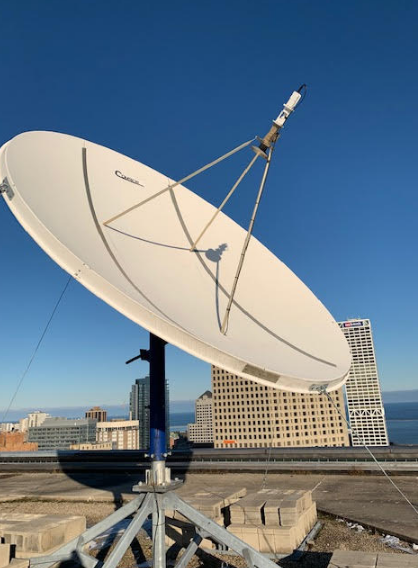
Ku-band (12–18 GHz) excels with compact user antennas (0.6–1.2m vs. C-band’s 1.8–2.4m), narrower beams boosting frequency reuse, and 54MHz transponders enabling 100+ HD channels or 10–20Mbps VSAT links, balancing high capacity with practical installation for TV/broadband. More Data in the Same Space​​ The primary advantage of the KU band lies in its higher frequency range, […]

What are the benefits of KU band Read More »
Why Use Array Antennas for Satellites

Array antennas boost satellite performance via phased element summation: multi-element arrays achieve 35–40dBi gain, enable microsecond electronic beam steering (vs. mechanical’s minutes), and support multi-beam coverage (e.g., 100+ spot beams on HTS satellites), enhancing capacity 10x+ for global high-speed links. ​​What is an Array Antenna​​ A typical satellite communication array might use 256 individual patch

Why Use Array Antennas for Satellites Read More »

Why Are Satellite Bands Important

Satellite bands matter: L-band (1–2 GHz) powers GPS, delivering meter-level accuracy; Ku-band (12–18 GHz) enables high-throughput satellite TV via wide bandwidth. Infrared (8–14 μm) on weather sats monitors cloud temperatures, refining forecasts. What Are Satellite Bands? The International Telecommunication Union (ITU) manages this global resource, categorizing bands from VHF (30-300 MHz) to Ka-band (26.5-40 GHz).

Why Are Satellite Bands Important Read More »

Which Satellite Frequency Bands Are Best

Best depend on needs: L-band (1–2 GHz) penetrates clouds for GPS (meter accuracy); Ku-band (12–18 GHz) suits TV, carrying 100+ HD channels via 500MHz bandwidth; Ka-band (26.5–40 GHz) powers Starlink, delivering 100+ Gbps with tight spot beams. Trade-offs: lower bands resist interference, higher boost speed. Common Satellite Frequency Bands Satellite communications operate across a spectrum

Which Satellite Frequency Bands Are Best Read More »

What’s the Role of S Band in Space

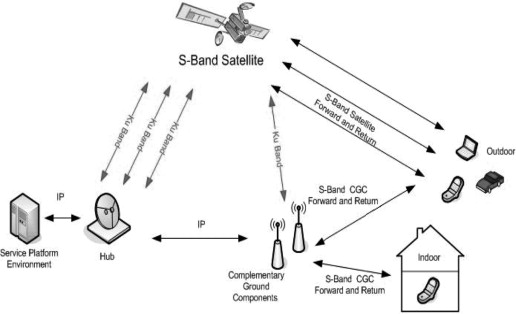
S-band (2–4 GHz) is vital in space: NASA’s Tracking and Data Relay Satellites use it for near-continuous Earth-spacecraft links, enabling 1–4 Mbps downlink for ISS telemetry. Its lower frequency penetrates rain/fog better than Ku/Ka bands, ensuring reliable command uplinks and science data (e.g., Mars rover health updates) even in harsh conditions. ​​Talking to Deep Space​​

What’s the Role of S Band in Space Read More »

5 factors affecting the bandwidth of circular waveguide

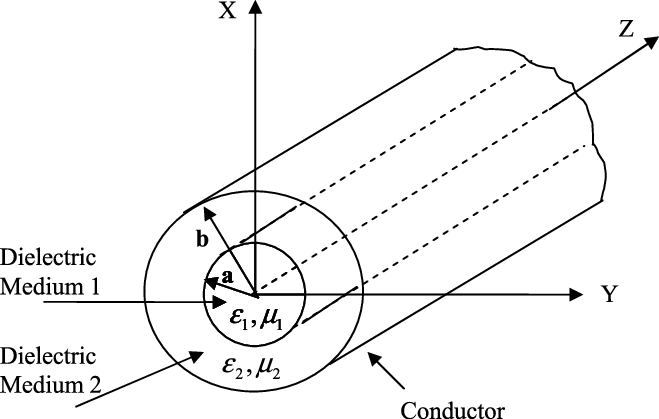
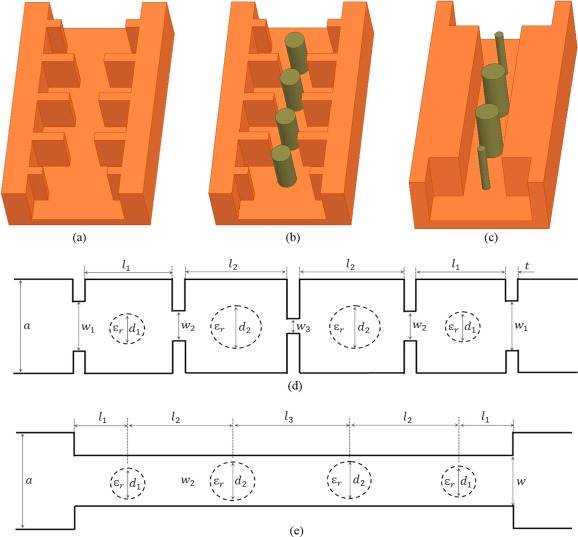
Waveguide bandwidth hinges on inner diameter (e.g., 3cm radius boosts TE₁₁ cutoff to 3.412cm, squeezing higher-mode onset), loss (TE₁₁ at 10GHz attenuates 0.015dB/m, narrowing usable range), and excitation purity—probes often stir multiple modes, unlike resonant couplers, trimming effective bandwidth by ~15%.​ Operating Frequency Cutoff In a ​​circular waveguide with a diameter of 2.54 cm (1

5 factors affecting the bandwidth of circular waveguide Read More »

5 characteristics of evanescent modes in waveguides

Evanescent modes feature steep attenuation (e.g., TE₀₁ in rectangular waveguides decays ~0.6dB/μm at 10GHz), trapping >85% energy within 10μm of walls as fields diminish exponentially from surfaces; excited via near-field probes, they never propagate, unlike guided modes. ​Rapid decay with distance​​ A standard silicon optical waveguide operating at a wavelength (λ) of 1550 nanometers, the

5 characteristics of evanescent modes in waveguides Read More »

RF Bands

The Ultimate Guide to RF Bands: Everything You Need to Know

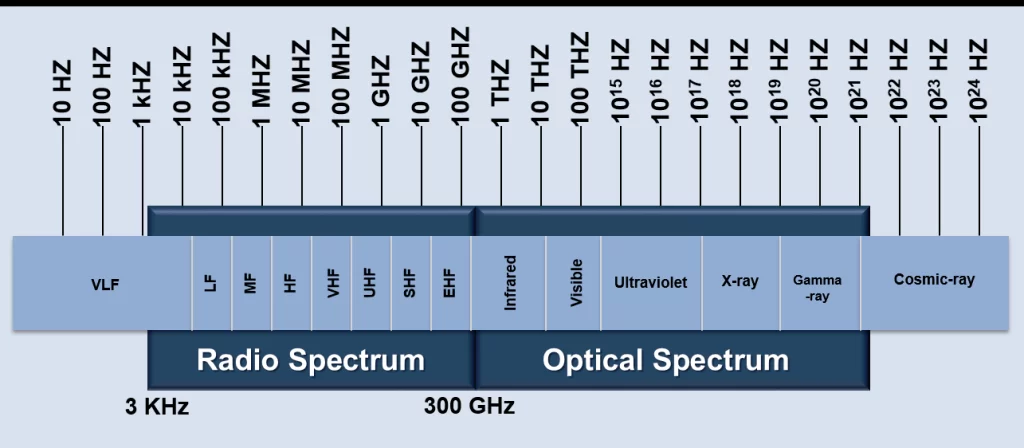
RF bands span LF (30-300kHz, e.g., NDB navigation) to 5G mmWave (24-100GHz, 20dB/km loss driving small-cell densification). HF (3-30MHz, 10-100m waves) supports global shortwave; GPS L1 (1575MHz) hits 5m accuracy—physics like path loss and antenna size define each band’s role. What Are RF Bands? The entire RF spectrum is officially defined as waves with ​​frequencies

The Ultimate Guide to RF Bands: Everything You Need to Know Read More »

5 Things radio waves and microwaves have in common

Radio waves and microwaves both propagate at 3×10⁸m/s, obey reflection/refraction (e.g., 99% reflect off copper), suffer atmospheric loss (oxygen absorbs 60GHz microwaves like HF radio in ionosphere), and enable comms—Wi-Fi (2.4GHz) or FM (100MHz)—via amplitude/frequency modulation. Same Family, Different Energy They are fundamentally the same type of energy—oscillating electric and magnetic fields—and they both travel

5 Things radio waves and microwaves have in common Read More »

Scroll to Top
Blank Form (#3)