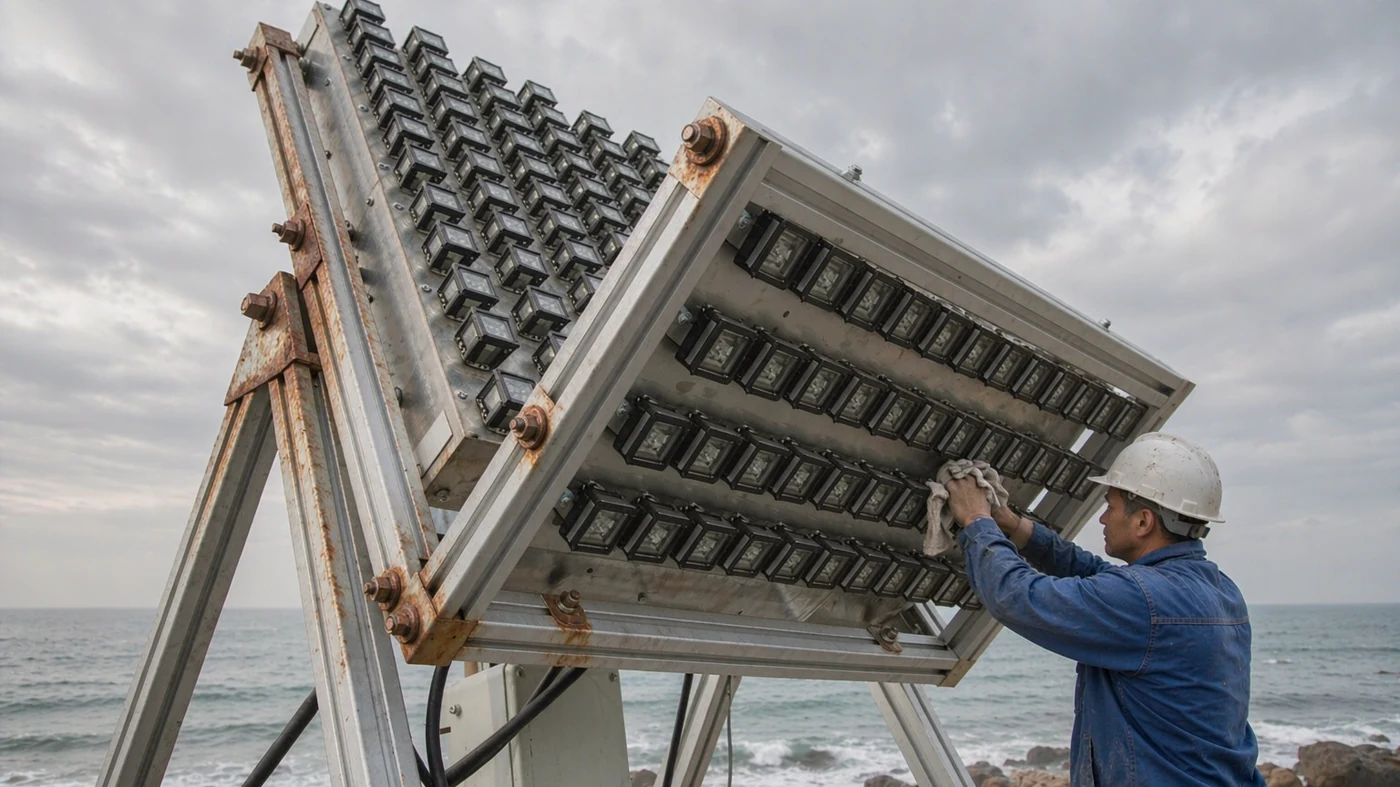
Fiberglass or another fiber-reinforced polymer reflector avoids iron rust in the panel itself. Coated aluminum is another option for coastal dishes, while hot-dip galvanized steel can protect mounts and supporting structures. Stainless-steel hardware also needs a suitable grade and compatible joints. There is no universal material ranking for a complete dish: compare the reflector, mount, coating, and fasteners separately, then match the assembly to the site’s salt exposure.
Table of Contents
What Coastal Corrosion Means for Material Choice
Airborne salinity, temperature-humidity conditions, and sulfur-dioxide pollution are key factors in the ISO 9223 framework for atmospheric corrosivity. A coastal location therefore needs an exposure assessment, not just a material label [1].
Salt-spray hours alone do not establish how many years a dish will last outdoors. ASTM B117 describes a controlled test environment and cautions that prediction of natural-environment performance has seldom correlated with salt-spray results used as stand-alone data [2].
Rust on carbon steel is only one failure mode. Pitting, crevice corrosion, and galvanic corrosion also matter when evaluating metal panels and joints. A dish that looks sound across its face may still need attention at its connections [3].
Coastal Dish Materials Compared
Use this comparison to identify what each material contributes, rather than treating it as a tested best-to-worst ranking. Product-specific construction and exposure determine the final choice.
| Material and component | Corrosion advantage | What to verify |
|---|---|---|
| Fiberglass or other fiber-reinforced polymer reflector | The polymer-and-fiber panel does not form iron rust | Surface durability, sealed edges and inserts, any metallic reflective layer, and the separate metal backing structure |
| Coated aluminum reflector | Aluminum has a protective oxide film; a suitable coating adds a barrier | Alloy, coating system, edge coverage, drainage, and isolation at dissimilar-metal joints |
| Hot-dip galvanized steel mount or structure | Zinc protects the underlying steel | Applicable material category, coating standard and grade, damaged-area repair, and whether an additional paint system is specified |
| Stainless-steel fasteners and small parts | Can offer better corrosion resistance than unprotected carbon-steel hardware | Exact grade, strength requirements, crevice exposure, and compatibility with aluminum and galvanized parts |
Fiberglass Reflectors Avoid Panel Rust, Not All Deterioration
A fiberglass reflector removes iron rust as a failure mode in the composite panel, but that does not establish the life of the complete antenna. Ask how the rim, mounting inserts, rear frame, and reflective surface are constructed. A composite face can still depend on steel brackets or a metal backing structure.
Check the manufacturer’s requirements for ultraviolet exposure, surface damage, and repair. If a chip exposes fibers or an edge seal is damaged, use the specified repair procedure. Do not assume that a non-rusting panel makes its mount or embedded hardware maintenance-free.
Coated Aluminum Needs Sound Edges and Compatible Joints
For aluminum panels, request the alloy and complete coating system, including pretreatment and coverage on rear faces, holes, and cut edges. A coating defect does not mean instant failure, but it is a location to assess for localized attack rather than ignore because the panel is aluminum.
Review brackets, rivets, and feed connections for dissimilar-metal contact. When checking the feedhorn assembly, distinguish the feed body from its support arm: their materials and protective finishes need not be the same. Ask the supplier how each interface is protected without obstructing drainage.
Galvanized Steel Needs a Component-Specific Coating Specification
Hot-dip galvanizing forms a bonded zinc-iron alloy coating when fabricated steel is immersed in molten zinc. The American Galvanizers Association describes this process as corrosion protection for the steel substrate [4].
For mounts and supporting structures, request the applicable galvanizing specification, coating grade, and repair procedure. ASTM A123/A123M covers hot-dip zinc coatings on a range of fabricated and unfabricated iron and steel products, including structural fabrications; its scope does not make one coating grade suitable for every component [5].
The AGA’s published summary illustrates why the material category matters. Its structural-shapes row includes minimum average coating grades of 45, 65, 75, and 100 µm across increasing steel-thickness bands. For a structural shape well above 6.4 mm, the listed grade is 100 µm; the pipe-and-tubing row instead lists 75 µm in that thickness range. These are category-specific minimum average requirements, not universal coastal-dish specifications [6].
A Worked Specification Check for a Tubular Pole
Suppose a quote describes a tubular pole with an 8 mm wall and says only “galvanized.” In the AGA summary, the pipe-and-tubing category at that thickness lists grade 75, while the structural-shapes category lists grade 100. The practical check is to ask which material category and specification edition the supplier is applying, then request its coating inspection record. The 8 mm dimension here is an illustrative input, not a measured product or a field test [6].
For scale, the same summary gives grade 45 as approximately 1.8 mils or 320 g/m² and grade 100 as approximately 3.9 mils or 705 g/m². It also states that time to first maintenance in atmospheric exposure is proportional to zinc thickness with other variables held constant. That relationship is not a service-life promise for two different coastal sites [6].
For severe exposure, ask whether the specified protection includes a compatible paint-over-galvanizing system. Confirm surface preparation, repair of handling damage, and suitability for any ground or concrete contact separately. Atmospheric coating examples alone do not establish suitability for buried or continuously wet parts.
Stainless Hardware Still Needs Grade and Joint Checks
“Stainless screws” is not a complete fastener specification. Request the grade, strength class where applicable, and materials of the matching nuts, washers, and brackets. Stainless steel can suffer localized corrosion in unfavorable conditions; its presence also does not protect an adjacent, less corrosion-resistant metal from galvanic attack [3].
Where the design calls for isolation, ask for the approved washers, sleeves, or other separating detail. Do not replace structural bolts solely to change their material: the replacement must also meet the assembly’s mechanical requirements. Grounding and bonding connections require their own approved details, not indiscriminate electrical isolation.
If galvanized hardware is specified instead, confirm its hardware standard. ASTM A153/A153M addresses hot-dip zinc coatings on iron and steel hardware, with coating weight or thickness requirements by material class. The linked edition is historical, so the purchase specification should identify the applicable edition rather than treating this reference as the latest requirement [7].
How to Compare Two Coastal Antenna Quotes
Consider a buying scenario: one quote names a composite reflector but leaves the mount coating unspecified; another names an aluminum reflector and documents its coating, mount protection, and hardware materials. The first quote cannot be judged more corrosion-resistant just because the reflector does not rust. Request the missing assembly details before comparing them.
The same review applies to compact flyaway terminals and large fixed antennas, although their structural requirements differ. When comparing SATCOM antenna configurations, keep corrosion protection separate from aperture, wind loading, foundation, and grounding requirements. Meeting one requirement does not demonstrate compliance with the others.
Before purchase, request these details for the exact model:
- Reflector material, surface finish, and any metallic layers or backing
- Mount and pole material categories, coating standards, editions, and grades
- Fastener grades and the approved details for dissimilar-metal joints
- Permitted coating repairs and cleaning methods
- Inspection intervals and any exclusions for direct marine exposure
If the supplier cannot document the complete assembly, treat its suitability for direct marine exposure as unverified, not as established by the reflector material.
Protect the Material Choice After Installation
Keep Water from Collecting at Joints
Check for upward-facing pockets around clamps and brackets. Preserve designed weep paths and clearance at the pole base. Do not seal a drainage opening while trying to weatherproof an adjacent joint.
Inspect Accessible Damage and Hardware
Follow the manufacturer’s inspection interval and cleaning instructions. Where safe access permits, check panel edges, bolt holes, clamps, and the pole base for coating damage, deposits, or visible corrosion. Record the location and condition so the next inspection can identify a change rather than rely on memory.
Use approved repair products, and have fixings and alignment assessed after storms as instructed by the installer. Do not drill extra holes or substitute hardware without approval. Use qualified personnel for climbing, roofing, structural, or grounding work.
For a coastal dish, choose the assembly with documented protection: a suitable composite or coated aluminum reflector, a correctly specified protected mount, and compatible hardware. Non-rusting panels reduce one problem; component-specific coatings, joint design, and maintenance address the rest.
Planning a coastal installation? Include the reflector size, mount material, site exposure, and available coating specifications in your inquiry.
Discuss Coastal Antenna Requirements