For shipping, yes. For an installed station that has to stay inside a standard container outline, don’t count on it. A panelized 4.5 m satellite dish can ship in standard freight containers if its crates fit and stay within the carrier’s load limits. Once assembled, the dish and mount need clearance to move. A container can still serve as the equipment shelter, but the antenna needs an engineered foundation and operating space.
Table of Contents
How the Dish Fits for Shipping
ISO 668:2020 classifies Series 1 freight containers by external dimensions and specifies ratings and certain minimum internal and door-opening dimensions[1]. The outside width of a standard container is about 2.44 m. Picking a 40 ft box instead of a 20 ft box gives you more length, not more width. A one-piece circular reflector of this size is not a candidate for end loading into a standard dry container.
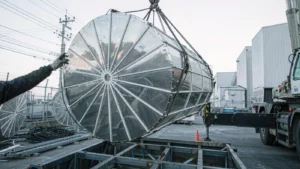
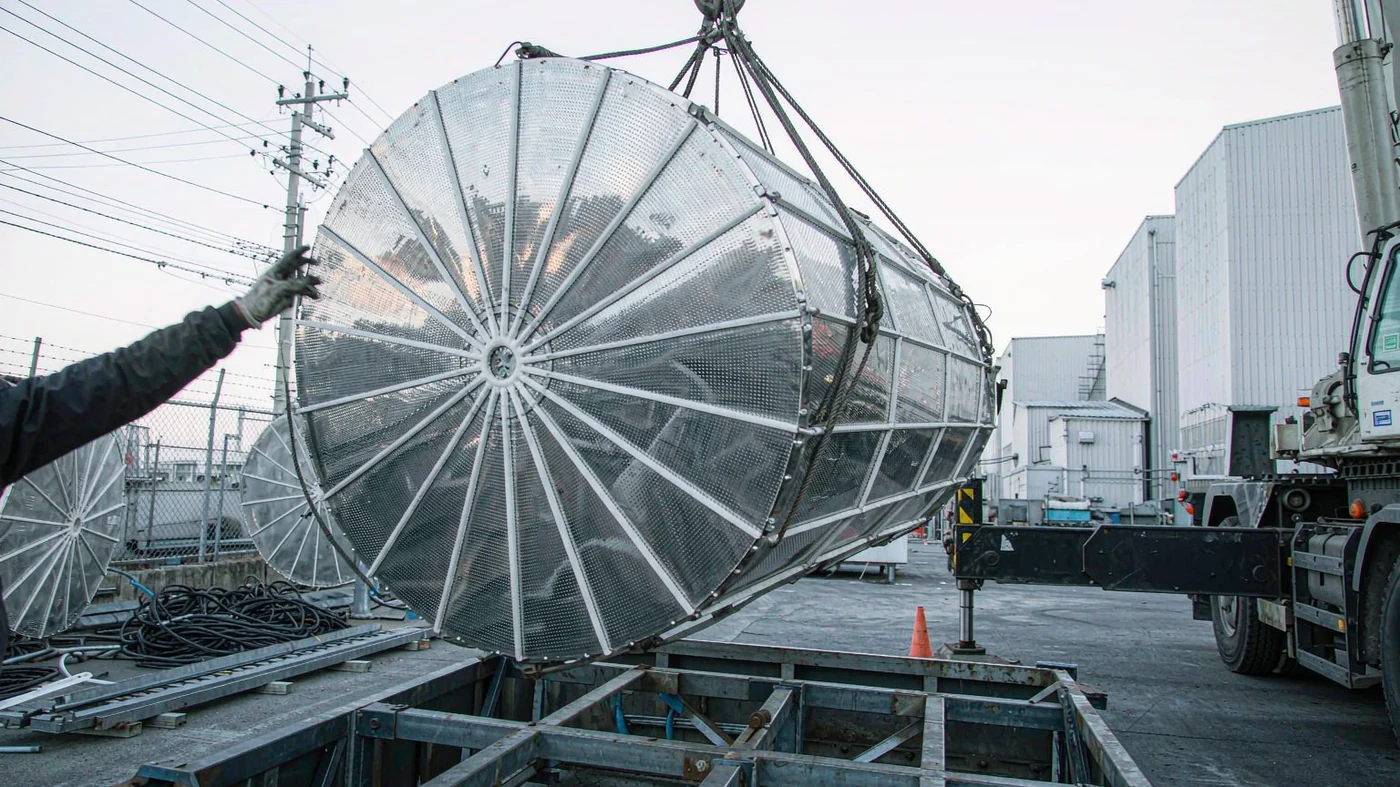
Dolph Microwave’s prime-focus antenna specifications describe a reflector built from contoured aluminum panels. The panels can be packed separately and assembled on site. The product page describes the reflector construction; it does not establish how many containers a particular order needs.
Ask for a crating drawing with the largest crate’s loaded dimensions, gross weight, and loading orientation. Check it against the carrier’s clear door width and height, the usable interior, and the room needed for handling. The CSC plate records the container’s safety approval[2]. Use the carrier’s dimensions or measure the actual door opening to check crate fit.
Crate-fit example: Suppose the carrier confirms a 2.34 m clear door width and the widest crate is 2.30 m across in its loading orientation. The difference is only 40 mm in total, or 20 mm per side if centered. That is not an approved handling clearance. Ask the packer and carrier to confirm how they will guide the crate through the opening, allowing for any protrusions. If the crate needs more width, ask for a narrower pack or different equipment; a longer container with the same door width will not help. If every crate clears the door but the set cannot be stowed together within weight and securing limits, ask for a different loading plan or a second container. The largest crate check cannot tell you the container count.
What Ships With the Antenna
Have the quote separate what ships with the antenna from what the site crew must supply:
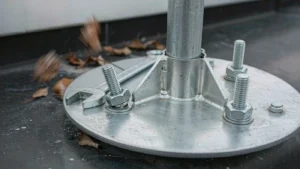
- Reflector panels, hub, backup structure, fasteners, and assembly instructions.
- Mount and drive assemblies, position limits, and the antenna controller where specified.
- Feed assembly for the ordered band, feed support, and a subreflector if the design uses one. Check the reflector feedhorn options against the specified feed and interfaces.
- Anchor templates, cable and waveguide kits, tooling, and test records, as agreed in the quote.
Price the shelter separately from the freight container. If the container is to stay on site, ask who supplies its equipment racks, power distribution, cooling, grounding connections, and cable entries. If the box is only for transport, decide where the electronics go before ordering cables. An antenna-only quote and a quote that includes a fitted shelter are not directly comparable.
How Much Space the Installed Dish Needs
The pedestal drawing shows where the anchors go. The movement-envelope drawing shows what the dish rim, feed supports, and rear structure can hit as the mount turns and tilts. Use that second drawing to place the shelter, fence, and cable entries. Check the operating and stow positions, overhead obstructions, and maintenance access.
Worked layout example: Suppose the supplier’s drawing shows a 7 m circular plan-view envelope for a specific mount. That circle covers about 38.5 m² (π × 3.5²), compared with about 14.8 m² for the outside rectangle of a 20 ft container (6.06 × 2.44 m). A 7 m circle will not fit inside the container outline even before you add working room. The 7 m figure is an assumption for this example, not a minimum clearance or an estimate of the whole site.
On the same plan, mark the crane setup and crate staging area separately: temporary installation space can extend beyond the permanent station boundary. If the electronics can go in an existing building, you can remove the shelter from the plan, but that does not shrink the dish’s movement envelope.
How to check a narrow site: Draw the mount envelope on a scaled plan at the proposed centerline, then mark the shelter door swing and the path a technician needs to remove equipment. In the 7 m circular example, a clear strip only 6 m wide fails regardless of its length. If a smaller aperture is not an option, ask whether the supplier can document an envelope for the required pointing range and stow position. Do not assume that a fixed operating direction also restricts the movements needed for setup or service. Check the elevation drawing as well: a shelter can sit outside the movement envelope and still block the line of sight at a low pointing angle.
What the Foundation Must Support
A 4.5 m circular aperture has a face-on area of about 15.9 m². For scale, at an assumed wind speed of 50 m/s and air density of 1.225 kg/m³, the simple velocity pressure ½ρV² is about 1.53 kPa. Multiplying that pressure by the face-on area gives about 24 kN before aerodynamic coefficients or mount orientation are considered. This is not a design load or an operating wind rating.
Have the mount supplier provide anchor geometry and base reactions for the specified operating and stow cases. A qualified local engineer can use those reactions, the soil conditions, and the applicable codes to size the foundation. Do not infer the anchor forces or overturning moment from dish area alone.
If you plan to reuse a slab, send the engineer its drawings or survey information along with the supplier’s loads. A bolt pattern that fits on the slab does not establish that the slab can take uplift or overturning. Keep foundation reuse out of the cost estimate until the engineer confirms it; otherwise a cheaper-looking site can end up needing new civil work.
When the Larger Dish Is Worth the Space
Compare gain at the same frequency before trading floor space for a bigger dish. At equal aperture efficiency, a 4.5 m reflector gives about 11.5 dB more on-axis gain than a 1.2 m reflector, because gain scales with diameter squared. A compact flyaway antenna is worth comparing if the smaller aperture meets your link budget and space or mobility matters more.
The examples below use G = η(πD/λ)², with diameter D = 4.5 m and assumed aperture efficiency η = 50%. They are calculated values, not measured performance, product specifications, or frequency authorizations.
| Frequency | Wavelength | Gain |
|---|---|---|
| 4.0 GHz | 7.49 cm | 42.5 dBi |
| 9.4 GHz | 3.19 cm | 49.9 dBi |
| 12.0 GHz | 2.50 cm | 52.0 dBi |
| 30.0 GHz | 1.00 cm | 60.0 dBi |
Ask for guaranteed gain at your actual frequencies and for the surface accuracy and verification method after site assembly, especially at shorter wavelengths. Use those figures in a link budget that allows for pointing losses and weather before considering a larger earth-station antenna.
How to use the gain comparison: If a smaller dish falls 6 dB short of the required link margin, the illustrative 11.5 dB aperture difference is a reason to price the larger dish, not a promise that it will pass. Put the supplier’s guaranteed gain into the same link budget and verify the remaining margin at the required availability. If the smaller dish already meets that requirement, compare the two on installed clearance and cost rather than gain alone.
Delivery and Site Acceptance
Have the carrier check road widths, turn space, and bridge limits. Give the lift planner the crate and component weights, lifting points, and proposed setup locations. Compare the unload sequence with the manufacturer’s assembly instructions: if the mount crate is behind the reflector crates but is needed first, put space for those reflector crates on the staging plan.
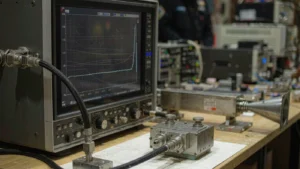
Agree with the supplier on who checks the reflector surface, drive limits, and RF performance after assembly, and what results must be documented. ITU-R S.580-6 provides radiation-pattern design objectives for earth-station antennas operating with geostationary satellites; it is not a universal site acceptance procedure[3].
For a panelized reflector, ask which checks must happen after reassembly and which can be done before shipment. For example, if the contract calls for a site pointing check, name the person who runs it, the reference signal, the pass criterion, and who pays for a repeat visit if the dish misses it. A factory report alone does not answer whether that site check has passed.
Licensing and Frequency Coordination
Check siting and radio requirements with the relevant national authority. For a transmitting station, confirm the authorization and any operator requirements before commissioning. The ITU’s Space Services Department describes international procedures for frequency coordination and notification where applicable[4].
What to Request Before You Order
- Before booking freight: Get a crate list and loading plan showing what fits, how many containers are needed, and what ships separately.
- Before committing to the site: Match the exact mount’s movement envelope and foundation interface drawing to the surveyed plot. Have the carrier and lift planner confirm access and staging.
- Before signing the order: Compare quotes on the same scope. Assign responsibility for freight, unloading, civil work, shelter fit-out, and testing. Attach the site acceptance criteria so the required RF performance and the way it will be verified are part of the order.
If your limit is a single container’s rectangle on the ground, ask about a smaller aperture or another site. If your limit is standard container transport, start with the loading plan and verify the installed layout separately.
Send your operating band, site dimensions, and delivery limits when requesting a crating and layout proposal.
Request a 4.5 m Station Quote