Operating wind speed is the rated wind limit at which an antenna meets its specified communication performance. Survival wind speed is the rated wind limit at which it meets specified structural requirements, often while parked and locked. It does not guarantee continued communication. An antenna rated for 72 km/h operation and 200 km/h survival is not rated to maintain its normal pointing accuracy or signal quality at 200 km/h.
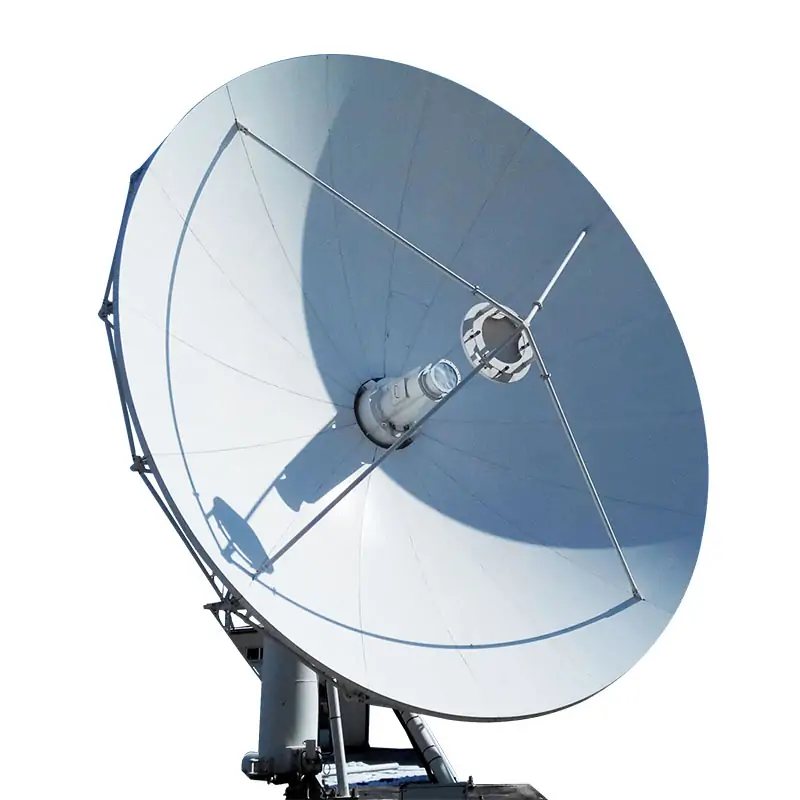
Reading the Wind Specifications
Dolph Microwave’s published earth station antenna specifications list operating wind, operating gusts, and survival wind separately:
| Parameter | Published Value | Details to Confirm |
|---|---|---|
| Operating wind | 45 mph, approximately 72 km/h | Allowable pointing error or gain loss, wind averaging period, and antenna configuration |
| Operating gusts | 60 mph, approximately 97 km/h | Gust duration and applicable performance limits |
| Survival wind | 125 mph, approximately 200 km/h | Wind definition, antenna position, locking requirements, and structural acceptance criteria |
These are product-family values, not independently verified test results for every configuration. The specification supplied with a quotation should confirm the exact model, mount, performance criteria, and basis of the rating—calculation, testing, or both.
Operating ratings need an allowed performance loss. If a supplier gives one wind speed at 0.5 dB loss and a higher speed at 1 dB loss, a link that permits only 0.5 dB must use the lower-speed rating.
With other conditions unchanged, losses of 0.5 dB and 1 dB leave approximately 89% and 79% of the original power. These are power ratios, not data-rate reductions. A link with only 1 dB of margin above its current modulation and coding threshold would use up that margin with another 1 dB of loss.
Why Performance Drops Before Structural Failure
Wind can temporarily bend the reflector support or pole enough to move the beam off target without causing permanent damage. For a dish with a symmetrical 0.7° half-power beamwidth, a pointing error of about 0.35° reaches the half-power point: approximately 3 dB below peak gain. With the rest of the link unchanged, received power falls to about half.
For scale, the approximate formula “beamwidth in degrees ≈ 70 × wavelength ÷ dish diameter” gives about 1.5° for a 1.2-meter dish and 0.7° for a 2.4-meter dish at 12 GHz. The coefficient depends on the antenna design; these estimates are not allowable pointing errors.
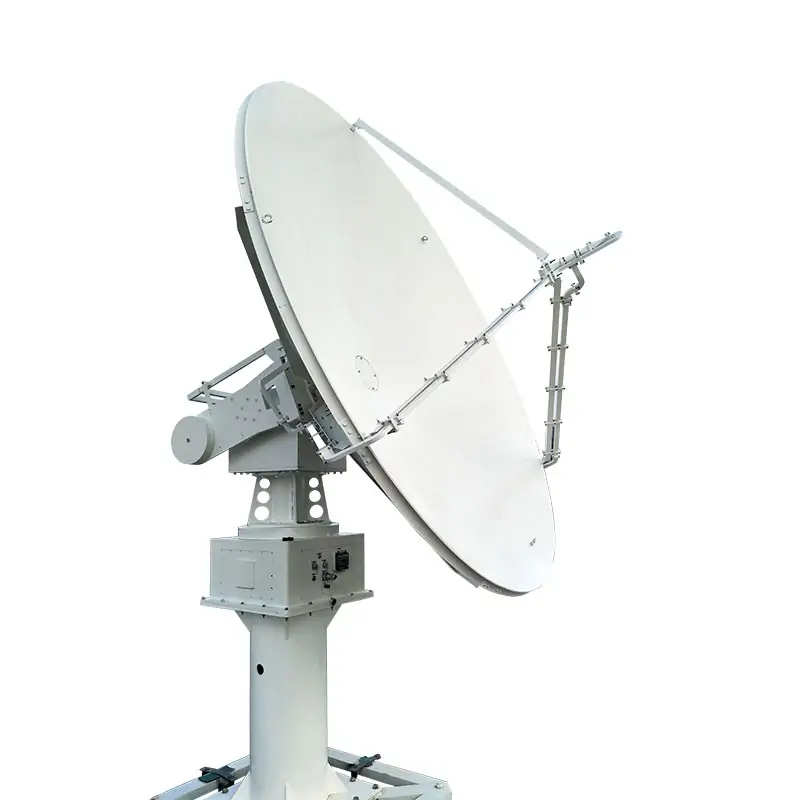
For LEO/MEO tracking antennas, ask for tracking accuracy under the specified wind load. Encoder resolution alone does not account for reflector movement or support deflection.
Even within the operating wind rating, heavy rain or a power interruption can break the link. The antenna rating covers its stated performance, not end-to-end service availability.
Survival Ratings and Antenna Position
| Datasheet Term | Required Condition |
|---|---|
| Any-position Survival | The rating applies within the manufacturer’s specified range of antenna positions. |
| Survival at Stow / Stowed Survival | The antenna must reach its specified protective position, with any required locks engaged. |
If a 200 km/h rating applies only when stowed, it cannot be assumed to apply while deployed. Stowing may mean moving to a set elevation, pointing at the zenith, or folding into a transport position. Follow the procedure for the exact model.
A survival rating is not an exact breaking point or a promise that no maintenance will be needed afterward. Its acceptance criteria should state whether permanent deformation is permitted and whether inspection, realignment, or calibration is required.
Wind Speed and Structural Load
Dynamic pressure follows q = ½ρV². At a fixed air density, a 20% increase in wind speed raises dynamic pressure by 44%; doubling wind speed raises it fourfold.[1]
| Wind Speed | Approximate Dynamic Pressure | Relative to 20 m/s |
|---|---|---|
| 20 m/s = 72 km/h | 245 Pa | 1× |
| 30 m/s = 108 km/h | 551 Pa | 2.25× |
| 40 m/s = 144 km/h | 980 Pa | 4× |
| 50 m/s = 180 km/h | 1,531 Pa | 6.25× |
Dish size changes the load too. A 1.2-meter circular aperture has four times the area of a 0.6-meter aperture: approximately 1.13 m² versus 0.28 m². If the projected area facing the wind increases fourfold while pressure and force coefficient remain unchanged, wind force also increases fourfold.
These calculations cannot size a mount or foundation. That requires the manufacturer’s base forces and overturning moment, applicable design factors, and checks of the pole, connections, anchors, and supporting structure. A larger dish needs a capacity check even if it fits the existing bolt pattern.
Comparing Supplier Ratings
The World Meteorological Organization defines a gust as the maximum three-second running-average wind speed over the observing cycle.[2] A 40 m/s three-second gust is not equivalent to a 40 m/s ten-minute average. The datasheet must identify which definition applies.
- Performance conditions: Compare the same frequency, allowed loss, assessment method, antenna position, and mount configuration.
- Site conditions: A reference wind speed at 10 meters above ground needs the applicable height and terrain adjustments before use for a 30-meter rooftop installation.
- Combined loads: Separate maximum wind and ice ratings do not establish a rating for both maximums occurring together.
- Supporting evidence: Request the applicable design standard, calculation or test documentation, and installation limits for the offered configuration.

Portable Antenna Anchoring
For a quick-deploy flyaway antenna, confirm any ballast, ground anchors, or restraints required for the stated wind rating.
Setup time does not establish how quickly the antenna can be safely dismantled in rising winds. The operating procedure should specify when to stop using it and how to secure it.
When to Stop Operation or Stow
Exceeding the operating rating does not mean immediate structural failure. It means the stated performance is no longer assured. Follow the manufacturer’s shutdown or stow threshold rather than treating the gap between operating and survival speeds as an unrestricted operating range.
Motorized antennas may have a separate drive-to-stow wind limit: the wind conditions under which the drive can still move the antenna into its protective position. The locked structure may withstand higher winds than the drive can work against.
The automatic stow trigger must leave enough time to complete the move before conditions exceed the drive-to-stow limit. Do not set it at the survival wind speed.
If stowing takes 60 seconds, wind can continue rising during that minute. The procedure must account for movement time, detection and control delays, and power availability. The 60-second figure is illustrative; use the model’s actual timing and limits.
Checks After Strong Winds
A leaning pole, shifted brackets, reflector distortion, loose anchors, or unusual drive noise requires inspection before returning the equipment to service. Receiving a signal does not confirm that the structure is undamaged. Follow any inspection requirements in the manual, including after a recorded wind-limit exceedance.
Wait for safe weather before inspecting or tightening hardware. Do not climb onto a roof to adjust an antenna during strong winds.
Product figures are taken from the linked manufacturer specifications. Power ratios, aperture areas, and dynamic pressures are calculated examples; beamwidths are approximate. Final selection and installation require current model-specific documentation and the applicable local design requirements.