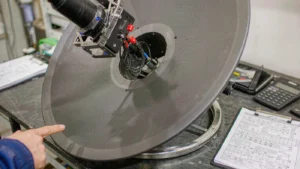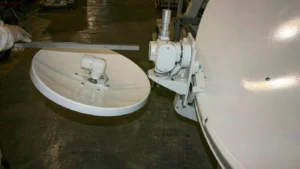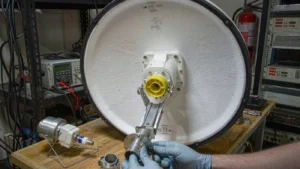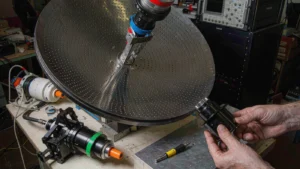
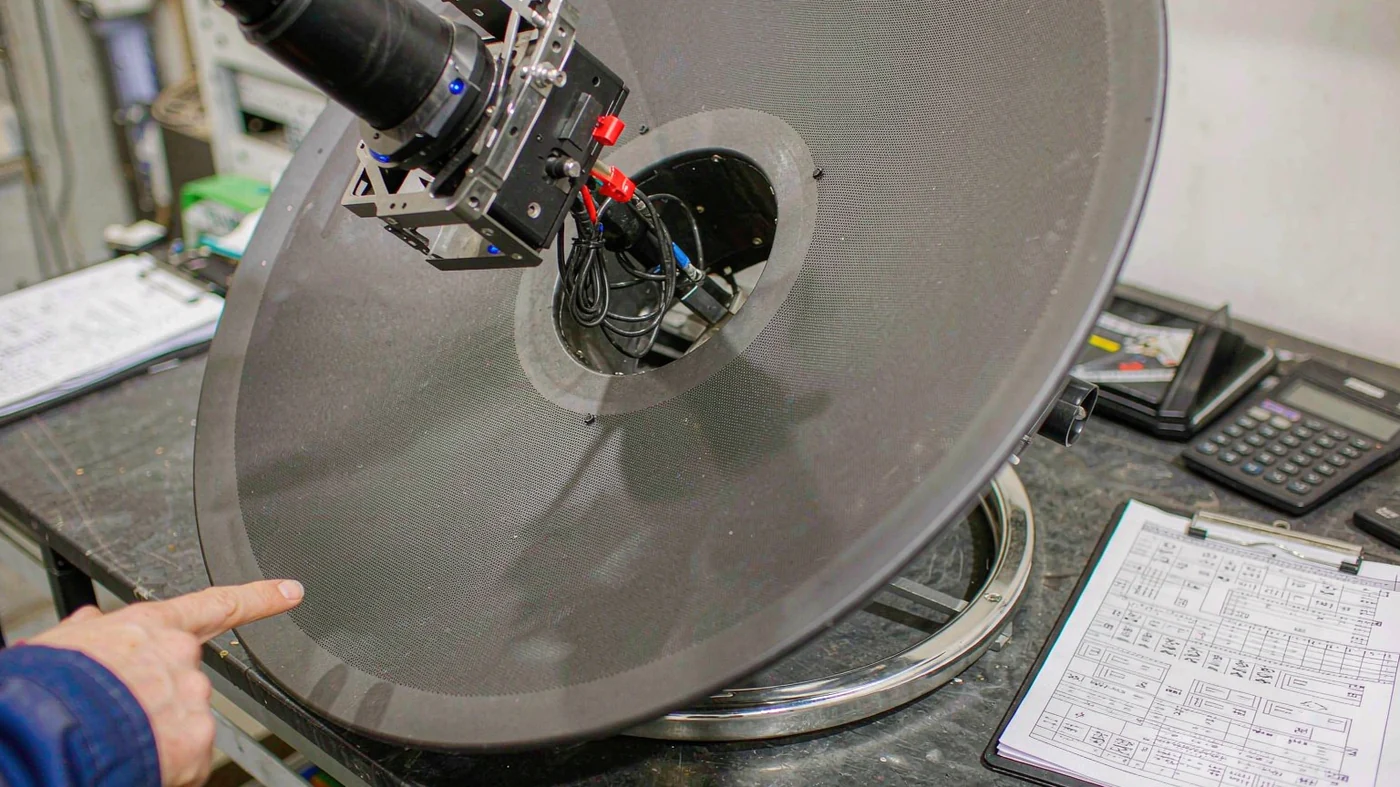
The cost of a VSAT antenna depends on dish size and gain, frequency band, feed and electronics, pointing system, environmental ratings, approval requirements, and installation scope. Larger reflectors add structure and transport costs; tighter tolerances and motion tracking add manufacturing and control costs. Before comparing prices, establish whether each quote covers only the antenna or a complete installed terminal.
Table of Contents
Aperture and gain
Double a dish’s diameter at the same aperture efficiency and frequency, and gain increases by about 6 dB. That is roughly four times the gain in linear terms, not four times the amplifier’s output power.
Take the 14 GHz pair in the table: 42.7 dBi from a 1.2 m dish, 48.7 dBi from a 2.4 m dish. Those extra 6 dB let a station run a smaller amplifier or keep extra rain margin. The trade shows up in steel and logistics — extra reflector panels, heavier backup structure, stronger foundation, higher wind load, plus freight and crane charges.
The table is a worked calculation, not measured product data or a price estimate. It assumes aperture efficiency η = 0.6 and light speed c = 299,792,458 m/s. Wavelength λ = c/f; linear gain G = η(πD/λ)2; gain in dBi = 10 log10(G), where D is dish diameter. Reflector analysis relates gain to aperture, wavelength, and efficiency [1].
| Dish diameter | Frequency example | Wavelength | Illustrative gain with efficiency 0.6 |
|---|---|---|---|
| 0.9 m | 14 GHz uplink | about 21.4 mm | about 40.2 dBi |
| 1.2 m | 14 GHz uplink | about 21.4 mm | about 42.7 dBi |
| 2.4 m | 14 GHz uplink | about 21.4 mm | about 48.7 dBi |
| 1.2 m | 30 GHz uplink | about 10.0 mm | about 49.3 dBi |
The 1.2 m dish at 30 GHz has slightly more calculated gain than the 2.4 m dish at 14 GHz. That does not make them interchangeable links: changing frequency also changes propagation loss, equipment, and satellite compatibility. A smaller reflector alone does not establish a lower installed cost.
A worked sizing decision
Consider a hypothetical comparison of the 1.2 m and 2.4 m dishes at 14 GHz. Keeping aperture efficiency, feed loss, and transmitter output unchanged, the smaller dish loses about 6 dB of transmit gain. Matching the larger dish’s equivalent isotropically radiated power (EIRP) would require roughly four times the RF output power. That is an arithmetic comparison, not a recommendation: amplifier capacity, permitted emissions, and receive performance must also be checked. A larger amplifier cannot restore the smaller dish’s receive gain, and consuming existing rain margin reduces availability rather than replacing that gain.
Frequency band
C-band, Ku-band, and Ka-band designs face different size and precision requirements. ITU-R V.431 provides frequency and wavelength nomenclature; the terminal’s exact operating frequencies must still be specified [2].
For the same gain and aperture efficiency, longer wavelengths require a larger dish. Shorter wavelengths require tighter surface accuracy for comparable reflector efficiency. Ku-band lies between C-band and Ka-band in frequency, but that does not establish a universal price ranking. Rain attenuation also depends on location, elevation angle, polarization, and the availability target; link planners use Earth-space prediction methods such as ITU-R P.618 [3].
Standards illustrate why exact scope matters. ETSI EN 301 360 V2.1.1 covers specified GSO interactive and user terminals transmitting at 27.5 to 29.5 GHz, with antenna diameter no greater than 1.8 m or equivalent effective area [4]. ETSI EN 303 978 V2.2.1 covers specified GSO earth stations on mobile platforms, including 27.5 to 30.0 GHz transmission and 17.3 to 20.2 GHz reception [5]. These are defined equipment scopes, not universal band allocations or proof of a particular product’s approval.
Feed and electronics
Receive-only setups stay simple — feed plus low-noise downconversion. Once the terminal transmits, the chain grows: filtering, waveguide runs, and a block upconverter or higher-power amplifier join in — all of which land on the feed, waveguide, and electronics lines of a quote.
The reflector and feed together affect sidelobes and cross-polarization. Feedhorns, orthogonal-mode transducers, diplexers, and the rest of the feed network also introduce loss. Dolph Microwave’s published 48-model miter-bend table lists VSWR of 1.1:1 to 1.15:1 and insertion loss of 0.15 to 0.25 dB across its rows. Those are component catalog specifications, not measured losses for a complete installed VSAT feed chain; the relevant row and operating band must match the proposed part.
With 1 dB of transmit feed loss, about one-fifth of the RF power entering that chain does not reach its output: the retained fraction is 10−0.1, or about 0.794. Receive-path loss ahead of the low-noise amplifier also degrades sensitivity. Ask for the total feed-path loss at the operating frequencies, rather than treating a single bend’s specification as the entire system budget.
Mount and tracking
For comparable aperture and environmental ratings, manual pointing avoids the motors, sensors, and controls required by automated systems. Auto-acquisition, beacon tracking, and continuous stabilization add different capabilities and testing needs. Stabilized shipboard and airborne terminals must maintain pointing while their platforms move.
A 1.2 m quick-deploy flyaway antenna addresses transport and deployment differently from a fixed earth-station antenna. Dolph Microwave’s SATCOM antenna catalog spans roughly 0.9 m quick-deploy units to 11.3 m earth-station antennas. That range illustrates different equipment classes, not a price ladder: a large fixed station can cost more than a small automated terminal.
Materials and environment
Outdoor exposure sets the maintenance bill. Reflector material, mount steelwork, fasteners, seals, cables, and surface treatment decide how many years gain and pointing survive wind, salt, dust, ice, and sun.
Price differences here trace to:
- rated wind speed for operation and survival;
- corrosion protection for coastal or offshore sites;
- temperature range and ingress protection;
- lightning and grounding provisions;
- optional heating or de-icing.
Stronger mounts, suitable fasteners, corrosion protection, and tested seals can raise purchase cost while reducing exposure-related maintenance. Specify the actual operating and survival conditions rather than relying on a broad label such as marine-grade.
Interchangeable panels, measured reflector surfaces, aligned feeds, and factory RF testing leave fewer unknowns at install time.
Approvals and sidelobes
Where satellites sit close together, weak sidelobe control causes or picks up interference. Coordination and interference assessment for fixed-satellite earth-station antennas use the reference patterns in ITU-R S.465, which covers 2 to 31 GHz [6].
Equipment conformity, satellite-operator acceptance, and national station authorization are separate requirements. In the United States, the FCC explains earth-station licensing [7], with detailed requirements in 47 CFR Part 25 [8]. Section 25.209 includes antenna performance envelopes for relevant FSS earth stations; applicability depends on the operating band and configuration [9]. System-level frequency-sharing analyses can use the characteristics in ITU-R S.1328 [10].
Budget for the pattern measurements, documentation, and any design changes the deployment requires. Existing test evidence may reduce repeat work, but antenna compliance alone does not guarantee an operating license. Confirm the applicable national rules and operator requirements before ordering.
Installation and service
How much installers charge for site preparation, foundation, crane use, assembly labor, pointing and cross-polarization alignment, cable installation, lightning protection, licensing support, and network commissioning depends on the site.
Reaching and aligning a remote, rooftop, island, desert, mountain, maritime, or disaster-response location usually costs more. After handover, owners keep paying for:
- preventive inspection, repainting or fastener replacement;
- de-icer power use;
- spare feeds and electronics;
- software updates for controllers;
- responses to wind or corrosion damage.
A fair comparison needs the same boundary on both sides: equipment only, equipment plus installation, or equipment plus installation and multi-year support.
Comparing quotes
A workable request names location, satellite and band, required data rate and availability, dish size or gain range, transmit power, receive figure of merit, mount type, wind and environmental ratings, pattern or approval standards, plus what installation and warranty work the price covers.
| Quote line | What to check | Why it changes cost |
|---|---|---|
| Reflector and mount | Diameter, optics, wind ratings, foundation scope | Steel, freight, civil works, survival margin |
| Feed and waveguide | Feed type, OMT or diplexer loss, waveguide length | Efficiency, interference behavior, test effort |
| Electronics | BUC power, LNB noise, redundancy | Power, noise, backup protection |
| Pointing | Manual, motorized, auto-acquire, stabilized | Motors, sensors, software, sea or air qualification |
| Compliance | Pattern standard, operator or national approval | Testing, documentation, redesign risk |
| Deployment | Installation, alignment, commissioning, training | Labor, travel, crane, test instruments |
| After-sales | Warranty, spares, maintenance response | Downtime risk and operating cost |
When one quote sits far below the rest, check these gaps first:
- smaller effective aperture;
- lower transmit power;
- manual pointing instead of auto-acquisition;
- no de-icing;
- weaker wind rating;
- no pattern test data;
- installation excluded.
A higher quote should buy something concrete: more rain margin, lower sidelobes, faster deployment, longer service life, or broader approval coverage.
A practical quote check
For a hypothetical remote-site deployment, one offer might include only the reflector and mount, while another includes the feed, electronics, foundation work, and commissioning. The lower total cannot identify the better purchase until both suppliers price the same scope. Ask each supplier to mark every table row as included, optional, or excluded, and identify who pays for travel, lifting equipment, and alignment tests.
Planning a VSAT deployment?
Send your band, dish-size range, power level, mount type, and site conditions for an engineering review.
Request an engineering review