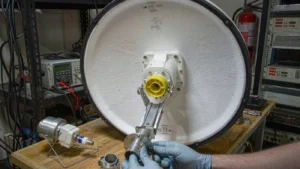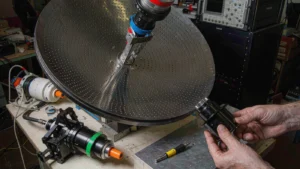
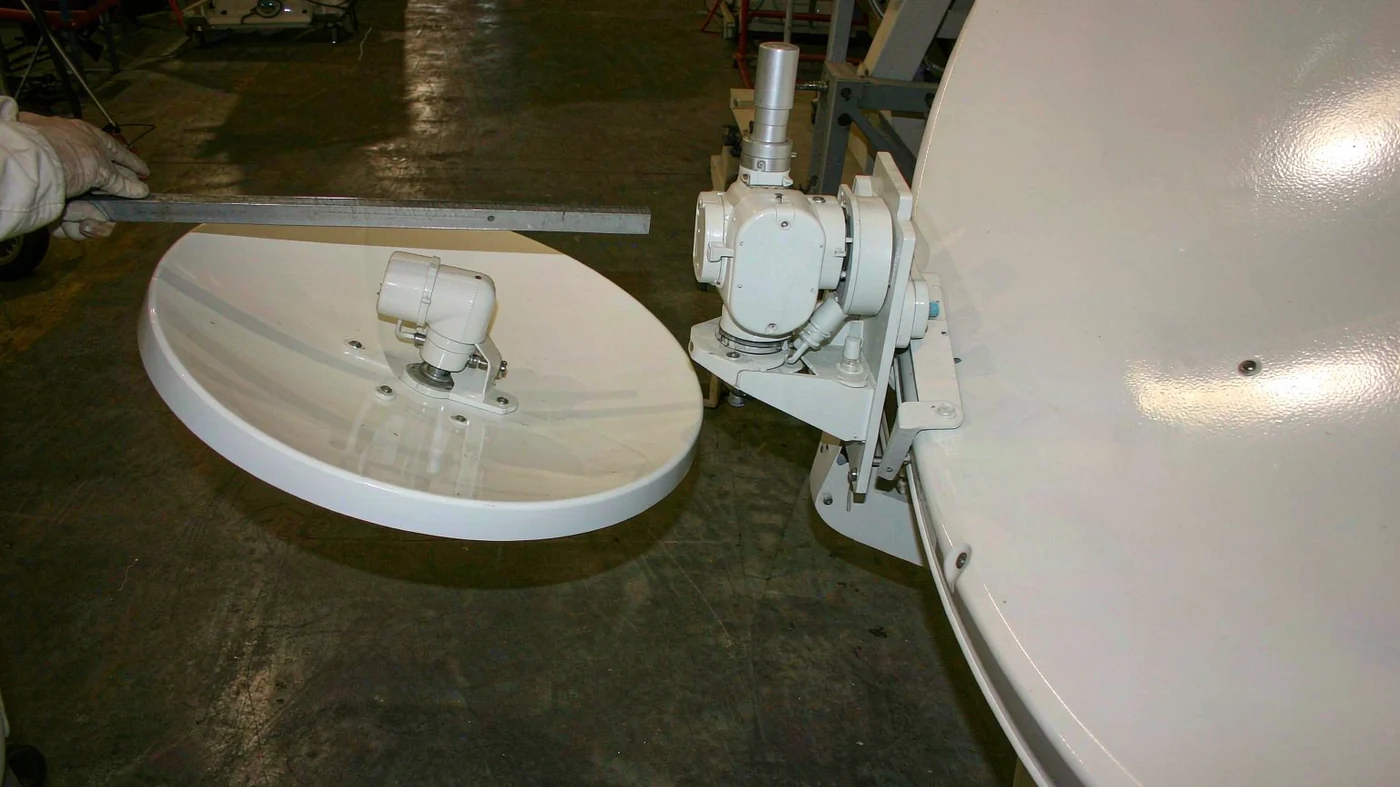
A VSAT is a small-aperture satellite earth station, not a separate category outside earth stations. When compared with a large hub or gateway antenna, a VSAT typically serves a remote site, while the larger antenna supports hub traffic or a dedicated uplink. The practical differences are aperture, link performance, RF equipment, installation, and operating requirements. “Earth station” is the broader term, not a synonym for a large dish [1].
Table of Contents
Is a VSAT an Earth Station?
Yes. VSAT stands for Very Small Aperture Terminal. The term describes the terminal, whereas “antenna” describes one part of it. A two-way terminal includes the antenna, receive and transmit equipment, and a modem. Not every VSAT is two-way or connected through a central hub: ETSI EN 301 428 covers transmit-only, receive-only, and transmit/receive equipment, and describes star, mesh, and point-to-point networks [2].
The comparison below concerns a typical two-way remote VSAT and a larger hub, gateway, or broadcast-uplink antenna. It is not a universal size classification. The applicable standard, satellite operator, frequency plan, and link budget determine the acceptable equipment.
VSAT and Large Earth Station Antennas Compared
| Factor | Typical remote VSAT | Large hub or gateway antenna |
|---|---|---|
| Network role | Connects a remote site to a satellite network | Supports hub traffic, gateway connectivity, or a dedicated uplink |
| Aperture and gain | Compact aperture selected for the remote link budget | Larger aperture can provide more gain at equal frequency and efficiency |
| RF equipment | Transmit and receive chains sized for the assigned service | RF chains sized for the hub or uplink, with redundancy where required |
| Pointing | Fixed for a stationary GEO installation; tracking or stabilization where needed | Fixed or tracking, depending on satellite orbit and mission |
| Installation | Mounting, alignment, grounding, cabling, and operator commissioning | Site-specific structural, RF, monitoring, and maintenance arrangements |
| Approval | Operator acceptance and applicable national authorization | Applicable authorization, coordination, and site-specific requirements |
How Aperture, Power and Tracking Differ
A reflector collects incoming radio waves and focuses them at the feed [3]. Matching the feedhorn to the reflector geometry and operating frequencies is part of antenna selection, not a detail to leave until installation.
Antenna gain follows physical and electrical design, not the number of sites sharing the connection. The link budget determines whether that gain, the transmit power, and the receiving system can meet the required service. Free-space attenuation is one input; receiver noise, equipment losses, propagation, and modem requirements also matter. ITU-R P.525 provides the free-space attenuation calculation [4].
For a circular aperture, the usual gain model is G = η(πD/λ)2, where G is a linear power ratio, η is aperture efficiency, D is diameter, and λ is wavelength. Diameter alone therefore cannot establish performance: illumination, surface accuracy, and losses affect the result. Shorter wavelengths also demand tighter surface accuracy for a comparable efficiency [5].
Transmit power is a separate specification. Neither “VSAT” nor “earth station” supplies a universal wattage rating. Compare the required RF output, feed losses, operating bandwidth, and approved emissions rather than assuming that a bigger dish must use a stronger amplifier.
Tracking follows orbit and platform motion, not simply dish size. A geostationary satellite appears fixed relative to the ground, while satellites in lower orbits move across the sky [6]. A stationary GEO terminal can use fixed pointing; a moving platform needs stabilization or steering. Systems such as X/Y tracking antennas for low- and medium-orbit passes address moving targets. A conventional single-beam dish points at one target at a time; a teleport serving multiple orbital positions may use multiple antennas.
Do VSATs and Large Earth Stations Use Different Bands?
The bands overlap. C-band, Ku-band, or Ka-band alone does not identify a terminal as a remote VSAT or a gateway. As US regulatory reference definitions, conventional C-band covers 3700–4200 MHz downlink and 5925–6425 MHz uplink; conventional Ku-band covers 11.7–12.2 GHz downlink and 14.0–14.5 GHz uplink. These definitions do not establish present-day availability or permission to operate at a particular site [7].
Check the exact transmit and receive frequencies, bandwidth, and polarization. The OMT separating orthogonal polarization paths and the rest of the antenna feed network must match those requirements. A shared band label is not proof of compatibility.
A Calculated Aperture Comparison
For an initial paper comparison, wavelength is λ = c/f, using the exact vacuum speed of light, 299,792,458 m/s [8]. The following frequencies fall within the conventional downlink ranges defined above [9].
| Illustrative frequency | Calculated wavelength | Equal-gain comparison |
|---|---|---|
| 4.0 GHz | About 7.5 cm | Requires three times the diameter of the 12.0 GHz aperture at equal efficiency |
| 12.0 GHz | About 2.5 cm | Requires one-third the diameter of the 4.0 GHz aperture at equal efficiency |
For a separate same-frequency example, suppose an engineer compares hypothetical 1.2 m and 2.4 m apertures with equal efficiency. The gain ratio is (2.4/1.2)2 = 4, or approximately 6.0 dB. This is a calculated antenna-gain difference, not a measured product result or a promise of four times the data rate. It does not establish equal rain availability across different bands.
Before using that result to select hardware, compare gain at the actual operating frequency and check the feed interface drawing, waveguide and flange, mounting reference, and operator acceptance. The calculation narrows a comparison; it does not replace a complete link budget or compatibility review.
How Installation and Licensing Differ
A remote VSAT may be supplied as an operator-approved package, but installation still requires suitable mounting, alignment, and commissioning. A portable product such as a 1.2 m quick-deploy flyaway antenna addresses transport and setup needs; portability does not remove authorization requirements. In the United States, earth-station application procedures are set out in 47 CFR 25.115. The applicable route depends on the station and service, not on a small-versus-large label alone [10].
A large station also needs its foundation, structural loads, RF paths, monitoring, and any backup equipment specified as a site project. Emission constraints matter for transmitting terminals of either size. ITU-R S.524 addresses maximum off-axis e.i.r.p. density for GSO fixed-satellite-service earth stations transmitting in the 6, 13, 14, and 30 GHz bands; the applicable national and operator requirements still need to be checked [11].
Which Antenna Fits Your Site?
For a remote connection, start with the operator’s supported terminal and service plan. For a hub, gateway, or dedicated uplink, start with the traffic, link budgets, and operating requirements. Compare the SATCOM antenna options for remote terminals and larger earth stations only after those requirements are defined.
A useful technical inquiry includes:
- Satellite, beam, orbit, and installation location
- Exact transmit and receive frequencies, bandwidth, and polarization
- Required data rates and service availability
- Transmit-power limits and receive-performance requirements
- Fixed, portable, or moving-platform operation
- Operator acceptance and national authorization requirements
The deciding question is not whether to choose a VSAT or an earth station as mutually exclusive products. It is which earth-station antenna and terminal configuration can meet the site’s link and operating requirements.
Planning a VSAT rollout or a hub upgrade?
Send the satellite and beam, exact Tx/Rx frequencies, data rate, rain target, power, and approvals for a technical review.
Request a Technical Review