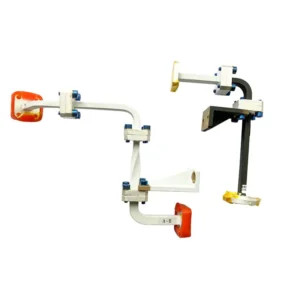
Millimeter waves are conventionally the 30–300 GHz band, which includes 39, 60 and 77 GHz. For exact classification, ITU-R V.431-8 defines the extremely high frequency (EHF) band as 30 GHz < f ≤ 300 GHz: the lower endpoint is excluded and the upper endpoint is included. Frequencies such as 24 and 28 GHz are below this formal band. [1]
Table of Contents
Which frequencies are inside the band?
Using the exact speed of light in vacuum, 299,792,458 m/s, the conversion is λ₀(mm) = 299.792458 ÷ f(GHz). The table takes each frequency as an exact illustrative input and rounds the vacuum wavelength to four significant figures. These are calculations, not measurements. [2]
| Frequency | Free-space wavelength | In the ITU EHF band? |
|---|---|---|
| 24 GHz | 12.49 mm | No; below the band |
| 28 GHz | 10.71 mm | No; it is called mmWave in broader usage |
| 30 GHz | 9.993 mm | No; exactly 30 GHz belongs to super high frequency (SHF) |
| 39 GHz | 7.687 mm | Yes |
| 60 GHz | 4.997 mm | Yes |
| 77 GHz | 3.893 mm | Yes |
| 300 GHz | 0.9993 mm | Yes; upper endpoint |
| 330 GHz | 0.9085 mm | No; above the band |
Do exactly 30 and 300 GHz count?
Exactly 30 GHz is SHF; exactly 300 GHz is EHF under ITU-R V.431-8. Use those frequency limits rather than an exact 10–1 mm wavelength test. [1]
A reverse calculation explains the difference: in vacuum, 10 mm gives 29.9792458 GHz, and 1 mm gives 299.792458 GHz. Divide 299.792458 by the wavelength in millimeters to reproduce the results. The familiar “10–1 mm” range is therefore approximate; the table’s wavelengths at 30 and 300 GHz fall slightly below those values. [2]
Why is 28 GHz still called mmWave?
“mmWave” is also used more broadly than the formal EHF band. NIST’s historical millimeter-wave channel-sounding project describes equipment at 28, 60 and 83 GHz. That is a documented use of the label for 28 GHz, not a change to the ITU boundary. [1] [3]
Does all of Ka-band count as millimeter wave?
No—not under the formal EHF definition. ITU-R V.431-8 gives 27–40 GHz as a radar-band example for Ka. Only the portion 30 GHz < f ≤ 40 GHz falls within EHF. Letter-band limits vary by application, so this is not a universal definition of Ka-band. [1]
How do you check a frequency range?
Suppose your application needs 28–39 GHz. This illustrative range crosses the boundary: its portion through 30 GHz is below or at the excluded lower endpoint, while 30 GHz < f ≤ 39 GHz is within EHF. Calling the whole range “mmWave” would use the broader label, not the strict EHF classification. [1] [3]
When checking standard waveguide components or a standard gain horn antenna for that application, compare the particular model’s specified operating range with the full 28–39 GHz requirement. The example classifies frequencies; it does not establish that any linked product covers them.
Need a component for your operating band? Send Dolph Microwave your frequency range, interface and power requirements.