L-band uses lower frequencies than S-band, favoring lower transmit power at equal antenna gains; S-band favors smaller apertures at equal gain. L-band covers 1–2 GHz; S-band covers 2–4 GHz. [1] The power advantage assumes the same free-space distance and required received power. [2] The size advantage assumes comparable aperture antennas with equal efficiency. [3] Neither band label guarantees a faster link: compare the actual channel bandwidth and radio specifications.
Table of Contents
What Frequencies and Uses Distinguish L-Band from S-Band?
| Comparison | L-band | S-band |
|---|---|---|
| Common frequency range | 1–2 GHz | 2–4 GHz |
| Approximate free-space wavelength | 30–15 cm | 15–7.5 cm |
| Satellite-service examples | GPS navigation, satellite phones, maritime communications | Telemetry, tracking and control; mobile satellite communications |
These are ESA’s common band definitions and application examples, not permission to transmit throughout either band. Wavelengths are rounded from c/f. [1]
Does L-Band Offer More Range or Need Less Power?
Our Calculated Comparison at 1.5 and 3 GHz
We calculated both links over a 100 km one-way free-space path, using 1 W (30 dBm) at the transmitting antenna and 10 dBi gain at each end. The calculation assumes far-field operation, matched polarization, correct pointing and no additional losses, including feeder, weather or obstruction losses. It is a worked example, not a field test.
Free-space loss came to 135.97 dB at 1.5 GHz and 141.99 dB at 3 GHz. Using received power (dBm) = transmit power (dBm) + transmit gain (dBi) + receive gain (dBi) − path loss (dB), we obtained −85.97 dBm and −91.99 dBm, respectively. The L-band example therefore has a 6.02 dB advantage with these fixed antenna gains. [2]
To recover that difference, the 3 GHz link needs 4 W instead of 1 W at the antenna, with everything else unchanged. This is delivered RF power, not electrical supply consumption; equipment and radiated-power limits must allow the increase. [2] Whether the extra margin provides usable range depends on receiver sensitivity and the real path. The 6.02 dB result applies to this two-to-one frequency ratio, not every L/S pair.
Can S-Band Use a Smaller Antenna?
Yes, for comparable aperture antennas at equal gain and efficiency. In a separate size calculation, a 2 m circular aperture at 1.5 GHz and a 1 m aperture at 3 GHz each give 27.73 dBi at an assumed 60% aperture efficiency. S-band needs half the diameter in this example; these are calculated values, not product measurements. [3]
Keeping physical size instead of gain fixed changes the result. For a move from 1.5 to 3 GHz, the following received-power changes assume constant transmit power, distance, aperture efficiencies and other losses, with matched polarization and correct pointing:
- Both antenna gains unchanged: received power falls by 6.02 dB.
- One physical aperture unchanged, the other antenna’s gain unchanged: received power is unchanged, a 0 dB difference.
- Both physical apertures unchanged: received power rises by 6.02 dB. [2] [3]
If equivalent isotropically radiated power (EIRP) must stay fixed, a 6.02 dB increase in transmit-antenna gain requires reducing transmitter power to one-quarter, with feeder loss unchanged. [2]
The size calculation excludes the antenna feed network, support, radome and mount. Check the complete assembly dimensions before treating a smaller aperture as a smaller installation.
Is S-Band Faster than L-Band?
S-band spans 2 GHz, versus 1 GHz for L-band, but those spans are not individual channel allocations. [1] For a speed comparison, use each link’s occupied bandwidth in MHz, modulation and coding, receiver sensitivity at the required error rate, and net payload rate in Mbps under the same traffic load.
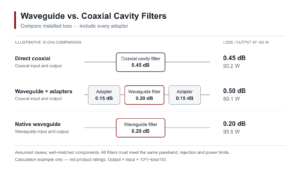
The same distinction matters when comparing the RF hardware. A waveguide filter must pass the chosen channel and provide the required rejection at unwanted frequencies. An “S-band” label alone does not establish coverage of the entire 2–4 GHz range.
Which Band Is More Reliable in Rain?
Both bands support weather-resilient satellite services: ESA describes L-band as having excellent weather resistance and S-band as offering stable, resilient performance. That does not establish an availability percentage for a particular link. [1]
For the 1.5/3 GHz comparison, ITU-R P.838-3 calculates specific rain attenuation in dB/km from frequency, rainfall rate in mm/h, polarization tilt and path elevation. Total rain loss also needs the rain-path length and geometry. Compare that loss with each link’s available margin; the 100 km radio distance is not automatically a 100 km rain path. [4]
Which Band Fits Your Link?
Start with the frequencies supported by the service and permitted for the application. If either band is available, compare two designs against the same required data rate, received signal level and installation limits. A power-limited design with fixed antenna gains favors the lower frequency; a size-limited aperture design may favor S-band. If both antenna sizes stay fixed, use the fixed-aperture comparison above rather than assuming L-band always has the stronger signal. [2] [3]
Discuss your RF component requirements
Send Dolph Microwave your operating frequencies, power level, polarization and interface requirements for a technical review.