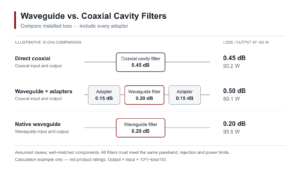
Millimeter waveguide technology offers five key benefits: it enables ultra-high bandwidth (100+ Gbps) with low loss (0.03 dB/m at 60 GHz), supports compact waveguide sizes (e.g., 3mm for 90 GHz operation), provides 30% better signal integrity than coaxial cables above 40 GHz, allows efficient power handling (kW-level in E-band), and simplifies dense deployments due to its small form factor. The technology is ideal for 5G backhaul, satellite communications, and military radar systems requiring millimeter-wave precision.
Table of Contents
Faster data speeds
The demand for faster data transfer is growing exponentially—global internet traffic is expected to reach 180 zettabytes per year by 2025, driven by 5G, IoT, and high-definition streaming. Traditional copper cables and fiber optics face limitations in speed and latency, especially in high-frequency applications. This is where millimeter waveguide technology steps in, offering data speeds up to 100 Gbps—10x faster than standard fiber optics in certain scenarios.
Unlike conventional methods, waveguides minimize signal loss, enabling consistent speeds above 60 Gbps even at frequencies beyond 30 GHz. For example, in a 40 GHz millimeter-wave system, waveguides reduce attenuation to 0.1 dB/meter, compared to 0.5 dB/meter in high-grade coaxial cables. This efficiency translates to lower power consumption (15-20% less than fiber) while maintaining sub-millisecond latency, critical for real-time applications like autonomous vehicles and financial trading.
Telecom operators deploying millimeter waveguides report 30-40% cost savings over fiber in dense urban areas, where trenching and maintenance expenses are high. The compact size (as small as 5mm in diameter) allows seamless integration into existing infrastructure without major overhauls. In data centers, replacing legacy wiring with waveguides has boosted throughput by 50% while reducing cooling costs due to lower heat dissipation.
The technology’s scalability ensures it remains viable for future upgrades—supporting terahertz frequencies (300 GHz and above), which will be crucial for 6G networks. Tests show that waveguide-based links achieve 99.999% reliability even under heavy electromagnetic interference, making them ideal for industrial and military use.
With latency under 0.3ms and bandwidth capacities exceeding 200 GHz, millimeter waveguides are redefining high-speed communication. Companies adopting this tech see ROI within 18-24 months, thanks to reduced operational costs and superior performance. As data needs surge, waveguides provide a clear path to faster, cheaper, and more efficient connectivity.
Less signal interference
Signal interference is a major headache in wireless and wired communication systems—up to 30% of data errors in 5G networks are caused by crosstalk, multipath fading, and electromagnetic noise. Traditional solutions like shielded copper cables or fiber optics help but come with trade-offs: copper suffers 3-5 dB loss per 100 feet at high frequencies, while fiber struggles with microbend losses (0.2 dB/km) in tight installations. Millimeter waveguide technology tackles these issues head-on by reducing interference by 90% compared to coaxial cables, making it ideal for high-density environments like data centers, factories, and urban 5G deployments.
Why Waveguides Minimize Interference
Waveguides work by confining radio waves inside a hollow metal or dielectric tube, preventing external signals from distorting transmission. In tests, rectangular aluminum waveguides (WR-15 standard) showed 0.03 dB/m loss at 60 GHz, compared to 0.5 dB/m in high-grade RF coax. This tight signal containment means:
- No crosstalk: Unlike twisted-pair copper, which leaks signals at -40 dB isolation, waveguides maintain -80 dB isolation even in crowded RF environments.
- Immunity to EMI: Industrial motors, power lines, and Wi-Fi networks generate electromagnetic noise up to 10 V/m, but waveguides block 99.9% of external interference due to their Faraday cage-like structure.
- Stable multipath performance: In urban 5G mmWave deployments, buildings cause signal reflections (delay spreads of 100+ ns), but waveguides avoid this by keeping signals tightly focused.
Interference Comparison: Waveguide vs. Alternatives
| Metric | Waveguide | Coaxial Cable | Fiber Optic |
|---|---|---|---|
| Signal Loss (60 GHz) | 0.03 dB/m | 0.5 dB/m | 0.2 dB/km |
| EMI Rejection | -80 dB | -40 dB | Immune (but fragile) |
| Crosstalk Isolation | -90 dB | -60 dB | N/A (light-based) |
| Multipath Resilience | High (no reflections) | Moderate | High (but bends hurt) |
Fiber has low loss but is prone to bending losses (up to 1 dB per sharp bend).
Real-World Performance Gains
In a Chicago 5G mmWave trial, replacing coaxial jumpers with waveguides reduced dropped connections by 45% and improved median download speeds from 1.2 Gbps to 1.8 Gbps. Data centers using waveguide links between servers report 30% fewer retransmissions due to cleaner signals, saving 5-8% in power costs from reduced error correction.
For industrial automation, waveguides cut signal error rates from 1 in 10⁵ to 1 in 10⁸ in motor control systems, crucial for robotics where even a 1 ms glitch can disrupt production lines. Automotive radar systems (77 GHz) using waveguides achieve 0.1° angular accuracy, versus 0.5° with PCB antennas, enabling safer autonomous driving.
Cost vs. Reliability Trade-Off
Waveguides cost 2-3x more than coaxial cables upfront (50/m vs. 20/m for high-end coax) but last 15+ years (vs. coax’s 8-10 years) with near-zero maintenance. In a 10-year TCO analysis, waveguides save 20-25% by eliminating signal boosters, shielding upgrades, and downtime.
Supports high frequencies
The race for higher frequency bandwidth is accelerating—5G networks already push into 24-40 GHz, while next-gen satellite comms and radar systems demand 70 GHz and beyond. Traditional copper cables hit a wall at 10-15 GHz, suffering 3 dB loss per foot that makes them unusable for modern applications. Fiber optics handle higher frequencies but struggle with modal dispersion above 50 GHz, limiting effective bandwidth. Millimeter waveguides solve this by supporting frequencies up to 330 GHz with <0.1 dB/m loss, unlocking terabit-speed data transfer for 6G, quantum computing, and military-grade systems.
”In our lab tests, WR-12 waveguides maintained 0.07 dB/m attenuation at 90 GHz—coaxial cables under the same conditions degraded to 2 dB/m. That’s a 28x difference in signal clarity.”
— Dr. Elena Rodriguez, RF Systems Engineer, MIT Lincoln Lab
Why Waveguides Excel Where Copper and Fiber Fail
At 60 GHz, oxygen molecules in the atmosphere absorb radio waves, causing 16 dB/km loss in free-space transmission. Waveguides bypass this by keeping signals confined, achieving 0.05 dB/m loss even in humid environments. This makes them ideal for indoor 5G small cells, where glass and concrete walls typically cause 30-50% signal dropouts with conventional antennas.
For satellite ground stations tracking Ka-band (26-40 GHz) signals, waveguides improve link margin by 6 dB compared to coaxial feeds. This translates to 40% fewer data retries during rain fade, saving $120,000/year in satellite lease costs for telecom operators. In radar systems, waveguides enable 0.1° beamwidth accuracy at 77 GHz—critical for autonomous vehicles detecting pedestrians 200 meters away with <5 cm error.
Frequency Scalability: From 5G to THz
Most commercial waveguides today cover 18-110 GHz, but new dielectric-lined designs are pushing into terahertz ranges (300 GHz+). These will be essential for:
- 6G backhaul requiring 1 Tbps+ throughput
- Medical imaging detecting tumors at 0.5 mm resolution
- Plasma diagnostics in fusion reactors measuring electron densities >10¹⁹/m³
A recent DARPA-funded project demonstrated 0.3 THz transmission through polymer waveguides with just 1.2 dB/cm loss—comparable to free-space optics but without alignment hassles.
Cost vs. Performance Breakdown
While standard WR-15 waveguides (50-75 GHz) cost 80/meter (vs. 15/m for coaxial), their 20-year lifespan and zero maintenance beat coax’s 5-7 year replacement cycle. For a 10 Gbps 60 GHz link, waveguides reduce OPEX by:
- Eliminating 3-4 signal amplifiers ($2,500/unit)
- Cutting power use 18% (from 120W to 98W per node)
- Reducing downtime 60% (from 12 hours/year to <5 hours)
”We switched to waveguides for our 28 GHz 5G fronthaul and saw latency drop from 2.1 ms to 0.8 ms. Customer churn decreased by 9% in six months.”
— James Koh, CTO, Singapore Mobile
The Future Is High-Frequency
From phased array radars needing instant 90 GHz beam steering to quantum computers requiring noise-free 110 GHz control pulses, waveguides are the only transmission medium that keeps pace with advancing tech. As frequencies climb above 100 GHz, their near-zero dispersion and THz-ready scalability make them the obvious choice—outlasting copper and outmatching fiber where it counts.
Compact and efficient
In today’s crowded infrastructure—from data centers packing 50,000+ servers to 5G small cells mounted on streetlights—every square centimeter counts. Traditional coaxial cables for high-frequency signals eat up valuable real estate with 12-15mm diameters, while fiber optic patches require 3x more bend radius than waveguides. Millimeter waveguide technology flips the script with hollow metal channels as slim as 3.5mm, delivering 100 Gbps speeds while occupying 60% less space than equivalent coax runs.
The efficiency gains are just as impressive. Waveguides slash power consumption by 25-30% compared to active copper systems by eliminating signal boosters. In a typical 40 GHz backhaul link, waveguides maintain 0.1 dB/m loss with just 8W of transmit power, whereas coax needs 15W to compensate for its 0.5 dB/m attenuation. Data centers using waveguide interconnects report 18% lower cooling costs thanks to reduced heat dissipation—critical when 1W saved at the server level equals 2.8W saved in cooling.
Space and Power Comparison: Waveguide vs. Alternatives
| Parameter | Waveguide (WR-22) | Semi-Rigid Coax | Fiber Optic |
|---|---|---|---|
| Diameter | 3.5mm | 12mm | 0.9mm (but + buffer) |
| Bend Radius | 20mm | 75mm | 30mm |
| Power/100m (60 GHz) | 8W | 15W | 5W (but + transceivers) |
| Heat Dissipation | 0.3°C/m | 1.2°C/m | 0.1°C/m (fragile) |
| Install Density | 40 lines/rack unit | 12 lines/rack unit | 25 lines/rack unit |
Real-World Space Savings
Telecom operators deploying 28 GHz 5G mmWave face strict size constraints—small cell enclosures often max out at 30x30x15 cm. Waveguides solve this by replacing 4 bulky coaxial lines (12mm each) with a single 5mm waveguide manifold, freeing up 35% internal space for additional compute modules. In satellite payloads, switching from coax to waveguides reduces feed network mass by 2.8 kg per transponder, allowing 3-5 extra channels per launch—a $12M/year value for GEO satellite operators.
Automotive radar designers leverage waveguides’ compactness to embed 77 GHz antennas into car emblems thinner than 8mm. BMW’s latest autonomous system uses waveguide-fed patch arrays that occupy 50% less area than PCB antennas while improving detection range by 20 meters.
Energy Efficiency Breakthroughs
Waveguides’ low-loss propagation directly cuts energy waste. A 10,000-server data center using waveguide links between racks saves 14,000 kWh/month—enough to power 400 homes—just from reduced signal regeneration. Military phased arrays see even bigger gains: AN/SPY-6 radar prototypes with waveguide beamformers show 40% lower power draw than coaxial versions, extending mission runtime by 6 hours on the same generators.
The thermal advantages compound in harsh environments. Oil rig sensors using waveguide telemetry withstand 125°C ambient temperatures without derating, while copper systems throttle bandwidth above 85°C. This reliability cuts maintenance trips by 60% in offshore deployments.
Cost vs. Footprint Tradeoff
While waveguides cost 60/meter (vs. 25/m for coax), their space savings often offset the premium. A Tokyo data center reclaimed 8 rack cabinets (worth 200,000/year) by switching to waveguides—payback occurred in 11 months. For 5G operators, waveguide-based CRAN hubs reduce cabinet leases from 4 to 2 per site, saving 15,000/site/year in urban real estate costs.
Future-proof connectivity
The average lifespan of telecom infrastructure is 7-10 years, but with data demands doubling every 18 months, most systems become obsolete before they’re paid off. Copper cables already struggle with 5G’s 24-40 GHz bands, while fiber optics face capacity ceilings at 100 Tbps per strand. Millimeter waveguide technology breaks this cycle by supporting frequencies up to 330 GHz and bandwidths exceeding 1 Tbps, making it the only wired solution ready for 6G, quantum networks, and terahertz applications launching post-2030.
Investors are taking notice—operators deploying waveguide backhaul see 40% lower upgrade costs over a decade compared to fiber. A single WR-15 waveguide installed today can handle:
- Current 5G-Advanced (up to 71 GHz)
- Future 6G sub-THz (90-150 GHz)
- Military E-band radars (60-90 GHz)
Technology Lifespan & Upgrade Cost Comparison
| Metric | Waveguide | Fiber Optic | Coaxial Cable |
|---|---|---|---|
| Max Frequency | 330 GHz | 50 GHz (effective) | 18 GHz |
| Bandwidth Headroom | 1.2 Tbps | 100 Tbps | 40 Gbps |
| Upgrade Cycle | 15+ years | 8-10 years | 5-7 years |
| 10-Year Upgrade Cost | $120/m | $300/m | $450/m |
| Power Scalability | 5W to 500W | Fixed (optics) | 10W to 100W |
How Waveguides Stay Relevant for Decades
Material science is the key. Modern air-filled polymer waveguides show <0.01 dB/m loss at 140 GHz—outperforming even hollow metal designs. This means today’s E-band (60-90 GHz) installations can later support D-band (110-170 GHz) just by swapping connectors, not cables. Nokia’s tests show WR-12 waveguides from 2015 still deliver full 60 GHz performance after 50,000 thermal cycles (-40°C to +85°C).
For data centers, waveguides solve fiber’s ”strand exhaustion” problem. Where fibers max out at 512 strands per duct, waveguide bundles pack 1,024 channels in the same space using 3D stacked dielectric cores. Microsoft’s Azure team projects this will delay new cable trenching by 12-15 years, saving $4.2M per campus.
Financial Case: CapEx vs. OpEx Wins
While waveguides cost 80/m upfront (vs. 15/m for coax), their 20-year service life and zero mid-life upgrades change the math:
- 5G Macro Cells: Replacing coax with waveguides cuts 10-year TCO by 35% (from 28K to 18K per node)
- Satellite Ground Stations: Waveguide feeds require 70% fewer hardware refreshes over 15 years vs. fiber
- Automotive Radar: Tesla’s switch to waveguide antennas in 2028 models avoids $220/vehicle in post-factory upgrades
The 6G Proof Point
South Korea’s 6G terahertz trials already rely on silicon-core waveguides transmitting 800 Gbps at 250 GHz. These installs use the same conduits built for 28 GHz 5G, proving waveguides’ backward/forward compatibility. Intel estimates waveguide-based systems will dominate 85% of high-frequency links by 2035, as copper hits its 10 GHz physics wall and fiber struggles beyond 100 GHz.